🚨 XDC HOLDERS! 🚨
If you stake your XDC make sure you upgrade from V2 to V3.
Here's what changed and why it matters.
V3 is now a non-custodial ERC-4626 vault. No admin in your withdrawal path. You control it directly. Same standard used by Aave, Yearn, and Morpho.
The big upgrade — rewards now auto-compound into the exchange rate automatically. No claim button. No manual restaking. Your psXDC shares just become worth more XDC over time while you sleep.
You start at 1.00000 XDC per psXDC. As validators earn that rate climbs. Same number of shares. More XDC underneath them every day.
One more thing people overlook — no principal-stake slashing on XDC. Validators get penalized with missed rewards only. Your principal is never burned. Unlike ETH-based protocols.
V3 was audited by Nethermind Security in May 2026. The same firm that audits Lido, EtherFi, Optimism, and Worldcoin. ✅
psXDC is transferable and usable in DeFi — trade it on DEXs, deposit into XDC NFTs to boost APY, or just hold it passively and let the exchange rate do the work.
On a red day when everything is bleeding your XDC just got a silent upgrade.
That's the kind of infrastructure that compounds while the market figures itself out.
Head to https://t.co/x78geQo9se to migrate. 🛡️
People keep saying " $XRP can't reach $100 because the market cap would be too high."
The market cap argument is fundamentally broken.
AND I EXPLAINED EXACTLY WHY
You don't compare Apple to the internet. Apple sells products.
The internet is the infrastructure that everything moves across. That's the difference between a stock and a utility blockchain.
When someone says "XRP can't hit $100 because the market cap would be larger than Apple," they're comparing a company that sells devices to a network designed to settle trillions in cross-border value across global financial rails.
THOSE ARE NOT THE SAME CATEGORY
The question was never "how high can XRP go."
The real question is how much of the world's $900 Trillions in assets will eventually settle on-chain.
If even a fraction moves through the rails being built right now, the market cap argument collapses entirely.
BlackRock, JPMorgan, DTCC, and Mastercard didn't enter blockchain because of market cap charts.
They entered because they see infrastructure replacing the pipes that move global finance.
And those pipes handle quadrillions.
Watch this. This might change how you value every digital asset in your portfolio.
Still think market cap tells the whole story? 👇
🎁 1000 XRP GIVEAWAY 🎁
5 winners × 200 XRP each — enough to start earning up to 20%+ APY on FortisX right away! 🔥
How to enter:
1️⃣ Follow @FortisX_fi
2️⃣ Like + Repost this post
3️⃣ Tag 1 friend who needs to see this
🏆 5 winners will be chosen randomly
🗓 May 23, 2026 at 4:00 PM UTC
Winners announced here!
Good luck everyone! 🍀
💥 BOOM 💥
WE HAVE $XRP RECEIPTS!!!
Remember when YOU said XRP was just a gas token?
"It's just fees."
"RLUSD does everything XRP does."
"You don't need XRP anymore."
Today the Chief Business Officer of Evernorth — a Nasdaq listed company — published a blog post that answered every single one of those arguments.
Here's the short version.
RLUSD is the juice box.
XRP is the swap kid.
When you trade a tokenized Treasury for a euro stablecoin on the XRP Ledger — XRP is what makes that trade happen in one step. Invisible to the trader. Essential to the trade.
RLUSD can't do that job.
Three reasons.
One — a stablecoin issuer can have a bad day. Court order. Regulatory issue. Freeze. If the routing asset has a single failure point, every trade on the ledger breaks simultaneously. XRP has no issuer. Nobody mints it. Nobody can freeze it.
Two — the router has to work for everyone. Stablecoins follow sanctions lists, geographic restrictions, blacklists. The bridge asset can't. Under current protocol design no party can prevent XRP from settling a trade.
Three — every liquidity pool needs two different assets. Once you accept the pool needs something that isn't RLUSD — XRP is the natural choice. Most liquid. No issuer. Years of uninterrupted history.
The gas token narrative was always wrong.
Now there's a receipt.
WE'RE SO BACK XRP FAM! 🤝
ISO Ledger 🛡 👇👇
https://t.co/IcQIAQnGMo
With the big news about @The_DTCC soft launch coming soon and the CLARITY Act mark up this week, I thought it would be helpful to post this Observatory article on exactly how $XRP might fit into the settlement layer for the DTCC. This one was written for the common man like myself 👇
Important note. This is posted in The Observatory where articles are more thought experiments and theories that are broader than the XRP Valuation Series Framework. This article should be seen as a possibility for XRP inside of the DTCC and it does not factor in other use cases like SWIFT, full derivatives market, etc. Enjoy!
Editor's Note - this version has been updated against a previous version that I posted to the site before I announced it here on X. Hence the language under the heading.
https://t.co/48ixCaDSu3
When tokenized economies, real world assets, and global payments fully migrate to digital rails, value won’t be scattered, it’ll concentrate, just as it did when the dollar became the world’s reserve currency.
XRP was architected to sit at the center of that consolidation as the neutral bridge asset for global liquidity and settlement.
That’s why the price must be significantly higher.
For XRP to efficiently handle trillions in daily cross-border value flows without massive slippage and market disruption, its unit price needs to be high enough that only a small number of tokens are required to move enormous amounts of money.
So a higher price creates the necessary depth and efficiency for institutional-scale liquidity.
That’s liquidity mathematics under constrained supply and exploding demand. At $5 or even $50, XRP can’t achieve its own objective to function as the primary settlement layer for a tokenized global economy.
The math will demand a much higher price for it to operate at the scale it was designed for.
That’s the real utility thesis most people still don’t seem to understand. At this point, it’s clear most people won’t understand it until it’s too late.
With DTCC starting limited trading in July and going full scale in October 2026.
DTCC has made the roles and importance of these five networks clear.
$XRP and $XDC Network are the primary assets for settlement, while $LINK, $QNT and $HBAR provide the "piping" to make it happen.
XRP:
Leads for high-liquidity bank-to-bank settlement. In March 2026, Ripple Prime (formerly Hidden Road) was officially named a participant in the DTCC’s NSCC directory, specifically to facilitate institutional post-trade settlement using XRP as a bridge asset.
XDC:
Dominates in trade finance settlement. It is the primary rail for tokenized bills of lading and letters of credit, achieving under-2-second finality. Its 2026 growth is driven by its Contour acquisition, which integrated thousands of trade finance users directly onto the XDC rail.
QNT:
Focuses on CBDC-to-commercial bank settlement. Its Overledger platform allows central banks (like the Bank of England) to settle tokenized liabilities using regulated "locked" digital currencies rather than open-market bridge assets.
Chainlink and HBAR however, currently hold the deepest structural integrations within the traditional financial bank systems.
LINK:
The most integrated data and messaging layer. By 2026, Chainlink has moved into full production with the DTCC, Swift, and Euroclear to automate $58 billion in annual corporate actions (dividends, splits). It uses its CCIP and Runtime Environment (CRE) to link existing Swift messages directly to the DTCC's private blockchain nodes.
HBAR:
Holds a governance-level integration. As a member of the Linux Foundation's Decentralized Trust alongside the DTCC, Hedera is the preferred public chain for "RWA" (Real-World Asset) notary services. Its Governing Council members, including Google, IBM, and Standard Bank - use the network to track the lifecycle of assets that the DTCC eventually clears.
QNT:
Deeply embedded via the Murex partnership. Murex's MX.3 platform, used by 60,000+ traders daily - now has native Overledger integration, allowing banks to "switch on" blockchain features within their existing trading terminals.
With this cleared out, we now know the importance of these networks within DTCC’s Financial Infrastructure.
@ZachHumphries@bgarlinghouse@consensus2026 “The SEC came after XRP, Most companies would have folded, that’s not what happened - The SEC won in a major way” 🧐🤔. ??? Can you elaborate on this a little bit? Perhaps you meant to say that XRP won in a major way? 🤔
I have been quiet long enough.
This is perhaps the most important thread on X ever published.
And the most powerful and impactful comic book you will ever read.
If you want to understand the reverse carry trade, bookmark this.
Oil, Yen, Japan, and an all-star cast.
1/24🧵👇
Hypothetically…….. I’m being taxed on money I never made. Let that sink in.
If I bought my property outright for $60,000 in 2009
Now the county says it’s worth $246,000.
Did I sell it? No.
Did I make a profit? No.
Did I get a check for $246,000? No.
But my taxes jumped like I did.
That’s the problem.
This isn’t income.
This isn’t cash.
This is a number someone decided on paper — and now I’m being billed for it.
If my stock portfolio doubles, I don’t pay taxes until I sell.
If my income doesn’t increase, I don’t magically owe more income tax.
So why does owning a home work differently?
Why am I being taxed on unrealized gains?
A house isn’t just an investment — it’s where people live. And this system means you can do everything right, pay off your home, and still get squeezed harder every year because of a number you never turned into money.
You don’t truly own something if you can be taxed out of it.
This isn’t about “services” or “inflation.”
It’s about being charged for value you never received.
And people are starting to notice.
This needs to be on everyone’s mind✔️
Elon Musk just put the entire university system on trial.
Not the curriculum. Not the professors. The premise.
Musk: “You don’t need college to learn stuff. Everything is available basically for free. You can learn anything you want for free.”
For a thousand years, universities held one monopoly. Access. You paid the toll or you stayed ignorant.
The internet erased that in a decade.
Every lecture. Every framework. Every textbook. Free. From any screen on Earth.
The six-figure tuition is no longer buying knowledge. It is buying a signal.
Musk: “There is a value that colleges have, which is seeing whether somebody can work hard at something, including a bunch of annoying homework assignments, and still do their homework assignments.”
That is the product. Not intelligence. Not creativity. Not vision. Compliance.
You are paying $200,000 to prove you can tolerate bureaucracy on a schedule.
Musk: “Colleges are basically for fun and to prove you can do your chores. But they’re not for learning.”
The entire system is a sorting machine for corporate HR. It does not measure what you can build. It measures whether you can sit still, follow directions, and deliver on command.
Four years of obedience dressed as education.
Musk: “If you’re trying to do something exceptional, you must have evidence of exceptional ability. I don’t consider going to college evidence of exceptional ability.”
The system optimizes for average. It rewards the compliant. It certifies the patient. It quietly filters out everyone who refuses to wait for permission.
The ones who reshaped the modern world never finished the test.
Musk: “Gates is a pretty smart guy, he dropped out. Jobs is pretty smart, he dropped out. Larry Ellison, smart guy, he dropped out.”
They did not drop out because it was too hard. They dropped out because the speed limit was too low.
The most dangerous thing a university does is convince a generational talent that finishing the syllabus is the achievement.
It is not. It is the floor.
A degree is a receipt for compliance. The future has never belonged to people who finish their homework. It belongs to the ones who never needed the assignment.
🚨 BREAKING: CFTC Drops Historic Bomb on Crypto Self-Custody and XRP is Perfectly Positioned to Explode! 🚨
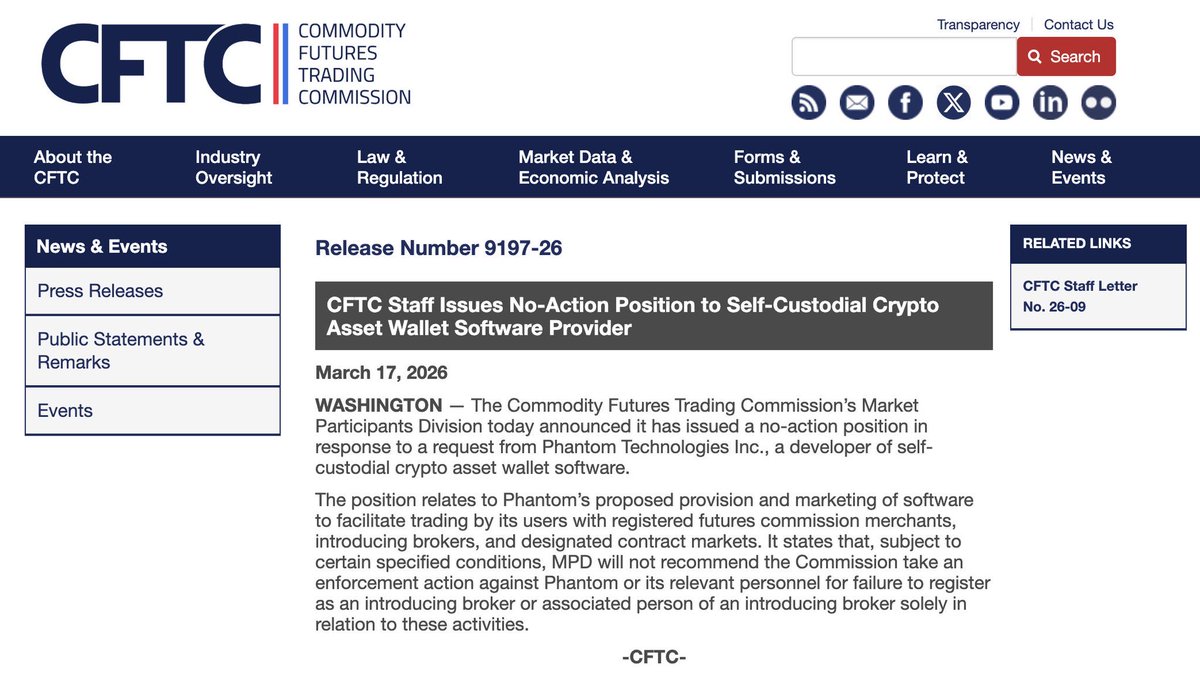
While the world was still celebrating the SECs landmark move last week classifying XRP as a digital commodity, the CFTC just delivered an even bigger game changer that barely got noticed.
The CFTC issued its very first no action letter to a self custodial wallet provider.
The explosive core principle: If you do not hold customer funds you are not a financial intermediary. You are infrastructure not a broker.
This means self custodial wallets can now safely connect users directly to markets without being forced to register as brokers. Users keep full control of their own keys and assets.
This is decentralization winning big time.
And XRP was literally built for exactly this future.
Assets settle on chain instantly with no need for any central counterparty. True peer to peer value transfer that is fast scalable and regulator friendly.
Ripples vision of bridging traditional finance with blockchain just received a massive regulatory turbo boost from the very agencies that once fought it.
Self custody plus on chain settlement plus official commodity status equals the perfect storm for the next massive bull run.
The old gatekeepers are losing their power fast.
The future belongs to non custodial on chain crypto and XRP is ready.
What an incredible time to be holding XRP.
Get ready for takeoff.
Over the last few weeks I’ve been researching quantum computing risk across blockchains, and here’s what I found.
The short answer: no blockchain today is fully quantum proof, not Bitcoin, not Ethereum, not XRP.
All of them rely on elliptic curve cryptography. In simple terms, this is a way to secure digital assets using math. Your public key is visible, but only your private key can unlock and control them.
The concern is very real. A sufficiently advanced quantum computer could theoretically break these keys.
And if that happens, the impact wouldn’t just hit crypto, it could compromise global banking, SWIFT, military encryption, and large parts of the internet.
Here’s where XRP stands apart.
Bitcoin and Ethereum are largely frozen in their cryptography.
Changing them isn’t impossible, but it would require major network upgrades, hard forks, and could risk destabilizing the system.
XRP, on the other hand, was built differently. Its ledger is governed at the protocol level, meaning its cryptography can be upgraded through validator consensus without halting the network.
When quantum computing becomes a real threat, XRP can evolve in real time, keeping the network secure and functional.
Bitcoin is rigid by design. Ethereum upgrades are slow, complex, and risky. XRP, however, was built as adaptable financial infrastructure/that can respond to tomorrow’s threats without stopping today’s transactions.
So when people ask, “Is XRP quantum proof?” the answer isn’t a simple yes or no.
The real question is, which network can adapt when quantum computers become capable of breaking modern encryption?
XRP doesn’t just survive. It was built to upgrade. That’s the distinction between static code and functional infrastructure.
Apologies for getting a bit technical, but I wanted to understand this properly so I could explain it clearly.
Hope this provides some value.
Let me make this very clear: Big Banks (think JPMorgan Chase, Bank of America, Wells Fargo, etc.) are lobbying overtime to block Americans from getting higher yields on their savings—while trying to block any rewards or perks from being given to customers.
These banks, and others, pay rock-bottom rates on standard savings (often 0.01%–0.05% APY), even as the Fed pays them 4% or more. This massive spread fuels record profits, with almost none passed back to their customers / everyday depositors.
Today, the banks are desperately targeting crypto/stablecoins, where platforms plan to offer 4–5%+ yields or rewards. The ABA and other lobbyists are spending millions trying to ban or restrict those yields via bills like the Clarity Act, crying “fairness” and using words like "stability"—when it's really about protecting their low-rate monopoly and preventing deposit flight. This is anti-retail, anti-consumer, and straight-up anti-American.
Next time you see a big bank dropping billions on a shiny new Midtown Manhattan HQ, you know exactly where that money comes from: the non-existent interest rate they “pay” you!
Fortunately, the big banks are losing this fight as customers wake up to the games…
@worldlibertyfi
@BTC_JEDI21@Teslaconomics Completely disagree , there are a handful of more suited layer 1s that are faster/cheeper. BTC has been termed a store of value because it is no good for anything else- a store of value is even a failure because if it were actually true it would mimic the gold price action.