For the record, I (strongly) believe P \neq NP. I think this is mostly a communication problem: the informal framings we've used to convey what P vs NP means are failing badly right now. That's not evidence either way. It says more about how flawed our intuition, and the way we communicate it, is, even with researchers outside the area.
Related: when I TA'd algorithms in Fall 2022, I polled the class on P vs NP, framing it with Avi Wigderson’s question of whether intuition can be “mechanized”, or whether solving a problem feels "polynomially close" in effort to verifying a solution. Exactly one student believed P=NP.
I asked again when I taught in early and late 2025. Nearly a third of the class raised their hands.
I suspect many students growing up with AI will eventually wonder why we were ever stuck on math problems that AI now solves in seconds.
With sub-n log n FFT (130), subcubic APSP & subquadratic 3SUM, today has shaken my belief that humans were ever good at algorithms.
At this rate, I've updated to maybe P = NP after all, via some clever SAT algorithm GPT-8 discovers running in n^c time for c ~ 10^6. 🙈
Not CS473. It was CS374 in the complexity part and I later asked a similar question in my own course CS498AE (to a smaller group of students). In CS374 in ~2025, around a third (not half) raised their hand.
I wasn't asking about P vs NP formally. I was asking about their intuition: does finding a solution to a (say) HW/Exam problem feel "polynomially close" in effort to verifying or understanding a solution, that we give them? Can search be mechanized? For most this was their first real encounter with complexity classes, which is why I like it. It shows how many people "feel" P = NP before they've been trained out of it (i.e. us sharing why most researchers believe P \neq NP).
Holy fuck. Just based on a cursory look, major ones seem:
Unique Games Conjecture proved
L = RL = BPL
Matrix multiplication with ω ≤ 9/4, insane jump from the current best ~2.37
Ω(n³) permanent vs. determinant lower bound
FFT and integer multiplication faster than nlogn
Almost-linear time maximum matching and edit distance approximation
We’re releasing a broad range of new mathematical results produced by an internal frontier model.
We’ve been consulting with the independent Advisory Group on Mathematics and Artificial Intelligence at the Institute for Advanced Study, and we have drawn on their advice and public recommendations to inform how we release these results.
https://t.co/7N6TPlft1P
Maybe I'm missing something, but what's the point of autoformalization if AI gets astronomically better than us at proving and checking proofs?
Any examples were autoformalization caught an error that a few GPT-6 Astra agents red-teaming the manuscript wouldn't have caught?
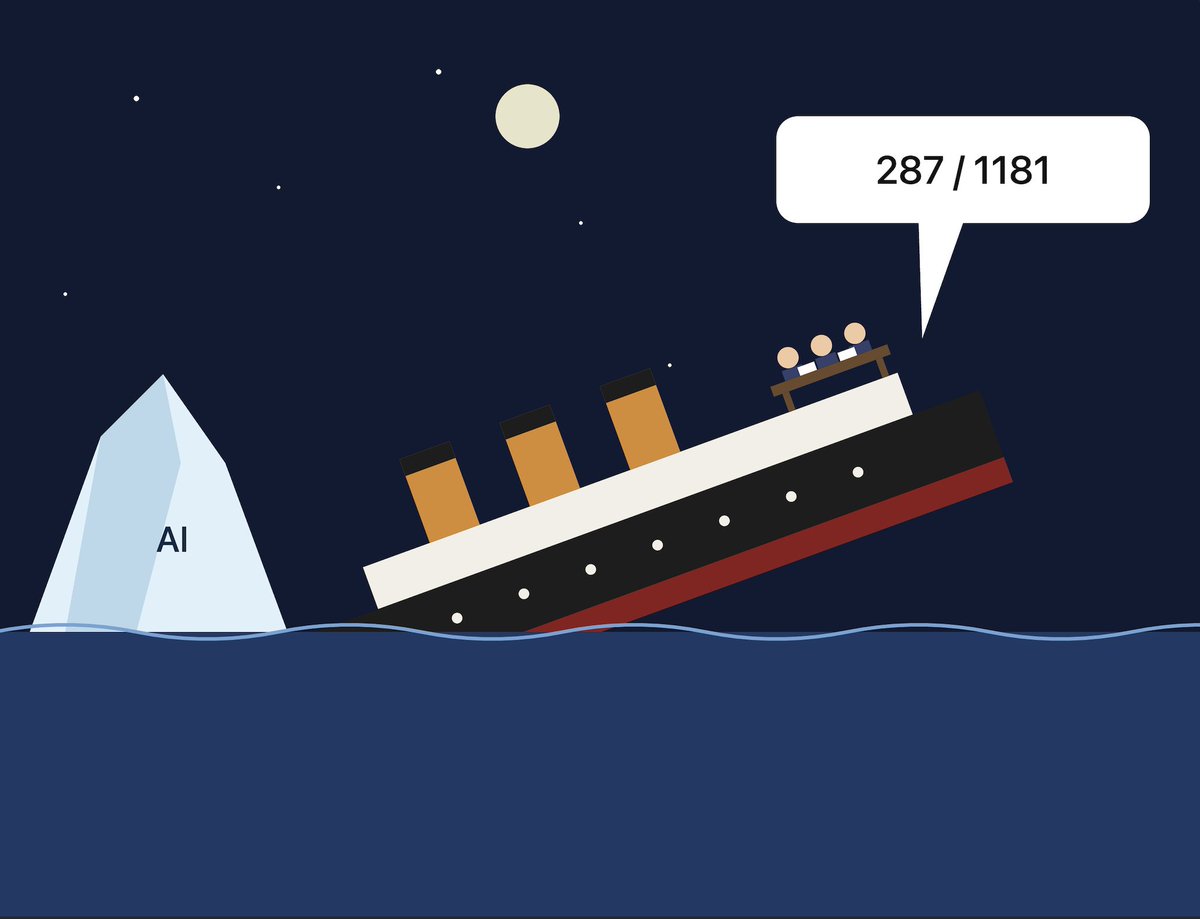
"The competition was fierce and we were only able to accept 287 out of 1181 submissions. This means that many strong submissions that met the high bar for SODA were finally not selected."
This attitude will need to be fixed. Anything that meets the bar has to be accepted.
I hope the optimists are right, but I've seen too much ego and dishonesty in this field to expect it.
Mark my words: the next STOC PC will be picking from a pile of AI results, and anyone not using AI will be at a massive disadvantage. And the STOC after that will be mostly useless, because by then the jig will be up.
I hope the optimists are right, but I've seen too much ego and dishonesty in this field to expect it.
Mark my words: the next STOC PC will be picking from a pile of AI results, and anyone not using AI will be at a massive disadvantage. And the STOC after that will be mostly useless, because by then the jig will be up.
@Pooyahat@TaliaRinger I did read it. You said you hope it's a transitional phase, which I took to mean you'd like the field to shift toward truth over ego. My question is what makes you optimistic, when TCS has been obsessed with hierarchy/publishing first long before AI came along??