UAE restricts input tax recovery on large cash payments under Cabinet Decision 149. New thresholds to be set by Minister of Finance. https://t.co/jDkPKxls5w #UAETax#VAT
@JohnOBrennan2 Short answer: no. Others took Chinese roads, mines and battery plants. #Vucic is taking armed humanoid robots. Today it kicks a ball, tomorrow 'very serious weapons.' #Serbia#China
@GeorgeKcb350 The fear trade only pays when the damage is cyclical, not structural. This one was demand-side: Hormuz access, not facility failure. I've cleared cargo through Jebel Ali for years and it stayed fully operational. The peg held. That's the tell.
@MarhelmData The nine-year low is as much an insurance story as a strike story. Pull war-risk cover and uninsured tonnage doesn't transit. Same dynamic I watched in 2019. #OOTT#Shipping
@JohnOBrennan2 Fair on the trend, but 'tech barons' is doing a lot of work there. I'd point to COVID closures first: this cohort tested in 2022, before generative AI hit classrooms. Ireland's rank held. #PISA
Odd read: 'UAE paying the price' while every Saudi reform listed benchmarks against Dubai. Copying policy takes a decree. Copying institutions takes decades. I know which one I'd bet on. #Geopolitics#Vision2030
Saudi Arabia's sovereign wealth fund has dropped to fifth place among the country's own construction clients.
Its share of contractor awards was 65% in April 2026 and under 5% by June.
Building awards reached $32bn in the first half of 2026, up 82% on the $17bn a year earlier, on the Contractors Authority's own project tracker. Infrastructure nearly doubled to $7bn. Power and water fell 60% to $5bn. The fund held a single place in the top ten, a $3bn runway extension in Riyadh, while the largest award of the half was a $4bn Jeddah tower for a foreign brand-licensing developer. The other names at the top of the table are a private property company, two royal commissions and a football club.
Read as recovery, this is private money finally arriving. Read against the balance sheet it is narrower. The fund's outstanding debt was around $68bn in April, the state approved a SR217bn borrowing plan for 2026, and banks have been slowing lending as the fund's cutbacks feed through. Awards did not rise because money got cheaper. They rose because the client changed.
We set this out when The Line was cut down and Trojena lost its games, and the same 72 hours carried a widened premium residency, foreign property ownership and the removal of the limits on who could buy Saudi equities. The fund was being made to behave like an investor rather than a chequebook, and whatever it stopped underwriting had to be sold to someone else. Foreign ownership went live on 21 January 2026, one unit per resident, designated areas for everyone else, 10% in fees and taxes on the way in.
That is why building doubles while power and water falls by 60%. A tower can be sold to a buyer. A grid cannot.
This is not a construction boom. It is a state stepping back from the risk and selling the asset in its place.
Saudi-UAE Feud and the Great Recalibration: Neom Scales Back as Vision 2030 Confronts Reality, with the UAE paying the price
https://t.co/LNPcObK8ww
With Qatar's force majeure still hanging over the market, every spot buyer I talk to is calling Adelaide this week. GLNG cargoes are getting bid hard. #LNG $STO
Australian #LNG player @SantosLtd on Tuesday announced the spudding of its first appraisal well in the Beetaloo Basin, marking a “major” milestone towards unlocking a new source of long-term gas supply for Australia. #lngprime https://t.co/gsKDYRjYRh
@bozorgmehr "No Information, No Cooperation": Grossi Says #Iran Won't Cooperate With The #IAEA Until A Political Agreement With Washington. Verification On Hold.
@johnredwood Fair point. The £330m is a competitiveness signal, not a budget line. Capital moves where tax is predictable and courts enforce contracts. DIFC and ADGM compete for exactly this. What does the UK regime signal? #TaxPolicy
@bozorgmehr Undeclared, denied, configured for fissile material. Nobody builds a reactor like that by accident. I followed Deir el-Zour back in 2007. The new government finally letting the IAEA in is the actual news. #Syria#IAEA
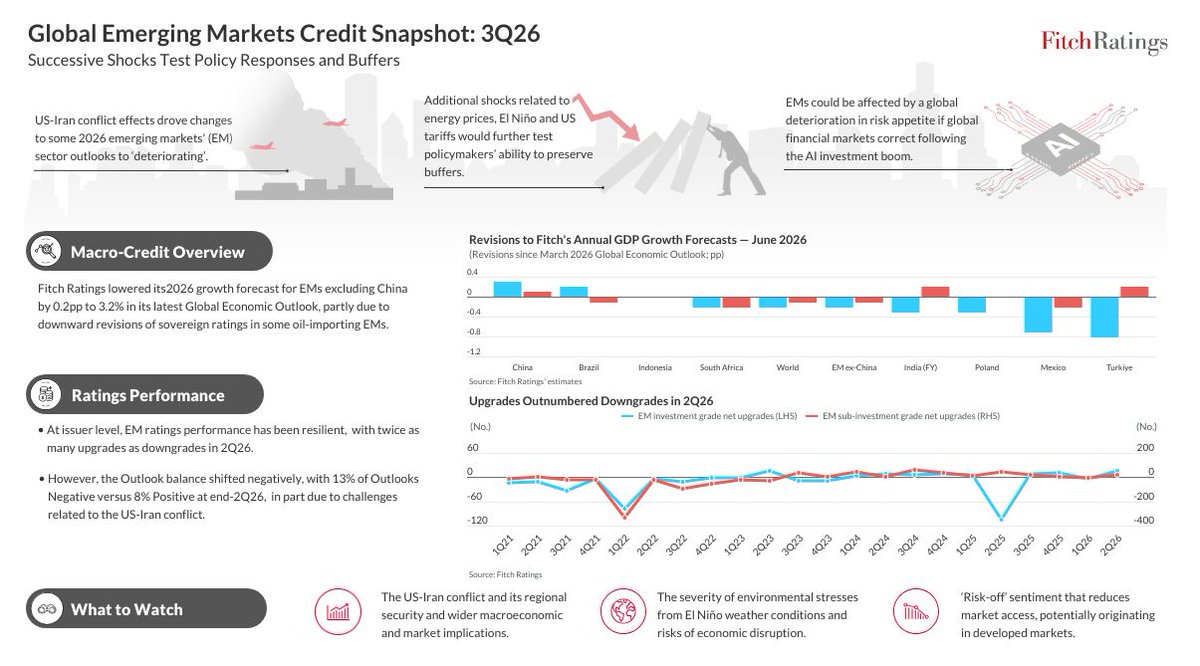
The renewed closure of the Strait of Hormuz in July underscores continuing geopolitical and energy supply risks facing emerging markets credit in 2H26.
Download this infographic to find out more: https://t.co/Nhuu7LK6ot
#EmergingMarkets#Credit#ElNino#USTariffs#IranWar
@AndersSjastad Ton-mile math does it. Every rerouted barrel adds days at sea. I wouldn't put a date on Hormuz normalising either. Clarksons read it right. $FRO $TRMD
@Mar_Ex IRGC declares 'full control' of Hormuz, yet transits clear only with Iranian acquiescence, like the March passage paid in yuan. I've moved cargo through the Gulf: the real gatekeeper is the war-risk underwriter, not Tehran. #Hormuz#Iran
Clayton Griffin, President of OTR Solutions (@OTRSolutionsLLC), explains why simply calculating cost per load is not enough. Freight brokerages need to understand which expenses are fixed, variable, controllable, and tied directly to each additional load or invoice.
“It’s not only important, I think, to understand general high-level cost-per-load. I think most everybody can go in and do the math on costs, operating expenses, over the number of loads that they’re moving, and back in to what the cost-per-load is.
But understanding how much of that is fixed, how much of that is variable, and how much of that is something that you can control, I think is really important. And where the cost lives, because when you have an understanding of which part of the organization the vast majority of your cost exists, you can say, ‘Alright, how much of this is, for instance, revenue costs? How much of this cost is back office costs?
Where every time that an incremental load or invoice comes through our platform, we’re paying some amount in dollars that is required of us to ensure that the business is running as we expect it to run.”
Watch the full webinar on YouTube, or listen to it on Spotify and Apple Podcasts.