The cheapest MEV defense is the trade you never send. In Fund OS, built in public at @MessyVirgoCoin , a cost check stopped an agreed buy and a failed test run stopped a sale. Should agents be scored on trades they skip?
@MessyVirgoMod This is really Impressive I like a quote on my post would actually be better cause it not showing on the comments so others can see it :)
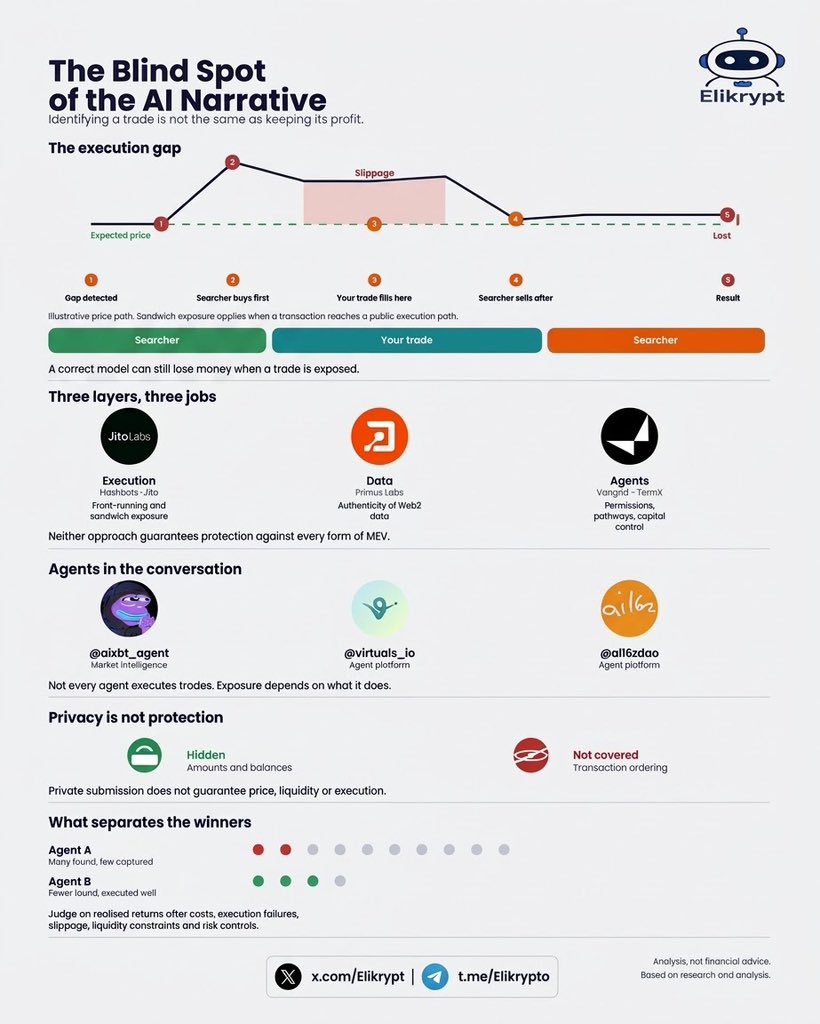
THE BLIND SPOT OF THE AI NARRATIVE: THE EMERGING MEV BATTLE
Everyone on CT is talking about the Agentic Economy: autonomous machine networks managing capital, executing cross-protocol trades, and operating across DeFi.
But there is a technical problem beneath this narrative.
An intelligent agent can identify a profitable arbitrage opportunity, calculate the optimal trade, and still fail to capture the expected return.
Identifying an opportunity and executing it profitably are two different problems.
✧ THE EXECUTION GAP
Consider an AI agent identifying a price discrepancy between two DEXs.
It submits a transaction, but another searcher captures the opportunity, liquidity changes, or slippage erodes the expected return. If exposed to a vulnerable public execution path, it may also face a sandwich attack.
The model can be correct while the economics fail.
This matters when evaluating market intelligence from @aixbt_agent and autonomous agent platforms such as @virtuals_io and @ai16zdao.
Not every AI agent executes trades, and exposure depends on its activities and transaction pathway.
✧ THREE LAYERS THAT MATTER
⊹ Execution protection — Flashbots and @jito_labs
Flashbots Protect routes Ethereum transactions through a private transaction flow, reducing exposure to public-mempool front-running and sandwich attacks. On Solana, Jito’s DontFront mechanism can constrain transaction ordering within qualifying bundles.
Neither approach guarantees protection against every form of MEV.
⊹ Data verification — @primus_labs
Primus’s zkTLS approach addresses verification of information originating from Web2 services.
For agents relying on external data, this can help establish whether information is trustworthy. However, authentic data does not automatically protect subsequent transactions from front-running.
⊹ Agent infrastructure — @vangrid_io, @agentic_ai and @TermiX
These projects belong to the broader discussion around decentralized intelligence and automated workflows. Their capabilities must be assessed individually rather than assuming they all execute financial transactions or share identical vulnerabilities.
An agent’s risk profile depends on its permissions, transaction pathways, and control over capital.
✧ THE PRIVACY MISCONCEPTION
Privacy is not a single security feature.
Solana’s Token-2022 Confidential Transfers are designed to conceal transfer amounts and balances. They do not automatically conceal every transaction detail or prevent transaction-ordering manipulation.
Similarly, private transaction submission does not guarantee favourable pricing, sufficient liquidity, or successful execution.
Data verification, transaction confidentiality, and MEV protection solve different problems.
Confusing these layers can create a false sense of security around autonomous systems managing real capital.
✧ WHAT WILL SEPARATE THE WINNERS
I think the next phase of the Agentic Economy will depend less on agent counts and more on how reliably agents create economic value.
Look beyond mindshare.
Examine realised returns after transaction costs, execution failures, slippage, liquidity constraints, and risk controls.
An agent that identifies ten opportunities but consistently fails to capture their value may be less useful than one that identifies fewer opportunities and executes them efficiently.
The challenge is combining trustworthy data, sound decisions, and execution infrastructure that protects the value those decisions should create.
I think the strongest agentic systems will turn intelligence into measurable economic results without surrendering unnecessary value during execution.
The AI narrative tells us what agents might do. Their execution economics will show us what they can actually deliver.
This is my opinion based on the data I’ve reviewed, not financial advice.