That's a really good question, but it's hard to answer in a single tweet because our mission is quite extensive, and it requires a lot of background knowledge to really understand what sets Kaspa apart.
Currently, a lot of people see Kaspa as “Bitcoin’s crazy little brother” that improves time-to-finality by leveraging the benefits of DAG-based consensus protocols without accepting their traditional drawbacks, such as decreased decentralization or a limited validator set.
This perception is somewhat accurate, but it falls short of conveying the full picture, because Kaspa’s vision extends far beyond just trying to be a better Bitcoin.
Anyone willing to study Kaspa and its broader vision will discover similarities to nearly all major existing DLT designs: from Bitcoin, to Ethereum, to Solana, Sui, Celestia, and beyond.
My personal view is that “research” in the DLT space is approaching a point of convergence. We increasingly understand how to push distributed systems close to the limits of what physics permits. The frontier is no longer only about raw throughput or faster finality. The attention is shifting toward game theory, incentives, sequencing, MEV, alignment, and how to build systems where the economic incentives of users, builders, miners, validators, applications, and infrastructure providers do not work against each other.
That is why debates like based rollups versus arbitrary sequencing, shared sequencing, MEV mitigation, proposer-builder separation, and execution-layer incentives matter so much. These are not niche technical details. They determine whether a network can remain neutral, decentralized, and aligned while scaling to global usage.
And this is where I think Kaspa is pushing the boundaries in a very important way.
Kaspa is not merely trying to be “fast.” The goal is to build an L1 where speed, decentralization, security, and incentives are aligned at the base layer. A system that does not scale by hiding complexity behind trusted committees, privileged sequencers, centralized validator sets, or opaque coordination mechanisms, but instead tries to preserve the spirit of proof-of-work while extending what an L1 can realistically do.
Because Kaspa arrived later than many other major projects, it does not carry the same degree of technological debt. It can absorb lessons from Bitcoin, Ethereum, rollups, modular blockchains, high-throughput monolithic chains, DAG research, MEV research, and the broader history of decentralized systems, and combine those lessons into something more optimal.
To me, that is what Kaspa is building: not just a faster blockchain, but a more incentive-aligned decentralized infrastructure layer.
But this also creates a different challenge.
Kaspa’s biggest problem today is not its technology. It is the lack of centralized coordination around communicating the vision. And because Kaspa is a grass-roots movement, that responsibility does not belong to a marketing department, or a single leadership team. It belongs to the community.
That also means the community has a different role to play.
There will always be holders who are mainly interested in price, and that is completely fine. But there also need to be people who are here because they want to use the technology to build a different future. People who care about the architecture, the incentives, the open questions, the trade-offs, and the long-term trajectory of decentralized infrastructure.
I am one of those people.
I am not interested in DLTs merely as a way to generate wealth. I am interested in them because I believe they can change the trajectory of humanity as a whole.
For that reason, I want to use this opportunity to announce a regular community hangout where we discuss the current state of development, the open questions, and where we can align our vision together.
The first session will be on Tuesday, June 9th, 2026.
We will talk about the vProgs framework, how the codebase works, what sets Kaspa apart, where we improve on existing solutions, and what still needs to be done. The goal is for this to become a regular, possibly bi-weekly, event where we as a community come together to discuss the future and understand the technology.
Eventually, we can invite people from other projects as well, but the main focus at the beginning will be explaining and communicating how things work under the hood.
There is still a lot of work to be done, and I do not want to waste precious time. So the first sessions may feel a little improvised, but we can improve as we go.
The important thing is that we start.
So mark the date: Tuesday, June 9th, 2026.
@JoshMandell6 Once we see Bitcoin for what it is (brilliant tech) then we can ask "is there an upgrade? A better bet?". That's when Kaspa all of a sudden makes sense. And that's also the reason big exchanges are suppressing it: it makes any crypto currency irrelevant, including Bitcoin.
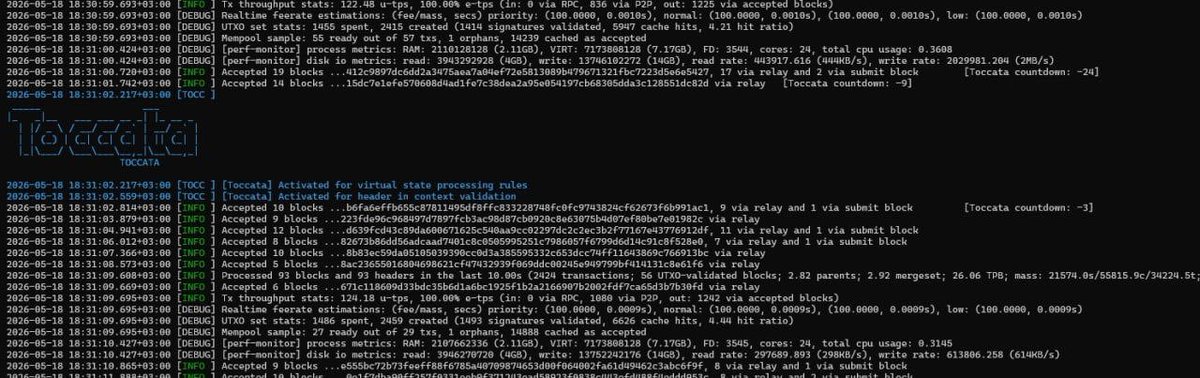
Update: Testnet 10 underwent the Toccata hardfork about 30mins ago and everything’s still running like clockwork. Transition was smooth and seamless.
This seamlessness is the standard that kaspa devs set. It’s easy to take it for granted so I want to take this moment to recognize the effort and due diligence that went into making this happen @michaelsuttonil@OriNewman@Max143672@IzioDev@FreshAir08@manyfest_@hus_qy (and sorry if I missed anyone)
Mainnet HF soon
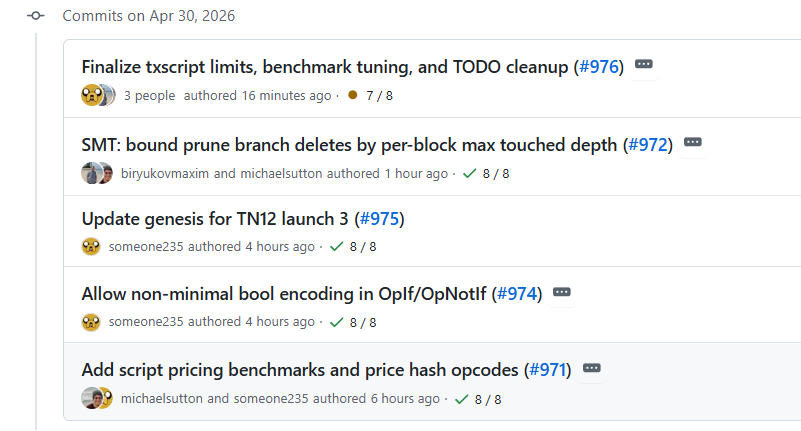
Toccata consensus feature freeze is finally here after a heroic last-mile push by kas core devs.
Aiming to reset TN12 tonight, or tomorrow at the latest.
Genesis update:
+ 0x6b617370612d746573746e6574 // kaspa-testnet
- 12, 2 // TN12, Launch 2
+ 0x544f4343415441 // TOCCATA
+ 12, 3 // TN12, Launch 3
If @Truthcoin would be really interested in tech and not just marketing, he would advocate Kaspa, that will support the same features and more in the upcoming Toccata hardfork, and is obviously superior to any Bitcoin fork.
The only rarionale behind a Bitcoin fork is to compete on the brand with the same history, but he already gave up when he decided to name it ecash and confiscated Satoshi's coins.
I just got back from my Easter trip visiting family, and one of the first things I made time for was listening to Yonatan’s Oxford Union speech. I think he absolutely nailed it: https://t.co/46WvWwy2xg
If there is one thing we can learn from our progress in AI, it is that intelligent behavior emerges when many components explore degrees of freedom and converge, through distributed constraint resolution, into coherent and stable patterns.
The modern world has connected an enormous number of people and given us unimaginable freedom, but it still lacks a credible way to enforce shared constraints.
The result is a crisis of responsibility at every scale of society: from cyberbullying to former superpowers chasing old glory through war, to leaders blaming the weakest members of society for national decline, or even killing their own citizens to preserve power.
At the same time, our capacity to inflict harm on one another has become increasingly asymmetric. Small actors can now create disproportionately large disruptions, and conflicts no longer remain local. They send shockwaves through the emerging superorganism we call humanity.
The age in which we could dominate one another and still produce a stable world is coming to an end. The only serious path forward is collaboration.
People may feel pessimistic about the future, but I think we are approaching an inflection point. Even the old superpowers are beginning to learn this lesson the hard way.
The American Dream of "I can make it" is gradually giving way to the realization that individual prosperity depends on collective wellbeing, and that we can build far larger and more meaningful things when we share a common dream.
That is why I am excited about DLTs, and Kaspa in particular.
Not because I see them as safe havens for hiding wealth from corrupt governments in some dystopian future, or because I want people to get rich by selling to later participants.
But because I believe DLTs can offer a superior foundation for large-scale human coordination: one that is more neutral and reliable than traditional models based on force and mutual deterrence.
In that world, wealth is not the goal in itself, but a byproduct of coordinating around shared missions, empowering people to contribute, and aligning incentives toward common outcomes.
The future is not about building better products. It is about building better protocols: systems that allow human beings to coordinate meaningfully at larger scales than ever before.
For the first time in human history, we have the tools to build institutions that are not bound to territory, yet can still provide structural coherence without having to fight wars to establish their legitimacy.
What we need now is a group of people bold enough to take that mission seriously.
@Grayscale@realvijayk arigato gozaimasu!
if Kaspa army showed up here, think how they'll show up when you provide a KAS digital asset..
by mid june Kaspa OP_CAT++ Bitcoin. worth the attention _/\_
Kaspa is real-time bitcoin, solving scalability is great but not the core value prop.
Real-time bitcoin means achieving in a few seconds the same security guarantees that nakamoto consensus / bitcoin achieves after an hour; decentralizing each consensus round rather than chain quality achieved through a coarse aggregate of rounds.
A clean definition anchor for real-time decentralization (RTD): The ability to sample the honest majority in real-time.
(Note that even fast leaderless VRF-based proof-of-stake cant sample honestly bc the selected nodes get to choose the content of their blocks after they've been selected; pos=select then write, pow=write then select)
--
RTD affects: txn confirmation, censorship resistance, secure oracle finality, MEV resistance.
Eg censorship resistance, bitcoin is the most censorship resistant chain, but if 60% of the miners are censoring you (point in reference: OFAC abiding tornado censoring eth miners), your txn will pend for 30-40 minutes. For shady business payments that's not prohibitive, but for a real economy, for an asset aspiring to be at least a king of collateral even if not an MoE, this is unacceptable, esp under economic stress.
Beyond censorship, all things finance benefit tremendously from pow density, from sampling the majority in real-time in a secure and honest manner.
I wont get into MEV resistance now, but having a "conscious" stream of oracle attestations (not price oracles) finalized in real-time qualitatively upgrades the ability to encode informed risk, collateral, liquidity management, which is the lifeblood of defi.
In context of conf times, increasing from 1 to 10bps saturates the latency optimization. But for pow density we need dozens of blocks per second, with the endgame of 100 bps: Under 10bps a 37% attacker can fake the majority signal with probability 12%. With 100bps this drops to 0.3%. Today Kaspa can't accelerate to >10bps w/o harming conf times, but DAGKNIGHT will be implemented hopefully by Q3 at least on testnet, by which we will push for 25-40bps.
The cherry on top: RTD also implies netsplit resistance, as per the partial synchrony framework.
WWIII cyberwar resistance. Hypothetically speaking ofc.
(elaborated- https://t.co/o8vKa7gBwm)
In my view, these posts are for creating the inner circle and occupying it with strong and correct understanding of the fundamentals. To some degree, second order explanations will mostly echo in the wild when actual usecases and apps emerge to the world. The point is making sure that when that day comes, correct info flows with it
Kaspa’s covenant stack is converging on a shared goal: make real L1 apps approachable, and make secure design the default rather than an expert-only art.
tl;dr
Two layers are landing in tandem:
(i) Top of stack: a high-level language that makes covenant authoring feel like “writing apps”, not “fighting script”
(ii) Base of stack: a consensus primitive that makes stateful covenants practical at scale, without recursive lineage proofs
Silverscript was just announced as Kaspa’s first high-level covenant language/compiler, targeting local-state apps in the UTXO model. Complementing that tooling is KIP-20: Covenant IDs.
The strategic role of KIP-20: UTXO already ties “rules own state” locally via the spending script. The difficulty is carrying that relation temporally across transitions in a local-compute model, without turning every spend into a recursive “prove my ancestors” witness construction.
KIP-20 tightens that temporal linkage at the consensus layer by introducing a covenant_id tracked by consensus. Result: stateful designs no longer depend on parent or grandparent transaction witnesses as a lineage workaround. They become first-class citizens: covenant identity and lineage are native, so designing secure stateful schemes becomes simpler and more robust.
The broader theme is security-by-construction: Approachability isn’t just syntax. It is making it easy to write covenants that correctly validate state transitions, and hard to accidentally ship an insecure scheme. The compiler/scheme connection is still wip, but the direction is clear: have the compiler generate transition logic, then wrap it in schematic code that enforces a declared covenant pattern.
For now, Silverscript’s covenants/sdk folder is the best reference for how these pieces should meet from my pov. I am planning a longer overview tying together the various recent components.
Spec: https://t.co/aoTBUlAqsZ
PR: https://t.co/gOKQEZlOet