Powerful habit changes for more inclusive teaching. > This is packed post with lots of ideas for deepening thinking and systematically involving all students. Common issues with lots of lessons.. check it out. Link follows.
We’re pleased to share OCMAT’s Mainstream Inclusion Strategy exemplification and a practical template for schools. We hope it supports high expectations while reducing barriers to learning, participation and belonging. Please use or adapt anything useful. https://t.co/3OijZ1YMod
Anon post:
My NEU rep has emailed to say staff are getting worn down by how many learning walks we’re doing, especially when each one is followed up with feedback. I understand we’ve got three formal observations, but learning walks feel like they could happen endlessly.
Would you scale them back? Keep them purely developmental and not always attach feedback? Or stick with the current approach?
If I’m being honest, it’s starting to feel like it’s tipping into “too much.”
The five forms of feedback I give to teachers most often... https://t.co/c62cyn5AyZ from 2018.. more or less the same now. With embedded kitchen pedagogy videos. Worth a revist?
These are some of the things that I think mainstream secondary schools should be able to expect of the overwhelming majority of its students:
Turn up to lessons on time
Start work without talking to anyone
Bring your books and equipment to school
Don't call out questions, answers or comments
Don't get out your chair and wander round the classroom
Raise your hand if you want to say something
Talk politely to everyone (especially teachers)
Don't roll your eyes or kiss your teeth if challenged on behaviour
Pay attention to what the teacher is saying
Don't turn around to try and get your friend's attention
Complete your homework
Don't chew gum
Don't break the law (e.g. vaping on premises)
Don't use your phone
If a teacher asks you your name, say it
Walk calmly (if not quietly) in the corridors
Complete your homework
If someone says good morning to you, say good morning back
Hold the doors open for people if you can
Don't fight
Don't playfight
Don't swear
Comply with reasonable instructions (e.g. "please get your planner out" or "please follow along with class reading" or "please come over here.")
For many of the things on the list, students should expect a consequence (like a detention) for not following them.
I suspect most of the above sounds entirely reasonable to the public, and schools should not be pilloried for attempting to cultivate these behaviours.
This is not an exhaustive list. But these are the ways that students in the best-performing schools I have visited behave.
Are there a tiny minority of students who couldn't comply with this list? Absolutely.
Sometimes, those students need a different type of school environment, and we should (and often do) have high quality provision for them.
Sometimes, those students would comply if they were in a mainstream school where these behaviours were normal and enforced. High performing schools have the same number of
-"difficult" students
-students on free school meals
-students with EHCPs
than low performing ones (they often have more). Whatever demographic you pick, there will be a high performing school where those same students are behaving beautifully.
Of course, teachers and leaders also have their part to play in this but that, dear reader, would require a different post.
Planning an intro to how learning happens with your Ss at the start of term, but not sure how?
I've uploaded all my KS3/KS4/KS5 or MS/HS resources (ppt/notes) to my website - help yourself!
It's SO helpful for them to have the language of learning!
https://t.co/xSAcm0qBlZ
NEW! This week’s ⚗️DistillED argues that teaching can become mechanical when it is reduced to a checklist of approved techniques, divorced from the thinking that gives them purpose. It introduces a five-step framework for planning from principles rather than strategies, plus a FREE planning tool and one-page guide.
Inspired by @HughesHaili recent Substack post, The De-intellectualisation of Teaching
https://t.co/Y1DJwsy49k
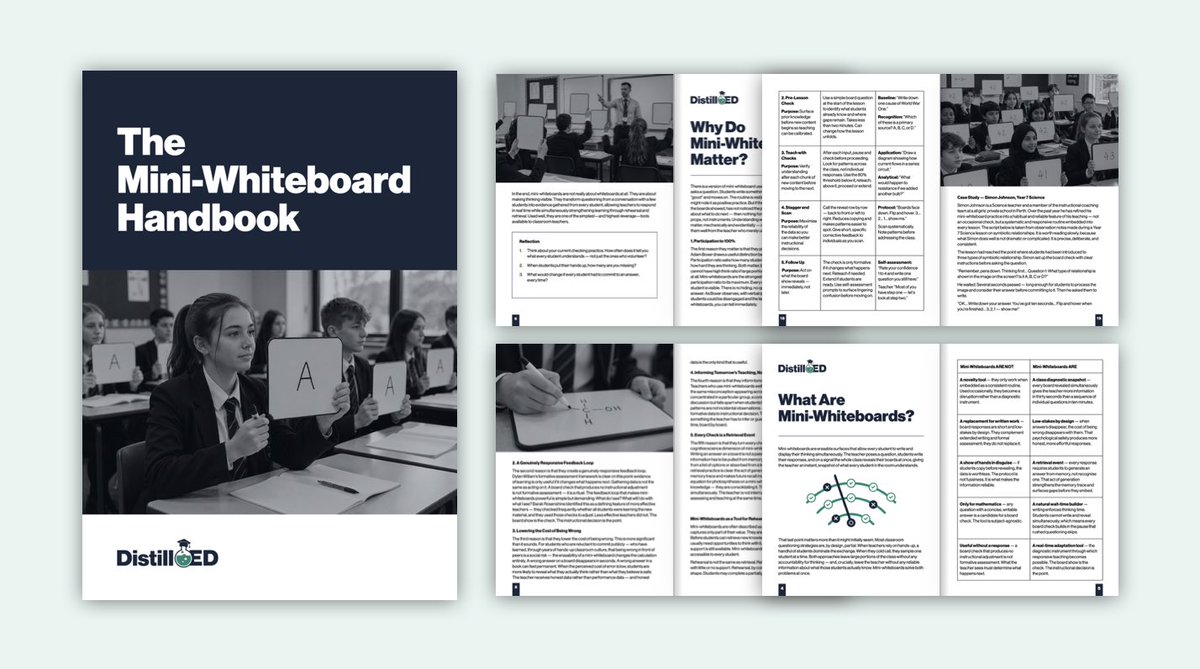
📘 FREE HANDBOOK! This edition includes a FREE 30-page Mini-Whiteboard Handbook… A printable PD booklet with the What, Why and How of MWB implementation. If you find it useful, please repost this to help spread evidence-informed practice with more educators. 👍
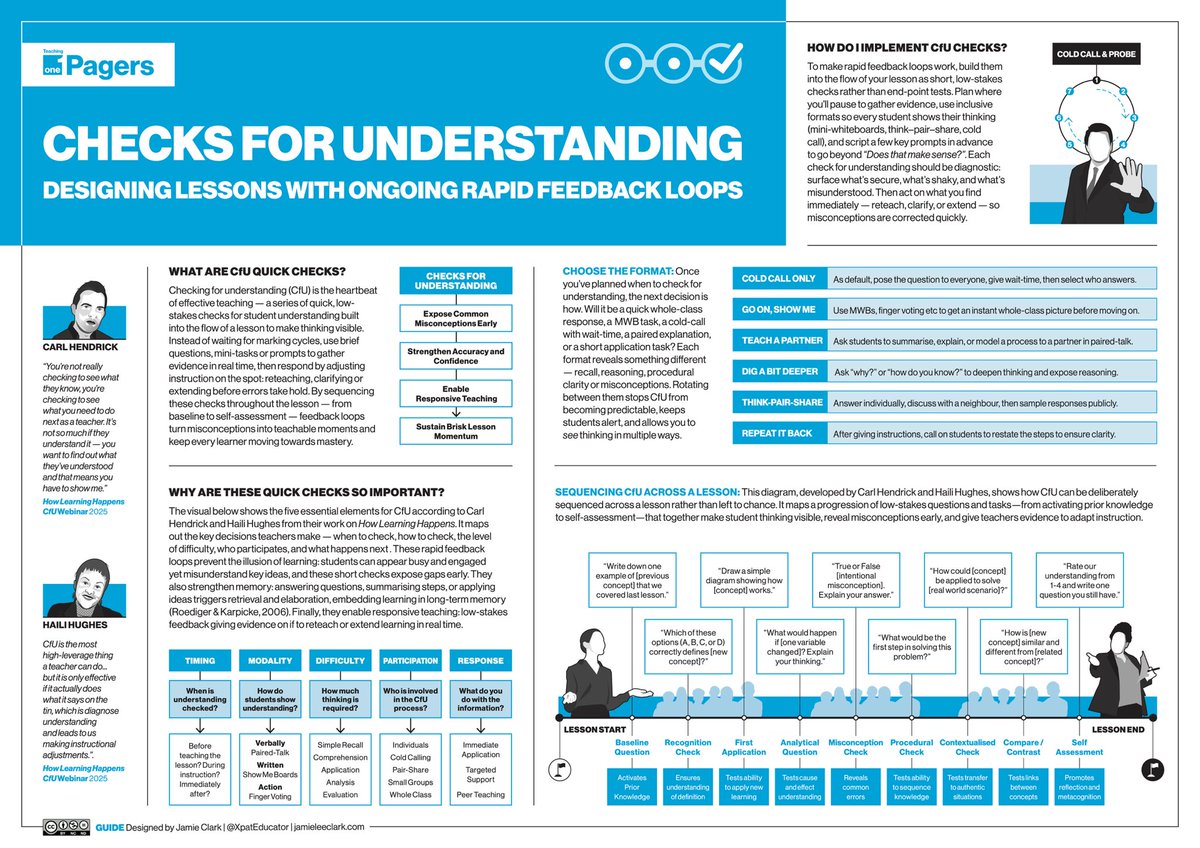
📣 CHECKING FOR UNDERSTANDING! “If there’s one thing to get right in teaching, it’s checking for understanding.” This one-page guide breaks down how to thread CfU checks into every lesson — inspired by the ‘How Learning Happens’ work by @C_Hendrick and @HughesHaili
Read and download free: https://t.co/7NvPGRaMIK
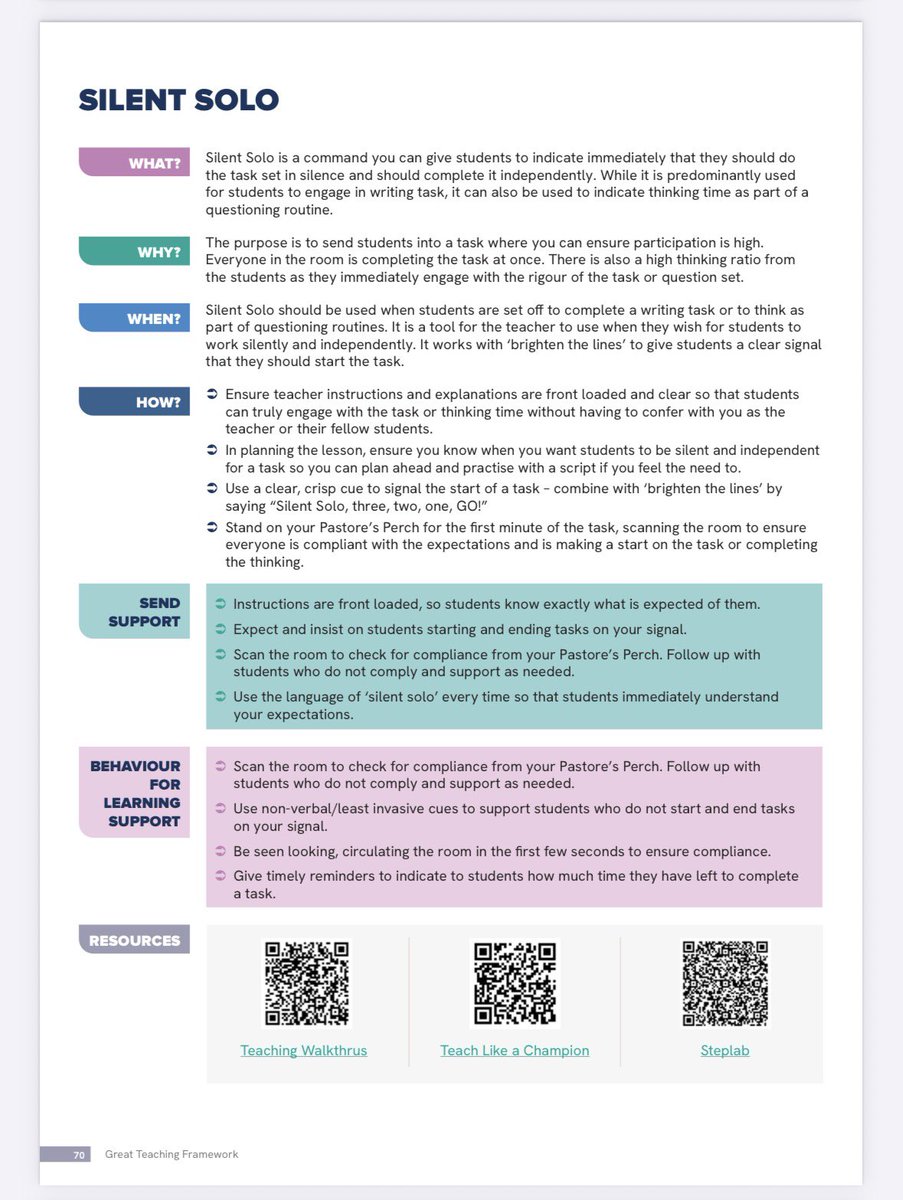
***GREAT TEACHING FRAMEWORK***
Our great teaching framework is nearly complete. Over the last few months, we (@MissCole279) have been working on creating a shared language of what excellent teaching looks like in every classroom.
The framework is built around seven key principles. Each principle is underpinned by:
Clear instructional components ✅
Observable classroom techniques ✅
Coaching questions ✅
This isn’t a checklist. This is a framework to ensure that every student experiences high quality teaching.
#TheLongdendaleLegacy
Love it when we can use the flexibility of @WALKTHRUs_5 to make bespoke resources for schools - here's a PD booklet for the Savannah Trust schools in NW Ghana.
🎬️ NEW VIDEO CLIP: Adaptive teaching in mathematics
Our brand new video, spotlighting practice at St Cuthbert's Catholic Academy in Blackpool, is available now.
Read more and watch the video here: https://t.co/tOduZt6b53
***GREAT TEACHING FRAMEWORK***
Over the last few months we have been working on developing our great teaching framework to ensure every student experiences consistently high quality teaching.
Our framework has four key drivers of excellence:
✅ Subject knowledge
✅ Relationships
✅ Routines
✅ Hard Thinking
The framework has six principles, key components and linked techniques from @WALKTHRUs_5, @teacherhead, @olicav and TLAC @Doug_Lemov. We have mapped the techniques to the Great Teaching Toolkit.
For each technique, we have codified what it means and our teaching and practice labs CPD sessions allow staff to get it, see it and try it.
We then use @Steplab_co for our coaching model to keep it, fit it and continue to try it through deliberate practice.
#TheLongdendaleLegacy #GreatTeaching