ok after a full day of using gpt 6.2 astra and sol on my real projects, here's my review
tl;dr - they are not a drop-in replacement for fable 5.2 and opus 5.5, but they are _really good_ once you figured out how to use their strength
1. first, the quirks
i started called these the "gpt smell", which is still here with the 6.2 series
the models' judgment on when to ask the user about something and when to go ahead is just not quite right. it'll escalate trivial decisions where clearly only one option is preferable, or choose to go down a path by itself that makes significant tradeoffs that should have needed my eyes
so as a primary driver for "let me just talk to it about everything" type of use case, they aren't great - i'd say they are close to opus 5 in this regard, and far behind opus 5.5
2. but... i found something _really_ cool
having ultrafast on sol is completely insane. with astra, it burns my wallet ultrafast, but with sol it's actually quite affordable!
the best use of sol on ultrafast that i've found is adversarial code reviews - they typically don't need to run a lot of heavy tool calls that would slow them down. most of the time is spent on the model, which gets massively accelerated by ultrafast
once you got a feel from using sol ultrafast as the code reviewer, you can never go back. it feels like pure magic
3. and... i found something else that's really cool
we are not supposed to ask the gpt 6.2 series to respond in text. we should let them respond in html! (i use lavish-axi, but you can just ask for html or use whatever fits in your harness)
i suspect they are post-trained specifically on their latest "intelligent UI" concept in chatgpt - these models are so good at visual presentations of ideas
once you allow the model to respond in visual artifacts, it's a completely different game. the reports and decisions explained by astra in html is a clear step function better than what fable and opus give me
so after a day of use, i've made two changes to my setup:
- always sol ultrafast as code reviewer
- i started preferring asking astra for planning in html artifacts over fable/opus. i think i'll keep a/b testing for a while to decide how much and for which case i fully switch over
all in all, i strongly recommend spending more time with these two models. don't expect them to be the "everything" model, but rather figure out where they fit best in your workflow. i couldn't be happier for the two use cases i found above, and i'm pretty sure there are more
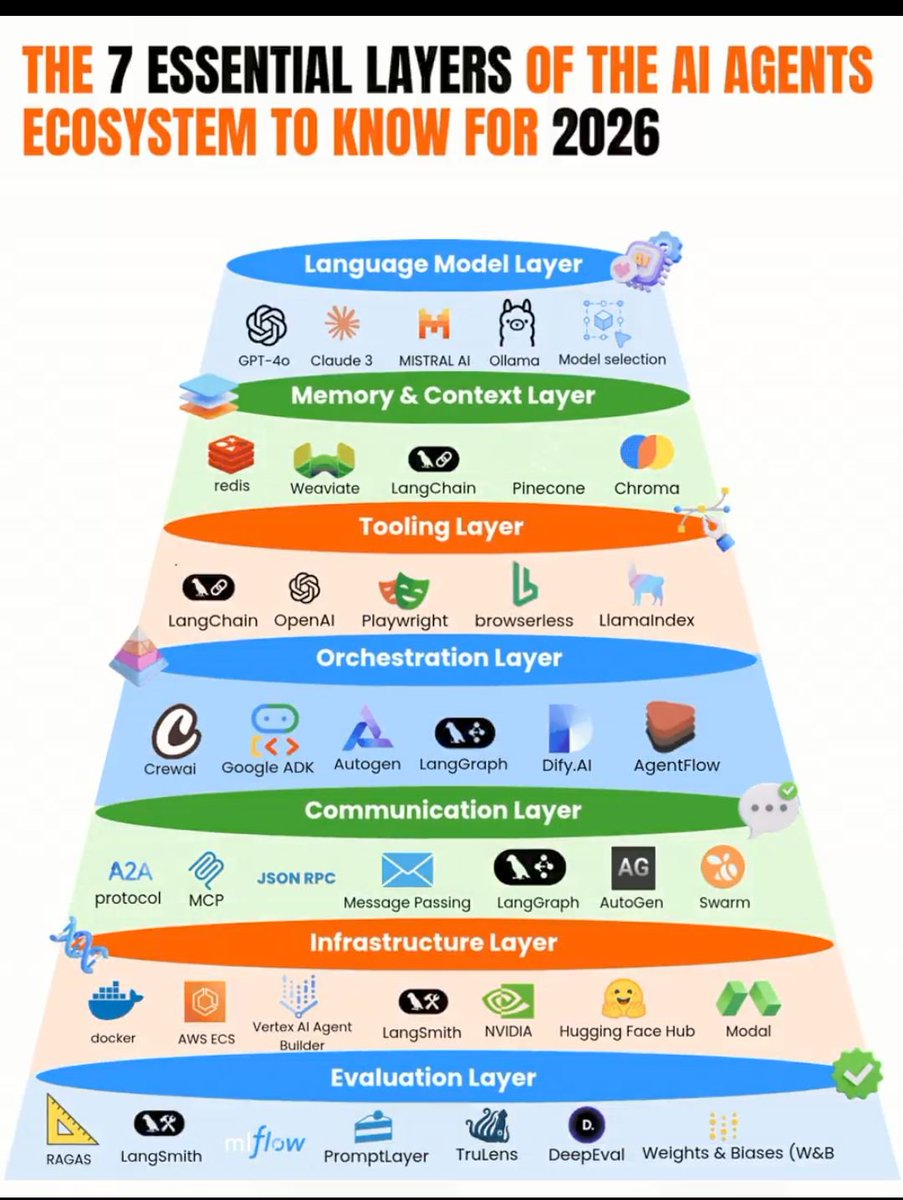
𝗧𝗛𝗘 𝟳 𝗘𝗦𝗦𝗘𝗡𝗧𝗜𝗔𝗟 𝗟𝗔𝗬𝗘𝗥𝗦 𝗢𝗙 𝗧𝗛𝗘 𝗔𝗜 𝗔𝗚𝗘𝗡𝗧 𝗘𝗖𝗢𝗦𝗬𝗦𝗧𝗘𝗠 🤖
Building powerful AI agents isn't just about choosing the right LLM.
A complete AI agent system needs memory, tools, orchestration, communication, infrastructure, and evaluation to work together.
Here are 7 essential layers that make modern AI agent ecosystems possible.
1. Language Model Layer — The Brain
The LLM handles reasoning, understanding instructions, and generating responses.
Examples:
- GPT-4o
- Claude
- Mistral AI
- Ollama
2. Memory & Context Layer — The Knowledge Base
This layer stores information and provides relevant context across interactions.
Tools:
- Redis
- Weaviate
- LangChain
- Pinecone
- Chroma
3. Tooling Layer — The Action Center
Allows agents to interact with external tools, browsers, APIs, and applications.
Examples:
- OpenAI
- Playwright
- Browserless
- LangChain
- LlamaIndex
4. Orchestration Layer — The Workflow Manager
Coordinates agent tasks, manages execution, and connects different workflow components.
Tools:
- CrewAI
- Google ADK
- AutoGen
- LangGraph
- Dify AI
5. Communication Layer — Connect Agents Together
Enables agents to exchange information, delegate tasks, and collaborate.
Examples:
- A2A Protocol
- MCP
- JSON-RPC
- Message Passing
- AutoGen
6. Infrastructure Layer — Run AI Agents at Scale
Provides the environment required to deploy, host, and manage AI agents.
Tools:
- Docker
- AWS ECS
- NVIDIA
- Hugging Face
- Modal
7. Evaluation Layer — Measure Performance
Helps developers test agent quality, monitor performance, and improve reliability.
Tools:
- RAGAS
- LangSmith
- MLflow
- PromptLayer
- DeepEval
- Weights & Biases
𝗪𝗵𝘆 𝗗𝗼 𝗧𝗵𝗲𝘀𝗲 𝟳 𝗟��𝘆𝗲𝗿𝘀 𝗠𝗮𝘁𝘁𝗲𝗿?
Each layer solves a different challenge in AI agent development.
Together, they help build systems that can reason, remember, use tools, coordinate workflows, communicate, and improve over time.
The real power of Agentic AI comes from the entire ecosystem, not just the language model.
Follow @AamirAnsar94694 for more AI tools & tech updates.
#AI #AIAgents #AgenticAI #LLM #MCP #Automation #ArtificialIntelligence
Deniz being the most rational and mature person in that whole mansion and acting as a couple therapist for his parents you just can't make this sh!t up 😭😭😭
At least they're finally talking calmly for the first time thanks to him
Caption
10 AI tool updates you missed last week, and every one of them makes agents a little more useful at real work.
🔹 Claude Code Review is GA. Reviews now take 6 to 10 minutes, down from about 20, with Quick, Standard or Deep modes for Team and Enterprise.
🔹 An Anthropic sales rep in Japan runs his day with six Claude agents that route leads, qualify them, draft replies in two languages and update Salesforce. He still reviews every email.
🔹 Codex now lets you steer a task while it’s running. Send a follow-up and it changes direction, or interrupt it and the running tool calls stop too.
🔹 DeepSeek opened its search engine as an API. Search and Fetch cost $0.75 per 1,000 successful calls each.
🔹 Gemini Skills let you save a workflow once and reuse it. The app rollout finishes by mid-November, but Workspace access is delayed.
🔹 Replit now deploys into your own cloud, with three options for enterprise customers.
🔹 GitLab’s MCP server is GA. Your agent can dig into a failed pipeline, read the logs and start a fix, all under your existing permissions.
🔹 Grok Voice 3.0 runs a voice agent for $4.80 an hour. Starlink says about 70% of its calls get resolved without a human.
🔹 Mirelo SFX 2.0 replaces a video’s soundtrack but keeps the dialogue, for videos up to 10 minutes.
🔹 Figma Specs give coding agents the full brief, not just screenshots. Open beta on paid plans.
Which one are you trying first?
throwback to s8 when aisha directed 8x11 and said she would like to see oliver direct an episode too and he said s10.
i wonder if he kept this in mind. could we see him make a director debut on 911 this season 👀👀
Human/AI collaboration is accelerating— but it's not the AI models with the greatest capabilities that are winning.
It's the the people who know what to ask, what to doubt, and what to decide. Let's break-down the "Collaboration Gap." https://t.co/Rf0yOt0yAJ
" Eyes don't lie "
Your sister is right Changxuan. You're in love with her you just don't know how to control that love / feeling yet. You probably need more talk with your sister.
Also Pingjun is a strong girl, but nevertheless she’s still a girl with her heart on her sleeve. She’s strong but fragile, like the flower in your brother-in-law’s garden. You’ll have to take care of her carefully. Pingjun has already told you how she wants to be loved. I think when you calm down, you’ll see more reason.
You two are also from two different worlds. You definitely had a point from your perspective, but from hers, she comes from a humble background, and many times what matters is love and equality.
And no, I’m not speaking to the Changxuan in the novel, fuck that, I’m speaking to the one in the drama 😂. I don’t claim the novel Changxuan, lol. Don’t ask why. If you know, you know.
As for Pingjun, girl just know that even family members can kill you. I hope you come to the realization soon that JXT is a spy and if he truly cares for you and your mom he wouldn't had put you guys in danger. The 5th young master maybe many things but he'll always put you behind him in dangerous situations. Just that he's a crazy ass right now because he's jealous asf and letting his jealousy running the show 😅
#TheLamentOfAutumn #ChengLei
#XuRuohan
Claude Code desktop app just got what might be its best update of the year! They've added nested sessions for parallel work, so when you ask Claude to handle multiple tasks at once, it creates a separate session for each one, lets them work independently and sends the results back to the main session when they're done, keeping everything much cleaner and easier to follow, There's also a new smart sidebar that shows which sessions are Working, Needs Input or Completed, making it so much easier to manage multiple projects at once, I've been running Opus 5.5 High with 20 agents working on my financial app and it's only consumed 8% of my 5 hour usage limit, at this point it almost feels unlimited!