You didn't build a business to become a human ATM.
But that's what happens when your whole team is waiting on your one card to pay for tools, run ads, and keep subscriptions alive.
Orbit by Cashwise fixes this — dedicated virtual dollar cards for your teams, with limits and visibility built in.
Waitlist open 👉 https://t.co/rREe3pmtr2
World Cup 🏆
European Championship 🏆
Nations League 🏆
Club World Cup 🏆
Champions League 🏆
Super Cup 🏆🏆
Premier League 🏆🏆🏆🏆
FA Cup 🏆🏆
EFL Cup 🏆🏆🏆
Community Shield 🏆
Ballon d'Or 🏅
Rodri.
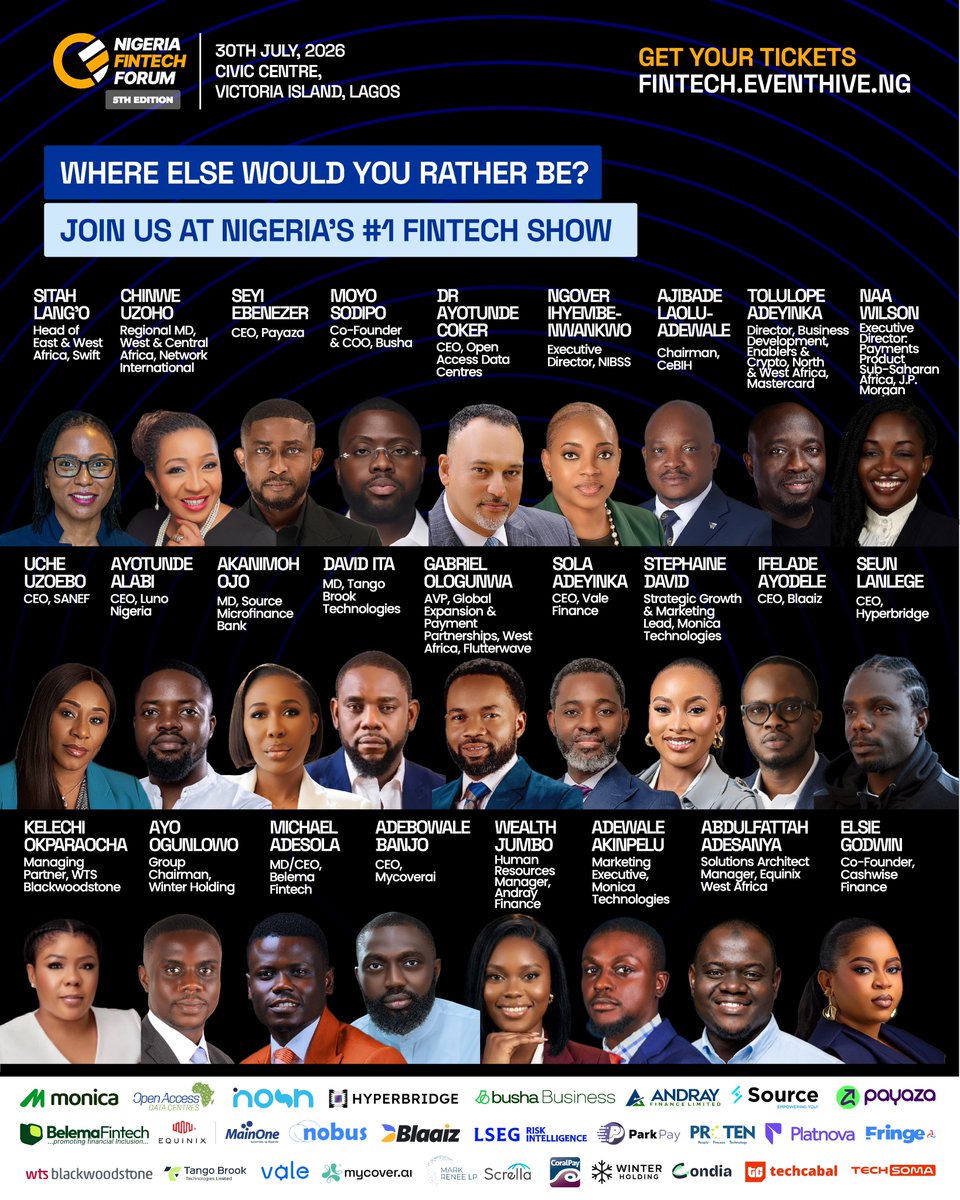
Get ready to explore the future of financial services at Nigeria Fintech Forum 2026!🚀
Dive deep into the latest innovations in payments, fintech, banking, lending and credit across Nigeria.
Don't miss out on this opportunity to connect with the industry's brightest minds which includes;
🎤Sitah Lang’o – Head of East & West Africa, Swift
🎤Chinwe Uzoho – Regional MD, West & Central Africa, Network International
🎤Seyi Ebenezer – CEO, @mypayaza
🎤Moyo Sodipo – Co-Founder & COO, @getBusha
🎤Dr Ayotunde Coker – CEO, @OADC_Official
🎤Ngover Ihyembe-Nwankwo – Executive Director, @NIBSS_NG
🎤Ajibade Laolu-Adewale – Chairman, @CeBIHNG
🎤Tolulope Adeyinka – Director, Business Development, Enablers & Crypto, North & West Africa, @MastercardSSA
🎤Naa Wilson – Executive Director: Payments Product, Sub-Saharan Africa, @jpmorgan
🎤Uche Uzoebo – CEO, SANEF
🎤Ayotunde Alabi – CEO, Luno Nigeria
🎤Akanimoh Ojo – MD, @SourceMFB
🎤David Ita – MD, Tango Brook Technologies
🎤Gabriel Ologunwa – AVP, Global Expansion & Payment Partnerships, West Africa, @theflutterwave
🎤Sola Adeyinka – CEO, Vale Finance
Stephanie David – Strategic Growth & Marketing Lead, Monica Technologies
🎤Ifelade Ayodele – CEO, @myBlaaiz
🎤Seun Lanlege – CEO, @hyperbridge
🎤Kelechi Okparaocha – Managing Partner, WTS Blackwoodstone
🎤Ayo Ogunlowo – Group Chairman, Winter Holding
🎤Michael Adesola – MD/CEO, @BelemaFintech
🎤Adebowale Banjo – CEO, @MyCoverAI
🎤Wealth Jumbo – Human Resources Manager, Andray Finance
🎤Adewale Akinpelu – Marketing Executive, @Monicanigeria
🎤Abdulfattah Adesanya – Solutions Architect Manager, @Equinix West Africa
🎤Elsie Godwin – Co-Founder, @Cashwisefinance
Join us at the Civic Centre, VI Lagos, on 30 July 2026!
1,700+ Attendees | 40+ Exhibitors | 400+ Companies
Earlybird tickets close out this weekend, book your pass now at 50% off standard price; https://t.co/50bR8djazF
Cashwise Finance has launched Orbit, a new product letting African businesses issue dedicated virtual dollar cards to individual teams, projects and departments.
Read more: https://t.co/D1mhR5vrg2
You bring in Expatriates and pay them in USD, give them a car, driver, chef, maid and house in ikoyi
You will employ Nigerians and pay them peanuts for the same role and expect them to have work ethic and not be preoccupied with survival
It is highly interesting and deeply ironic that Nigeria is currently being paraded as having the "world's best-performing stock market."
To put statistical illusion into clear mathematical perspective, South Korea comfortably has over 200 publicly traded companies with an individual market capitalization exceeding $1 billion USD. In stark contrast, the total number of companies on the Nigerian Stock Exchange with a market cap exceeding that same $1 billion mark sits at a measly, fluctuating 11 to 18. Furthermore, the South Korean Stock Exchange is home to over 2,500 listed companies, whereas the entire Nigerian stock exchange is struggling to maintain even 150. To make matters infinitely worse, the annual revenue of just one single South Korean conglomerate, Samsung, comfortably exceeds the entire, devalued annual Gross Domestic Product (GDP) of the Federal Republic of Nigeria.
So, it is obviously completely insane and deeply delusional to imagine that Nigeria is genuinely outperforming the rest of humanity in its actual economic output, industrial productivity, or stock market indices. Nigeria is currently the undisputed poverty capital of the world, where small businesses are collapsing by the dozens every single day. So that begs the question: what does this glowing market report actually mean for the ordinary people of Nigeria?
Well, for one, if a struggling, debt-ridden developing nation suddenly starts to heavily outperform advanced, highly industrialized nations on its stock exchange, it is actually a massive, flashing red indicator that the country in question is facing a severe and monumental hyperinflation. Nigeria is currently experiencing historic, record-breaking inflation, so this stock market boom is merely an indicator that wealthy oligarchs, institutional investors, and local investment banks have smartly recognized that if they hold their cash in standard bank accounts during this highly volatile period, they will lose their purchasing power every single day. Since they cannot easily access scarce foreign currencies like US dollars or Euros due to strict government currency controls, they desperately dump their fast-depleting Naira into solid, tangible local stocks like Dangote Cement, BUA Group, or MTN Nigeria just to preserve their wealth.
So, this triumphant news report that we are passionately commanded to celebrate is actually a terrifying warning sign that Nigeria is experiencing severe, runaway inflation. The local elites, corporate cartels, and bank directors are frantically tripping over themselves to buy blue-chip local stocks strictly to hedge against currency collapse, and this sudden, desperate surge in local demand has artificially driven up the prices of these shares to such a disproportionate, heavily padded percentage that on paper, it looks much more profitable to invest in the Nigerian stock market than in the highly productive, technologically advanced South Korean stock exchange.
Another major reason for this artificial stock market spike is the aggressive, reckless increase in interest rates by the Central Bank of Nigeria on behalf of the IMF and the World Bank. While this brutal rate hike has successfully collapsed thousands of local manufacturing businesses because commercial banks are now charging as high as 40% interest on business loans, it has also temporarily attracted a massive influx of volatile "hot money" from foreign speculators who are lending money to the Nigerian government by purchasing short-term treasury bills and sovereign bonds just to greedily exploit these high yields.
It is crucially important to historically emphasize that Nigeria is absolutely not the only developing country to be declared the "best-performing stock market in history." Mexico proudly achieved this exact same fraudulent title in the run-up to 1994, and it ended up almost collapsing their entire national economy into absolute oblivion. At the time, the Mexican government, acting on the strict advice of the World Bank, aggressively increased interest rates and adopted painful Structural Adjustment Programmes that triggered massive hyperinflation across the country. This temporarily, artificially increased their foreign reserves as yield-hungry international speculators dived in to exploit these high interest rates, causing their local real estate markets and stock exchanges to explode into a virtual goldmine for foreign investors. But this artificial boom did not even last for a few years. The moment the United States Federal Reserve increased its own interest rates, international investors panicked, liquidated their assets overnight, and pulled their hot money completely out of Mexico. This massive, sudden capital flight almost collapsed the Mexican Peso, forcing their desperate government to raise domestic interest rates to an astronomical 70%, but even this extreme measure was not enough to save the country from descending into total state failure. This was the exact moment Mexico was forced to accept a humiliating, sovereignty-destroying bailout from the IMF and the United States totaling a massive $57 billion. Exactly $20 billion of that came directly from the US treasury, but it came with the highly insulting, neocolonial condition that all revenues from the global sales of Mexican state-owned oil must be deposited directly into the Federal Reserve Bank in New York City as collateral to secure the debt, while the IMF forced even more brutal, structural adjustment programs on Mexico that the country has still not fully recovered from even to this very day.
So, while this stock market boom is currently being heavily marketed as another monumental, ground-breaking macroeconomic achievement by the Tinubu Administration, it is in reality extremely dangerous, deceptive, and reckless. Not only does it completely fail to reflect the actual, material reality on the ground, which is that Nigeria is currently the bleeding poverty capital of the world, but this exact, artificial economic bubble has the direct, terrifying potential to completely collapse the Nigerian economy, trigger massive capital flight, and permanently reduce the country to a subservient, bankrupt puppet state run entirely by the harsh austerity measures, economic dictates, and financial chains of boardroom terror organizations like the IMF and the World Bank.
A campaign is ready to go.
The creatives are approved.
The audience is defined.
The budget has been signed off.
Then someone asks:
"Whose dollar card are we using?"
Suddenly, the marketing manager is waiting for the founder. The finance team is chasing screenshots. An ad campaign pauses because the one card linked to the business isn't available.
For many African businesses, the biggest bottleneck isn't strategy, it's payments.
That's the problem @Cashwisefinance is aiming to solve with Orbit, a virtual dollar card platform designed specifically for businesses.
Instead of relying on one shared card, companies can instantly issue dedicated virtual dollar cards for teams, departments, or projects, set spending limits, monitor transactions in real time, and pay for global tools such as Meta Ads, @GoogleAds, @awscloud, @Adobe, @canva, and @NotionHQ, all from one platform.
As more African businesses expand globally, payment infrastructure is becoming a competitive advantage, not just a back-office function.
Read the full story on Techeconomy:
https://t.co/5MuypBDPwU
#Fintech #DigitalPayments #BusinessGrowth #Startups #VirtualCards #SMEs #Cashwise #Orbit #AfricaTech #Techeconomy