Captain Santosh Kumar,
a retired Army officer who noticed something wrong the moment he came home.
He returned to Muthanallur in Anekal Taluk after retiring from the Army in 2008. Every monsoon, roads flooded while nearby lakes stayed dry, and that contradiction bothered him enough to start digging.
He documented lakes and stormwater drains across the taluka and traced the problem to Bengaluru's buried Raja Kaluves between 2017 to 2019. Ancient channels that once moved rainwater from lake to lake. He found British-era maps from 1923 and used them to walk village by village, matching old waterways against what had been built over them.
While studying the link between Muthanallur and Bidaraguppe lakes, he identified four historic Raja Kaluves. One had been so thoroughly encroached that it no longer looked like a waterway at all. Working with residents, he got approvals from the Minor Irrigation Department and restored nearly four kilometres of it, reconnecting it to Battalakere Lake.
The lakes he helped revive are believed to be close to 1,000 years old, some dating back to the reign of Rajaraja Chola I.
This monsoon, neighboring areas flooded again but not Muthanallur.
"In natural settings, rainwater either gets soaked into the soil or makes its way to rain streams, lakes and rivers. If these are maintained efficiently, we will never face floods and calamities." ~ Kumar
The fix already existed, buried under a century of concrete, waiting for someone to go looking with an old map instead of a new budget.
@swatntra_anuj Insulting labour is foolish remember his work will not be replaced by AI whereas yours is, dignity of labour is non negotiable you cannot do what these men can do
If you have ever listened or read Srimad Bhagwat you may have come across - Navdha Bhakti- the nine forms of devotion. Stripped of its spiritual packaging, it becomes a surprisingly practical guide to building meaningful life.
Here’s what those nine forms look like in today’s world:
Listen deeply
Speak honestly
Reflect consistently
Contribute selflessly
Create structure
Show appreciation
Take responsibility
Build trust
Stay open
A blueprint for living a perfect life.
An MIT professor taught the same math course for 62 years, and the day he retired, students from every country on earth showed up online to watch him give his final lecture.
I opened the playlist at 2am and ended up watching three of them back to back.
His name is Gilbert Strang. The course is MIT 18.06 Linear Algebra.
Every machine learning engineer, every data scientist, every quant, every self-taught programmer who actually understands how AI works learned the math from this one man. Most of them never set foot on MIT's campus. They just opened a free playlist on YouTube and let him teach.
Here's the story almost nobody tells you.
Strang joined the MIT math faculty in 1962. He retired in 2023. That is 61 years of standing at the same chalkboard teaching the same subject to 18-year-olds.
The interesting part is what he did when MIT launched OpenCourseWare in 2002. Most professors were skeptical. They worried that putting their lectures online would make their classrooms irrelevant. Strang did not hesitate. He said his life's mission was to open mathematics to students everywhere. He filmed every lecture and gave it away.
The decision quietly changed how the world learns math.
For decades linear algebra was taught the wrong way. Professors started with abstract vector spaces and proofs about field axioms. Students drowned in the abstraction. Most never recovered. They walked out believing they were bad at math when they had simply been taught in an order that nobody's brain is built to absorb.
Strang inverted the entire curriculum.
He started with matrix multiplication. Something you can write down on paper. Something you can compute by hand. Something you can see. Then he showed his students that everything else in linear algebra eigenvectors, singular value decomposition, orthogonality, the four fundamental subspaces was just a different lens for understanding what the matrix was actually doing under the hood.
His rule was strict. If a student could not explain a concept using a concrete 3 by 3 example, that student did not actually understand the concept yet. The abstraction was supposed to come last, not first. The intuition was the foundation. The proofs were just confirmation that the intuition was correct.
The second thing Strang changed was the classroom itself. He said please and thank you to his students. Every single lecture. He paused mid-derivation to ask "am I OK?" to check if anyone was lost. He never used the word "obviously" or "trivially" because he knew exactly what those words do to a student who is one step behind. He treated 19-year-olds learning math for the first time the way he treated his own colleagues. With patience. With respect. With the assumption that they belonged in the room.
For 62 years.
The result is something that has never happened in the history of education. A single math professor became the default teacher of his subject for the entire planet.
Universities in India, China, Brazil, Nigeria, every country with a computer science department, started telling their own students to just watch Strang's lectures. The University of Illinois revised its linear algebra course to do almost no in-person lecturing. The reason was honest. The professor said they could not compete with the videos.
His final lecture was in May 2023.
The auditorium was packed with students who had never met him before. He walked to the chalkboard, taught for an hour, and at the end the entire room stood and applauded. He looked confused for a moment, like he genuinely did not understand why they were cheering. Then he smiled and waved them off and walked out.
His written comment under the YouTube video of that final lecture was four sentences long. He said teaching had been a wonderful life. He said he was grateful to everyone who saw the importance of linear algebra. He said the movement of teaching it well would continue because it was right.
That was it. No book promotion. No farewell speech. No legacy management.
The man whose teaching is the foundation of modern AI just thanked the audience and went home.
20 million views. Zero ego. The entire engine of the AI revolution sits on top of math that millions of people learned for free from one quiet professor in Cambridge.
The course is still on MIT OpenCourseWare. Every lecture, every problem set, every exam, every solution. Free.
The most important math course of the 21st century is sitting one click away from you. Most people will never open it.
India quietly rewrote how it measures GDP last month. And simultaneously slipped from the 4th to the 6th largest economy. Most people missed the connection.
On Feb 27, 2026, MoSPI rolled out a new GDP series:
• Base year: 2011-12 → 2022-23
• FY26 real growth: 7.4% → 7.6% (UP)
• FY26 nominal GDP: ₹357 → ₹345 lakh crore (DOWN ₹12L cr)
• USD size: $4.15T vs UK's $4.26T → India falls to 6th
Growth up. Size down. Ranking down. All three are simultaneously true.
Two flaws economists have been flagging since 2019 just got quietly fixed. Worth understanding what they were.
🏪 The informal sector ghost
Until 2015, the informal sector was measured the obvious way — by actually surveying it. Then the methodology changed. Post-2015, India started inferring informal sector growth by extrapolating from the formal sector, using IIP as a proxy.
For a while, this felt fine. Formal and informal moved roughly together.
Then 2016 happened. Demonetisation wiped out cash-dependent businesses overnight. A year later, GST squeezed out informal traders who couldn't comply, while formal firms absorbed their market share.
Informal collapsed. Formal boomed.
But the statistics showed both growing together — because informal was being inferred from formal. The market share that quietly migrated from informal to formal got counted twice: once as formal's organic growth, again as informal's "inferred" growth layered on top.
Informal = ~45% of GDP. ~88% of the workforce. Not a rounding error. A phantom sector credited with growth it never had.
2026 fix → ASUSE: a direct annual survey of 3 lakh small businesses. Back to actually counting them.
📉 The deflator that didn't deflate
Real GDP = Nominal GDP ÷ deflator. The deflator strips out inflation. A smaller deflator means a bigger "real" growth number.
India deflated manufacturing using WPI. The problem: WPI tracked only ~180 items, heavily skewed toward tradable commodities — oil, metals, raw materials.
Then Brent crashed from $115 to $28 between 2014 and 2017. WPI went negative for 17 straight months. Meanwhile, CPI — the inflation households actually felt — stayed at 4–6%.
Picture a barber. He charges ₹100 for a haircut. His scissors cost ₹40. Value added = ₹60.
Next year, scissors drop to ₹20. He still charges ₹100. Value added = ₹80.
Did he get more productive? No. He's cutting hair the same way. But under single deflation — which India uses, while the rest of the world uses double — he shows up as 33% more productive.
Multiply that across an entire manufacturing sector during a commodity crash, and "real growth" inflates without anyone actually producing more.
2026 fix → double deflation, and the basket expanded from 180 to 600 items.
🎯 The number we're really waiting for
Former CEA Arvind Subramanian, back in 2019:
"Growth from 2011-12 onwards was overstated by ~2.5 percentage points per year. What we called 7% growth was probably closer to 4.5%." The 2026 revision fixes exactly the two flaws he flagged. That's a quiet technical admission.
The real test comes in December 2026 — when MoSPI releases the back-series. A decade of GDP recalculated on the new methodology.
If pre-2023 growth gets revised down materially, the "fastest-growing major economy" story needs a rethink.
Until then, the headline deserves more scepticism than it's getting.
@DanQayyum Good for them but realpolitik is different and long term game which someone with economic leverage like India will win , you have no arguments and figures for that
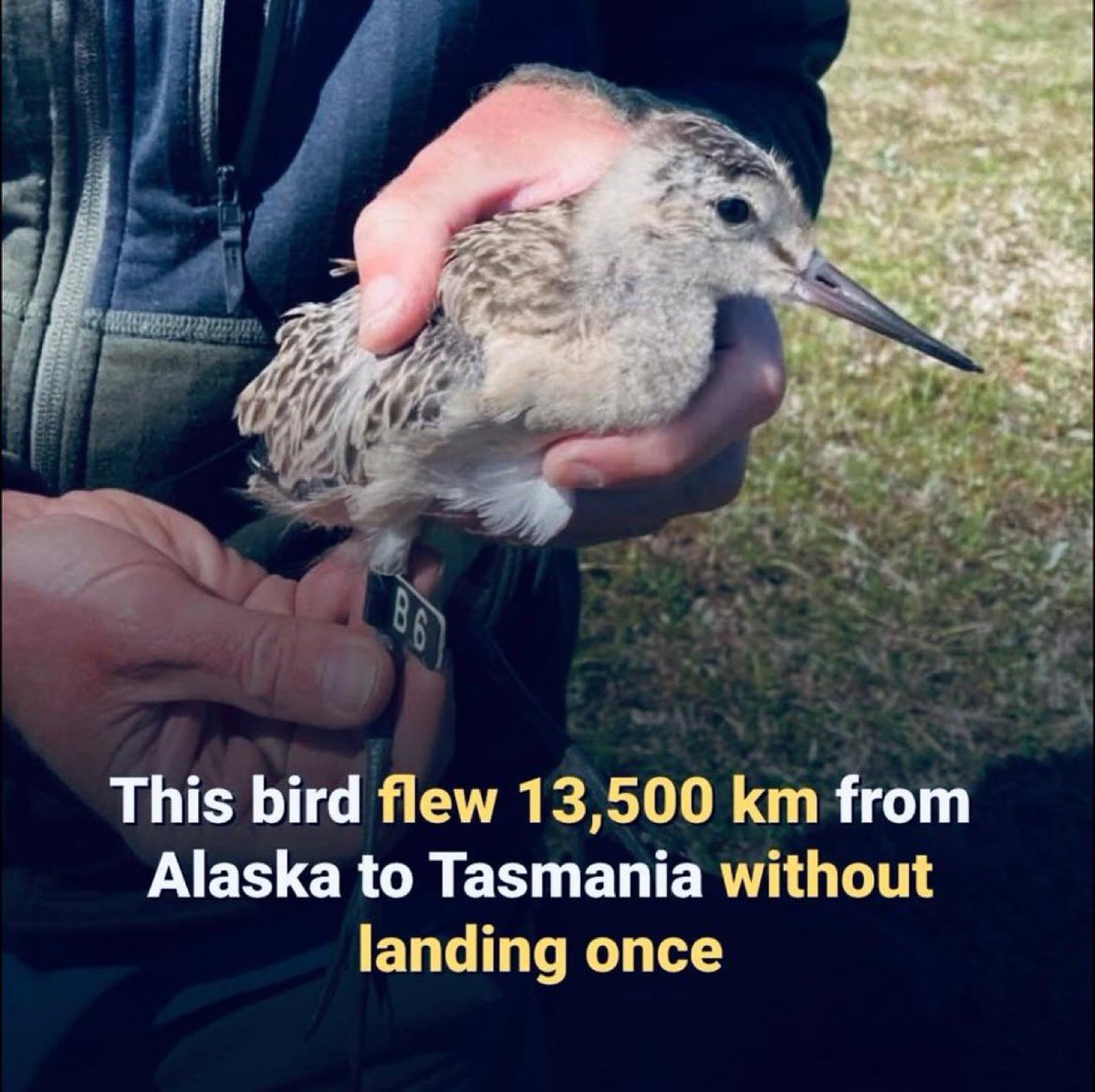
🚨 JUST IN: A migratory bird just shattered world records — flying 8,425 miles (13,560 km) NON-STOP across the Pacific without landing once.
The bar-tailed godwit doesn’t stop to eat, drink, or sleep during its migration across the Pacific Ocean. Its journey from Alaska to Australia takes roughly 11 days of continuous flight, covering over 13,000 kilometers through storms, headwinds, and open ocean with zero land beneath it the entire time.
Before departure, it does something almost surgical to its own body. It shrinks its digestive organs down to almost nothing, converting the stomach, intestines, and liver into raw fuel. The bird essentially eats its own gut to make room for fat reserves that will power its wings for nearly two weeks straight.
The brain doesn’t fully sleep either. Half of it stays active while the other half rests, alternating in shifts mid-flight at altitude over the open Pacific. The godwit is simultaneously unconscious and navigating with magnetic field sensitivity that no human instrument in the 18th century could replicate.
What makes this genuinely staggering beyond the physical record is the navigational precision involved. The bird leaves Alaska and arrives in New Zealand with accuracy that would embarrass early GPS systems. It reads Earth’s magnetic field, atmospheric pressure gradients, star positions, and potentially quantum-level compass mechanisms inside its eye that literally let it see magnetic field lines overlaid on its visual field.
Evolution spent millions of years building an aerospace navigation system inside a 300 gram animal.
We spend billions engineering machines that do what this bird does on instinct, fat reserves, and half a sleeping brain.
The longest recorded non-stop flight by a commercial aircraft is around 20 hours.
This bird does 11 days.
Without a runway.
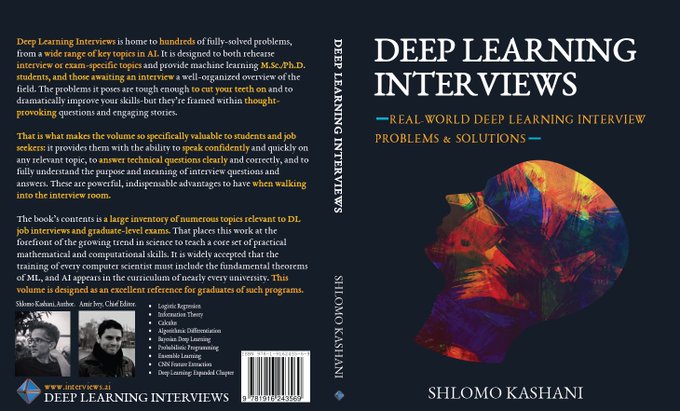
This book alone can change your ML interview game
If you're serious about AI, ML, or landing top-tier roles... this book is DIFFERENT.
This isn’t basic theory.
This is the kind of prep that makes you walk into interviews confident.
How to get it :
1️⃣ Follow me @daievolutionhub (So i can dm you)
3️⃣ Repost and Comment “DL”
If you’re preparing for ML interviews in 2026, this could literally change your trajectory.
This book alone can change your ML interview game
If you're serious about AI, ML, or landing top-tier roles... this book is DIFFERENT.
This isn’t basic theory.
This is the kind of prep that makes you walk into interviews confident.
How to get it :
1️⃣ Follow me @daievolutionhub (So i can dm you)
3️⃣ Repost and Comment “DL”
If you’re preparing for ML interviews in 2026, this could literally change your trajectory.