Sharing our ambition to get to net zero. We already have $500 million invested in climate solutions & $600 million with managers using #ESG. Grateful to @allen_tonya & @McKnightFdn Board & @KateWolford for their leadership.
Today we are committing to achieving net zero emissions across our $3 billion endowment by 2050 at the latest. To get there, we will boldly accelerate our work to reduce emissions in our portfolio and make new investments to build a carbon-free economy. https://t.co/BlN2y8TpNC
Seeking qualified manufacturers of heat pump equipment to partner on the development of a new Heat Pump Access Program with @rewiringamerica. Please spread the word. RFP closes Oct 11! https://t.co/WV6iPDL6bM
Journalist briefly nods to fact that women of color and their pain is ignored far more than the mostly white women at @YaleFertility@Yale Additional commentary and data on racial inequity would make it stronger — particularly during the Sentencing episode.
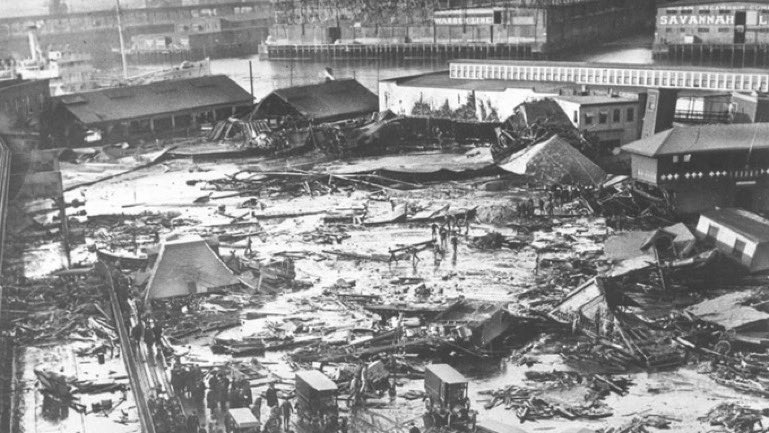
In 1919, a massive molasses tank in Boston burst and unleashed a deadly wave of sticky syrup that flooded the streets, crushing buildings and killing 21 people. The disaster, known as the Great Molasses Flood, was caused by a combination of poor construction, high temperature, and fermentation.
The molasses was used to make rum and other products, and was stored in a 50-foot tall tank that could hold 2.3 million gallons. On January 15th, the tank suddenly exploded, sending a wall of molasses up to 15 feet high and 160 feet wide, traveling at 35 miles per hour.
The molasses engulfed everything in its path, trapping people, horses, cars, and debris. Some people drowned or suffocated in the sticky substance, while others were crushed by the force of the wave or the wreckage. The rescue efforts were hampered by the viscous and sticky nature of the molasses, which made it hard to move or breathe.
It took four days to recover all the bodies, and weeks to clean up the mess. The cause of the explosion was never conclusively determined, but it was likely due to a faulty weld in the tank that failed under pressure.
highly recommend. @samsanders and @tressiemcphd should turn this one conversation on country music, race, demographics, Nashville and great music into a series. https://t.co/i0jF2MMOIq
@rgunns For sure, it’s one of greatest weaknesses in our ability to fight climate change. I have the honor of working with an amazing climate leader @allen_tonya
Maine is pumped about heat pumps! The Pine Tree State met their goal of installing 100,000 new heat pumps two years ahead of schedule. Now, they’re aiming to install 175,000 more by 2027. So yes, they work in cold weather. https://t.co/wlXbBfA6kU
Maine is pumped about heat pumps! The Pine Tree State met their goal of installing 100,000 new heat pumps two years ahead of schedule. Now, they’re aiming to install 175,000 more by 2027. So yes, they work in cold weather. https://t.co/wlXbBfA6kU
Exciting News! MEDA is collaborating with the MN Alumni Market! Any University of Minnesota Alumni, who are utilizing MEDA’s services, can now enjoy the added benefit of having their MN Alumni Market fees graciously covered by MEDA.
Mornin’ folks.
We’ve had a lot of people enquiring about and commenting on #bumblebees asleep on #flowers, especially at this time of year, so here’s a quick (long)🙄 thread explaining what’s going on.
Please retweet so more are more informed.
Thanks good people.
#bees
1/16
Many years ago, back when you had to go to SEC to see no action letters, I came across a shareholder proposal filed at Mattel that called for the company to may Barbie versions that reflected realistic/average measurements. It was out on ordinary business.
Congratulations to Joel Krogstad who will now lead the McKnight Endowment Fund for Neuroscience as its next program manager! 🧠🙌
He started July 10, working closely with Eileen Maler as she prepares for her retirement.
Learn more: https://t.co/ZIxFuaeXfT