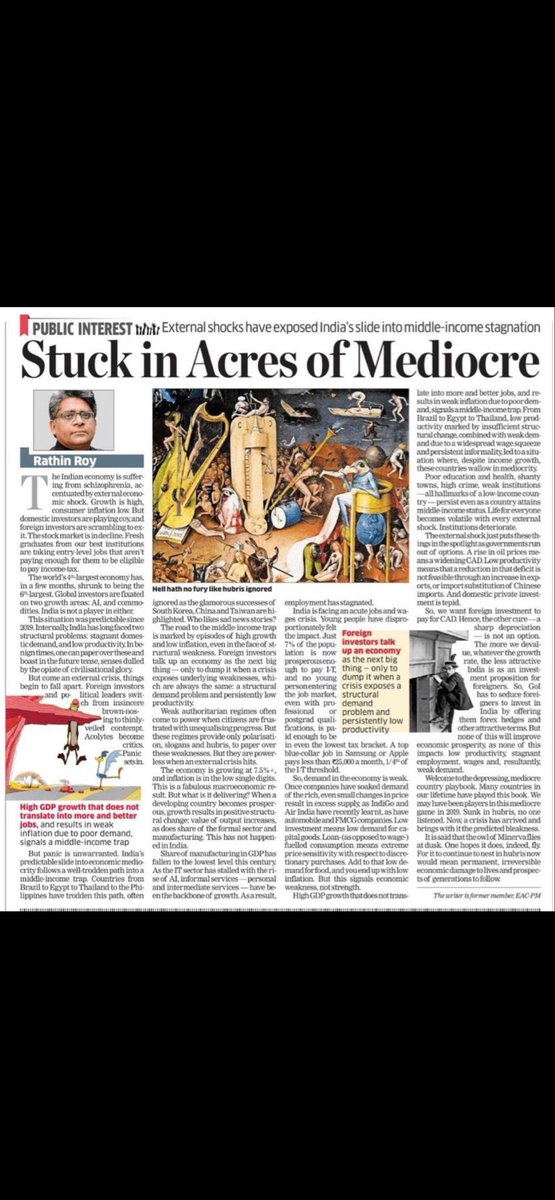
It is common in India’s centuries old decadent political culture that those who flag danger are ignored and reviled
As Dhananant did to Chanakya
As Mohammed Shah Rangila’s court, in decadent hubris, when warned of Nadir Shah
So it is with Modi Shah Rangila’s court
History repeats
Impeccable analysis BUT
IF only when I was a lone voice in 2019
-SOME of these worthies had spoken up
maybe we would not be in this pathetic situation
We lack smart people with courage who see things in advance and are typically correct
Hope GenX can reproduce my ilk
good luck
Anthropic CEO Dario Amodei stated in a Bloomberg interview that the India AI Summit was "extremely disorganised".
About the chaos on stage: "There was Narendra Modi up there suddenly telling everyone to hold hands..." (collapses with laughter).
India Should Discourage Excessive Investments in Stocks and Equity Mutual Funds
My column @91basispoints
India’s stock market boom has a hidden cost.
As retail investors have poured money into stocks and SIPs, foreign investors – especially VCs and private equity firms – have been cashing out of loss-making startups at eye-watering valuations and taking those gains back home.
That means more demand for dollars, more pressure on the rupee, and wider economic consequences.
This explains why FDI repatriation has gone up dramatically in the last few years. And so has selling by the FIIs.
Thus, excess money being invested into stocks and equity MFs needs to be disincentivised.
One way is to tax all kinds of income at the same rate.
Capital gains from the sale of shares or equity mutual funds should be taxed at the same rate as gains from debt mutual funds, interest earned on fixed and other deposits, or gains made from selling gold and real estate.
This will create a level playing field across asset classes and ensure that tax considerations do not disproportionately influence investment choices.
Of course, saying that India should discourage excessive investment in stocks and equity mutual funds is a great way to become unpopular.
In a country where every market correction is a "buying opportunity" and every IPO is "wealth creation", this may sound like heresy.
But if buying gold can be portrayed as unpatriotic because it hurts the rupee, perhaps buying IPOs and investing in SIPs without restraint deserves a similar hard look.
And I say this as someone who has largely been an SIP investor for more than 20 years.
(Let the abuse begin.)
https://t.co/zdYRFF44Dl
I have also read several of Tavleen Singh’s columns in @IndianExpress, and it feels less like pure political disillusionment with the Gandhi family and more like a deep personal animosity she seems to carry toward the dynasty. I now tend to skip her columns, as the tone often feels unnecessarily harsh, deeply biased, and irrational. It’s one thing to critique dynastic politics, but another to repeatedly slip into personal attacks.
To understand her perspective, one can also read her book Durbar, where she comes down heavily on the Gandhi family. The book reflects the mindset of someone who was once inside the same social and political circles as Rajiv and Sonia Gandhi, but later grew deeply disillusioned with what she saw as an insulated, entitled political world surrounded by loyalists. Much of Durbar reads as an attempt to process that break.
At the same time, parts of her writing, especially on Sonia Gandhi, carry a personal edge that makes it feel less like detached political history and more like an account shaped by long-standing resentment. She criticises how Rajiv Gandhi surrounded himself with Delhi’s elite and inexperienced advisers, which in her view weakened governance and shaped a culture of favouritism at the top. She may have a point, but she also suggests she was once close to Sonia Gandhi before they drifted apart, which adds a personal layer to the narrative.
Put together, the impression is of a journalist whose political critique is tightly interwoven with personal history, making the writing feel more emotionally charged than neutral analysis.
I won’t say it’s a bad book. I used to like her writings; in fact, I read her columns in India Today magazine during my formative years. But now that I believe her views are strongly shaped by a long-standing conflict with Sonia Gandhi, I feel the book, like her columns and social media posts, carries less objectivity and more personal interpretation.
Doctor refuses to double her Practo subscription. Practo quietly downgrades her profile from Endocrinologist to MBBS general physician. Patients start calling to question her credentials.
Wild. #Doctors
Either RSS falls in line with the law like every other organisation, or the government must immediately lift the ban on ALL NGOs receiving overseas aid.
No one is above the law. Period.
“Priyank Kharge has rightly hit back at RSS chief Mohan Bhagwat, exposing the core contradiction: An organisation that claims to have ‘no political agenda’ while openly functioning as the BJP’s ideological parent cannot escape public accountability.
RSS runs a vast ecosystem of 2500+ affiliates, controls massive influence, enjoys taxpayer-funded security, yet dodges transparency.
Read full story: https://t.co/zGoQsg5fUm
#NoOneAboveLaw #RSSAccountability”
Brilliant! @EmergingRoy Rathin Roy removes the fig leaf.
If only the government of India had heeded his sage counsel earlier.
This is our fate. https://t.co/VqJ44MqzgI
‘Why should a Dalit person be concerned with RSS?’, asks Karnataka BJP MP, warns Home Minister @PriyankKharge against taking on the RSS.
https://t.co/gZ5vUmmXOu
Hyderabad Outer Ring Road expressway 120 kph speed limit
Telangana has 4 times the per capita income of Bihar
But savagery along with caste keeps India united
@HYDTP@SajjanarVC_IPS@revanth_anumula will not see anything wrong with such behaviour so relax
Question for RSS @RSSorg
If the Ramakrishna Mission could be successfully registered under the Societies Registration Act, 1860, why can’t the RSS do the same?
The Ramakrishna Mission was founded by Swami Vivekananda on 1 May 1897. It was officially registered on 4 May 1909 under the Societies Registration Act, XXI of 1860. This formal registration gave the Mission a clear legal identity to carry out its charitable, educational, and philanthropic activities across the country.