Kavuma J✍️Driver on the Main road has “right of way” compared to a driver trying to enter the main road✍️Driver coming onto the main road is expected to exercise a High degree of care while coming onto the road✍️The law will not give allowance to inexperienced or learner drivers
Case Alert:🔔
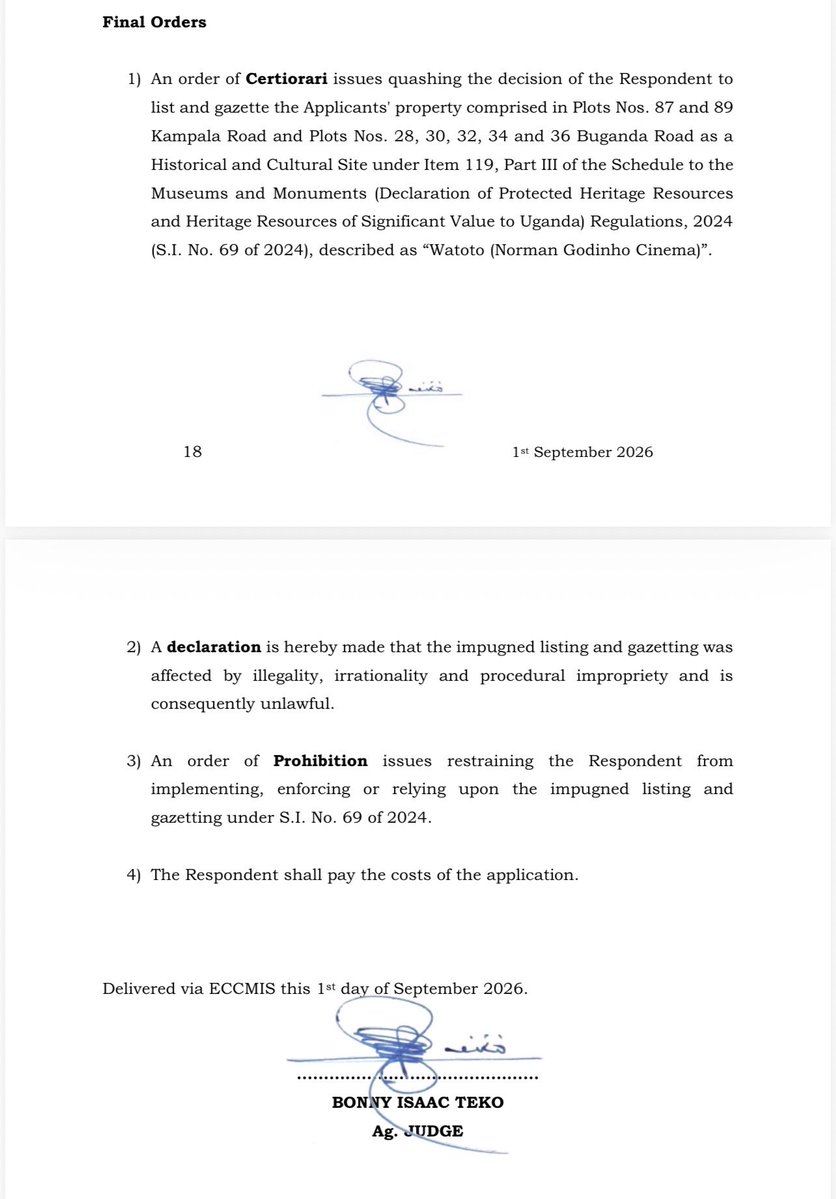
The High Court has granted our client’s application for judicial review, quashing the decision of the Ministry responsible for Tourism, Wildlife and Antiquities to list and gazette Watoto Church’s Building (Watoto Downtown) as a historical and cultural site.
Justice ssemogerere, strikes out an Appeal due to want of prosecution ✍️Court does not have jurisdiction to entertain complaints against other judicial officers, ✍️An inaction to prosecute a case entitles the respondent to award of costs in the discretion of court under Section 27 of the Civil Procedure Act, Cap 282
Legal Representation:
Respondent: Ms. Rebekah Ayesiga.
Case link: https://t.co/eBE0NoNyfY CC @JSCUganda
Court of Appeal sets aside sentence where a trial Judge accepted the plea bargain agreement but sentenced the Appellant to 25 years' imprisonment✍️trial Judge did not reject the plea bargain agreement in accordance with Rule 13✍️Having accepted the agreement, the court was bound by the sentencing limits stipulated therein✍️Sentence of 25 years' imprisonment imposed upon the Appellant, instead of the agreed 12years, was contrary to the Plea Bargaining Rules and consequently illegal
case link: https://t.co/w6MQojVCAz
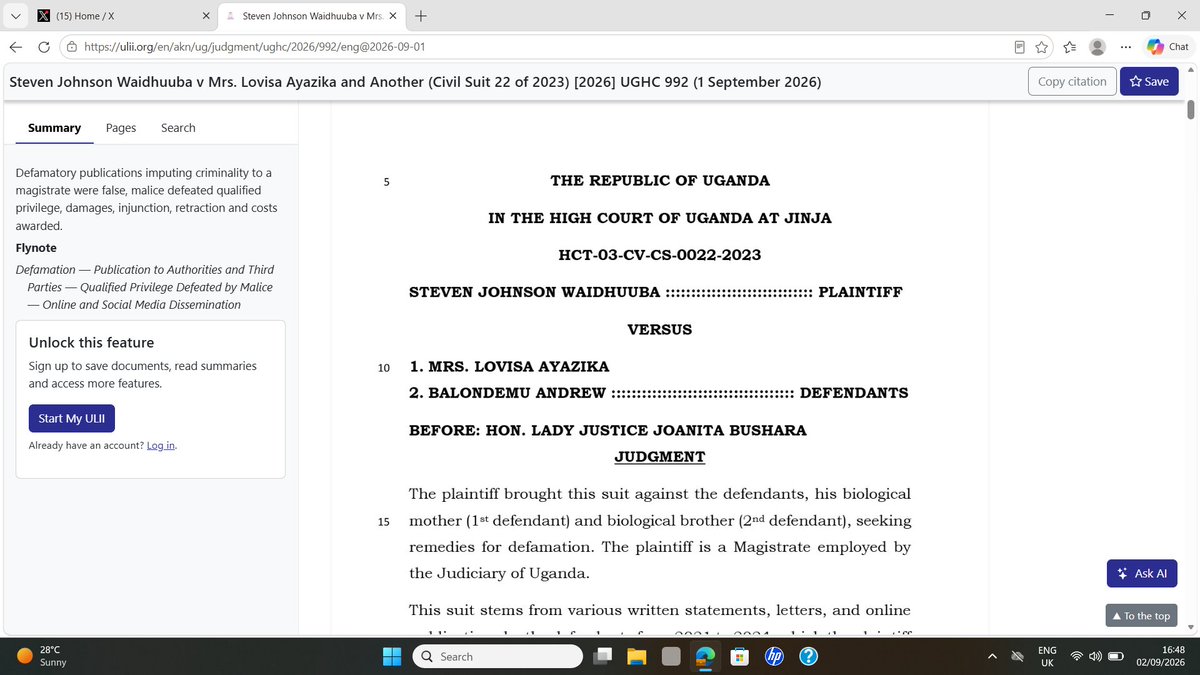
YOU CAN SUE YOUR OWN FAMILY FOR DEFAMATION.
The High Court in Jinja presided by Her Lordship Joanita Bushara has found that Magistrate Steven Johnson Waidhuuba was defamed by his own biological mother and brother.
The Court found that the statements, letters and publications made against the Magistrate were false and defamatory and awarded him UGX 20 million in general damages, with interest at 6% from the date of judgment until payment in full.
The Court further issued a permanent injunction restraining the defendants from republishing the defamatory allegations and ordered them to issue a written retraction and apology.
A significant judgment affirming that even family members cannot use false and defamatory allegations to destroy a person's reputation and professional integrity.
In Tifu Lukwago vs. Samwiri Mudde Kizza & Another; SCCA No.13 of 1996 (March 26, 1998) Mulenga, JSC held that documents if written in any other language must be translated into English before they are exhibited in court.
Makerere University offers official translation services.
In Simbamanyo Estates Ltd v Equity Bank & Ors, the Court provided important guidance on foreign lending, syndicated loans, Standby Letters of Credit and enforcement of security.
https://t.co/UXdXr0jYUe
Mohammed Alibhai v Salim Mohamedali and Others (Consolidated Company Petitions Nos. 89521 / 03429 of 2026) [2026] UGRSB 44 (1 September 2026)
Registrar found he was precluded by Regulation 4(1) from hearing the petition because the same substantive dispute was pending in the High Court, and dismissed the petition
👉:https://t.co/Fz9157VmbY
Shumuk Aluminium Industries Ltd and Mukesh Shukla v Bank of Baroda (Uganda) Limited (Miscellaneous Application No. 1322 of 2026) [2026] UGCommC 463 (28 August 2026)
Court dismissed Shumuk Aluminium Industries Ltd and Mukesh Shukla’s application for a stay of execution of its June 2, 2026 judgment in HCCS No. 138 of 2019 and ordered the applicants to pay costs to Bank of Baroda (Uganda) Ltd
👉:https://t.co/KE2o9kqn7b
Medequip Uganda Ltd v Paramount Hospital Kampala Ltd (Civil Suit 130 of 2021) [2026] UGHCCD 275 (31 August 2026)
Court found Paramount breached a November 2019 contract for a Fuji CR X‑ray system and ordered Paramount to pay Medequip UGX 42,018,000 special damages, UGX 6,000,000 general damages, interest (20% p.a. on special damages from filing; 6% p.a. on general damages from judgment) and costs
👉:https://t.co/eYgNrpRgRn
DO YOU HAVE A COURT CASE AGAINST A BANK WHICH RESCINDED YOUR LOAN OFFER?
Equity Bank has lost a court battle to Gombe Educational Services over loan facility.
The High Court has found that Equity Bank breached a Loan Facility Agreement by failing to avail the agreed facility and subsequently rescinding the agreement.
The Court awarded the Plaintiff UGX 233,748,000 in special damages, UGX 80 million in general damages, interest and costs.
The judgment also provides an important lesson on force majeure: COVID-19 does not automatically excuse contractual non-performance; the party relying on it must prove that the event actually prevented performance.
Gombe Educational Services Limited v Equity Bank (U) Ltd (Civil Suit No. 101 of 2022) [2026] UGCommC 464 (27 August 2026)
Court found Equity Bank in breach of a Loan Facility Agreement worth UGX 17,800,000,000 and ordered it to pay UGX 233,748,000 in fees and damages, plus interest and costs
👉:https://t.co/6Wxl0WV8Up
Osborn Turyasigura v Attorney General (Miscellaneous Cause 98 of 2026) [2026] UGHCCD 274 (27 August 2026)
Court quashed the Minister of Gender’s 1 April 2026 termination of Osborn Turyasigura for alleged forged academic documents, finding the decision illegal and procedurally improper for failing to afford him a fair hearing, ordered the Ministry to follow proper procedure, denied general/punitive damages, and directed each party to bear its own costs.
👉:https://t.co/7rWdGbXx9k
Supreme Court ✍️we do not have a civil procedure regime that conducts bifurcated trials, our judgments are dichotomic in how they delineate the question of ancillary reliefs from the main suit✍️Consolidation is inappropriate and unfairly disadvantages a party where they are forced to defend a case to which they were not initially a party✍️The authority to consolidate suits is discretionary and must be exercised judiciously, guided by established principles and with due regard to the interests of justice
Legal representation:
Appellant: Mr Peter Allan Musoke.
Respondent: Mr Peter Kimanje Nsibambi and Mr Moses Wandera.
Case link:https://t.co/idwNvCdDSi
Social media law
This decision sends a strong message concerning the consequences of persisting with allegedly defamatory publications after being placed on notice.
In appropriate circumstances, continued publication, absence of retraction and failure to apologize may not only increase compensatory damages but may also justify exemplary damages, injunctive relief and an order for public retraction and apology.
High Court Holds Social Media User Liable for Defamatory Publications, Awards UGX 60 Million in Damages, and Orders Public Retraction and Apology
The Court held that the publications falsely portrayed the Plaintiff as a rapist, a habitual abuser of women and a person of immoral character. The Court found that the Plaintiff had proved the essential ingredients of the tort of defamation on a balance of probabilities and that the Defendant had failed to establish any lawful defence to the publications.
Read more
https://t.co/n4HhuplKgO
Supreme court Reaffirms✍️ It is established that the prosecution has the fundamental duty to call all material witnesses necessary to uncover the truth of the offence, ✍️failure to produce a necessary witness without adequate explanation entitles the court to draw an adverse inference that the evidence of such a witness would have been unfavourable to the prosecution
✍️failure to tender or produce the material witness statement attracts an adverse inference , creates a material gap in the prosecution's case, and requires resolving the benefit of doubt in favour of the appellant.
Legal Representation:
Appellant: learned counsel Mr. Walugembe Dauda
Respondent: learned Principal State Attorney Ms. Caroline Nabaasa
Case link: https://t.co/CE0lMottll
A good one for those interested in understanding about estate administration.
Here, the Defendants went as far as asking the Court to invoke Section 98 of the Civil Procedure Act, which gives the Court’s inherent powers to make such orders as may be necessary to meet the ends of justice or prevent abuse of the process of the court.
For this particular matter, the defendants relied on this provision to defend the impugned grant, arguing that it had not been obtained merely by consent, but through a Notice of Motion supported by an affidavit under Section 98, and that the Court’s inherent jurisdiction could therefore sustain the appointment of the new administrators despite the circumstances in which the original executors had been replaced.
The Court, however, made it clear that the inherent powers of court could not be used to override substantive succession law, emphasising that while civil procedure governs how succession disputes may be litigated, procedural powers cannot be used to defeat or circumvent the requirements of the Succession Act.
According to the Court, revocation applies to an active grant, while annulment applies to a grant that has lapsed. The Court therefore held that once “just cause” is established under Section 230(2), particularly where the proceedings through which the grant was obtained were defective in substance, the Court has only the statutory options of revoking or annulling the grant. In other words, the Court cannot simply allow a defective grant to stand once the statutory threshold for revocation or annulment has been established.




![Uganda_LII's tweet photo. Mohammed Alibhai v Salim Mohamedali and Others (Consolidated Company Petitions Nos. 89521 / 03429 of 2026) [2026] UGRSB 44 (1 September 2026)
Registrar found he was precluded by Regulation 4(1) from hearing the petition because the same substantive dispute was pending in the High Court, and dismissed the petition
👉:https://t.co/Fz9157VmbY](https://pbs.twimg.com/media/HRHrQNKW8AA6xOl.jpg)
![Uganda_LII's tweet photo. Shumuk Aluminium Industries Ltd and Mukesh Shukla v Bank of Baroda (Uganda) Limited (Miscellaneous Application No. 1322 of 2026) [2026] UGCommC 463 (28 August 2026)
Court dismissed Shumuk Aluminium Industries Ltd and Mukesh Shukla’s application for a stay of execution of its June 2, 2026 judgment in HCCS No. 138 of 2019 and ordered the applicants to pay costs to Bank of Baroda (Uganda) Ltd
👉:https://t.co/KE2o9kqn7b](https://pbs.twimg.com/media/HRE7vbJWQAEiW2L.jpg)
![Uganda_LII's tweet photo. Medequip Uganda Ltd v Paramount Hospital Kampala Ltd (Civil Suit 130 of 2021) [2026] UGHCCD 275 (31 August 2026)
Court found Paramount breached a November 2019 contract for a Fuji CR X‑ray system and ordered Paramount to pay Medequip UGX 42,018,000 special damages, UGX 6,000,000 general damages, interest (20% p.a. on special damages from filing; 6% p.a. on general damages from judgment) and costs
👉:https://t.co/eYgNrpRgRn](https://pbs.twimg.com/media/HREkNsRXQAAkx11.jpg)

![Uganda_LII's tweet photo. Gombe Educational Services Limited v Equity Bank (U) Ltd (Civil Suit No. 101 of 2022) [2026] UGCommC 464 (27 August 2026)
Court found Equity Bank in breach of a Loan Facility Agreement worth UGX 17,800,000,000 and ordered it to pay UGX 233,748,000 in fees and damages, plus interest and costs
👉:https://t.co/6Wxl0WV8Up](https://pbs.twimg.com/media/HRDYOp5W4AAQrJO.jpg)
![Uganda_LII's tweet photo. Osborn Turyasigura v Attorney General (Miscellaneous Cause 98 of 2026) [2026] UGHCCD 274 (27 August 2026)
Court quashed the Minister of Gender’s 1 April 2026 termination of Osborn Turyasigura for alleged forged academic documents, finding the decision illegal and procedurally improper for failing to afford him a fair hearing, ordered the Ministry to follow proper procedure, denied general/punitive damages, and directed each party to bear its own costs.
👉:https://t.co/7rWdGbXx9k](https://pbs.twimg.com/media/HRDa5LaWkAANSD0.jpg)


