A woman wanting a domestic abuse refuge without males present is not hateful.
A woman expecting a rape crisis centre without males present is not a bigot.
A woman wanting intimate care from a female, not a male, is not a Nazi.
A woman wanting female-only changing rooms without males present is not intolerant.
A woman wanting female sport to be for females, not males, is not extremist.
A woman believing that sex matters is not dangerous.
Stop demonising ordinary women for asking for boundaries that have existed for generations.
Rayner's £182,000 Masterclass In Hypocrisy
Angela Rayner spent years telling the country that MPs' second jobs were a racket. In March 2023 she wrote that being an MP "isn't a second job. It is the job." Labour, she promised, would put an end to the practice. Eighteen months later she resigned from Cabinet in disgrace over her own financial affairs. Within a year she had earned £182,376 from speeches, book advances and a severance payment she had no obligation to keep. Then she walked straight back into the job she had left.
The figures are not subtle. She earned £104,000 from speaking fees in ten months, on top of an MP's salary that rose to £98,599 in April. She took £61,500 as a book advance for a memoir about her own life. She kept a £16,876 exit payment while Wes Streeting, reappointed to Cabinet the same week, is serving his first three months for nothing.
One fee stands apart from the rest. Propertymark, a trade body representing the property sector, paid Rayner £20,000 for a two-hour speaking engagement. That is £10,000 an hour, from an industry lobby group, paid to a former Housing Secretary weeks before she was reappointed Housing Secretary. Nobody pays that rate for after-dinner charm. They pay it for access, and they got exactly what they paid for. This is not a speaking fee. It is a retainer with a lectern attached.
The woman collecting these cheques left the department with a housebuilding record to be ashamed of. Official figures published by the Ministry of Housing in November show England delivered 208,600 net additional dwellings in 2024-25, a fall of 6 per cent on the year before. New build completions dropped from 198,610 to 190,600. Labour's manifesto promised 1.5 million homes over the Parliament, a rate of 300,000 a year. Rayner delivered barely two-thirds of that. Housebuilding did not accelerate under her stewardship. It slowed.
She has an answer ready for all of it. The severance payment was earned, she told BBC Radio 5 Live, because she had genuinely left government for a period of time. That defence collapses under its own logic. The payment exists to cushion ministers against sudden unemployment. Rayner was not unemployed. She was the best-paid backbencher in Britain, drawing more from four speeches than most of her constituents earn in three years.
Joanna Marchong of the think tank Onward put it plainly: Rayner built her brand attacking Tory sleaze and demanding a ban on MPs' outside earnings, then pocketed £180,000 the moment the rules stopped applying to her. Lee Anderson called her year out a good little earner. Both are right, and neither goes far enough. The deeper failure sits in the housing numbers, where the gap between rhetoric and delivery is measured not in pounds but in homes that were never built.
Labour came to power promising a government that would look different from what came before it. Rayner's year off shows how quickly that promise curdles into the same old story: rules for the public, exemptions for the powerful, and a lobby group's cheque book standing in for genuine accountability. She missed her housing target by a third and was rewarded with reappointment. She broke her own stated principle on second jobs and was rewarded with £182,376. The voters who elected this government on a promise of change deserve to know that the change stopped at the Cabinet door.
"Rayner's year off shows how quickly that promise curdles into the same old story: rules for the public, exemptions for the powerful"
“You’re only alive because I allowed you to live…”
Jessica Cook.
Same trans National Socialist who threatened me last year…
@gmpolice This is the man who I spoke to you about. I’d be grateful if you’d take this seriously.
Probably worth bearing in mind that other religions are available, whose views on homosexuality remain far more worrisome than anything she believed.
She had many gay friends, who didn’t necessarily agree with her on everything, but were intelligent enough to understand that mild disapproval, due to her religious convictions, was NOT a barrier to years of friendship, laughter & mutual admiration.
Lisa Nandy told her staff that Julia and I had edited this film of her saying child rapists should be able to choose to go to a women’s prison. That’s not just misinformation, it’s a lie https://t.co/Bkv2fLj7Mh
You mean men, men who claim to be women. You are a national broadcaster that consistently obfuscates facts around sex because you’ve taken an ideological position the public overwhelmingly rejects. This isn’t news, it’s propaganda.
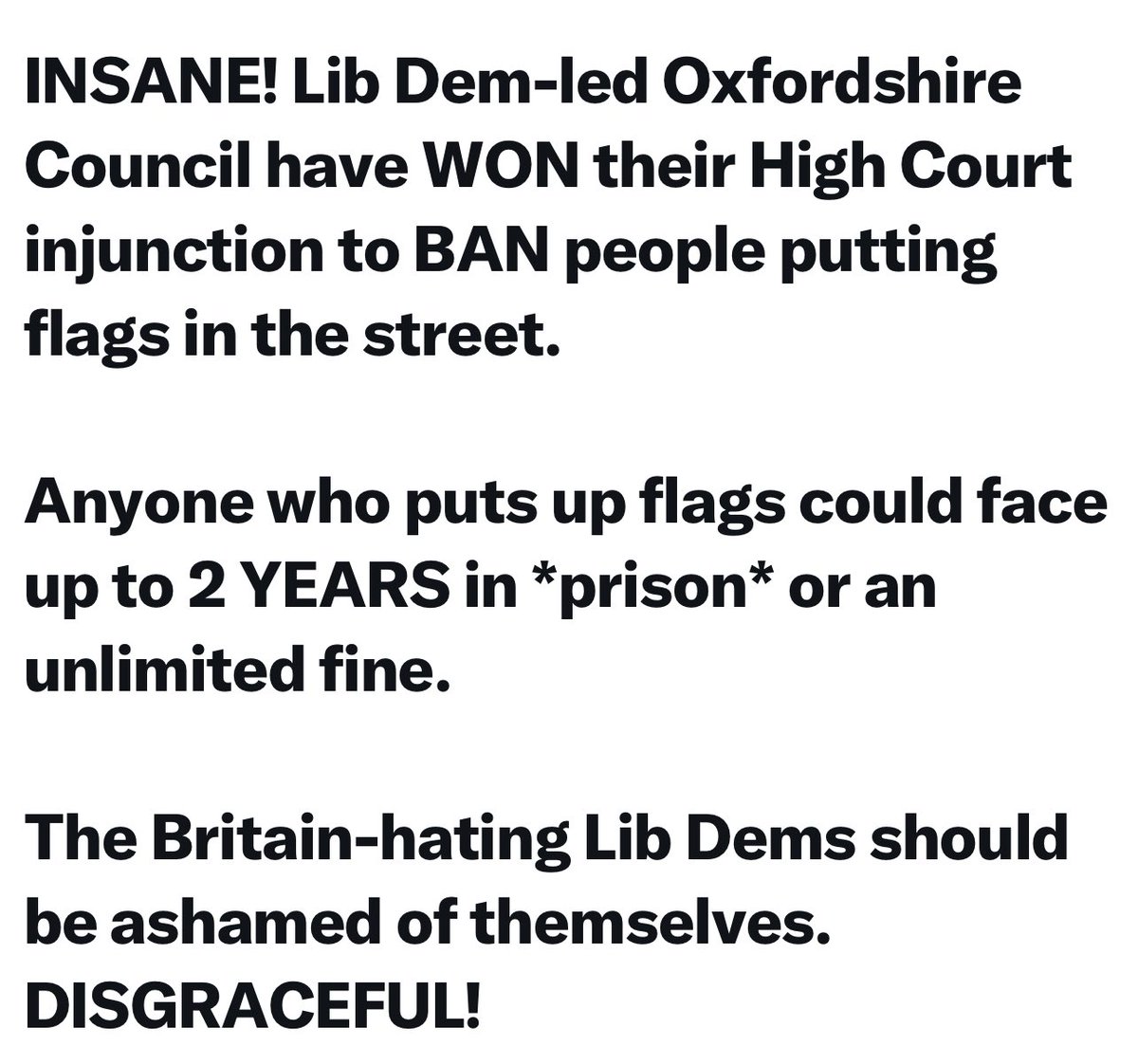
We are in a very dark place. The football World Cup is on & this council has spent tax payers money going to court to make it illegal to fly Our flag on Our streets.
Dear Lush (cc Chelmsford City Council),
As a woman who had half a breast removed last year due to cancer, I am writing to raise my concerns about your “Proud of My Stripes” window display.
I am also, on behalf of other women who have experienced breast cancer, respectfully requesting its removal.
Because mastectomies are not a fashion statement, an identity marker or something to be celebrated.
They are something women undergo because they are ill, because they are frightened, because they are trying to stay alive.
Around 59,000 women are diagnosed with breast cancer in the UK every year. Many will undergo surgery - a mastectomy, lumpectomy or other procedure.
Others choose preventive mastectomies because they carry a high-risk BRCA gene mutation.
If a woman chooses to have her breasts removed to affirm a gender identity, that is her personal choice.
I honestly don’t know the number of women who have elective mastectomies for this reason.
What I do know is that it is a tiny number compared with those for whom breast surgery is medically necessary and not something to be celebrated.
I think I speak for many women who have experienced breast cancer - and for their families - when I say this:
Breast removal surgery is not something I regard as cute, playful or empowering.
Nor is it something I believe retailers should be celebrating.
For that reason, I am requesting that the display be removed and that @ChelmsCouncil apologise for promoting it on social media.
Yours sincerely,
Janet Murray
"Men in dresses won't hurt you. Stop being a bigot and strip down in the change room while they're there. They have a right to look at you. If you have a problem with that, that's your problem. Stop being a fear monger. Shut up and accept it! Nazi!"
Of course women don’t confront men in female-only spaces. The man’s presence is the confrontation. Most women are sensible enough not to pick a fight with a man who has just demonstrated his contempt for their boundaries.
I challenge every single person who believes minors should be enabled and even encouraged to transition to read this first person testimony to the end.
1/3
via @IWF https://t.co/3276o4tg8J
Being biologically female means having a body that is observably organised to produce large gametes (eggs), as opposed to a body organised to produce small gametes (sperm). A woman is female whether her eggs have been fertilised or not. A man can never be female.
Apparently Andy Burnham thinks women started a culture war for wanting back what was taken away from us, against our wishes, without our permission … privacy, dignity, sport, all rights enshrined in law, & reality! But hey…How very dare we..
My thoughts on the @EHRC guidance laid yesterday; this is not about non-existent "rights". It is about the safety of women - mothers, sisters, wives, daughters. We men need to hear their voices. Virginia Woolf : "Though we see the same world, we see it through different eyes".
My intro on @TimesRadio yesterday:
Where I live there are two different routes to and from the tube station. One, let’s call it Acacia Avenue, is quiet and residential. The other, London Road, is a busy major route with lots of traffic. At all times of the day, I automatically head for Acacia Road. It’s just much nicer.
The women in my family, on the other hand, will never willingly make that walk after dark. They live with an anxiety that most men find it hard to imagine, and frankly, rarely think about unprompted.
Last year 739,000 women were sexually assaulted in Britain. Virtually all such assaults - nine out of ten - are perpetrated by men. One in four women have been attacked at some time in their lives. Acacia Avenue is exactly the sort of place in which most women fear that they become vulnerable, and they are right.
As the author Virginia Woolf once wrote " Though we see the same world, we see it through different eyes".
I think this is the right context in which to understand the furore over the guidance being laid today by the government, over the meaning of the words man and woman when it comes to providing services and facilities in workplaces.
Many men think this is about a rather arcane dispute about who gets to use what loo. For their mothers, sisters, wives and daughters, it isn’t.
In a previous life, as Chair of the Equality and Human Rights Commission, I had a hand in writing this country’s equality laws, in particular the 2010 Equality Act. It never occurred to any of us that there could be any confusion or dispute over the meaning of the words man and woman. But it has taken a decade of campaigning, a Supreme Court judgement and now hundreds of pages of guidance to settle the issue.
This is not about so called trans rights, which are completely unaffected by this guidance, since no-one has ever had the right to walk into a changing room reserved for teenage girls.
What it does mean is that women and girls are guaranteed the protection they deserve, and that their safety, which we spent half a decade drafting law to ensure, is protected.
But the whole business illuminates some serious issues in our politics.
First that many of our institutions, in spite of the fact that they always knew what the right thing to do was, decided to ignore the fears of their women customers and employees, under pressure from noisy pressure groups. Instead, the people who were supposed to be the grown ups behaved as though the law said what campaigners wanted it to say, rather than what it actually said. They settled for what they hoped would be a quiet life.
In a democracy, there’s little point in Parliament deciding anything if the law is then made an ass by activists intimidating bosses in companies, schools, universities and the media into doing something different.
Second, at the heart of the campaign to undermine the Equality Act is an idea that we specifically rejected in 2010, so called self-identification. That is to say, that it should be up to the individual to decide whether they have what’s called a protected characteristic - are you male or female, are you black or white. The problem is that self-ID would destroy the operation of any law against discrimination.
Look, it would almost certainly have been to my advantage as a young man to self-identify as a handsome, white public schoolboy. None of those things is true of me. And at various points I am pretty sure it’s been to my disadvantage. It is certainly statistically likely to have been to my disadvantage.
But according to the logic of those who say that self-ID should be the rule and that anyone should be able to decide for themselves whether they are male or female, black or white or Asian, were I to complain about racial discrimination, it would be difficult for anyone prove that I’d been discriminated against because of my race since anybody to whom I’d lost out could just tell the courts that they too were black.
I know that sounds like Alice in Wonderland but you can google the case where a chap, both of whose parents are white, insisted he should get money from the Arts Council because he so identified with the black struggle that he considered himself black, and everyone should accept his point of view. In the United States and Brazil exactly such outlandish claims have been made and people rewarded to the disadvantage of people actually born into minority families.
I have even been told about firms who, when reporting their gender pay gaps have put men who just happen to like wearing dresses at weekends - nothing wrong with that, let me be clear - into the female column and told their women employees that they really haven’t got anything to moan about because statistically they are paid equally, and they should get back in their box.
So today’s guidance isn’t just another tiresome chapter in culture wars. It is , I hope, a halt to the efforts to undermine one of the most important pieces of legislation on the statute book, by people who, for their own reasons, would prefer us to be living in the 1950s world of Mad Men.