The Future of Global Payments Is Being Built Through Blockchain Collaboration
Behind every major development in blockchain technology is a conversation about solving real-world problems.
During a behind-the-scenes discussion in New York City, TRON sat down with John Egan, Chief Product Officer at Polygon, to explore the Polygon OMS integration with TRON, the growing role of stablecoins in everyday payments, and the evolution of global money movement.
This conversation highlights something important about the direction of the blockchain industry: the next phase of adoption will not be driven by speculation alone. It will depend on how effectively blockchain infrastructure connects with the financial activities people and businesses already rely on.
Why does the Polygon OMS integration matter?
Blockchain networks have historically operated within separate ecosystems. While each network offers different capabilities, fragmentation can create additional complexity for developers, businesses, and users who want to move value across different environments.
Integrations such as Polygon OMS with TRON are part of a broader effort to improve interoperability and make blockchain infrastructure more useful beyond individual networks.
The bigger opportunity lies in creating more connected systems where digital assets and financial applications can operate with fewer barriers.
Stablecoins: Moving Beyond Crypto Trading
One of the most important topics discussed was the real-world application of stablecoins.
Stablecoins are digital assets designed to maintain a relatively stable value, commonly by being pegged to currencies such as the US dollar. Their usefulness extends far beyond trading.
They can support international transfers, business settlements, digital commerce, and payments between individuals across geographical boundaries.
For someone sending money internationally, the traditional process can involve multiple intermediaries, currency conversions, delays, and additional costs.
Blockchain-based stablecoin payments offer an alternative by enabling value to move across networks with greater accessibility and potentially lower friction.
TRON has become an important part of this conversation because of its significant role in global USDT circulation and stablecoin transfers.
The Bigger Picture: Global Money Without Borders
The future of payments will require more than fast transactions. It will require infrastructure that is reliable, accessible, interoperable, and capable of supporting financial activity at a global scale.
This is where collaboration between blockchain ecosystems becomes increasingly important.
Polygon and TRON represent different parts of a growing infrastructure landscape. Conversations around their integration reflect an industry increasingly focused on practical utility, connectivity, and financial accessibility.
The real measure of blockchain adoption will not simply be how many transactions a network processes, but how effectively it improves the way people and businesses exchange value.
The next chapter of blockchain is about making digital money work in the real world.
And conversations like this in New York offer a closer look at the infrastructure, partnerships, and ideas helping shape that direction.
@trondao@justinsuntron #TRONEcoStar
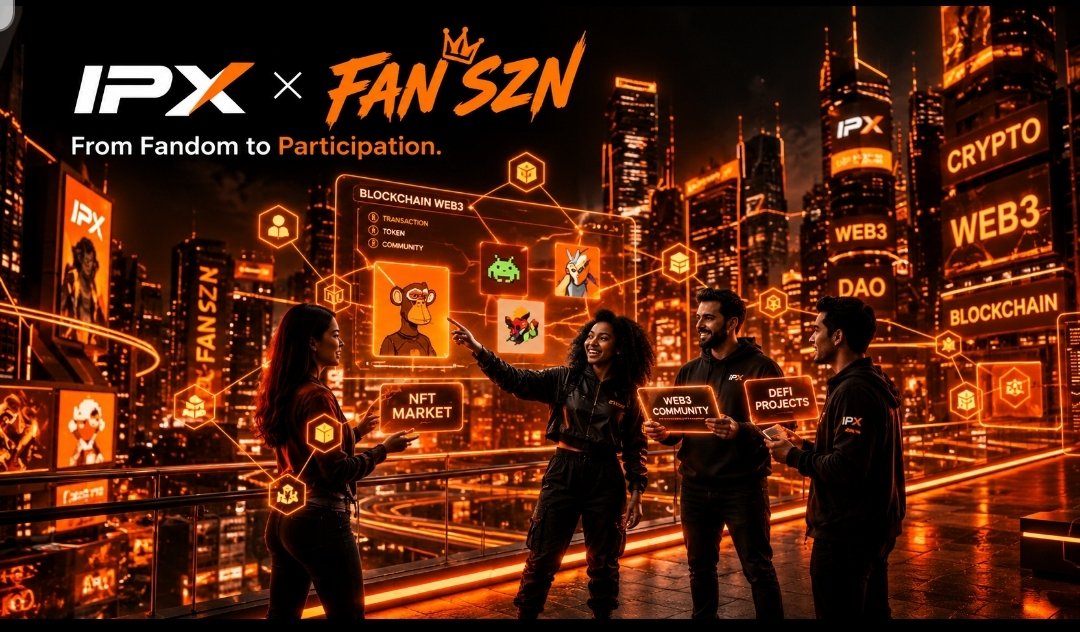
IPX × FAN SZN: More Than Just Participation
What makes a Web3 community valuable? For me, it's not just the number of people involved, but what they contribute.
FAN SZN brings together knowledge, consistency, creativity and community participation.
Here's how it works:
1. Fan Check: Seven questions, 10 seconds each. Every correct answer earns 10 Aura, with up to 5 additional speed-bonus points.
2. Content Quality: ALFRED evaluates submissions across three categories:
- Substance: 40 points.
- Originality: 35 points.
- Effort: 25 points.
3. Streak Rewards: The multiplier starts at 2.0× on Day 1 and increases to 2.9× by Day 10.
But there's a catch: your final content score must reach at least 40 to qualify for the streak multiplier.
For example, 500 base Aura at a 2.9× multiplier becomes 1,450 Aura.
My biggest takeaway is that consistency alone isn't enough. Creators must also demonstrate knowledge, originality and genuine effort.
That's what makes FAN SZN interesting: it gives participation a structure and makes the quality of contributions matter.
Build knowledge. Create value. Stay consistent.
@IPXExchange
One thing I think people misunderstand about FAN SZN is the relationship between content quality and streak rewards.
Having a long streak doesn't automatically mean every post receives a bigger reward.
There are two calculations happening.
First, ALFRED evaluates the content. Substance contributes up to 40 points, originality 35, and effort 25. That's a maximum of 100 before any applicable AI-writing deduction.
Second, the final score determines the base Aura reward range.
For example:
- 55–74 points: 150–350 Aura.
- 75–89 points: 400–700 Aura.
- 90–100 points: 750–1,000 Aura.
Then comes the streak multiplier.
Day 1 starts at 2.0×, and each consecutive day adds another 0.1×, reaching 2.9× on Day 10.
Let's use an example.
Suppose a post receives a final score of 75, and ALFRED awards it 500 base Aura.
On Day 5, the calculation becomes:
500 × 2.4 = 1,200 Aura.
On Day 10:
500 × 2.9 = 1,450 Aura.
That's a difference of 250 Aura from the same post simply because of the streak progression.
But there's a condition that deserves attention: the multiplier only applies to posts scoring 40 or higher.
A post scoring 39 can still receive its smaller base reward, but it won't receive the streak boost.
This changes how I look at FAN SZN.
The objective shouldn't be to publish as much as possible just to maintain activity. It should be to produce something that actually deserves a strong quality score while maintaining consistent participation.
A streak rewards consistency. Content quality determines whether your post qualifies for the additional benefit.
Both matter, but neither replaces the other.
That's the mechanic worth understanding before chasing the leaderboard.
@IPXExchange
I've been looking more closely at how @IPXExchange designed FAN SZN, and one detail caught my attention: the relationship between content quality and the daily streak multiplier.
Here's why I think this matters.
FAN SZN doesn't simply reward people for publishing repeatedly. Its Side Quest system evaluates every submitted post across three categories: substance (40 points), originality (35 points), and effort (25 points).
That means someone can write a technically correct explanation of IPX and still receive a weak score if the content contributes nothing new.
But there's another interesting mechanic.
The daily streak starts at a 2.0× multiplier and gradually increases to 2.9× by Day 10. The multiplier applies to eligible posts scoring at least 40 points.
Consider an example: if a post earns 100 base Aura and qualifies for a 2.5× streak multiplier, that becomes 250 Aura.
This creates an interesting relationship between consistency and quality. Maintaining a streak has value, but producing original, informative content is still necessary to benefit from the multiplier.
I also find the five-post daily scoring limit interesting. It discourages the idea that flooding the platform with repetitive content is the best strategy.
My take is that FAN SZN is testing something beyond ordinary social engagement: whether a community can demonstrate genuine knowledge of an ecosystem while contributing original ideas.
For me, the real measure of a creator isn't how many times they mention a project. It's whether someone understands the project better after reading their explanation.
That's the distinction I want to see more of in Web3 communities.
@IPXExchange
**WINkLink: The Oracle Infrastructure Helping TRON Smart Contracts See Beyond the Blockchain.**
A blockchain can execute instructions, process transactions, and maintain transparent records. But there is one fundamental limitation: smart contracts cannot independently access information from the outside world.
They cannot simply visit an exchange to check the latest asset price, retrieve a sports result, generate independently verifiable randomness, or automatically respond to external events.
This is where oracle infrastructure becomes essential.
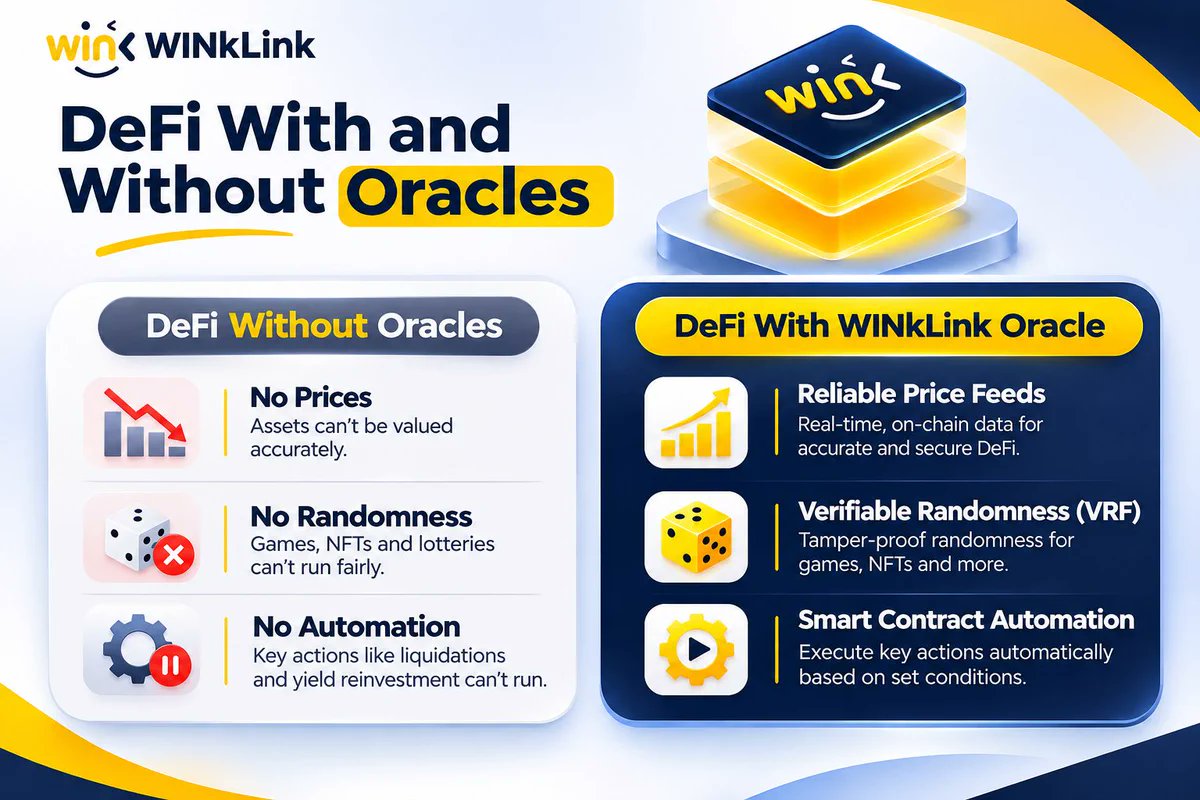
Built within the TRON ecosystem, **WINkLink** addresses this information gap by connecting smart contracts to external data and services through four important capabilities.
**1. Price Feeds: Giving Smart Contracts Market Awareness**
DeFi applications depend on accurate and timely market information. Lending platforms need asset prices to calculate collateral values, trading protocols need price references, and other financial applications rely on dependable data to execute their operations.
WINkLink's Price Service provides on-chain access to aggregated cryptocurrency price information, helping developers build applications that respond to market conditions.
**2. Verifiable Randomness (VRF): Making Digital Outcomes Fairer**
Randomness has important applications across blockchain gaming, NFTs, lotteries, and other decentralized experiences.
However, randomness must be difficult to predict or manipulate. WINkLink's VRF provides cryptographically verifiable random outputs, allowing applications to verify that generated results follow the specified process.
This creates opportunities for more transparent and trustworthy digital experiences.
**3. AnyAPI: Connecting Blockchain to the Outside World**
Not every useful piece of information exists on a blockchain.
Weather conditions, sports results, external events, and information from other data providers may all be relevant to decentralized applications.
WINkLink's AnyAPI service allows developers to request customized external information and make the resulting data available to smart contracts.
It expands what blockchain applications can interact with beyond their native network.
**4. Automation: Turning Conditions Into Action**
Some smart contracts need to do more than wait for someone to initiate a transaction.
Automation enables predefined conditions or schedules to trigger smart-contract execution.
For example, lending protocols can automate certain liquidation processes, while DeFi applications can build automated interest-reinvestment workflows.
This reduces dependence on manual intervention and creates opportunities for more responsive decentralized applications.
**The Bigger Picture**
These four capabilities solve different problems, but together they address a fundamental requirement for blockchain adoption: connecting reliable information with executable on-chain logic.
Price feeds provide market data. VRF introduces verifiable randomness. AnyAPI connects external information. Automation helps smart contracts respond to predefined conditions.
The important distinction is that an oracle does not replace a blockchain or make every external data source automatically trustworthy. Its job is to provide a structured bridge between external information and on-chain execution, with reliability depending on the underlying data sources, oracle design, and integration.
As decentralized applications become more sophisticated, infrastructure that connects smart contracts to the wider digital world becomes increasingly important.
**WINkLink is building this data-service layer for the TRON ecosystem, helping developers move beyond basic smart-contract execution toward applications that can access information, verify outcomes, and respond to changing conditions.**
Because a smart contract may contain the instructions, but the right data and infrastructure help bring those instructions to life.
Explore the infrastructure: https://winklink.organize
@justinsuntron #TRONEcoStar #WinkLink_Oracle
WINkLink Price Feed Migration: An Important Update for Developers and Integrators
Accuracy is a critical part of every reliable blockchain application, especially when smart contracts depend on external price data to execute their operations.
In September, WINkLink upgraded the precision of its WIN/USD and WIN/TRX price services from 6 to 10 decimal places, delivering more granular and precise WIN price information.
However, this upgrade comes with an important migration deadline.
The legacy 6-decimal price pairs are scheduled to stop updating on December 15, 2026 (Singapore Time).
What does this mean for developers?
If your application, protocol, or integration still relies on the older 6-decimal contracts, it is important to migrate to the new 10-decimal contracts before the deadline.
Why does this matter?
Price feeds are essential infrastructure for applications that depend on accurate market information. Outdated integrations may continue referencing legacy contracts that no longer receive fresh price updates, potentially affecting application functionality and data reliability.
Moving to the upgraded contracts ahead of time helps ensure continuity and avoids unnecessary disruptions.
The important takeaway:
- Old precision: 6 decimal places.
- New precision: 10 decimal places.
- Migration deadline: December 15, 2026 (SGT).
- Required action: Update integrations to the new WIN/USD and WIN/TRX contracts.
This is more than a technical adjustment. It highlights an important principle in Web3: infrastructure evolves, and applications built on top of it must evolve accordingly.
For developers, staying updated is not optional when uninterrupted data access matters.
Don't wait until the deadline. Verify your integrations and migrate early.
#WINkLink_oracle @justinsuntron #TRONEcoStar
GM.
If you could give an AI the responsibility of handling one task in your daily life, what would you choose?
Imagine waking up every morning knowing that one repetitive responsibility has already been taken care of. No unnecessary stress, no wasted time, and no need to constantly remind yourself of what needs to be done.
For some people, it would be managing emails, organizing schedules, tracking expenses, researching information, or keeping important deadlines under control.
For others, it might be something more valuable: having an intelligent assistant that helps them make better-informed decisions.
But here's something worth thinking about.
The real potential of AI isn't simply about making machines perform tasks. It's about giving people more time, improving productivity, reducing mental overload, and allowing them to concentrate on things that require human creativity, judgment, and experience.
Consider three practical ways AI could improve everyday life:
1. Time Management: An AI assistant could organize your calendar, prioritize responsibilities, identify scheduling conflicts, and remind you about important commitments.
2. Information Management: Instead of spending hours searching through different sources, AI could help gather, organize, and summarize relevant information so you can make more informed decisions.
3. Personal Productivity: From tracking goals to managing repetitive work, AI could help turn scattered intentions into structured, actionable plans.
However, convenience should never replace critical thinking. AI can make mistakes, misunderstand context, or produce unreliable information. Human judgment must remain part of the process.
Ultimately, the best AI assistant isn't necessarily the one that does everything. It's the one that consistently handles the right tasks, saves valuable time, and helps you become more effective.
Now, let's hear your thoughts:
If you could delegate just ONE daily responsibility to an AI and never worry about handling it manually again, what would that task be?
And more importantly, what would you do with the extra time?
GM. Let's talk about the practical side of AI.
@justinsuntron #TRONEcoStar #WINkLink_oracle
16 BILLION TRANSACTIONS: TRON'S NETWORK ACTIVITY CONTINUES TO REACH NEW HEIGHTS.
The numbers are getting bigger, but the real story goes beyond the milestone.
The TRON network has surpassed 16 billion total transactions, with an average of approximately 11.56 million transactions processed every day.
Take a moment to consider what that means.
Every transaction represents an interaction with the network. It could be a stablecoin transfer, a DeFi operation, a smart contract execution, a token movement, or another blockchain-powered activity.
When millions of transactions are processed daily, it demonstrates the level of activity taking place across the ecosystem.
But why is this milestone important?
1. Network Activity Reflects Real Usage
A blockchain's value cannot be measured by announcements and technical promises alone. Actual network activity provides another way to understand whether people and applications are using the infrastructure.
Surpassing 16 billion transactions represents a significant accumulation of on-chain activity.
2. Scalability Matters More Than Ever
As blockchain adoption expands, networks must be capable of processing growing transaction volumes without making everyday interactions unnecessarily complicated or expensive.
Handling an average of 11.56 million transactions daily highlights the importance of infrastructure designed to support sustained activity.
3. Infrastructure Must Support Everyday Utility
Blockchain technology becomes more meaningful when it moves beyond speculation and supports practical applications.
From stablecoin payments and transfers to decentralized finance and smart contract interactions, TRON's infrastructure plays a role in a growing range of blockchain activities.
4. Consistency Is Just as Important as Milestones
Reaching 16 billion transactions is impressive, but maintaining reliable network performance as activity increases is equally important.
Long-term adoption depends on more than transaction counts. Network reliability, security, affordability, developer participation, and genuine user demand all contribute to sustainable growth.
The bigger picture
Sixteen billion transactions is not simply a number to celebrate. It is an opportunity to examine how blockchain infrastructure is being used and how much capacity decentralized networks need to support the next phase of adoption.
The future of blockchain will not be determined by who makes the loudest promises. It will increasingly depend on who can provide dependable infrastructure for real-world activity at scale.
TRON has reached another major transaction milestone. The next challenge is to keep building on that foundation.
16 billion transactions recorded. 11.56 million processed daily. The conversation is no longer just about blockchain potential; it is about infrastructure, adoption, and sustained utility.
@justinsuntron #TRONEcoStar #WINkLink_oracle
POV: You're a robot waiting for data to load. But what should come first when an on-chain application wakes up?
Imagine an on-chain application as a robot that has just powered on. It has the intelligence to execute instructions, interact with smart contracts, and respond to users, but before it can make meaningful decisions, it needs reliable information.
So, what should it load first?
1. Price Data: The Foundation for Market Awareness
If the application handles DeFi, trading, lending, or swaps, accurate price data is essential. Smart contracts need reliable market prices to calculate asset values, determine collateral ratios, execute liquidations, and protect users from incorrect transactions.
Without dependable price feeds, even a well-designed protocol can make expensive mistakes.
2. Randomness: The Element of Unpredictability
Not every blockchain application revolves around financial data. Gaming, lotteries, NFT distribution, and fair selection mechanisms often depend on randomness.
But here's the challenge: randomness on a blockchain must be verifiable and resistant to manipulation. Predictable outcomes can compromise fairness, while weak randomness can create opportunities for exploitation.
3. API Responses: Connecting Applications to the Outside World
Sometimes, an application needs information that doesn't naturally exist on-chain. This could include external events, real-world data, weather updates, sports results, or other off-chain information.
APIs help bridge that information gap, allowing decentralized applications to interact with data beyond their blockchain environment.
But here's the bigger lesson:
An on-chain application is only as useful as the information it can access and the reliability of the systems delivering that information.
Price feeds provide market awareness. Verifiable randomness supports fairness. APIs connect smart contracts to the wider world.
These aren't competing technologies. They solve different problems, and choosing the right data source depends on what the application is designed to accomplish.
The real question isn't simply what a robot should load first. It's whether the information it receives is accurate, timely, secure, and verifiable.
Because in Web3, executing code is important, but executing the right code with the right information is what makes an application truly useful.
Now, if you were building an on-chain application, which would you integrate first: Price Data, Verifiable Randomness, or API Responses? And why?
@justinsuntron #TRONEcoStar #WINkLink_oracle
Keeping an Eye on Things
In a fast-moving digital world, staying informed is more important than ever. Things can change in seconds, opportunities can emerge unexpectedly, and important developments can happen when nobody is paying attention.
That's why keeping an eye on things matters. It means staying observant, paying attention to details, following developments, and understanding what is happening beyond the surface.
Whether it's technology, business, artificial intelligence, or the evolving Web3 ecosystem, awareness creates an advantage. The goal isn't simply to watch everything; it's to recognize meaningful changes, separate useful information from noise, and know when something deserves attention.
Sometimes, the biggest opportunities aren't announced loudly. They reveal themselves through small developments that only attentive people notice.
Stay alert. Stay informed. Keep watching.
@justinsuntron #TRONEcoStar #WINkLink_oracle
@thenameisbrill I'd take the $10K without hesitation.
A Rolex tells people what you own. $10K gives you options, opportunities, and the freedom to build something bigger.
I'd rather buy the Rolex with money I've multiplied than choose the watch over the money.
Your central argument has merit, but I would refine it to make it more accurate and intellectually stronger.
Jensen Huang's departure is a major leadership loss for NVIDIA and a significant moment for the AI industry. However, calling it an outright setback for AI development may be an overstatement.
His resignation is confirmed by NVIDIA's official announcement on November 12, 2026. Colette Kress has taken over as interim CEO while the board searches for a permanent successor. NVIDIA Newsroom +1
The more interesting argument is that the industry may lose an influential visionary at a critical moment, while the technology and institutions he helped build must prove they can continue without him.
Here is the version I recommend publishing:
**WHEN A VISIONARY LEAVES, THE INDUSTRY MUST PROVE IT CAN MOVE FORWARD WITHOUT HIM.**
Jensen Huang's departure from NVIDIA is more than a change in executive leadership. It marks the end of an extraordinary chapter in the history of one of the companies that helped shape modern artificial intelligence.
For NVIDIA, this is a significant leadership transition. For the wider AI industry, it raises an important question: how much of the momentum behind a technological revolution is connected to the people leading it?
Huang was not simply managing a semiconductor company. He helped transform NVIDIA from a graphics-focused technology business into a central force in accelerated computing and artificial intelligence.
Under his leadership, NVIDIA's GPUs, CUDA software ecosystem and computing infrastructure became essential components of the modern AI landscape.
That contribution cannot be measured by financial performance alone.
It is reflected in the developers building intelligent applications, research institutions advancing scientific discovery, cloud providers expanding computing capacity and companies competing to develop increasingly sophisticated AI systems.
**This is why his departure matters.**
A leader with decades of technical experience, strategic influence and established relationships across the global technology ecosystem cannot be replaced overnight.
NVIDIA now faces the challenge of maintaining its technological direction, protecting its competitive position and sustaining confidence among customers, developers, partners and investors.
Colette Kress, appointed interim CEO, inherits an extraordinary foundation. The responsibility ahead is to preserve that momentum while demonstrating that NVIDIA's strength extends beyond the individual who led it for more than three decades.
But there is another side to this development that deserves attention.
The departure of one influential executive does not mean the end of an industry. NVIDIA has experienced engineers, researchers, executives and an established technological ecosystem. AI development is also being driven by universities, startups, established technology companies and independent research communities around the world.
The real concern is not that artificial intelligence will suddenly stop advancing.
It is whether NVIDIA can maintain the same level of strategic leadership, execution and industry influence during this transition.
**There is a bigger lesson here about innovation and leadership.**
Visionaries can accelerate technological revolutions, but sustainable progress requires institutions capable of carrying their vision forward.
Jensen Huang helped build something much bigger than a successful company. He helped establish infrastructure that has become deeply connected to the future of computing.
His departure is undoubtedly a significant loss of leadership experience. However, the next chapter should not be judged solely by the absence of one individual, but by how effectively the organisation continues to innovate.
Perhaps the most important test for NVIDIA begins now.
Can the company preserve the vision, ambition and execution that made it a defining force in AI, even as its leadership changes?
**A visionary may leave the room, but the future he helped build does not have to leave with him.**
That is the real test of NVIDIA's legacy.
#NVIDIA #JensenHuang #ArtificialIntelligence #AI #Technology
### My assessment
9.8/10
I would particularly keep this distinction:
* His departure is a significant loss for NVIDIA.
* It creates uncertainty for the wider AI ecosystem.
* It is not yet evidence of a setback in the overall development of AI.
That makes your commentary more mature, balanced and credible.
The strongest closing line:
"A visionary may leave the room, but the future he helped build does not have to leave with him."
That's a statement worth remembering.
@justinsuntron #TRONEcoStar #nvidia
THE MAN WHO HELPED BUILD THE AI REVOLUTION IS LEAVING THE COMPANY THAT POWERS IT. WHAT HAPPENS NEXT?
Jensen Huang's resignation from NVIDIA is more than the departure of a CEO. It marks the end of an extraordinary leadership chapter at one of the most influential technology companies in modern history.
And the implications could extend far beyond NVIDIA.
To understand why this development matters, we first need to understand what Jensen Huang built.
When Huang co-founded NVIDIA in 1993 alongside Chris Malachowsky and Curtis Priem, the company's ambition was centred on computer graphics and accelerating computing.
At the time, few could have predicted that its technology would eventually become one of the foundations of the artificial intelligence revolution.
But Huang saw something important: computing would need to become significantly more powerful, flexible and parallel to handle the demands of future technologies.
That vision helped NVIDIA evolve from a graphics-focused semiconductor company into a critical infrastructure provider for modern AI.
Why is his departure such a significant development?
1. NVIDIA is more than a chip manufacturer.
Its GPUs power the training and operation of increasingly sophisticated AI systems. From large language models to advanced scientific computing, NVIDIA's hardware and software ecosystem has become deeply embedded in the AI industry.
Its CUDA platform, developer ecosystem and accelerated computing architecture have helped establish a competitive advantage that goes beyond manufacturing powerful processors.
This is why Huang's leadership has mattered so much.
2. Leadership continuity is critical in an industry moving this quickly.
The AI industry operates on aggressive innovation cycles. Hardware development, software optimisation, data-centre infrastructure and strategic partnerships must work together.
Huang understood how these different pieces connected.
Replacing a leader with that level of technical understanding, industry relationships and strategic influence is not a simple administrative exercise.
NVIDIA has an experienced team, but the next CEO will face the difficult task of preserving the company's momentum while establishing their own leadership direction.
3. The consequences could reach the wider AI ecosystem.
NVIDIA's influence extends beyond its own products.
Its technology supports cloud providers, AI laboratories, developers, research institutions and companies building the next generation of intelligent systems.
Its investments and strategic relationships have also helped shape parts of the broader AI infrastructure market.
A significant leadership transition at NVIDIA therefore deserves attention across the technology industry.
However, it is important to recognise that NVIDIA's established engineering teams, existing product roadmap and customer relationships do not disappear with one executive's departure.
The real question is how effectively the organisation can maintain its direction without the person who helped define it.
4. This is also a lesson about leadership and institutional strength.
One of the biggest lessons from NVIDIA's journey is that building a successful technology company requires more than identifying a promising market.
It requires long-term thinking, technical investment, calculated risks, strong execution and the ability to recognise opportunities before they become obvious.
But there is another side to that lesson.
A company must also build systems, talent and institutional structures strong enough to survive beyond its founder or CEO.
No matter how exceptional a leader may be, sustainable innovation should never depend entirely on one individual.
WHAT HAPPENS NEXT?
Colette Kress, NVIDIA's long-serving CFO, has been appointed interim CEO. The board is considering internal and external candidates for a permanent replacement.
The incoming leadership will inherit an extraordinary technological position, but also enormous expectations.
For NVIDIA, this is a test of organisational resilience.
For the AI industry, it is a moment to watch how much influence leadership continuity has on the future of technological innovation.
And for the technology community, it is a reminder that even the most successful companies eventually face defining transitions.
Jensen Huang's contribution to NVIDIA and the development of modern AI infrastructure is significant. His departure represents a major loss of leadership experience, but it does not automatically mean the end of NVIDIA's dominance or the AI revolution.
Great leaders build companies. Exceptional institutions build futures that can outlive their founders.
The next chapter of NVIDIA will reveal just how strong that foundation really is.
#NVIDIA @justinsuntron #TRONEcoStar