Annual energy bills around the world
Austria- £470
Belgium - £520
France - £485
Germany - £550
Israel - £590
Norway - £460
Poland - £150
Spain - £495
United Kingdom - £2,325
Net stupid zero strikes again.
#NetZero
So it looks like the government is going to try and effectively remove older vehicles from the road.
They've created a sneaky consultation on this huge change with an end date of only the 6th of September.
They want to have a yearly emissions check on every car and motorcycle on the road AS WELL as your MOT.
If you pass the MOT but then go to your emissions check, if the vehicle doesn't emit exactly the same emissions as when it was built the car will be banned from any use on the road even if it passed its MOT emissions.
This will effectively destroy a majority of the car industry as car tuning and modification will stop you being able to drive your car.
This is targeting all vehicle, cars, motorbikes, trikes, kit cars etc.
So far they are just targeting cars after 2001 but they want to use it on every vehicle on the road targeting mot & tax exempt (historic) vehicles.
They've purposely not given this consultation much time, so please go to the bottom of this page, tell them you do not want any of this from the government and share the consultation for others to do the same.
Only possible way to stop this would be to get the results of this consultation to be a resounding NO! The whole survey needs to be completed - don’t skip to the end as they try and nudge you to do.
[https://t.co/WY42fjNENj)
@sianydevine@TNLUK I closed my online account tonight.. Allwyn has made the @TNLUK a joke & it basically comes down to their greed.. I'm hoping enough people/players will pick up on my # and do the same.. It's only through mass action that Allwyn might take notice.. #CloseYourAccount
The middle class is the most expensive place to live, and no one talks about it. Lower income households get assistance. The wealthy use tax strategies and loopholes. But the middle class pays full taxes, full tuition, full healthcare, full everything. So you work 50 hours a week just to stay in the same place and fund everyone’s life except yours.
Alcohol and tobacco are available on every street corner.
Cigarettes proven to cause cancer. Alcohol proven to destroy the liver, the brain, the marriage, and the careful plans of an entire weekend.
Both legal. Both taxed. Both stocked at the petrol station.
Raw milk, on the other hand, sold by a farmer three miles down the road from a cow that has a name, must apparently be regulated as a public health threat.
The petrol station sells nicotine pouches, vodka, energy drinks containing seven grams of taurine and a kilogram of sugar, and an entire wall of ultra-processed snacks designed by chemists.
The farm gate down the lane sells a glass of milk. The same milk humans have been drinking for ten thousand years.
The petrol station is fine. The farm gate is the problem.
You can decide which of these your government is actually trying to protect you from.
The NHS states that some folk should be avoiding FOLIC ACID but how can they when it’s being put into every item ingested?
The appalling discovery that ORGANIC flour will have folic acid mandated must be brought to everyone’s attention!
ORGANIC MEANS NO ARTIFICIAL CHEMICALS!🤬
I submitted my tax return to HMRC one day late.
I was fined £100. And I didn't even owe them any tax!
Angela Rayner tried to avoid paying £40,000 stamp duty for nearly a year and could have been fined £8,000 by the HMRC after she recently coughed up the money, (shortly after being gifted £50,000 from a refrigeration company for 'Office Expenses').
She wasn't fined a single penny. No fine. No penalty. No comeback whatsoever.
Is it any wonder that us little folk are getting so pissed off with these freeloading, opportunistic, money grabbing, holier than thou, two faced charlatans?
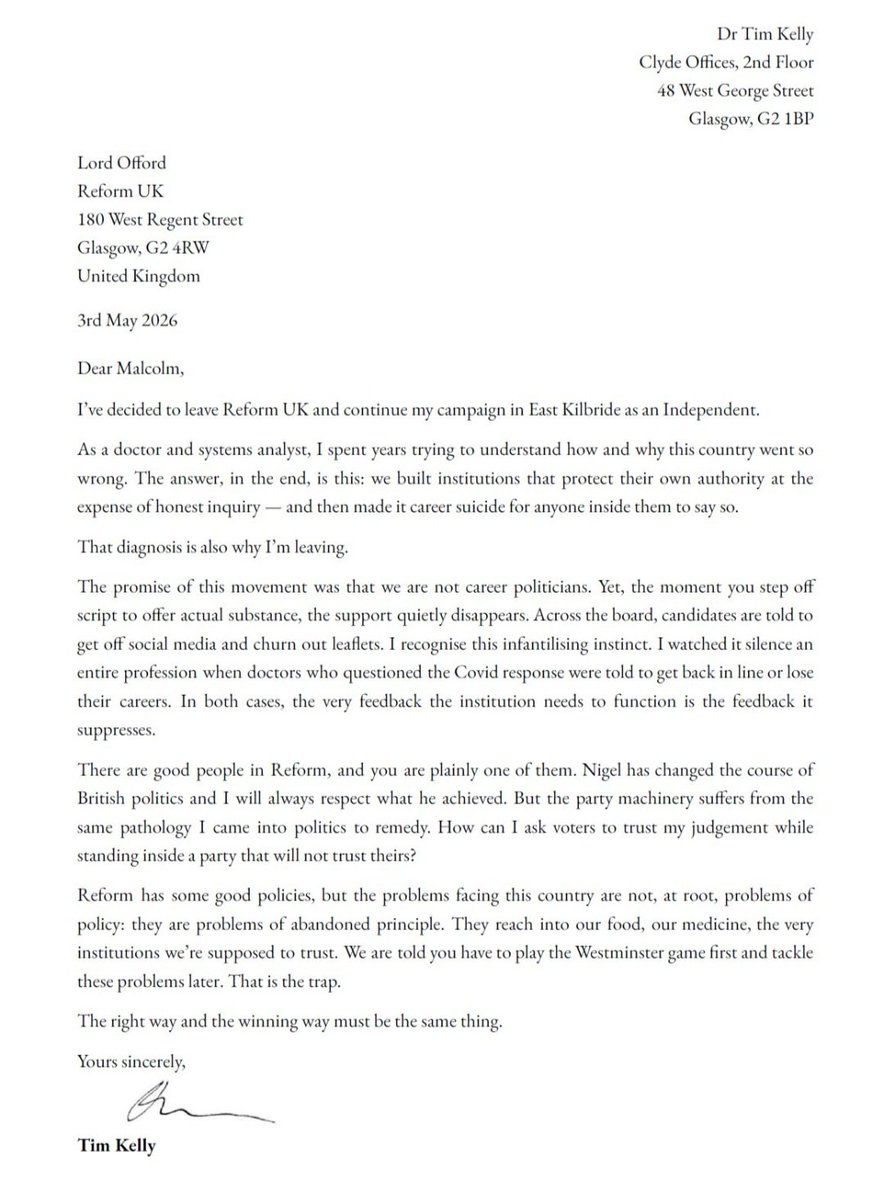
Dr Tim Kelly resigns from Reform just before the local elections and gives his reasons.
I think there will be many more resignations and defections from Reform UK in the coming weeks
Kier Starmer was visiting a very small village in the UK, and asked the villagers what the
government could do for them.
"We have two big needs" said the village spokesman. "First, we Have a health centre, but no doctor." Starmer whipped out his mobile
phone, spoke for a while and then said "I've sorted it out, a doctor will arrive here tomorrow.
“What is your other need then?" “We have no mobile phone reception at all in our village”. 😬🤣
There is a region in southeastern Spain called Almería. If you pull it up on satellite imagery, you will assume the screen has glitched. A vast, blinding white scab where a landscape used to be.
It's not a glitch. It's 64,000 acres of plastic greenhouses. So much plastic sheeting that it is, genuinely, visible from space. The entire region has been wrapped in industrial farming film to grow tomatoes, peppers, cucumbers and lettuce for European supermarkets in January.
The plastic has created its own microclimate. The reflective surface is so vast it has measurably lowered local temperatures by bouncing sunlight back into the atmosphere. Scientists have a name for it. The Albedo effect of Almería. The only place on earth where human activity has cooled the local climate, and they did it by accident, while building the world's largest open-air plastic factory.
The plastic itself is single-use agricultural film. It sits in UV light for three to five years, degrades into microplastics, blows into the Mediterranean, and ends up in the ocean and the soil. Every year, 45,000 tonnes of plastic waste is generated just from replacing degraded greenhouse covering. Every year. Just the covering.
Inside, workers from Morocco and sub-Saharan Africa labour in 45°C heat for €30 a day. No contracts. No rights. Spraying crops with pesticides at concentrations that would be illegal on outdoor fields. Ventilation: minimal. Chemical exposure: constant. The aubergine looks lovely.
The groundwater underneath Almería is so contaminated with agricultural runoff that it has been declared unusable. The region now imports water from elsewhere in Spain while sitting on top of a poisoned aquifer it created. The land that was meant to feed Europe more efficiently has become a place that needs water flown in to keep the show running.
And this is what supplies your fresh vegetables in January. Grown in plastic factories. By exploited workers. Using groundwater they have already destroyed. Wrapped in more plastic. Shipped across Europe. Refrigerated the whole way. So a person in Manchester can have a tomato in February that tastes of nothing.
But sure. Cattle grazing on Scottish hills are the environmental problem.
Pull the satellite up. Have a look. Then tell me which system is the one that needs explaining.
So the RSPCA want to stop crabbing because of concerns for crabs but they don’t seem to have a problem with Halal.
What a strange organisation they have become.
In 1946 the British government introduced free school milk for every child in the country. One third of a pint, every school day, from the age of five to the age of fifteen.
The milk was whole. Full-fat. From British dairy herds. It was delivered to the school gate in small glass bottles with foil caps and left on the doorstep in metal crates, where it sat in the sun until morning break if the weather was warm and developed a slightly suspect taste that an entire generation of British adults can still describe with uncomfortable precision.
The generation that grew up on school milk was, by every anthropometric measure, the healthiest generation of British children ever recorded.
Average height increased. Bone density improved. Dental health, despite the sugar in everything else, improved. Iron deficiency rates among school-age children dropped. The growth charts that the Ministry of Health had been keeping since the war showed a consistent, measurable, year-on-year improvement that tracked precisely onto the introduction of the milk programme.
In 1971 Margaret Thatcher, then Education Secretary, cut free school milk for children over seven. The tabloids called her Thatcher the Milk Snatcher. She was vilified. She kept the policy.
The next generation of British children, the ones who grew up without the daily third of a pint, were measurably less healthy than the one before.
The growth charts show it. The dental records show it. The conscription medicals, while they lasted, showed it. The thing the milk had been providing, the calcium, the vitamin D, the vitamin A, the complete amino acid profile, the conjugated linoleic acid, the fat-soluble nutrients that a growing skeleton requires in order to reach its genetic potential, was no longer arriving at morning break in a glass bottle with a foil cap.
It was replaced, eventually, by nothing. Or by a carton of fruit juice. Or by a packet of crisps from the vending machine that appeared in the school corridor in the 1990s.
The generation that drank the milk is now in its seventies and eighties. They are, on average, taller, stronger-boned, and longer-lived than the generation that came after them.
The milk was not magic.
The milk was milk.
It was the thing the body needed, delivered at the time the body needed it, at a cost the government considered acceptable until it didn't.
The cost of not providing it has been rather higher.
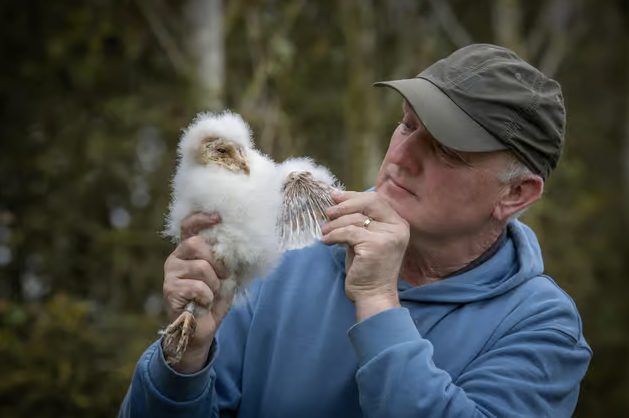
A bricklayer in East Yorkshire has spent 35 years installing nest boxes for barn owls in his free time.
No grant. No organization behind him. Just Robert Salter, quietly building and mounting over 350 boxes across fields and farms on weekends, before and after work, for three and a half decades.
This year was the second-best barn owl breeding season in the region in decades. 304 owlets counted. Last year there were 95.
Barn owls have struggled across the UK for generations due to habitat loss, rodenticide poisoning, starvation from agricultural changes that eliminated the field margins where voles live, and collisions with vehicles on roads that cut through their hunting territory.
In many parts of England, populations collapsed while nobody was paying much attention.
One man paying attention changed the outcome for an entire region.
"This bird has lived alongside humans since they settled in this country," Salter told the BBC. "Because of that close relationship, I just feel like we owe it to barn owls to help and maintain their future populations."
The conservation story we usually tell involves governments, legislation, and international agreements.
Those matter, but so does one person who decided a species deserved better and just kept showing up.