A little behind the scenes… Most of what I share here is the work itself, but there is also someone behind all those designs and lines of code
Still learning, still building, and still working towards something bigger
One project at a time📌💪🏾
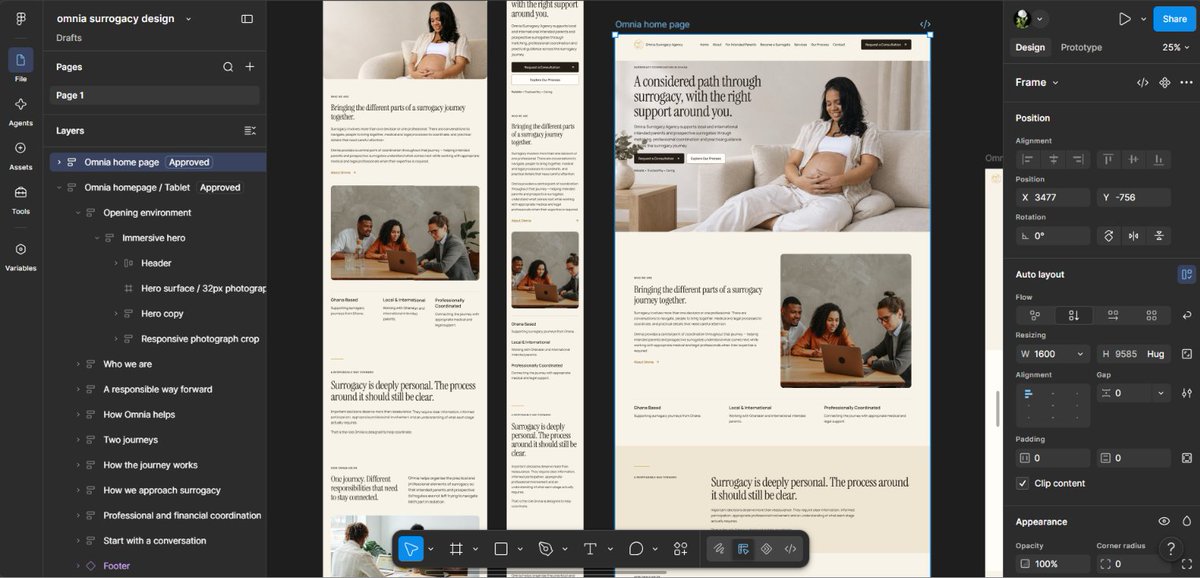
A little different from what I usually share here... This time, it is actual client work
I’m currently designing a website for Omnia Surrogacy Agency, and this is also the first time a client has given me permission to publicly share the work while I’m still working on it... The homepage is fully designed in Figma now, across desktop, tablet and mobile
Still more to do, but it is good to finally be able to show some of the client work happening behind the scenes too
@andrevalleee Yeah, I included permission to showcase the work in the agreement from the beginning… but I still asked before sharing the work in progress
A website can look polished and still be doing a poor job…. The harder part is deciding what deserves attention in the first place
What does the business need people to understand quickly ?
What might make them hesitate ?
What proof would make them trust the business enough to continue ?
What should feel obvious without explanation ?
Those decisions matter more than making every section look impressive
Design gets much easier once the business problem is clear
Flowmetric started with a product problem, not a website.
I wanted to understand what the product should do, who it was for, and how to make an abstract SaaS concept understandable before deciding what the website should look like. https://t.co/9ZlsodOdBb
@Francis_co Not directly… Flowmetric focuses more on where the process is sitting, moving or slowing down across tools, rather than tracking individual ownership at each step
Operational intelligence can get abstract very quickly
So instead of explaining Flowmetric with more SaaS language, I kept coming back to one example:
Customer onboarding
A deal is won… There is a handoff… A workspace gets set up… Integration happens.
Training follows… The customer is activated
Now the product has something real to explain… Sometimes making a complex product clearer is less about finding better words and more about giving people something concrete to follow.
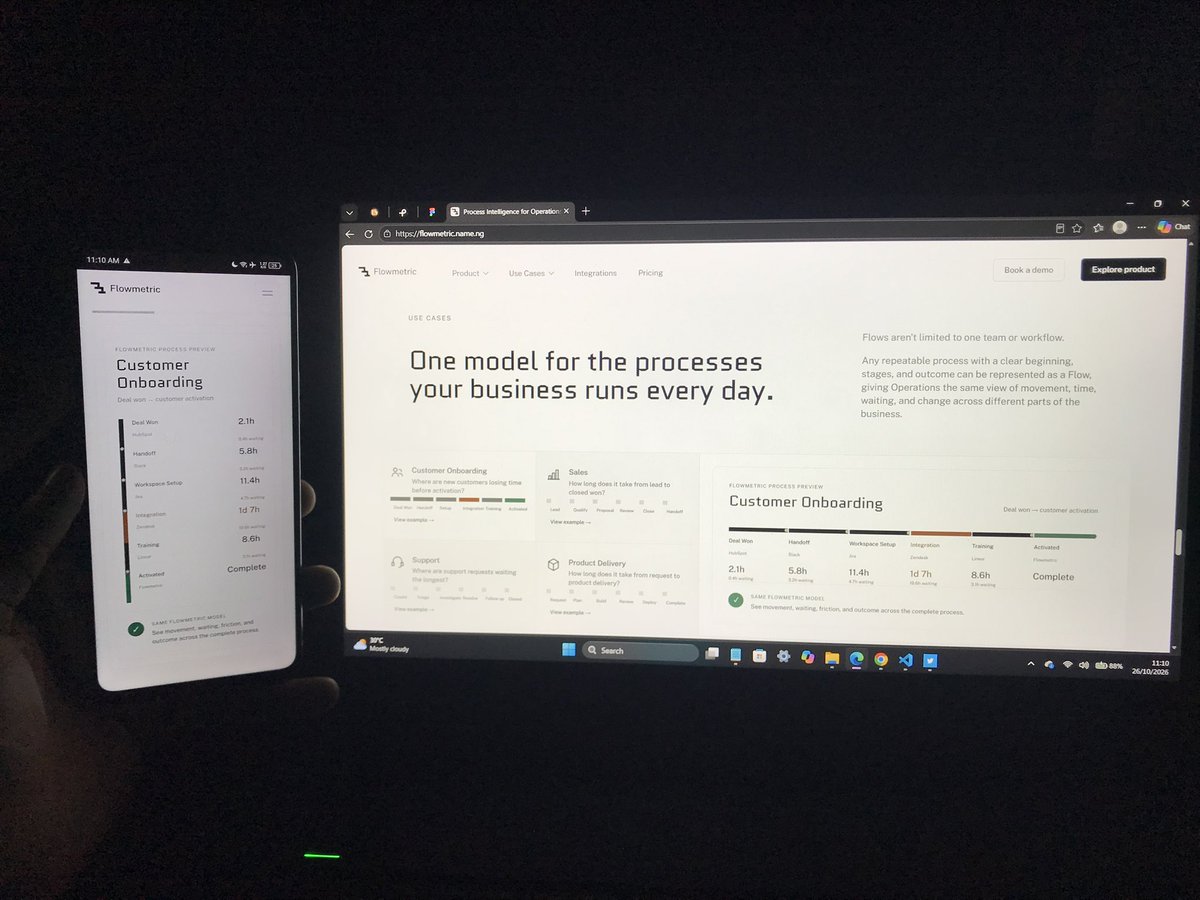
A desktop design working at 390px doesn’t automatically make it a good mobile design
Building Flowmetric meant making new decisions at smaller sizes:
What appears first?
What can stack?
What needs more room?
How should the product UI change?
Where should the CTA sit?
How should the text wrap?
Responsive implementation is still design work… The viewport changed, so some of the decisions had to change with it.
Responsive design is not only about making the page fit a smaller screen… Navigation has to be reconsidered too
Flowmetric has product areas, use cases, integrations, pricing and two primary actions
On desktop there is room to expose more of that structure… On mobile, the hierarchy has to do more work
Same website… Different navigation problem.
I designed Flowmetric completely in Figma before development.
That didn’t mean every decision in Figma survived development unchanged… Once a design enters the browser, you start seeing things differently
Text wraps differently… Spacing feels different… Interactions become real… Intermediate widths expose problems fixed frames don’t
Figma gave me the system… The browser helped me finish it
A final look at Flowmetric
A self initiated B2B SaaS project I took from the initial product idea through positioning, website strategy, Figma, frontend development, responsive refinement, testing and deployment
Probably one of the projects that has pushed me most to think beyond simply designing pages
The finished website is live:
https://t.co/VgTfNKZvXq
I designed Flowmetric completely in Figma before development.
That didn’t mean every decision in Figma survived development unchanged… Once a design enters the browser, you start seeing things differently
Text wraps differently… Spacing feels different… Interactions become real… Intermediate widths expose problems fixed frames don’t
Figma gave me the system… The browser helped me finish it
Responsive design is not only about making the page fit a smaller screen… Navigation has to be reconsidered too
Flowmetric has product areas, use cases, integrations, pricing and two primary actions
On desktop there is room to expose more of that structure… On mobile, the hierarchy has to do more work
Same website… Different navigation problem.
I didn’t want Flowmetric to feel like it only worked for the Customer Onboarding example I used throughout the website
The underlying idea needed to stretch further
Sales… Support… Product delivery… Customer onboarding
Different workflows, but the same question:
How is work actually moving through the process?
That led to one shared process model rather than designing each use case like a completely different product