🚨JUNE's top AI/ML research papers:
- Orca
- Autodata
- DSpark
- Looped World Models
- Qwen-AgentWorld
- Tmax
- Self-Harness
- MiniMax Sparse Attention
- You Don't Need Strong Assumptions
- Variable-Width Transformers
- FlashMemory-DeepSeek-V4
- Scaling the Horizon, Not the Parameters
- Is One Layer Enough?
overview for each + authors' explanations
read this in thread mode for the best experience
Ex-Google engineer reveals how to build AI agent loops, harnesses, LLM ops, and evals in 19 minutes.
Trace → evaluate → diagnose → fix → ship → repeat.
That loop is how agents self-improve over time.
Agentic loops + harness + memory + evals - that’s the senior engineer stack.
This is better than $500 paid courses on the same topic, explained in under 20 minutes.
Watch it, then save the framework below.
Working with Planet Tanager Hyperspectral Data (426 Bands) in QGIS with HyperCoast
Learn how to access, visualize, and analyze Planet’s Tanager hyperspectral imagery in QGIS using the HyperCoast plugin. In this tutorial, you will explore freely available Planet Tanager open data with over 426 spectral bands and learn how to stream imagery, download HDF5 datasets, inspect spectral signatures, and perform hyperspectral visualization directly inside QGIS.
Video Tutorial: https://t.co/QfPIevlsNR
HyperCoast: https://t.co/1GPh3h73Rv
QGIS Plugin: https://t.co/6CB4ApMkhd
Tanager STAC Repo: https://t.co/8Bn8I9T5bR
Tanager STAC Browser: https://t.co/ll9Hq1VEQS
#opendata #geospatial #hypercoast #QGIS #Tanager #hyperspectral
10 GitHub repos that distill the world's smartest people into AI you can run on your laptop.
In 2026, the greatest minds of our time became installable. Bookmark this list — you will not see anything stranger this year.
1. andrej-karpathy-skills
A single markdown file distilling Andrej Karpathy's wisdom on AI coding. 109K+ stars. The most starred single-file repo in GitHub history.
Repo → https://t.co/unItpr073y
2. MemPalace
Milla Jovovich, the Resident Evil actress, co-built this AI memory system using Claude Code. Near-perfect score on the LongMemEval benchmark.
Repo → https://t.co/o8xKSTz60D
3. autoresearch
Karpathy's own research automation framework. 23K stars in three days. The closest thing to having Karpathy as your research partner.
Repo → https://t.co/YURNnYJJN3
4. awesome-claude-code
The canonical playbook for Claude Code, the AI coding tool used inside FAANG, OpenAI, and Anthropic.
Repo → https://t.co/VhNjDoz7YM
5. SuperClaude Framework
The complete Claude Code methodology distilled into a deployable framework. Personas, commands, prompts, workflows.
Repo → https://t.co/vNnvQ9mq1e
6. AI-Agents-for-Beginners
Microsoft's free 12-lesson course on building AI agents. Real code, real exercises, real production patterns.
Repo → https://t.co/7dNsDw6bTj
7. awesome-llm-apps
106K+ stars. The most comprehensive collection of working AI applications on GitHub.
Repo → https://t.co/oXrD5A8K6a
8. mattpocock/skills
TypeScript wizard Matt Pocock's daily coding workflow, open-sourced. Planning, TDD, architecture, git guardrails.
Repo → https://t.co/Stzy92oYK4
9. hermes-agent
The self-evolving AI agent. Extracts skills from every conversation and gets smarter the more you use it.
Repo → https://t.co/OMgRfKAts4
10. qlib
Microsoft's full quant investment platform. The brain of a hedge fund analyst, free to clone.
Repo → https://t.co/aw74Z8aVTq
Here's the wildest part:
A Hollywood actress, a Stanford AI legend, a TypeScript world-class teacher, and Microsoft's research division all just open-sourced their thinking.
You don't need to be Karpathy. You don't need to be Milla Jovovich. You don't need a degree, a PhD, or a team.
You need a laptop, a weekend, and these 10 repos.
The greatest minds of our time are now installable.
Most people will scroll past this. The ones who don't will compound.
Save this before you forget.
100% free. 100% open source.
Researchers built a new RAG approach that:
- does not need a vector DB.
- does not embed data.
- involves no chunking.
- performs no similarity search.
And it hit 98.7% accuracy on a financial benchmark (SOTA).
Here's the core problem with RAG that this new approach solves:
Traditional RAG chunks documents, embeds them into vectors, and retrieves based on semantic similarity.
But similarity ≠ relevance.
When you ask "What were the debt trends in 2023?", a vector search returns chunks that look similar.
But the actual answer might be buried in some Appendix, referenced on some page, in a section that shares zero semantic overlap with your query.
Traditional RAG would likely never find it.
PageIndex (open-source) solves this.
Instead of chunking and embedding, PageIndex builds a hierarchical tree structure from your documents, like an intelligent table of contents.
Then it uses reasoning to traverse that tree.
For instance, the model doesn't ask: "What text looks similar to this query?"
Instead, it asks: "Based on this document's structure, where would a human expert look for this answer?"
That's a fundamentally different approach with:
- No arbitrary chunking that breaks context.
- No vector DB infrastructure to maintain.
- Traceable retrieval to see exactly why it chose a specific section.
- The ability to see in-document references ("see Table 5.3") the way a human would.
But here's the deeper issue that it solves.
Vector search treats every query as independent.
But documents have structure and logic, like sections that reference other sections and context that builds across pages.
PageIndex respects that structure instead of flattening it into embeddings.
Do note that this approach may not make sense in every use case since traditional vector search is still fast, simple, and works well for many applications.
But for professional documents that require domain expertise and multi-step reasoning, this tree-based, reasoning-first approach shines.
For instance, PageIndex achieved 98.7% accuracy on FinanceBench, significantly outperforming traditional vector-based RAG systems on complex financial document analysis.
Everything is fully open-source, so you can see the full implementation in GitHub and try it yourself.
I have shared the GitHub repo in the replies!
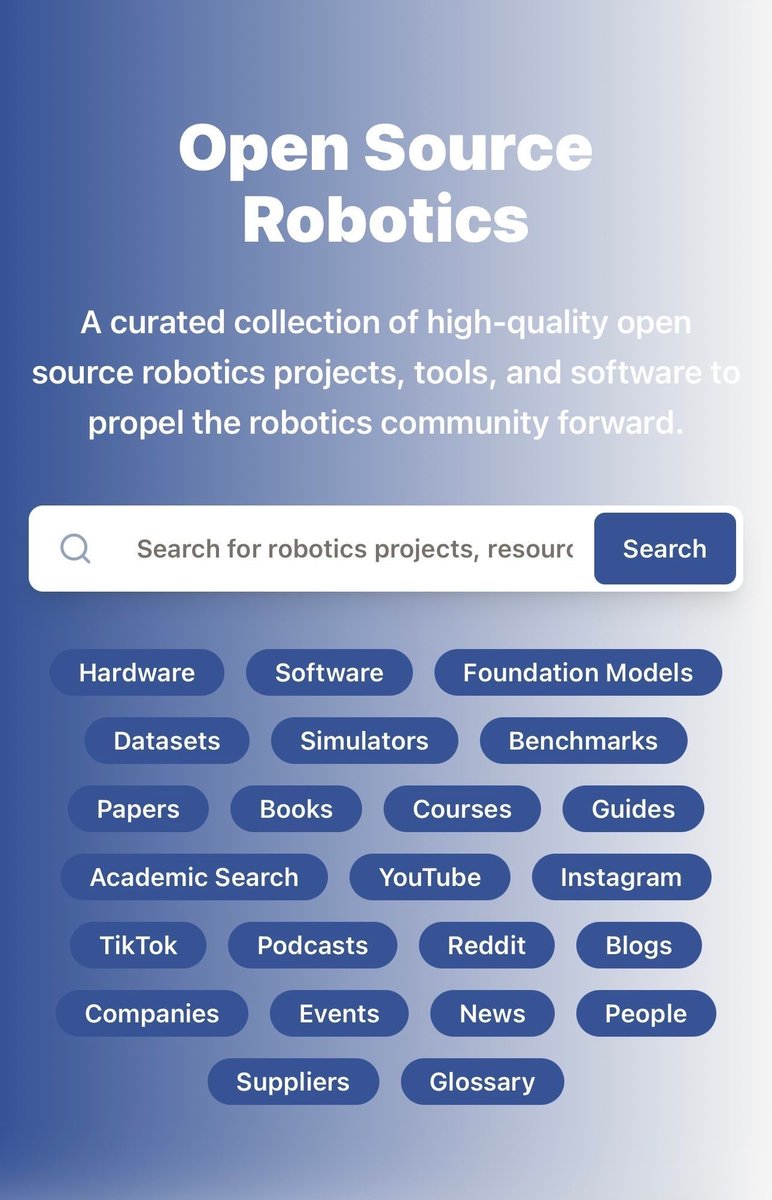
Open Source Robotics
A curated collection of high-quality open source robotics projects, tools, and software to propel the robotics community forward.
https://t.co/YwaZgyQlrj
—-
Weekly robotics and AI insights.
Subscribe free: https://t.co/xDnuw5nZ3q
In this case, the middleman was glass. And the future looks much faster without it.
What’s a piece of "legacy tech" in your industry that is overdue for a physics overhaul?
The biggest bottleneck in Computer Science wasn't your O(n^2) algorithm. It was physics.
For 40 years, we accepted that light travels 47% slower in glass fibers than in air. That’s a massive latency tax.
Microsoft just successfully tested Hollow-Core Fibers.🧵👇
#DarkCrawler
I'm happy to launch version 2.4 of DarkCrawler - a python-based tool that provides comprehensive dark web crawling capabilities with integrated threat detection, marketplace analysis, images extraction, and professional reporting features.
#OSINT#Cybersecurity