Prop challenges die on limits, not targets.
CarrotFunding (rulebook, 1 Oct):
• Target 8% (2-Phase: 5% then 8%)
• Daily loss cap 4–5% of equity
• Max loss trails your high-water mark
The detail people skip: limits use equity, so open losses count.
Which would trip you?
NFA
@FinancePrata The detail people skip: the raffle only helps if you can buy.
JUMP isn't open to US or UK persons, and KYC, the application and the USDC all happen on Legion, not in the Republic.
Check eligibility first, then earn the VP.
Jumper's token sale on Legion pulled ~$15M of bids for a $3M cap in its first 9 hours.
Most of that capital gets scaled to crumbs.
There's a second route into sales like this, and it runs on work, not bag size 🧵
@grebby Gazillion-or-0 checklist:
• Legion picks by reputation, not FCFS or lottery
• Public sale is 4% of JUMP supply
• 50% at TGE, rest vests over 4 months
The detail people skip: Legion's Republic runs a VP raffle too. A rank, not a guarantee. Happy to walk you through it.
NFA
What one oversubscribed ICO taught me today:
• $15.4M applied for a $2M JUMP target on day one (Legion, 29 Sep)
• Legion allocates by reputation, not speed or luck
• So the work happens before sale day
New to ICOs? Start in Legion's Republic: https://t.co/8OLv9TOywb
NFA
About 5% of the sale is set aside for the Legion Republic, with winners drawn by raffle after the sale closes. A chance at an allocation, not a guarantee.
Official sale page: https://t.co/45r4BnBQqk
Which term matters most to you?
NFA
JUMP sale in 4 lines (Legion sale page, checked 29 Sep 2026):
• Opens 29 Sep 2026
• FDV $75M
• Hard cap $3M
• 50% unlocks at TGE, the rest linear over 4 months
The detail people skip: sale date is not TGE. TGE is estimated for Q4 2026 🧵
Volume is money routed through Jumper, not money Jumper keeps.
Source (published 11 Aug 2026): https://t.co/GEu9X7myu5
What's the first metric you check on a new app?
NFA
Most people quote Jumper's volume like it's revenue. It isn't.
What Jumper shipped in July 2026: Private Swap on Base, and day-one support for Robinhood Chain (launched 1 July).
The number: $1.02B volume that month, per Jumper's own update 🧵
Where July's volume came from: Ethereum $383M, Base $126M, Arbitrum $114M.
Two more mix-ups I see a lot:
• Jumper is the app. https://t.co/jKACLLpJQT is the routing layer underneath, used by many apps.
• Monthly active users are not all-time wallets.
What's not live yet: Jumper Perps. The Sept 2026 launch materials call it upcoming, so treat it as a plan, not a product.
Source: https://t.co/1IWRFVy1F9
NFA
Fashion-brain take on Jumper Advanced: the sketch never looks exactly like the final fit until you try it on. Swaps work the same way. The quote is the sketch, the fill is the fit.
Advanced (Jumper blog, 5 Aug 2026) lets you see the fit before you sign 🧵
What's live now:
• Simulation: expected output, price impact, gas and slippage buffer, shown before you confirm
• Smart Slippage: tunes the buffer per pair
• Flow: splits big orders across pools
• Limit orders: set a price once, walk away
Which one would you use first?
@Sutheeohm@legiondotcc Rating: Clarity 4/5, Proof 3/5, Usefulness 4/5. Clear first-hand take on why VP-by-missions is fairer than Score alone. Proof would be stronger with a link to the Squid Prime sale results or the VP rules page.
@Sutheeohm@legiondotcc Agree on the fairness point. Just went through the enlistment trials and VP guides myself: the Discord quiz plus Legion ID verification is a solid filter, and VP has to be earned through missions, not bought. Curious how Score vs VP will be weighted in the Jumper sale.
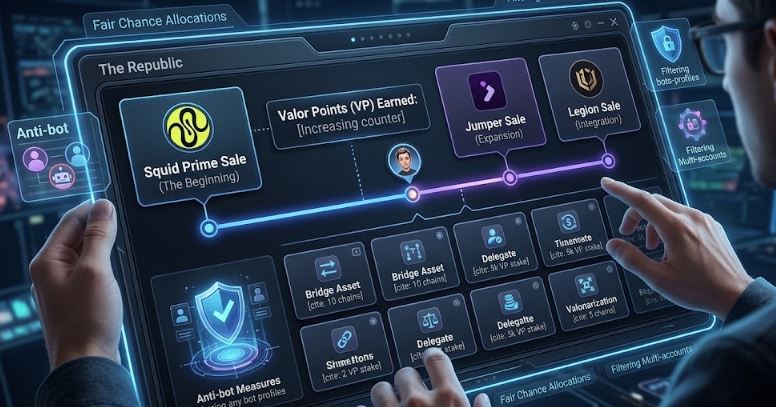
1/3 My journey with The Republic started with the Squid Prime sale post, where members could earn VP through missions. The mechanics hooked me immediately
Even without a high initial Score, it offered a fair chance at allocations while filtering out bots .@legiondotcc
The HyperEVM is live. This is a major step toward the vision of housing all finance by bringing general-purpose programmability to Hyperliquid’s performant financial system. The initial mainnet release of the HyperEVM includes:
1. HyperEVM blocks built as part of L1 execution, inheriting all security from HyperBFT consensus.
2. Spot transfers between native spot HYPE and HyperEVM HYPE. As a reminder, HYPE is the native gas token on the HyperEVM.
3. A canonical WHYPE system contract deployed at 0x555...5 for defi applications. The source code can be found at https://t.co/pXmVRNpqov
Effective immediately, the bug bounty program will pay mainnet bounty amounts for reports within the scope of the points above. See https://t.co/KamzgZAYWh for details.
For API and wallet users: the mainnet HyperEVM has chain ID 999. A JSON-RPC server for the mainnet HyperEVM is hosted at https://t.co/BB0W8L4cXp. Node operators and other builders are encouraged to host their own RPC servers.
Tooling and analytics around mainnet HyperEVM may not be polished on day one. However, there are many talented builders working to solve these developer pain points. To help with these efforts, raw HyperEVM block data is streamed realtime to S3 so that running a node is not required to index the HyperEVM. More technical details can be found here: https://t.co/h6GeFo8HIl
General ERC20 native transfers and precompiles will be enabled on a future network upgrade. Any ongoing feedback for these features on testnet is greatly appreciated. While these features are implemented on testnet, the mainnet releases are staggered for minimal disruption to existing users on the L1. The HyperEVM is composable with the L1 state while not affecting the low latency trading experience of existing users.
Thank you to all the builders and users who have shared feedback on testnet so far. It will be exciting to see new applications leveraging and building upon the existing onchain financial system of Hyperliquid.
Execution
Extremely proud of the community and team for the smooth launch of the HyperEVM. The upgrade happened amidst billions of dollars of daily volume, where the majority of defi derivatives trade. There was no downtime, and no performance degradation after the launch.
The UX of trading is still so seamless that many users assume the HyperEVM is a separate chain! To be clear: the HyperEVM and the existing native Hyperliquid financial system are one composable state.
The safest way to upgrade this uniquely complex system is a gradual rollout. Precompiles and other L1 interactions will build upon the sturdy foundation of the initial HyperEVM release. This will unlock an entirely new class of performant defi applications, but more on that later.
Right now I want to focus on the execution of the launch. A bug in HyperEVM logic or an unoptimized code path would've crippled the entire blockchain, affecting hundreds of thousands of users and billions in open interest.
This was a massively challenging launch: a jet's engine was flawlessly changed mid-flight.
--
Philosophy
The HyperEVM launch stayed true to Hyperliquid’s “no insiders” principle. Hyperliquid has always embodied the original ethos of crypto: no investors, no paid market makers, no fees going to any company. The HyperEVM launch is yet another example that integrity and fairness are the pillars of Hyperliquid.
The tradeoff of a fair launch is that things are a bit messy to start. Tooling might not be there from day one. Builders need to familiarize themselves with the tech. But these short term obstacles are nothing compared to the long term value of fairness. No one had a head start or unfair advantages. I’m impressed that some teams deployed dapps, tooling, and analytics within hours of the HyperEVM release, a testament to the strength of the builders and community.
Hyperliquid will eventually be the credibly neutral infrastructure that houses all of finance. Looking back, the L1 launch, HYPE genesis, and HyperEVM launch will all be important milestones. Success is path dependent, and there can be no blemishes on the fair trajectory towards the final state.
The HyperEVM is a clean slate. The community is hungry for quality applications. Where else in the world is there such an imbalance between supply and demand for applications built? Fast, general purpose chains are nothing new. But on Hyperliquid, builders can plug into a mature, liquid, and performant onchain economy with real users.
I've noticed a pattern that builders, traders, and communities who "make it" on Hyperliquid are those who call Hyperliquid home. Legacy players don't win just because of their credentials. Newcomers have equal opportunity to win by challenging the status quo and seizing the opportunities. There are empires to be built on the HyperEVM, and the community welcomes builders with open arms.
Hyperliquid
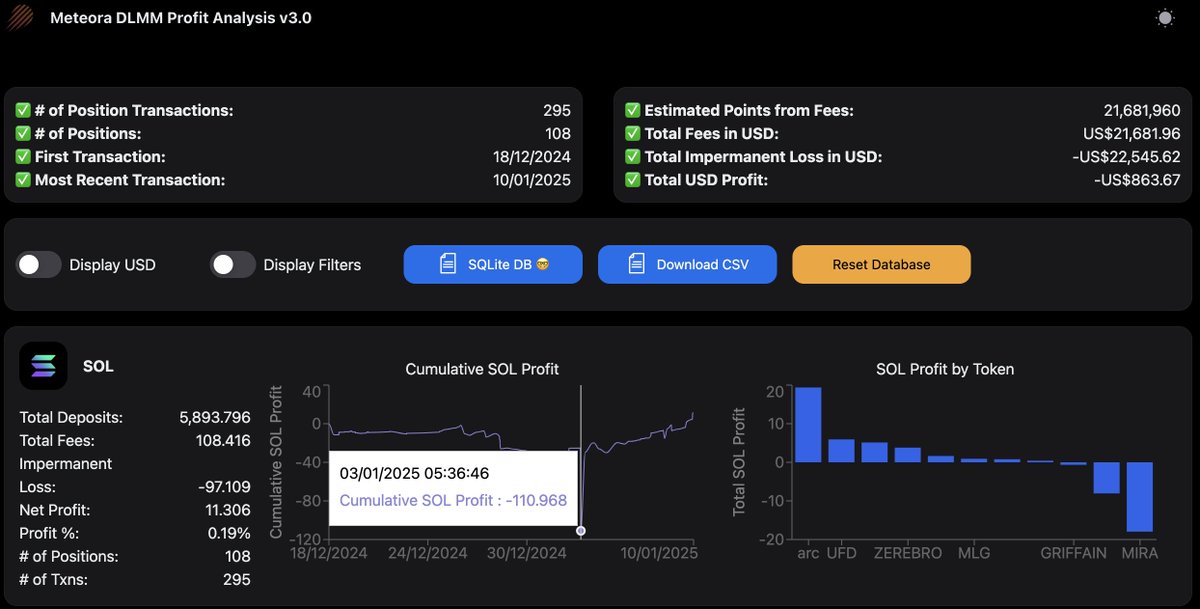
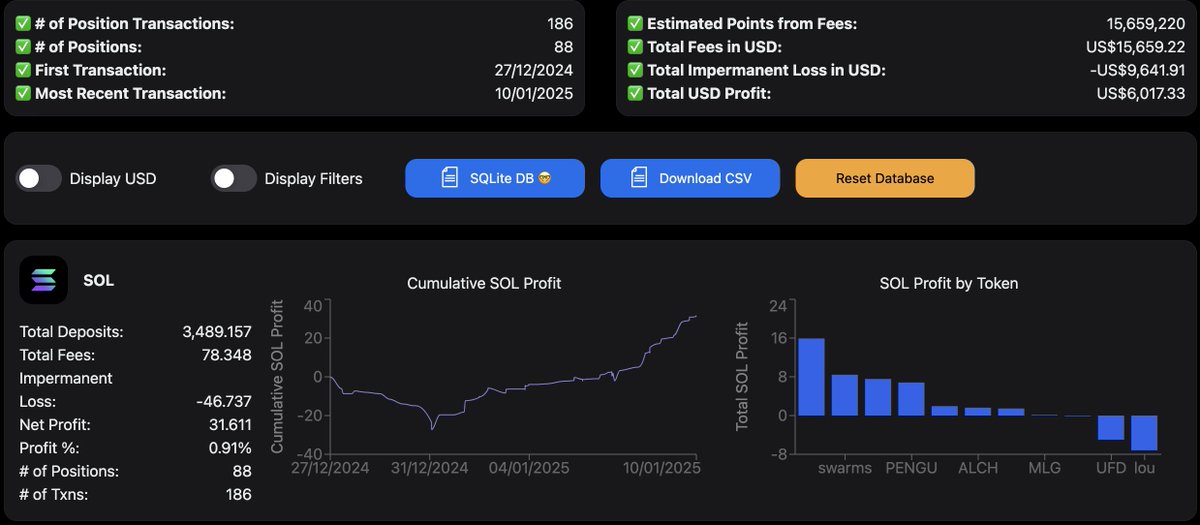
I went from losing -140 SOL to profiting +100 SOL and earning 100 million Meteora points. 🚀
Here’s a detailed breakdown of the strategies that helped me turn it all around 👇