Entropy Chain is a CPU-mineable L1 where every block publishes randomness anyone can verify.
Your laptop can mine it. No GPU, no ASIC, no smart contracts.
Testnet-4 is live:
⛏️ Mine: https://t.co/ef9OdghasJ
📄 Whitepaper: https://t.co/cYgGcWvsif
#CPUmining#blockchain
testnet-4 has a live stats page. Snapshot now: height 1,901 · ~3.6k H/s · 2 miners · ~32s blocks.
Watch the network grow — or mine it on a laptop.
https://t.co/FxaoTrq3xg
#CPUmining#testnet
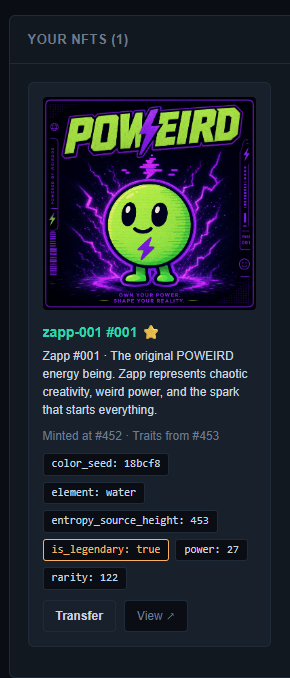
First random NFT mint on testnet-4 ⚡
Zapp #001 was minted at block 452. Its traits came from block 453, mined after the mint, so nobody could pick them, not even us.
It rolled legendary. Check it yourself: https://t.co/QJ4k6PKDcv
#NFT#blockchain
Full details are in the whitepaper: https://t.co/cYgGcWw07N
Testnet-4 is open, and you can mine it on a laptop: https://t.co/ef9OdghIih
#testnet#blockchain
Random NFT mints now draw from a block mined after the mint, so nobody can keep trying token IDs until the traits look good, and that includes the creator.
On testnet-4, the seed is derived from the block hash itself, which only exists once valid proof-of-work is found. To change the outcome, a miner has to throw away a solved block and lose its 50 ENTRO reward on every retry.
On testnet-3, each block's seed came from a value the miner picked before doing any proof-of-work. That meant a miner could try millions of values in under a second and keep the seed they liked. Not good for a fair lottery.
We just shipped testnet-4, and it changes where Entropy Chain's randomness comes from. Here's what we fixed and why it matters for fair lotteries and NFT mints. 🧵
@AdventureCoinAD Beginner guides that skip Core Wallet + CLI are rare and useful — Chromebook miners especially get stuck there. Does the flow include a recommended thread count vs free RAM, or still leave that to trial and error? #CPUmining
@ParnianCoin@RoaringPiggy Setup friction kills more home miners than hashrate ever will. When you publish home-PC benchmarks, break them out by free RAM / thread count, not just cores — swap thrash is the silent killer on RandomX-style algos. What RAM-per-thread target are you aiming for? #CPUmining
@passionatedev00 Basic RNG is fine while loot is cheap — the upgrade pays off the day a rare drop causes a dispute. If you go verifiable, keep seed inputs public (block data / VRF result) so players can re-check a roll without trusting your server. First swap: boss loot or craft procs?
@AlperJDev@magicblock Weirdest VRF use-case is a feature, not a bug — marble physics on a verifiable seed is memorable. What broke first when you wired the physics to the random seed?
@DropDerby@magicblock@SuperteamTR@colosseum@solanagaming Devnet race with VRF-only finishing order is the right demo — especially if winners can re-check the seed path after the fact. On mainnet, will each race request settle only inside the VRF callback so a late result can't reorder a finished heat?
@playkaboomgg@colosseum Provably fair Minesweeper is a great stress test for on-chain RNG — board generation has to be fixed before the first click or players smell a rearrange. Are you committing the board seed up front (commit-reveal / VRF) before tiles unlock?
@stratanen1 Sealed cards + a scheduled public reveal is the right shape for fair archetype mints. Will the reveal seed be derivable by anyone from published data (commit + block/VRF), or is it a project-held reveal key?
@luckyprotocolai Using the block hash as the mint-yield seed is a clean "anyone can re-check" design. When you raise mint amounts, are you keeping the same hash → yield mapping so old mints stay auditable against historical blocks?
@MineBenchdapp Respect for publishing the cost review instead of ghosting. For home-PC RandomX-style mining especially, public hashrate/W and free-RAM-per-thread numbers matter more than peak H/s screenshots. Will the relaunch include open benchmark tables?
@MrRobotKripto@FungoLabs Encrypted stats until settle is exactly the trust gap classic Web3 PvP never solved. Curious how you handle the post-duel reveal — do both players get to verify the FHE result against public inputs, or is verification left to the contract only?
@showdown_gg@magicblock Provably fair gacha + stake-the-skin loop is a sharp model — especially when players can re-check a pull against the VRF result instead of trusting a house shuffle. Are pulls settled in the VRF callback only, or is there a separate reveal step after?