EPCC, part of the University of Edinburgh, is the UK's first National Supercomputing Centre, leading in High Performance Computing, AI and Data Science expertis
Don't miss out on the 𝗗𝗮𝘁𝗮 𝗾𝘂𝗮𝗹𝗶𝘁𝘆 𝗮𝘀𝗽𝗲𝗰𝘁𝘀 𝗼𝗳 𝗮𝗱𝗺𝗶𝗻𝗶𝘀𝘁𝗿𝗮𝘁𝗶𝘃𝗲 𝗱𝗮𝘁𝗮 training course, held in London on 6 October 2026 - delivered by our Prof Peter Christen - *FREE* to attend. Sign up today! https://t.co/70Qo7I1hxa #dataquality@DataciseOpen
The latest issue of our newsletter is out! Read about the expansion of our Cirrus system as a UKRI National Compute Resource; the new Pilot UK AI Factory Antenna, which supports the adoption of trustworthy AI across the UK, and so much more! https://t.co/Rd16fUHNKY
EPCC has been working towards hybrid HPC and quantum since 2023. This new collaboration is a natural fit with our goals as the UK’s first National Supercomputing Centre.
We are delighted to announce a new collaboration with @RollsRoyce, @RiverLane_io and @EPCCed to explore how quantum computing might advance future industrial workflows.
Our focus: complex fluid dynamics simulations.
Read the full post: https://t.co/h4E3ZzPZqt
Joe Wallwork (University of Cambridge) was awarded a CAKE Fellowship focused on improving knowledge exchange of Fortran. He reports on progress so far and his next steps: https://t.co/8sTy2Kf5iF
This online Data Carpentry workshop will be presented by EPCC's Evgenij Belikov. For full details and to register, see the ARCHER2 website: https://t.co/sFMYVS5X2J
Looking for data services but not sure where to start? The Edinburgh International Data Facility's new Estimator tool may be the answer!
The EIDF pricing estimator allows you to explore and estimate project costs before creating an account. Read more: https://t.co/yGSAJTg19V
The CAKE Retreats programme provides funding for community-led retreats to shape the future of the UK’s Digital Research Infrastructure and large-scale computing ecosystem. This programme will run until April 2028. Full details: https://t.co/KZPyw6twek
The CAKE Retreats programme provides funding for community-led retreats to shape the future of the UK’s Digital Research Infrastructure and large-scale computing ecosystem. This programme will run until April 2028. Full details: https://t.co/KZPyw6twek
The Rubin Observatory’s Legacy Survey of Space & Time (LSST), expected to create up to 500PB of data, has begun. EPCC’s Somerville research cloud hosts the UK's Data Access Centre, which will serve LSST science data to the international community: https://t.co/srpkjzHkCg
At 15:10 today at The Royal Society Summer Science Exhibition, EPCC's Lorna Smith will be part of a discussion about the potential benefits of supercomputing and what is being done to minimise their environmental impact. Details at https://t.co/DUUNO25SEs
Digital Research Technical Professional skills and roles can be hard to navigate. CHARTED works to improve this. Join our webinar on July 23 to learn more! https://t.co/2TQrIwpPHM
Another busy day at The Royal Society Summer Science Exhibition in London! Our virtual reality museum activity shows how supercomputers address major challenges - we were delighted to see that one visitor had brought their own homemade model VR headset.
EPCC staff setting up our 'hook the duck' challenge before doors opened at the Royal Society Summer Science Exhibition. If you're attending this week, come to our booth to learn how this activity is key to understanding what a supercomputer is!
https://t.co/OJlLdwN5PI
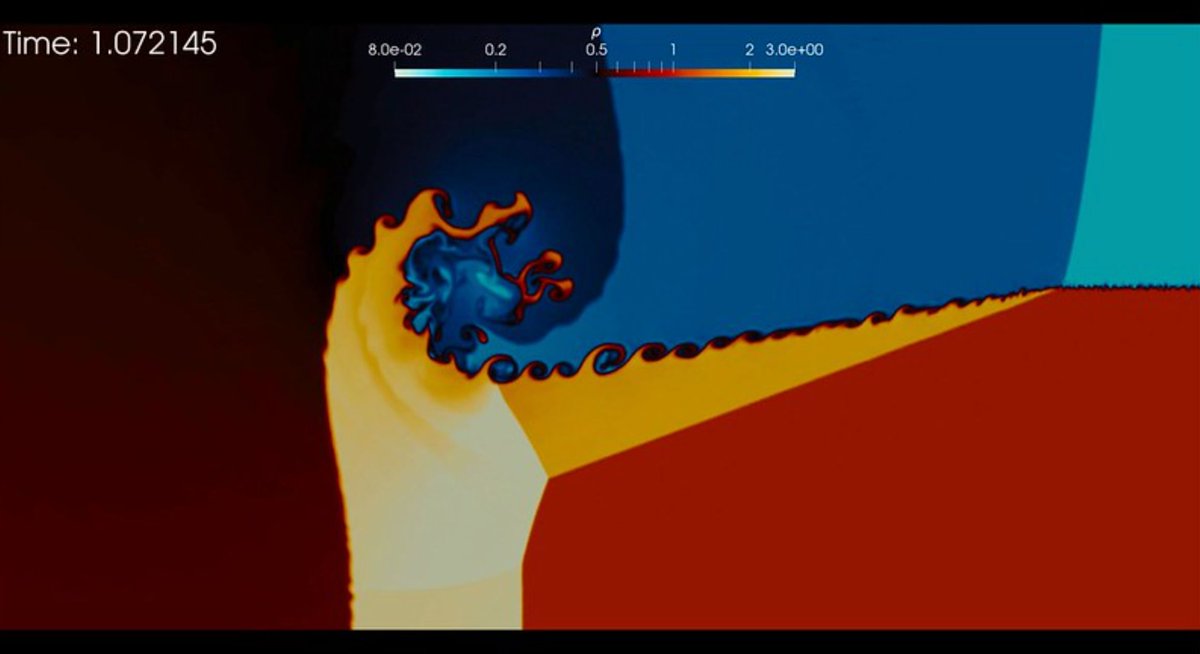
July's @ARCHER2_HPC calendar image is "Contour plots of density from the evolution of a triple material interaction, simulated with a hybrid DG-FV method using UCNS3D" by Prof Pangiotis Tsoutsanis, Cranfield University, UK. Full caption: https://t.co/cFzZ5qb82L
The ARCHER2 calendar image for July is "Contour plots of density from the evolution of a triple material interaction, simulated with a hybrid DG-FV method using UCNS3D" by Prof Pangiotis Tsoutsanis, Engineering and Applied Sciences, Cranfield University
https://t.co/gucXTgxBlb
EPCC is at the Royal Society Summer Science Exhibition this week, with our fun, informative activities. If you're attending too, come and say hello - and learn how supercomputers help address urgent challenges to our health, our security and our planet! https://t.co/OJlLdwN5PI
Daniyal Arshad from @EPCCed presents work at the @risc_v for #hpc workshop on exploring spectral element methods on the @tenstorrent Tennis accelerator with the Nekbone miniapp, done as part of the HPC-R project looking at alternative architectures for #cfd