Derivatives, anti-passive, debt is good in inflationary env, CFA, cricket chauvinist, in search of convexity, asymmetry, Man + machine greater than machine
A billionaire went on stage and explained in 42 minutes how the entire economy works. for free. Wall Street spent the next decade pretending nobody saw it.
he didn't sell a course. he didn't plug a fund. he stood at a whiteboard and drew three lines that explain every crash, every recovery, and every rate decision since 1929.
MBA programs charge $200,000 to teach frameworks he covered in the first 15 minutes. six of the models he drew on that board are still classified as proprietary at three major banks. he gave them away on YouTube.
the part nobody talks about: he predicted exactly what happened in 2020, two years before it played out. interest rates hitting zero, the central bank running out of tools, the money printer. he drew it on a whiteboard in 2018 like he was reading tomorrow's newspaper.
a portfolio manager at a top-five firm told me every new analyst on his desk watches this before they're allowed to open a terminal. not the CFA prep. not the internal training. this one lecture.
40 million people have seen it. almost none of them can name the three forces he draws in the first ten minutes.
it is still free.
Google just dropped a free 2-hour Graph Engineering course.
Most people stop at:
→ 1 prompt
→ 1 agent
→ 1 workflow
This goes much further:
17:44 → Build your first agent
39:30 → Loop engineering
1:12:38 → Graph engineering
1:34:26 → Self-throttling agents
1:55:05 → Multi-agent graph systems
The future isn't a single agent.
It's networks of agents that coordinate, evaluate, remember, and improve themselves.
Watch the course, then read the article below
HARVARD FILMED THE FIRST LECTURE OF THEIR MOST POPULAR STATISTICS COURSE - TAUGHT BY A PROFESSOR WHOSE STUDENTS CALL HIM THE BEST TEACHER THEY HAVE EVER HAD - AND IT PROVES WHY EVEN ISAAC NEWTON GOT PROBABILITY WRONG
This is Joe Blitzstein, Harvard, Statistics 110, lecture 1. He has won Harvard's Excellence in Teaching award multiple times, his textbook Introduction to Probability is used in over 200 universities worldwide, and his online course has been taken by over 2 million people across 190 countries. He opens by saying that after a few weeks of this course you will easily solve calculations that 300 years ago required consulting Isaac Newton - and Newton's intuition was still wrong.
He traces probability to Fermat and Pascal writing letters back and forth in the 1650s analyzing gambling games. No one had mathematically derived the rules before. They invented the subject by betting on dice in correspondence. Then he shows why the naive definition - probability equals favorable outcomes divided by total outcomes - breaks immediately. Ask what the probability of life on Neptune is. Either there is or there isn't. By the naive definition the answer is 1/2. So is the probability of intelligent life on Neptune. Something is severely wrong.
Then the multiplication rule. Two types of ice cream cone and three flavors gives 6 combinations - not because you memorized it but because you can draw a tree and count branches. Every counting problem in the course is just a bigger version of that tree. Then binomial coefficients - n choose k counts the number of ways to select k objects from n when order doesn't matter. The full house in poker falls out in 4 lines of multiplication once you understand the tree.
Watch the moment he fills in the sampling table - with or without replacement, order matters or doesn't. Three of the four boxes are immediate from the multiplication rule. The fourth requires a proof he saves for next lecture. That one box is harder than the other three combined.
A data scientist I know rewatched this lecture before switching careers into statistics. Said it was the first time probability felt like a system with rules rather than a collection of tricks.
Free on YouTube, Harvard, over 2 million views.
bookmark this and watch later - after this lecture you will never again confuse equally likely with obviously true
Mark Cuban on the next job wave.
Customized AI integration for small to mid-sized companies.
"Software is dead because everything's gonna be customized to your unique utilization. Who's gonna do it for them... And there are 33 mn companies in the US."
That person is called a Forward Deployed Engineer.
And it's the hottest job in tech right now and most people have never heard of it.
Here's the no-BS guide to what it is, what it pays, and how to become one ↓
Bookmark this.
Indian markets - equities & FX - will open to a bunch of good news on Monday Aug 3:
1. It's TACO again. Pres Trump, after threatening on July 31 to 'hit Iran very hard', held off the attack over the weekend claiming the 'perimeters of a deal' had been agreed upon.
2. This TACO has the power to pull down crude on Monday and thus fuel equities in India
3. Auto sales for July are dazzling:
-Maruti's sales rise 34%yoy; domestic sales up 42%
-M&M's auto sales are up 26%; tractor sales up 21%
-Eicher's <350cc bike sales up 38%; >350cc up10%
-Hero Moto sales in-line, up 19%
4.July sees over $1.5 bn of net FPI purchases in equity- first month of positive inflows after February
5.RBI says $40.8 bn has flowed in since mid June via FCNR(B) deposits, OFCBs & ECBs. With 2 more months left, bankers are scaling up their estimates of likely dlr flows, leading to a positive rupee view
6.Rupee retakes 3-week high of 95.25/$ on Friday. FPis may slowly get convinced rupee looks good to strenghthen some more; this can induce more FPI buying
7. In -ve news Bloomberg on friday said it isn't yet including India in its bond index & is waiting for India's tax and other measures to settle in. This can hurt bonds and hence rate sensitives, but with Bloomberg holding out hope that inclusion is on the cards, the negativity may be limited.
All told a decent equity and rupee rally looks possible
Don't waste 2 years learning to code.
Thariq Shihipar, the Anthropic engineer who built Claude Code tells you what to learn instead.
1 hour course. Free:
00:00 - build AI agent with loops
40:47 - prompting Claude with HTML
1:15:07 - Anthropic's coding playbook
Writing code is the old job. Building AI agent loops is the new one.
Bookmark now & read the article below to build your own AI agent with loops & graphs.
A single name has a shelf life. A way of deciding doesn't.
Ten of them, from the people who actually use them — so you can run one on a business nobody at the summit ever mentioned.
Andrew Ng just dropped a 3-hour course on how to become an AI Engineer in 2026:
• 00:00 - How to build agentic AI systems
• 04:25 - Future of AI engineering
• 23:38 - AI Prompting full course
• 2:52:17 - Creating an app with AI in 30 minutes
This 3-hour watch could replace 10 AI engineering courses on the internet.
Watch it today, then read the 12- month path to becoming an AI Engineer in the article below.
this is f**king insane
Jack Dorsey just open-sourced the operating system for the one-person business.
A free GitHub repo.
14.4K stars in days.
Here's what it actually does:
→ Self-host your own server
→ Channels, search, git, automation — all in one place
→ Add an AI agent to a channel like a teammate
→ Scope its permissions, let your team steer it live
No SaaS subscriptions.
No vendor lock-in.
No $500/month tools you barely use.
Just you, your agent, and full control.
This is what the future of solo operations looks like.
Save this before it blows up.
An Anthropic engineer shared the exact system they use as a second brain.
Three folders. One file. One evening to build.
Most people use Claude the same way every day. Open a new tab. Rebuild context. Get an answer. Close the tab. Tomorrow it remembers nothing. You are still the one holding all the context. You are still the one resetting.
This architecture solves that problem.
The system is built around three folders and one file.
raw/ holds everything unstructured. Articles, transcripts, PDFs, voice memos, screenshots. Drop it in and never touch it again. Immutable ground truth.
wiki/ is where Claude converts everything in raw into structured, linked, cross-referenced knowledge. Clean. Organized. This is the folder Claude actually thinks from. The human reads it. The model writes it.
output/ is where finished work lands. Reports, posts, documents, presentations. Everything Claude builds using the wiki as its source.
At the center is CLAUDE.md. Not a prompt, but a persistent layer of identity, preferences, goals, and project context. Claude reads it before every session. You never explain yourself again.
Five automations run the system.
Ingest captures and extracts new sources into the wiki. Write retrieves context and drafts outputs. Manage links decisions to context. Review summarizes and updates. Maintain prunes and improves connections.
Every session adds to the system. Every source makes the wiki smarter. The returns compound over time.
One month in, context stops disappearing. Three months in, the vault surfaces ideas you forgot you had. Six months in, the gap between compounding and resetting becomes impossible to ignore.
Build once. Maintain daily. Let it compound.
Bookmark this.
this is f*cking gold
Andrej Karpathy joined Anthropic five weeks ago.
A friend on his team just showed me the exact Claude.md file he actually uses.
I dropped it into my setup. The very first response was different.
Not slightly different. Completely different.
Claude stopped giving generic answers and started working exactly the way I think.
Bookmark it before it gets lost in your feed.
Read it now, then check the article below.
This TBPN interview with Martin Shkreli on the Leopold Aschenbrenner blowup today was a great listen, filled with lots of interesting information. HIGHLY recommended:
https://t.co/iEw1oCWLKF
OpenAI pays $785K/year to developers who know how to apply Forward Deployed Engineering in AI.
in 40-minute talk, Head of FDE at OpenAI revealed full roadmap for how they actually use FDE internally:
• 10% → 2:46 - why Morgan Stanley was their first FDE case
• 30% → 9:05 - FDE eval-driven development explained
• 55% → 16:01 - FDE live-demo: LLM rerouting a supply chain
• 80% → 24:33 - advice for founders building FDE teams
• 100% → 29:06 - the biggest FDE mistake they made this year
40 minutes replaces a $500 enterprise AI deployment course
bookmark & watch - then read how to become FDE engineer in article below ↓
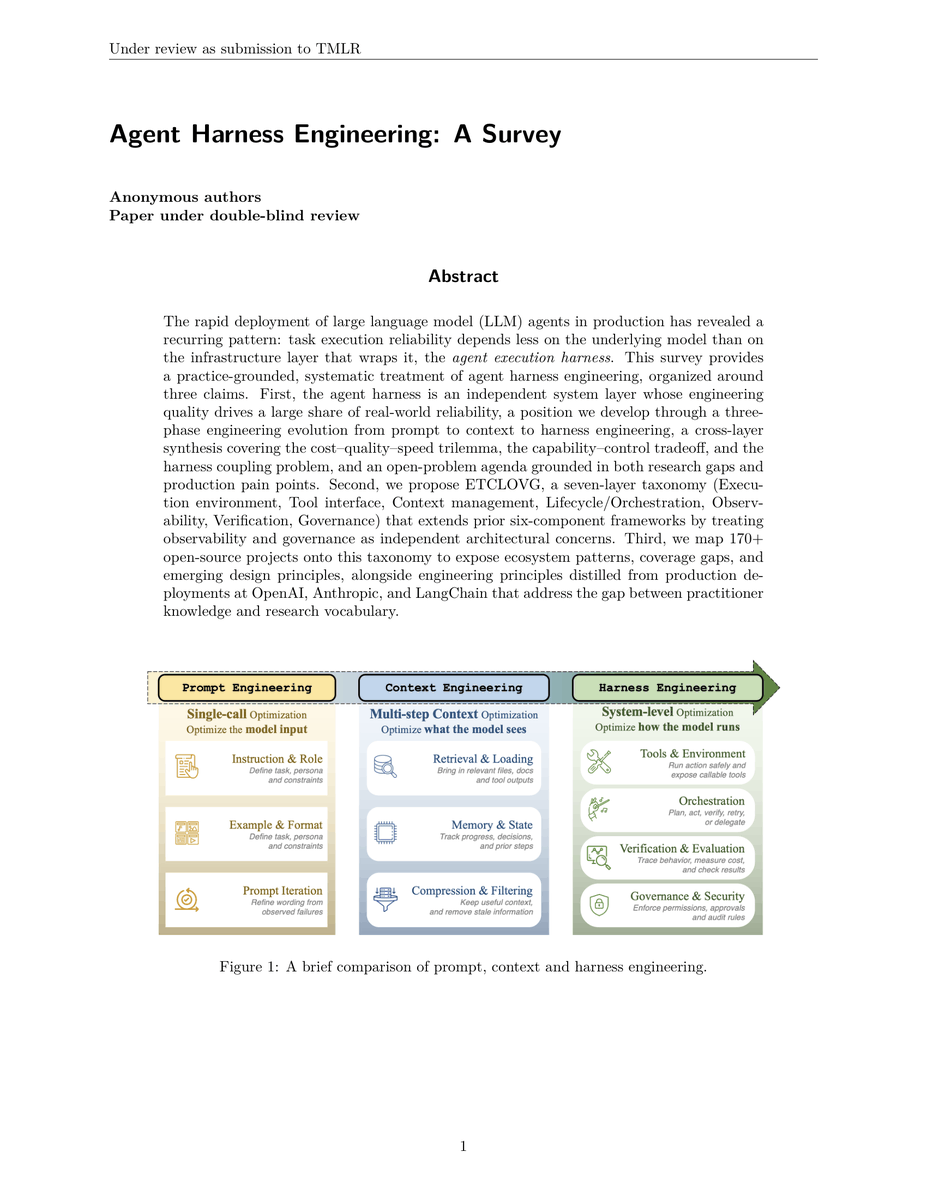
This paper is f*cking brilliant
A computer science paper establishes harness engineering as the primary determinant of AI agent reliability
The result: the ETCLOVG seven-layer architecture unifies execution sandboxes, tool protocols, context state, lifecycle graphs, observability, verifiers, and governance
The crazy part is how harness engineering boosts performance without changing the underlying model
Optimizing the execution harness alone increased SWE-bench coding benchmarks from 6.7% to 68.3%
Most developers try to fix agent failures by upgrading to larger LLMs
This framework shifts system reliability from model weights to deterministic harness architecture
Read the complete paper + article below
Bookmark it for future reference
Your PR has been "in review" for 72 hours.
CodeRabbit would've reviewed it in 3 minutes... line-by-line, with fixes ready to apply.
Make "waiting on review" a thing of the past!
Still the best hour on graph engineering ever recorded, Andrew Ng breaking down how to build agentic knowledge graphs from scratch:
00:00 - what agentic knowledge graphs actually are
03:05 - building a graph from scratch
13:58 - the architecture behind multi-agent systems
22:57 - building a real one with Google ADK
01:06:02 - why graphs are the future of AI agents
I've seen $500 courses that teach less.
Watch it, then take it further with my step-by-step guide on graph engineering below.
A Stanford mathematician who spent 10 years as a professional magician just described the entire market in one sentence.
Bookmark & watch today, no matter what.