"If your project is strong, exchanges will race to list your coin" @ergo_platform
"Focus on treating your users well. Don't focus on your competitors" @RosenBridge_erg
"If you are a bag holder of a coin, complain to the project. Not the exchange. Or use a DEX" @Mew_finance
Unpopular opinion post:
On Listing "Fees" (saw this a few times recently)
1. If you are a project complaining about listing airdrops or "fees" (to users),
Don't pay it.
If your project is strong, exchanges will race to list your coin.
If you have to beg an exchange to list, then... You need to ask yourself why, and who is providing value to whom.
2. If you complain about a competitor exchange's listing fees, then by all means, make your own listing fees 0, and be happy.
In fact, why not set all your fees to 0? including trading fees?
In a decentralized world, businesses are free to have their own business models. No one is forcing you to adopt a certain model.
Focus on treating your users well. Don't focus on your competitors.
3. If you are a bag holder of a coin, complain to the project. Not the exchange. Or use a DEX.
4. PancakeSwap doesn't have listing fees, and has very good volumes.
Further on this topic, exchanges adopt different listing models.
1. List everything on every blockchain. Most tokens are scams. Of the real "hard working" projects, most fail. Only a few projects will succeed.
2. Selectively list and make listing fee a revenue source. It's fine business model if you can attractive enough projects to list. Many small exchanges use this model, as they don't have enough trading fee revenue.
3. Selectively list. Ask for Airdrops to users. Security deposits, to make scams and failed projects more expensive to pull off. Protect users.
These models are not black and white, and many exchanges adopt a combination of them between spot listing, futures listing, alpha listing, web3 wallet buys, etc.
Work on your project, not other people. 🙏
Unpopular opinion, people on Cardano aren’t cypherpunks and don’t care about decentralization or tech.
Wanna know how I know?
Because they’d be focused on Ergo.
I personally think the basic goal of Ergo movement is to enable and empower p2p environments where self-sovereign communities as well as individuals may interact and thrive.
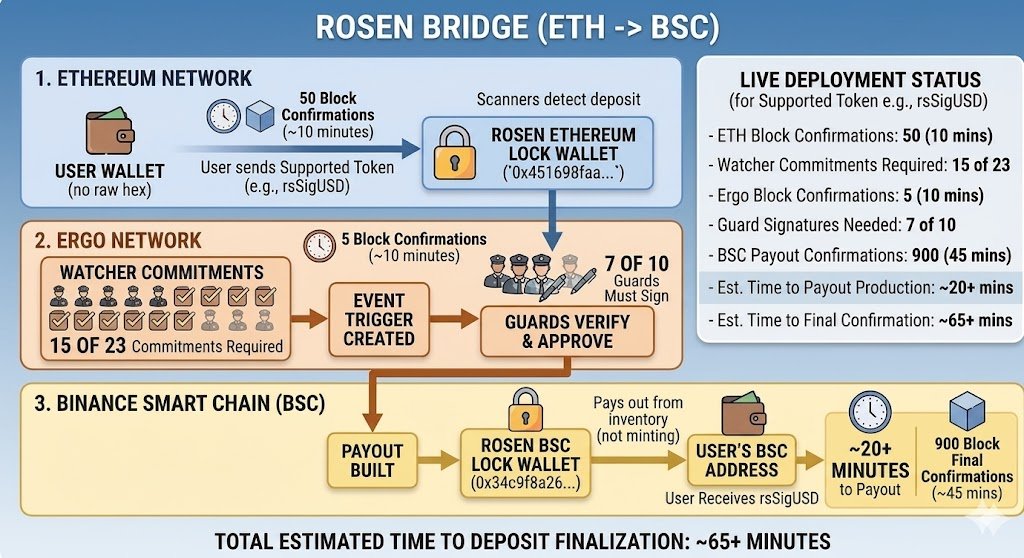
Assumptions are very clear with @RosenBridge_erg
Say we are going from ETH -> BSC
- user sends token to a msig like address on ethereum controlled by a guard set of 7/10
- watchers (decentralized) of 15/23 bring this event on to ergo blockchain where at least 15 watchers need to validate the event actually exists on ethereum and post about it on ergo
- at least 7 guards need to then verify this claim then only releases asset on BSC from another 7/10 msig like address
watchers can join us at ANYTIME and earn rewards while contributing to decentralization and security
Now consider KELP's LayerZero bridge
- user sends token to contract
- contract burns token
- DVN (equivalent to guard-watcher) ran by LayerZero verification and ONLY ONE verification required
- executor delivers message to ethereum where a contract unlocks the token on the ethereum side
To put the exploit in the simplest terms, the 1/1 DVN infrastructure was hacked.
Draw your own conclusions. Know your assumptions.
I added some gemini drawn visualizations of how the bridges work.
Also, good time to remind that massive onchain-transparent double layered multisig is seemingly superior in practice option in regards with trust assumptions. Choose Rosen over insecure bridges
In a peer to peer network you are your own server.
It is best to run your own node.
If you are not a network peer this should be your first question. Where is the server and what power does it have.
Running a node ensures maximum privacy, security, and financial sovereignty by running and verifying your own transactions, rather than trusting third party servers.
Reject the idea of "crypto" embrace p2p.
Be the network.
The real red pill isn’t crypto will free you.
It’s that no one is coming to free you.
Not Elon, not Vitalik, not the next guy.
Sovereignty is a DIY project.
Build things, run things, know your assumptions and work to improve your own local state.
This is exactly the missing link for #CKB
Two layers of verifiable security, the watchers and the guards for cross chain interaction
Secure, robust and direct access to cross chain liquidity
Rosenbridge isn't just another bridge it's a trustless gateway to the future of UTXO
The fact that no other crypto protocol has yet implemented Demurrage says a lot about the space. They can only kick the can down the road for so long. Stay locked in! #ERGO
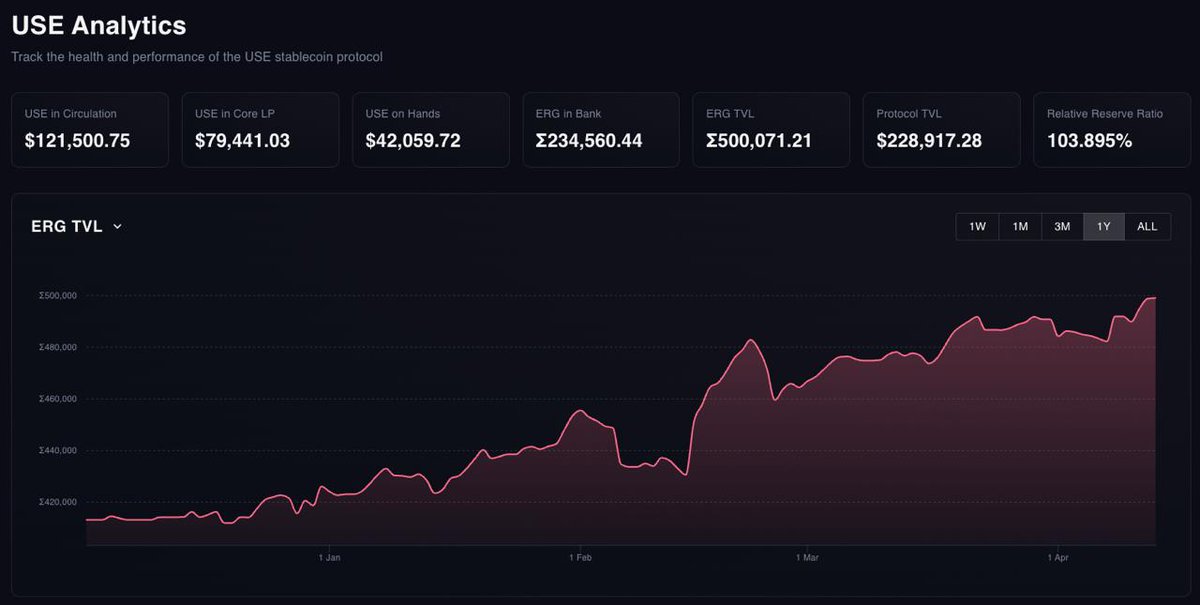
ERGO miners can now move in and out of USDT in a fully decentralised way using our next-generation algorithmic stablecoin, $USE, via @RosenBridge_erg
Who needs CEXs?
Everyone said GPU mining died with the Merge.
But what if it just moved — to $ERG?
ASIC-resistant. Fair launch. No VC money. Real Proof-of-Work.
The last refuge for real decentralization.
#Ergo#ProofOfWork#GPUmining#Crypto
@Armeanio’s essay perfectly diagnoses the pathology of modern crypto: much of what the industry celebrates as "protocol revenue" is simply digital corporatism, a technocratic rebranding of traditional Payment for Order Flow (PFOF). Lithos is the exact structural antidote required to democratize the PoW base layer.
But if we follow this logic to its natural conclusion, we must confront the next frontier of rent extraction: Layer 2 rollups.
The broader industry has accepted centralized L2 sequencers as a "necessary evil" for scaling. But this centralization isn't a temporary cultural failing; it is a matter of architectural determinism.
The EVM Account Model relies on a global, synchronous state. When thousands of users interact with a smart contract, they are fighting to overwrite the exact same shared ledger. To prevent a chaotic collision of concurrent transactions, the architecture strictly requires a centralized arbiter to act as a traffic cop and organize the queue.
By design, that arbiter becomes the ultimate Order Flow King. They are granted total visibility over the mempool and an exclusive monopoly on MEV extraction.
This is where Ergo’s architecture moves from a technical nuance to a structural necessity.
The eUTXO model fundamentally alters the physics of execution. Because state is local, perfectly partitioned into isolated, independent boxes rather than a shared global whiteboard, transactions are inherently asynchronous. They do not naturally collide. Consequently, an L2 built on Ergo doesn’t strictly need a monopolistic sequencer to dictate order.
If an intermediary ever attempts to extract rent, censor a user, or sandwich a trade, the eUTXO architecture natively allows that user to generate their own local state transition, bypass the middleman entirely, and settle permissionlessly on L1. You cannot be a King of Order Flow if your users can mathematically walk around your tollbooth.
But here is the critical synthesis that most modular theorists miss: an L2 "escape hatch" is purely theatrical if the underlying Layer 1 is controlled by a builder cartel. A malicious L2 sequencer will simply bribe the L1 cartel to censor your exit.
This is why these pieces must exist together. Lithos immunizes the L1 base layer against capture. eUTXO immunizes the L2 execution layer against monopoly.
You cannot build a non-extractive L2 on a shared-state EVM, and you cannot enforce a fair L2 on a captured L1. Ergo is quietly assembling the only complete, mathematically rigorous immune system left in the space.
"Money Creation with Elastic Supply via Trust and Blockchain Assets in Global Digital P2P Environment" - video from 1st Stability Workshop
Update:
The first Basis redemption transaction for offchain note with Bob redeeming a note signed by Alice (and also witnessed by tracker).
I think in future tracker could be federative, like oracle pools or Rosen
Next, demos for trading over mesh networks, and agent to agent debt creation and clearing.
https://t.co/EIrvM0x0Wd