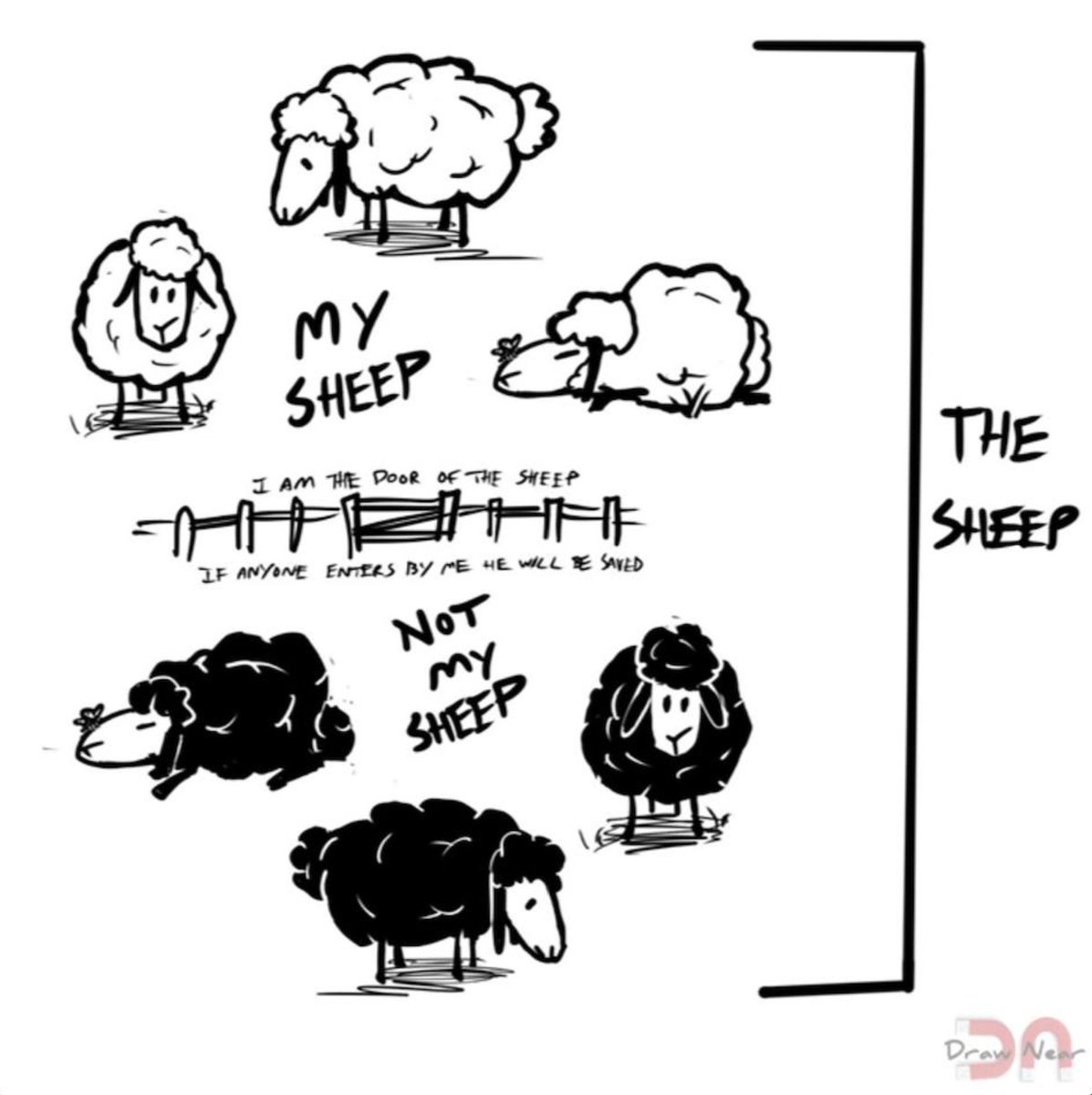
John 10:15 “I lay down my life for the sheep.”
Calvinist teachers use presuppositions to falsely imply that every verse is some aspect of TULIP. Does this verse say the sheep are a pre chosen elect? Absolutely not. The sheep are Israel and anyone who believes.
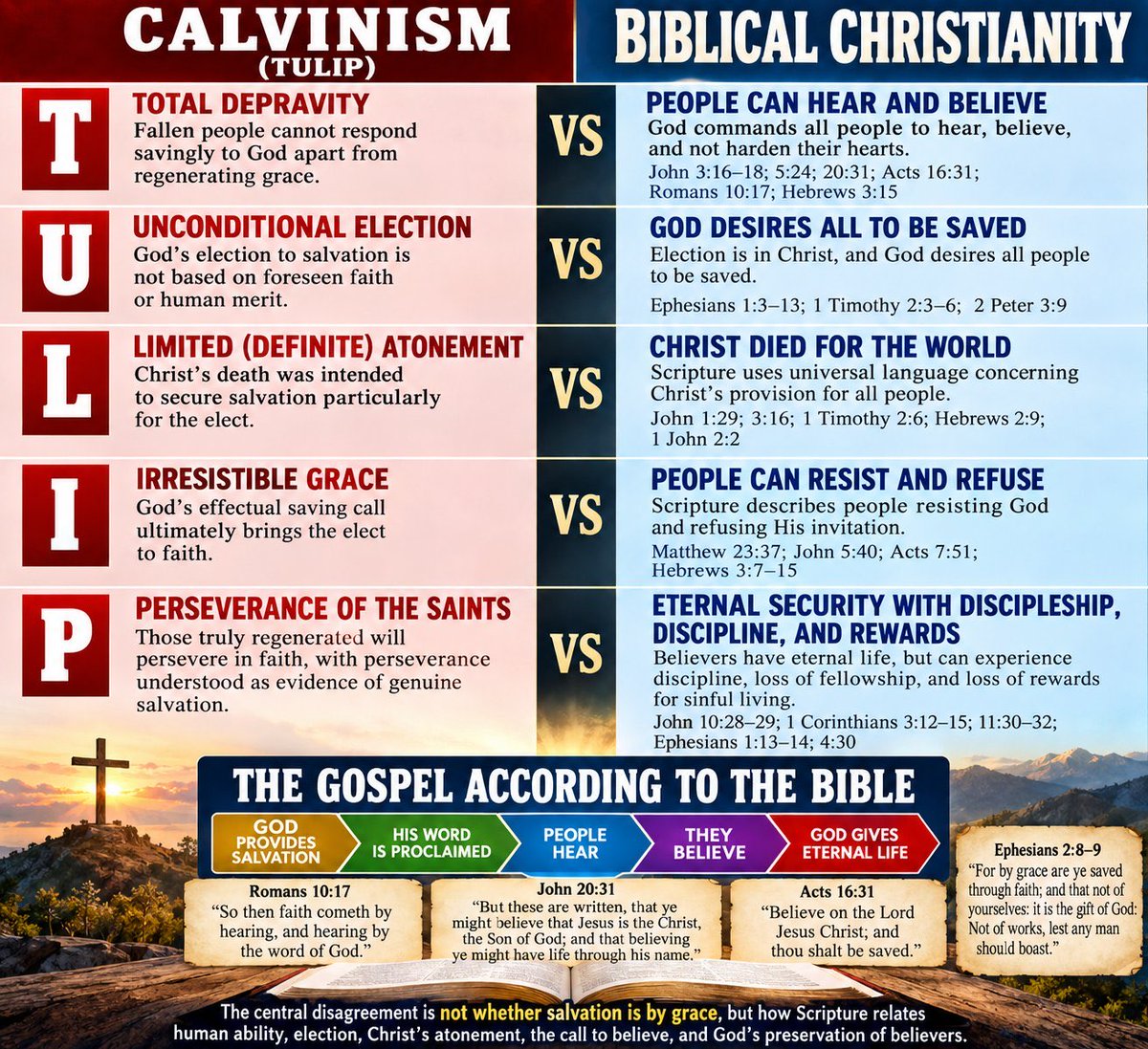
For those of you in this poll who didn’t understand the Calvinist TULIP doctrine
The only thing I’d add is the silent “E” for evanescent grace:
Evanescent grace = those who do not persevere were deceived with a grace that didn’t save
AMAZING!!
They show giant drogue stones cut loose like breadcrumbs leading to the Durupinar site, just like the story says. Twenty-six of them. Car-sized anchors pointing the way.
The Bible keeps looking less like a fairy tale and more like a record.
Faith is not blind. Sometimes it has receipts.
WHAT ABOUT THOSE WHO NEVER HEAR THE GOSPEL?
Not everyone hears the gospel. Everyone does have general revelation—creation and conscience—which Paul says is clearly seen and understood, so they are without excuse (Rom 1:20). That’s enough light to acknowledge God as God. If they don’t suppress that truth, God is faithful to give more light. That’s the story of Cornelius in Acts 10-11.
People aren’t condemned for rejecting a sermon they never heard. They’re condemned for sin and for trading the truth they did have for lies.
Why do some who hear the gospel receive it and others reject it? Same reason some respond to the light they already have and some don’t. They aren’t born unable. They can grow calloused. The gospel itself is the sufficient gracious appeal. We don’t need a second, secret work that only some get.
More here: https://t.co/trLKmUQQF9
You may have been told a very different story about the Potter, one in which He fashions some for mercy and others simply for destruction. But before we decide what the Potter does with His clay, shouldn't we first listen to the Potter Himself?
There is something about the usual treatment of Romans 9 that has troubled me for a long time. We are told that God is the Potter and man is merely clay, and from that perfectly biblical truth an enormous conclusion is drawn: God may unconditionally make one person a vessel of mercy and another a vessel of wrath, withhold from the latter the only grace by which he could ever believe, and then destroy him for remaining exactly what God determined he must remain. If anyone questions that conclusion, “Who art thou, O man?” is supposed to end the conversation.
But Paul did not invent the Potter and the clay in Romans 9. He reached back into a biblical story already told, and the strange thing is that when God Himself explains that imagery, the clay is not being arbitrarily destroyed without regard to its response to Him.
Jeremiah watched a vessel become marred in the potter's hand, and the potter made it again into another vessel “as seemed good to the potter to make it.” God then said, “O house of Israel, cannot I do with you as this potter?... as the clay is in the potter's hand, so are ye in mine hand” (Jer. 18:4–6). Nobody reading Scripture seriously should quarrel with that sovereignty.
Yet God immediately explains what He means. If He pronounces that a nation will be plucked up and destroyed, “IF that nation... turn from their evil, I will repent of the evil that I thought to do unto them.” Conversely, if He announces blessing and that nation turns to evil and refuses His voice, He says He will withhold the good He intended for it (Jer. 18:7–10). He then tells Judah, “Return ye now every one from his evil way,” and their answer is that they will continue after their own devices and evil hearts (vs 11–12).
That is important because God's own explanation makes the threatened outcome responsive to the moral condition of the people. The Potter is sovereign throughout, but His sovereignty is not arbitrariness. Destruction is deserved, repentance meets mercy, persistent rebellion meets judgment. The clay being in His hands never means that the clay's response to His warning is irrelevant.
Nineveh makes this even clearer. Jonah walked into the city announcing, “Yet forty days, and Nineveh shall be overthrown” (Jonah 3:4). If an announcement of destruction necessarily revealed an unconditional decree to destroy, Nineveh was finished. God Himself had announced its overthrow.
But the Ninevites believed God, humbled themselves, and turned from their violence. Scripture then says, “God saw their works, that they turned from their evil way; and God repented of the evil, that he had said that he would do unto them; and he did it not” (Jonah 3:10).
So God's announcement of destruction told Nineveh what its wickedness presently deserved. It did not mean that God had eternally fashioned those people for destruction and made any other outcome impossible. The warning itself became God's merciful means of bringing them to repentance.
That distinction matters enormously when we come to Pharaoh.
Yes, God told Moses beforehand that Pharaoh would resist and that He would harden Pharaoh's heart (Exod. 4:21; 7:3–5). But knowing beforehand what a wicked ruler will do does not make God the moral cause of his wickedness. Nor does God's sovereign determination to use Pharaoh's rebellion for His own purposes require us to believe that God first had to create the rebellion He intended to judge.
Pharaoh is introduced to us within an Egyptian system already oppressing Israel and murdering Hebrew sons (Exod. 1:8–22). When God's command finally reaches him, Pharaoh answers, “Who is the LORD, that I should obey his voice?... I know not the LORD, neither will I let Israel go” (Exod. 5:2). That defiance is Pharaoh's.
What follows is fascinating because Exodus refuses to tell the story in only one direction. Pharaoh's heart is hardened (Exod. 7:13). Pharaoh hardens his own heart (8:15, 32; 9:34). God hardens Pharaoh's heart (9:12; 10:20, 27). We have no right to erase Pharaoh's self-hardening in order to defend God's hardening, any more than we have the right to erase God's hardening in order to defend Pharaoh's responsibility.
And while Pharaoh is resisting, God does not stop revealing Himself. Pharaoh receives command after command, warning after warning, plague after plague, relief after relief. The revelation becomes so undeniable that Pharaoh eventually says, “I have sinned this time: the LORD is righteous, and I and my people are wicked” (Exod. 9:27). Yet after relief comes, Scripture says, “he sinned yet more, and hardened his heart” (9:34).
There is a small detail in that same chapter that deserves far more attention. Before the hail, God warns the Egyptians to bring their servants and cattle under shelter. “He that feared the word of the LORD among the servants of Pharaoh” obeyed the warning, while “he that regarded not the word of the LORD” left them outside (Exod. 9:20–21).
The distinction in the text is not between Egyptians whom God arbitrarily decided to warn and Egyptians He refused to warn. The warning went out. Some began to fear God's Word. Others disregarded it. Pharaoh himself continued resisting under an ever-increasing revelation of the God he had originally mocked with, “Who is the LORD?”
So when God eventually judicially hardens Pharaoh, He is not turning a humble seeker into a rebel. Pharaoh has repeatedly resisted the light given to him. God's hardening is terrible judgment upon rebellion, and at the same time God makes that very rebellion serve His purpose: “For this same purpose have I raised thee up, that I might shew my power in thee” (Rom. 9:17; Exod. 9:16).
That pattern did not disappear with Pharaoh. Paul describes it in Romans 1. Men suppress truth in unrighteousness, refuse to glorify God, exchange His truth for a lie, and then three times we hear the dreadful judicial response: “God gave them up” (Rom. 1:24, 26, 28). Second Thessalonians says people “received not the love of the truth, that they might be saved,” and “for this cause God shall send them strong delusion” (2 Thess. 2:10–11).
“For this cause” matters. Their judicial condition has a moral history.
And Paul has already told us the same thing about wrath before Romans 9 ever begins. God shows “goodness and forbearance and longsuffering,” and His goodness “leadeth thee to repentance.” But the person who continues “after thy hardness and impenitent heart” is said to “treasure up unto thyself wrath against the day of wrath” (Rom. 2:4–5).
That language is almost impossible to miss once Romans 9:22 comes into view: “What if God, willing to shew his wrath, and to make his power known, endured with MUCH LONGSUFFERING the vessels of wrath fitted to destruction?”
The same Paul has already joined longsuffering with repentance, and hardness with wrath. The man under judgment is said to treasure wrath unto himself through his hard and impenitent heart. So there is no exegetical reason to suddenly make “vessels of wrath” mean people whom God created for the purpose of destroying irrespective of their response to His goodness and patience.
Even Paul's wording deserves restraint. He calls them “vessels of wrath fitted to destruction,” but when he turns to the vessels of mercy he says, “which HE had afore prepared unto glory” (Rom. 9:22–23). Paul explicitly attributes the beforehand preparation for glory to God. He does not write the corresponding sentence that God “afore prepared” the vessels of wrath for destruction. We should be very careful about supplying words Paul did not.
And this is where Paul's later use of the same vessel imagery becomes extremely important.
In 2 Timothy 2:20 he writes that in a great house there are different vessels, “some to honour, and some to dishonour.” If “vessel unto dishonour” were itself a technical description of an individual whom God had immutably fashioned for that condition, Paul's next sentence would be very strange indeed:
“If a man therefore purge himself from these, HE SHALL BE A VESSEL UNTO HONOUR, sanctified, and meet for the master's use, and prepared unto every good work” (2 Tim. 2:21).
Paul has just taken the language of vessels, honour and dishonour and placed moral response right in the middle of it.
He does not tell the dishonourable vessel, “Discover which immutable class the Potter assigned you to before creation.” He tells the person to cleanse himself from what is dishonourable, and “he shall be a vessel unto honour.” That doesn't make Romans 9 and 2 Timothy 2 identical passages, but it tells us something we cannot honestly ignore: Paul's vessel language itself does not mean that a person's status as honourable or dishonourable must be an unchangeable identity imposed upon him without regard to his response.
In fact, that sounds remarkably like the Potter imagery God had already explained through Jeremiah. The Potter has unquestionable authority over His house and His clay, but what kind of vessel someone becomes is not therefore disconnected from repentance, cleansing, obedience or persistent rebellion. Jeremiah's threatened nation can turn and be spared. Nineveh can hear a sentence of destruction, repent and receive mercy. Paul can tell someone associated with dishonour that if he cleanses himself, “he shall be a vessel unto honour.”
So why should Romans 9 suddenly be required to mean that before any response whatsoever God secretly fixes every individual into one of two immutable categories?
That isn't even the question driving Romans 9.
Paul begins the chapter grieving over Israel (Rom. 9:1–5). The problem is that the people possessing the covenants, promises and fathers have largely rejected their own Messiah. Has God's Word therefore failed? Paul answers, “They are not all Israel, which are of Israel” (v.6). Physical descent never placed God under obligation to save somebody merely because Abraham was his ancestor.
That is why Isaac and Ishmael, Jacob and Esau, Pharaoh, mercy and hardening enter Paul's argument. God remains sovereign over the historical course of His promise. Israel cannot claim Him as an ethnic possession, and God's mercy is free to overflow Israel's national boundaries. Hence Paul identifies the vessels of mercy as those whom God called “not of the Jews only, but also of the Gentiles” (Rom. 9:24), before quoting Hosea's astonishing promise: “I will call them my people, which were not my people” (vs 25).
Then Paul himself tells us why Israel stumbled.
The Gentiles attained “the righteousness which is of faith,” while Israel did not attain it. Paul asks, “Wherefore?” and answers his own question: “Because they sought it not by faith... For they stumbled at that stumblingstone” (Rom. 9:30–32).
That explanation belongs to the same chapter as “whom he will he hardeneth.” We should allow Paul to retain both statements instead of using one to erase the other.
His grief continues immediately into Romans 10: “My heart's desire and prayer to God for Israel is, that they might be saved” (vs 1). Israel “have not submitted themselves unto the righteousness of God” (vs 3). Yet “whosoever believeth on him shall not be ashamed,” the same Lord is “rich unto all that call upon him,” and “whosoever shall call upon the name of the Lord shall be saved” (vv.11–13).
Did Israel never hear? Paul asks precisely that: “Have they not heard?” His answer is “Yes verily” (vs 18). And he closes with God's own lament: “All day long I have stretched forth my hands unto a disobedient and gainsaying people” (vs 21). Those hands matter when we are talking about the Potter.
Romans 11 then explains the present condition of the unbelieving branches in language so plain that it ought to control how we read what came before: “Because of unbelief they were broken off, and thou standest by faith” (Rom. 11:20).
Paul does not tell us that they were broken off because they had been eternally manufactured as vessels incapable of anything except unbelief. He says, “because of unbelief.”
More remarkably, he says of those very broken branches: “And they also, IF THEY ABIDE NOT STILL IN UNBELIEF, SHALL BE GRAFFED IN: for God is able to graff them in again” (Rom. 11:23).
Whatever else Romans 9 means, Romans 11 will not permit us to imagine that the unbelieving Israelite is simply an ontologically fixed “vessel of wrath” for whom movement from his present condition is impossible. Paul contemplates the same unbelieving branches being grafted in again if they do not remain in unbelief.
This is why the Old Testament background matters so much. Paul has not created a new Potter in Romans 9. The God who sent Jeremiah to the Potter's house is the God Paul is discussing. The God who warned Nineveh is the God Paul is discussing. The God who endured Pharaoh's resistance and eventually hardened him is the God Paul is discussing.
And that God says something astonishing about the wicked: “Have I any pleasure at all that the wicked should die?... and not that he should return from his ways, and live?” (Ezek. 18:23)
Again: “I have no pleasure in the death of him that dieth... wherefore turn yourselves, and live ye” (Ezek. 18:32).
And finally, God swears by His own life: “As I live, saith the Lord GOD, I have no pleasure in the death of the wicked; but that the wicked TURN FROM HIS WAY AND LIVE: turn ye, turn ye from your evil ways; for why will ye die?” (Ezek. 33:11).
I find it very difficult to read those words and then accept that God's longsuffering toward a vessel of wrath means He is merely delaying the destruction of someone whom He has unconditionally determined never to enable to repent.
Paul has already told us what God's goodness, forbearance and longsuffering are doing: they lead to repentance (Rom. 2:4). He has already told us what the hard and impenitent sinner is doing: treasuring up wrath unto himself (Rom. 2:5). Romans 9 then describes God enduring vessels of wrath with much longsuffering.
Nineveh shows what happens when people heed that patience and warning: they turn, and mercy meets them.
Pharaoh shows the other possibility. Warning follows warning, revelation increases, even Egyptians around him begin fearing God's Word, yet Pharaoh persists in hardening himself. Eventually the God he repeatedly resists judicially hardens him, and his rebellion becomes the very stage upon which God's power is displayed.
Those are not two different Gods. That is the same righteous Potter dealing differently with repentance and persistent rebellion. And this is why the question of God's longsuffering cannot be brushed aside with “Who art thou, O man?”
If God had already determined that a particular person would never receive the grace without which repentance was possible, what meaningful purpose would His longsuffering toward that person serve? What repentance is the delay giving room for? What alternative to destruction is God's goodness leading him toward if God Himself has eternally determined never to enable him to take it?
To tell someone, “Turn ye, turn ye... why will ye die?” while having unconditionally determined never to grant him any possibility of turning would make the revealed appeal extraordinarily difficult to reconcile with the secret intention attributed to God.
To say, “I have no pleasure in the death of the wicked,” while insisting that God created this particular wicked man for an unavoidable destruction and withheld the only grace by which that destruction could be escaped creates the same difficulty.
And to describe God as “enduring with much longsuffering” someone whose destruction He had made unconditionally inevitable would drain longsuffering of the significance Paul himself gave it when he said God's goodness and patience lead sinners toward repentance.
I don't need to diminish God's sovereignty to avoid that conclusion. Scripture never asks me to.
The Potter remains sovereign when Nineveh repents and He spares it. He remains sovereign when Judah refuses His warning and judgment falls. He remains sovereign when Pharaoh hardens himself, and He remains sovereign when He judicially hardens Pharaoh. He remains sovereign when unbelieving branches are broken off, and He will remain sovereign if those same branches cease from unbelief and He grafts them in again.
And Paul settles the question of whether “vessel unto dishonour” must describe an eternally fixed identity with his own words: “If a man therefore purge himself from these, he shall be a VESSEL UNTO HONOUR.” (2 Tim. 2:21).
There is no rebellion against the Potter in saying that. The Potter Himself told us so.
Acts 14:2 says, "But the unbelieving Jews stirred up the Gentiles and poisoned their minds against the brothers."
If everyone is born totally depraved and unable to accept the gospel, how could anyone poison their minds to the gospel? Weren't they born with poisoned minds?
If you have ever been persuaded by an impressively woven theological system, built through selective texts and carefully constructed definitions, that Jesus Christ could not possibly have died for ALL, for EVERY SINGLE INDIVIDUAL in the world, follow Paul to Athens with me. Because once you carefully follow the progression Paul deliberately builds, from creation to providence to repentance to the risen Christ and finally to righteous judgment, you cannot simply unsee it.
And the further Paul goes, the harder it becomes to make his “ALL” mean a secretly selected few. To slip that restriction into Paul’s “ALL” is not exegesis; it is theological bias overriding the text. Paul NEVER put the limitation there.
Paul begins:
“God that made the WORLD and ALL THINGS THEREIN, seeing that he is Lord of heaven and earth, dwelleth not in temples made with hands; Neither is worshipped with men's hands, as though he needed any thing, seeing HE GIVETH TO ALL LIFE, AND BREATH, AND ALL THINGS; And hath made of ONE BLOOD ALL NATIONS OF MEN FOR TO DWELL ON ALL THE FACE OF THE EARTH, and hath determined the times before appointed, and the bounds of their habitation.” Acts 17:24–26
Before anybody tells me what “all men” means in verse 30, I want Paul to tell me who these people are.
God made THE WORLD AND ALL THINGS THEREIN. He gives ALL life and breath. He made ALL NATIONS OF MEN from one blood. He placed them upon ALL THE FACE OF THE EARTH.
Who receives that life and breath? Only believers? Obviously not. The idolater breathes. The unbeliever eats. The wicked man wakes beneath God's sun. Jesus Himself said God “maketh his sun to rise on the evil and on the good, and sendeth rain on the just and on the unjust” (Matthew 5:45).
So Paul's “all” has not begun as “all kinds of elect people.” He is talking about the human race.
Then Paul tells us something even more remarkable about why God ordered humanity's existence: “That THEY SHOULD SEEK THE LORD, if haply they might feel after him, AND FIND HIM, though HE BE NOT FAR FROM EVERY ONE OF US: For in him WE LIVE, AND MOVE, AND HAVE OUR BEING.” Acts 17:27–28
Watch the movement carefully. The “all nations of men” are the “they” who should seek the Lord. And God is “not far from EVERY ONE OF US.”
Paul is saying this while standing among pagan Athenians surrounded by idols.
Then comes the command: “And the times of this ignorance God winked at; but now COMMANDETH ALL MEN EVERY WHERE TO REPENT.” Acts 17:30
Now tell me: who are “ALL MEN EVERYWHERE”?
We have just been told.
They belong to the world God made. They are among those to whom God gives life and breath. They comprise all nations of men. They inhabit all the face of the earth. They are among those who should seek the Lord. God is not far from every one of them.
And now God commands:
ALL MEN. EVERYWHERE. REPENT.
If “all men” suddenly means only certain individuals unconditionally selected from humanity, show me where Paul changed populations.
Where is the restriction?
Where did “all nations of men” become “some individuals from all nations”?
Where did “every one of us” become “only those selected for salvation”?
It isn't there.
But Paul is still not finished. The next word is “BECAUSE.”
“BECAUSE he hath appointed a day, in the which HE WILL JUDGE THE WORLD IN RIGHTEOUSNESS BY THAT MAN WHOM HE HATH ORDAINED; whereof HE HATH GIVEN ASSURANCE UNTO ALL MEN, in that HE HATH RAISED HIM FROM THE DEAD.” Acts 17:31
Read that again slowly.
God commands ALL MEN EVERYWHERE to repent BECAUSE He will JUDGE THE WORLD IN RIGHTEOUSNESS through Jesus Christ, and He has given ASSURANCE UNTO ALL MEN by raising Christ from the dead.
Paul has now surrounded his command with universal language:
ALL NATIONS OF MEN.
ALL THE FACE OF THE EARTH.
EVERY ONE OF US.
ALL MEN.
EVERYWHERE.
THE WORLD.
ALL MEN.
At what point exactly are we supposed to insert “only the elect”?
If “all men everywhere” means only a selected subset, should “judge the world” also mean God will judge only a selected subset of the world?
Nobody believes that.
Jesus says: “When the Son of man shall come in his glory, and all the holy angels with him, then shall he sit upon the throne of his glory: And BEFORE HIM SHALL BE GATHERED ALL NATIONS: and he shall separate them one from another, as a shepherd divideth his sheep from the goats.” Matthew 25:31–32
The world that God created is the world accountable to Him. The humanity receiving life and breath is the humanity commanded to repent. And the humanity commanded to repent is the humanity warned that it will meet the risen Christ.
But here is where the argument becomes even more profound.
Why can God command every sinner everywhere to repent? Why is the risen Christ God's assurance to all men? And why can the coming judgment of that world be called judgment “IN RIGHTEOUSNESS”?
Acts 17 itself explicitly gives us Christ's resurrection, not a complete doctrine of the extent of His atonement. So we follow the risen Christ through the rest of the New Testament, and Scripture tells us what happened before that resurrection.
“For the love of Christ constraineth us; because we thus judge, that if ONE DIED FOR ALL, then were all dead: And that HE DIED FOR ALL, that they which live should not henceforth live unto themselves, but unto him WHICH DIED FOR THEM, AND ROSE AGAIN.” 2 Corinthians 5:14–15
There it is again: death and resurrection.
And notice Paul's reasoning. ONE DIED FOR ALL, because ALL WERE DEAD. The scope of human ruin and the language describing Christ's provision stand together.
Hebrews says: “But we see Jesus, who was made a little lower than the angels for the suffering of death, crowned with glory and honour; THAT HE BY THE GRACE OF GOD SHOULD TASTE DEATH FOR EVERY MAN.” Hebrews 2:9
John says: “And he is the propitiation for our sins: and NOT FOR OURS ONLY, BUT ALSO FOR THE SINS OF THE WHOLE WORLD.” 1 John 2:2
Paul says: “For this is good and acceptable in the sight of GOD OUR SAVIOUR; WHO WILL HAVE ALL MEN TO BE SAVED, AND TO COME UNTO THE KNOWLEDGE OF THE TRUTH. For there is one God, and one mediator between God and men, the man Christ Jesus; WHO GAVE HIMSELF A RANSOM FOR ALL, to be testified in due time.” 1 Timothy 2:3–6
And Jesus says: “For God so loved THE WORLD, that he gave his only begotten Son, that WHOSOEVER BELIEVETH IN HIM should not perish, but have everlasting life. For God sent not his Son into THE WORLD to condemn THE WORLD; but that THE WORLD THROUGH HIM MIGHT BE SAVED.” John 3:16–17
Now the picture is coming together beautifully.
The God who gives humanity life and breath did not stop giving when humanity reached its greatest need.
He gave His Son.
The Creator's generosity toward humanity does not end with sunshine, rain, food and oxygen while salvation suddenly becomes a provision with no reference whatsoever to most of the people He commands to repent.
When Scripture finally speaks of God's supreme Gift, its language remains astonishingly broad:
THE WORLD.
WHOSOEVER.
ALL.
EVERY MAN.
THE WHOLE WORLD.
A RANSOM FOR ALL.
And now go back to Paul's word: RIGHTEOUSNESS.
“He will JUDGE THE WORLD IN RIGHTEOUSNESS...”
God is not judging merely for the sake of judging. The Gospel announces something God has actually done in Christ and summons sinners to respond to it. Christ died. Christ rose. God commands repentance and faith. And persistent rejection meets righteous judgment.
Jesus explains that judgment: “He that believeth on him is not condemned: but HE THAT BELIEVETH NOT IS CONDEMNED ALREADY, because HE HATH NOT BELIEVED in the name of the only begotten Son of God. And this is the condemnation, that LIGHT IS COME INTO THE WORLD, and MEN LOVED DARKNESS RATHER THAN LIGHT, because their deeds were evil.” John 3:18–19
That is breathtaking. The Light came. The problem was not that there was no Light for them. They loved darkness.
Jesus says elsewhere: “And ye WILL NOT COME TO ME, that ye might have life.” John 5:40
There is life in Christ. Yet they refuse to come.
This is why universal provision must never be confused with universal salvation. Scripture does not say everybody is automatically saved because Christ died for all. It says: “Therefore being JUSTIFIED BY FAITH, we have peace with God through our Lord Jesus Christ.” Romans 5:1
And faith contributes no merit to Calvary:
“Now to him that WORKETH is the reward not reckoned of grace, but of debt. But to him that WORKETH NOT, BUT BELIEVETH ON HIM that justifieth the ungodly, his faith is counted for righteousness.” Romans 4:4–5
The sinner who believes did not provide the Lamb.
God Himself provided the Lamb. Faith simply receives what grace has provided.
And this is why God's disposition toward those who reject Him matters so much. Listen to God Himself:
“As I live, saith the Lord GOD, I HAVE NO PLEASURE IN THE DEATH OF THE WICKED; BUT THAT THE WICKED TURN FROM HIS WAY AND LIVE: TURN YE, TURN YE from your evil ways; FOR WHY WILL YE DIE, O house of Israel?” Ezekiel 33:11
Notice how naturally that fits Acts 17.
“ALL MEN EVERY WHERE... REPENT.”
“TURN YE, TURN YE... WHY WILL YE DIE?”
This is not a God delighting in sinners remaining unrepentant so that He can destroy them. He is a righteous Judge, yes, but He explicitly tells us that He takes “NO PLEASURE IN THE DEATH OF THE WICKED.”
Then look at Christ: “O Jerusalem, Jerusalem... HOW OFTEN WOULD I HAVE GATHERED THY CHILDREN TOGETHER, even as a hen gathereth her chickens under her wings, AND YE WOULD NOT!” Matthew 23:37
“I WOULD.” “YE WOULD NOT.”
And when judgment approaches Jerusalem: “And when he was come near, HE BEHELD THE CITY, AND WEPT OVER IT.” Luke 19:41
The Judge weeps over those approaching judgment.
That should stop us from constructing a theology in which the destruction of the wicked becomes something God secretly delights in while publicly pleading with them to turn.
Now return one final time to Athens.
Paul's argument begins with the world God created, moves to all humanity sustained by His goodness, tells us humanity should seek Him, declares Him not far from every one of us, commands all men everywhere to repent, announces the risen Christ to all men, and warns that the world will be judged in righteousness through Him.
Then the rest of Scripture tells us why Christ can be proclaimed to that world:
“ONE DIED FOR ALL.”
“TASTE DEATH FOR EVERY MAN.”
“NOT FOR OURS ONLY... THE WHOLE WORLD.”
“A RANSOM FOR ALL.”
“GOD SO LOVED THE WORLD.”
And Scripture tells us why some nevertheless perish:
“HE HATH NOT BELIEVED.”
“MEN LOVED DARKNESS RATHER THAN LIGHT.”
“YE WILL NOT COME TO ME, THAT YE MIGHT HAVE LIFE.”
That is what makes the coming judgment so solemnly righteous. The Judge is not indifferent. God has acted in Christ. The Gospel announces that act to sinners. God commands repentance. Christ is offered as the object of faith. Yet the Light can be rejected, the outstretched hands resisted, and the Savior refused.
And so the Bible ends exactly where this theology would lead us to expect: “And the Spirit and the bride say, COME. And let him that heareth say, COME. And let him that is athirst COME. And WHOSOEVER WILL, LET HIM TAKE THE WATER OF LIFE FREELY.” Revelation 22:17
From Athens to Calvary, from the empty tomb to the final judgment, the picture holds together:
The God who gave all humanity breath did not withhold humanity's greatest provision. He gave His Son. The Christ who died for all rose again. The risen Christ is proclaimed to all. God commands all men everywhere to repent. Whosoever believes receives life. Those who reject the Light remain accountable. And the same Christ whom humanity is commanded to receive will one day judge that world “IN RIGHTEOUSNESS.”
That is not a Gospel searching for a tiny, hidden group of specially selected sinners. That is a Gospel for the world, purchased by Christ, proclaimed to all, received by faith, and rejected only at the sinner’s peril. So preach it exactly as God gave it: TO EVERY CREATURE UNDER HEAVEN. Do not make Calvary smaller than Scripture makes it.
If Steve Lawson came right out and said, “God determined that I commit adultery in order to take me through this wilderness so I couldn’t have resisted that temptation,” would the Calvinistic world protest or nod in agreement?
LIMITED ATONEMENT? Jesus died for the sins of all mankind. Not some people—all people! The apostle Paul makes this abundantly clear. Here’s the text, and the context.
Is Calvinism an unwitting form of devil worship? Here’s what C.S. Lewis, the greatest Christian apologist of the 20th century, had to say about “total depravity” and placing God above all human standards of good or evil.