No thanks! Keep that same fucking energy you’ve had for the past three years. Don’t preach “give and take” now when your ambitions have always threatened Eritrea’s sovereignty and territorial integrity. Your goal is to claim our land; our goal is to make sure your expansionist ambitions never succeed. Eritrea is not for sale, our borders are not bargaining chips, and our sovereignty is NOT negotiable. Keep your fake offers—we know exactly what’s behind them.
You cannot threaten a nation’s sovereignty and then expect that nation to compromise for the sake of peace. If Russia genuinely wants peace, it should urge Ethiopia to respect Eritrea’s sovereignty and abandon threats and intimidation.
Eritrea’s independence was won through enormous sacrifice. It is NOT a bargaining chip for Moscow or Addis Ababa.
Dialogue, maybe. Surrender, NEVER. Eritrea’s sovereignty and territorial integrity are NON-NEGOTIABLE. Peace must never come at the cost of Eritrea’s independence!
Ethiopia’s politics have become a masterclass in hypocrisy and double standards.
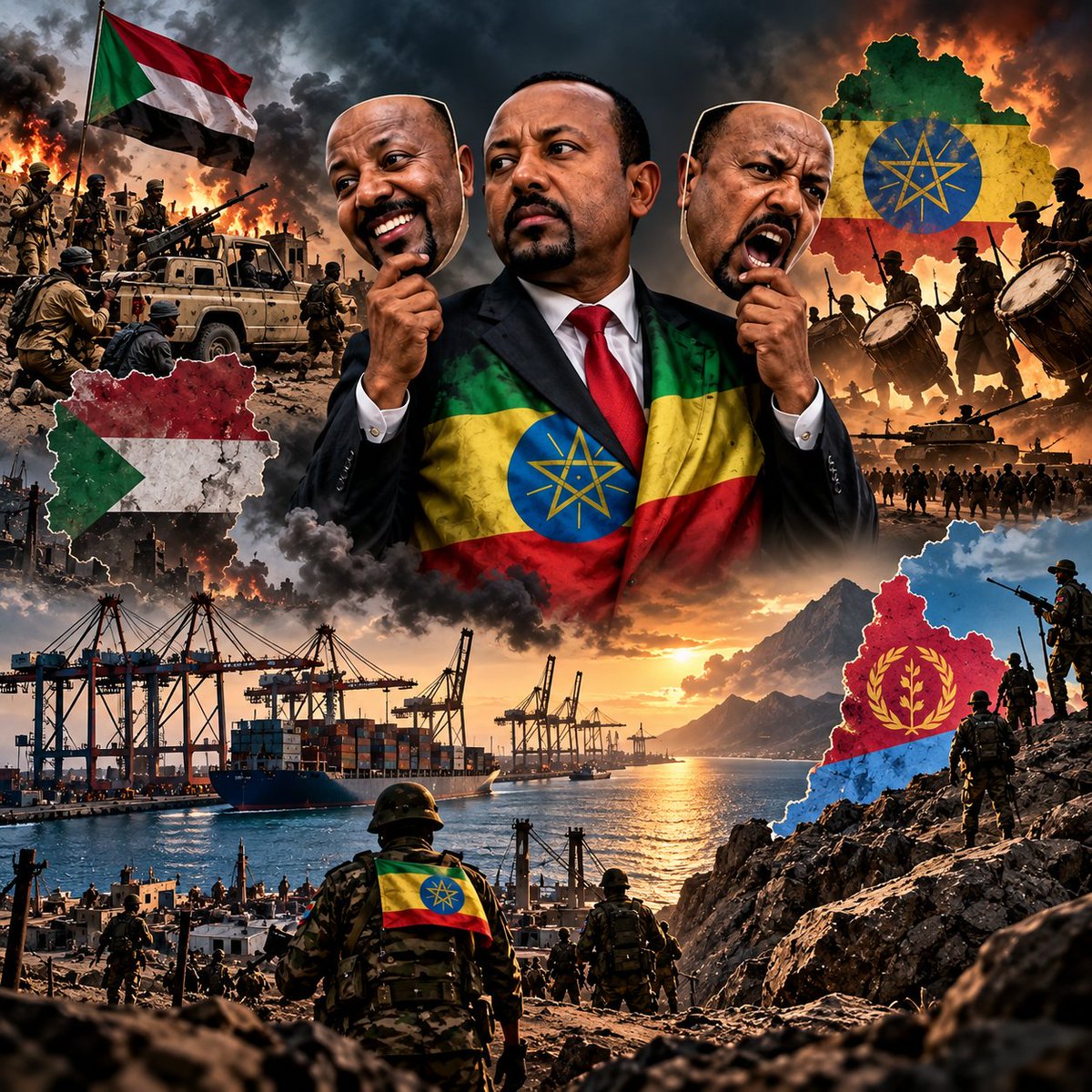
• Support forces accused of destabilizing Sudan, then accuse others of interfering in Ethiopia’s internal affairs.
• Threaten a neighboring country to seize its ports, then accuse that same neighbor of meddling in Ethiopia’s domestic affairs when resistance follows.
• Beat the drums of war, issue threats against neighboring states, and escalate tensions—then turn around and portray themselves as victims of aggression.
You cannot threaten your neighbors, challenge their sovereignty, and then cry interference when they refuse to surrender to your demands.
This is not diplomacy. It is not leadership. It is a dangerous combination of political immaturity, strategic arrogance, and hypocrisy.
A government that mistakes aggression for strength and provocation for diplomacy will eventually discover that the world does not owe it the consequences it refuses to accept.
#Eritrea #Assab #Sudan #Ethiopia
Generations come and go, and history repeats itself. The names may be different, but the mistakes remain the same, and in the end, the outcome is always the same for those who refuse to learn from the past. defeat is no longer a possibility—it becomes inevitable.
Ethiopian regimes never learn from history.Since 1952, successive Ethiopian governments have responded to aggression against Eritrea,supported by powerful foreign allies,but history has repeatedly demonstrated the limits of military power. Eritrea guarantee victory, and history.
The Ethiopian government and Oromo imperialist ambitions cannot hide behind propaganda while fueling conflict and threatening their neighbors. Those who cheer for war in the name of expansionism will soon feel the humiliation and devastation of their making.
🇪🇹 As fighting flares in the north, social media is increasingly flooded with fake images, recycled footage and AI-generated propaganda, all fueling fears and spreading lies in #Ethiopia.
Federal troops and allied militia have entered another key town after Tigrayan rebels withdrew, leaving residents fearful.
Learn more here ⤵️
I agree to some extent, but one thing people consistently overlook is that Eritrea’s military capabilities have never been fully transparent. The government has always maintained a high level of secrecy around its weapons, equipment, and military capacity. Much of what Eritrea possesses is not displayed for public observation or revealed through official figures. Some capabilities only become visible when they are actually put to the test.
Judging Eritrea purely by numbers on paper may therefore give an incomplete picture. What is publicly known is not necessarily the full picture of what exists. Never underestimate a military simply because it reveals less than others.
Eritrea appealing to the UN is not desperation, it is documenting its efforts to prevent war and exhausting diplomatic channels before taking further action. The point is to make it clear to the international community who sought a peaceful resolution and who chose escalation. You cannot accuse Eritrea of ignoring diplomacy when it is actively calling for international attention. If war comes after every reasonable diplomatic avenue has been pursued, the world cannot pretend it was never warned.
Abiy Ahmed, accused of atrocities against his own people, now embraces Netanyahu, whose government faces genocide allegations. Two sides of the same bloodstained coin. When leaders accused of war crimes call it “cooperation,” the world should question what they really have in common.
Ethiopia claims it needs the Red Sea, yet its own prime minister is openly strengthening ties with Israel while escalating tensions with Eritrea. The hypocrisy is staggering. Ethiopia’s landlocked status is a geographical reality, not a legal entitlement to Eritrean territory. No foreign alliance can rewrite history, and no manufactured security argument can turn Assab into Ethiopian property. If Ethiopia wants prosperity, it should pursue diplomacy and trade not gamble Ethiopian lives on ambitions that violate Eritrea’s sovereignty. The Red Sea is not Ethiopia’s birthright, and Eritrea is not a bargaining chip for foreign powers.
@GazettePlusET@AbiyAhmedAli 😂 2,000 years of history, but no sovereign Red Sea coastline before 1952. Ancient history doesn’t grant ownership of Eritrean territory. Stop confusing historical nostalgia with legal sovereignty.
ERITREA IS NOT ETHIOPIA’S ESCAPE FROM ITS OWN CRISIS. 🇪🇷
A country struggling with internal conflict, political instability, and armed rebellions has no business threatening the sovereignty of its neighbours. Eritrea did not fight for decades to surrender its independence to another country’s ambitions.
Assab is not a bargaining chip. Eritrea’s sovereignty is not negotiable, and its borders are not open for revision by force.
History has already answered the question of Eritrean independence. No amount of political arrogance, historical distortion, or military threats will rewrite that reality.
Eritrea is a nation, not a territory waiting to be claimed. 🇪🇷
#ASSAB IS ERITREA. 🇪🇷
Assab is an inseparable part of Eritrea’s sovereignty and national identity. No amount of political pressure, historical distortion, or threats can erase Eritrea’s borders. Our position is clear. Assab belongs within Eritrea’s internationally recognized territory, and its sovereignty must be respected by law, diplomacy, and the determination to defend our nation.
Let the message be heard loud and clear. Assab is part of Eritrea’s past, present, and future. Our sovereignty is not for sale, our identity cannot be erased, and our commitment to Assab will never fade. We will stand firm through law, unity, and unwavering determination. ERITREA FOREVER. 🇪🇷
This post is a masterclass in political absurdity. Imagine calling for the occupation of another country's capital, claiming another people's land, and then pretending that an imposed referendum under foreign military control would somehow prevent war. That's not peace, it's colonial thinking dressed up as democracy.
Eritrea is a society forged in the fires of history, hardened by generations of struggle, resistance, and sacrifice. From the fierce resistance against colonial powers to the 30-year war for independence, Eritreans endured hardships that would have broken many nations. Yet they stood firm, united by an unyielding determination to defend their land, dignity, and sovereignty.
Eritrea's history is not simply a history of war; it is a history of endurance. Its people learned to survive under pressure, to sacrifice in the face of adversity, and to value freedom above submission. The mountains, deserts, and rugged terrain became witnesses to a people's refusal to surrender their identity.
A society shaped by such a history carries a powerful legacy: the memory of those who fought, the resilience of those who survived, and the responsibility of those who inherited their freedom.
You can challenge Eritrea, you can threaten Eritrea, and you can underestimate Eritrea but never mistake its patience for weakness or its desire for peace for an absence of resolve.
A people who paid such a heavy price for sovereignty understand exactly what it means to defend it.
#Eritrean identity is no ordinary heritage: it is pride, unshakable courage, wisdom, and profound discernment. No Eritrean ever surrenders this priceless covenant. In devotion and loyalty, Eritrea is a land dipped in pure gold—a divine gift to every soul.🇪🇷❤️
Ethiopia’s growing demands for access to the Red Sea raise an important historical question: if Assab supposedly belongs to Ethiopia, what does the documented history of the region actually show?
The history of Assab and the Eritrean coast is far more complex than claims based on Ethiopia’s former access to the sea. Historical influence, religious connections, and economic dependence are not the same as territorial sovereignty.
The historical timeline
•16th Ottoman expansion: The Ottoman Empire established control over important Red Sea ports, including Massawa and Assab, and maintained a coastal presence in the region.
•1865 — Egyptian expansion: Egypt acquired coastal territories in the region and expanded its influence along the Eritrean coast. Egyptian authority was concentrated in coastal areas.
•1869 — Assab’s local rulers: The Sultan of Raheita entered an agreement transferring land around Assab Bay to the Italian shipping company Rubattino. This is a significant historical detail because it identifies a local ruler, rather than the Ethiopian state, in the documented transaction that initiated Italy’s presence at Assab.
•1882 — Italian administration: Italy formally took over Assab, turning it into its first African colonial possession.
•1885 — Egyptian withdrawal from Massawa: Italian forces occupied Massawa after the Egyptian withdrawal, extending Italy’s presence along the Eritrean coast.
•1890 — Establishment of Italian Eritrea: Italy formally consolidated its coastal and inland possessions into the colony of Eritrea.
•1941 — British military administration: British forces defeated Italian colonial forces in Eritrea during the Second World War, and Eritrea came under British administration.
•1952 — Federation with Ethiopia: Under a United Nations-backed arrangement, Eritrea became federated with Ethiopia while retaining a formally distinct political status.
•1962 — Annexation by Ethiopia: Ethiopia abolished the federation and annexed Eritrea, an act that helped fuel the subsequent 30 years independence struggle.
•1991–1993 — Independence: Eritrean independence forces took control of the country in 1991, and Eritrea became an independent state in 1993 following a referendum.
Historical accounts document these developments, including the Ottoman presence at Massawa and Assab, Egypt’s coastal expansion, and Italy’s acquisition of Assab.
What does this history mean for Ethiopia’s claim?
The timeline does not support the simplistic argument that Assab automatically belongs to Ethiopia because Ethiopia is landlocked or once used Eritrean ports. The region’s history involved local Afar authorities, Ottoman and Egyptian coastal influence, Italian colonial rule, and later Ethiopia’s federation and annexation of Eritrea.
There is also an important distinction between historical claims and modern international borders. Ethiopia’s former administration of Eritrea did not give it an unlimited right to retain Eritrean territory after independence.
Ethiopia has legitimate reasons to seek reliable access to maritime trade. But the solution is commercial negotiation, port agreements, and peaceful cooperation not treating another country’s coastline as an entitlement.
The central historical question is not whether Ethiopia once had access to the Red Sea. It is whether that history establishes a present-day right to own Assab. Historical connections alone do not establish such a right.
Assab’s history should be examined through documented agreements, actual political control, and the development of modern borders not through selective historical narratives used to justify contemporary territorial ambitions.