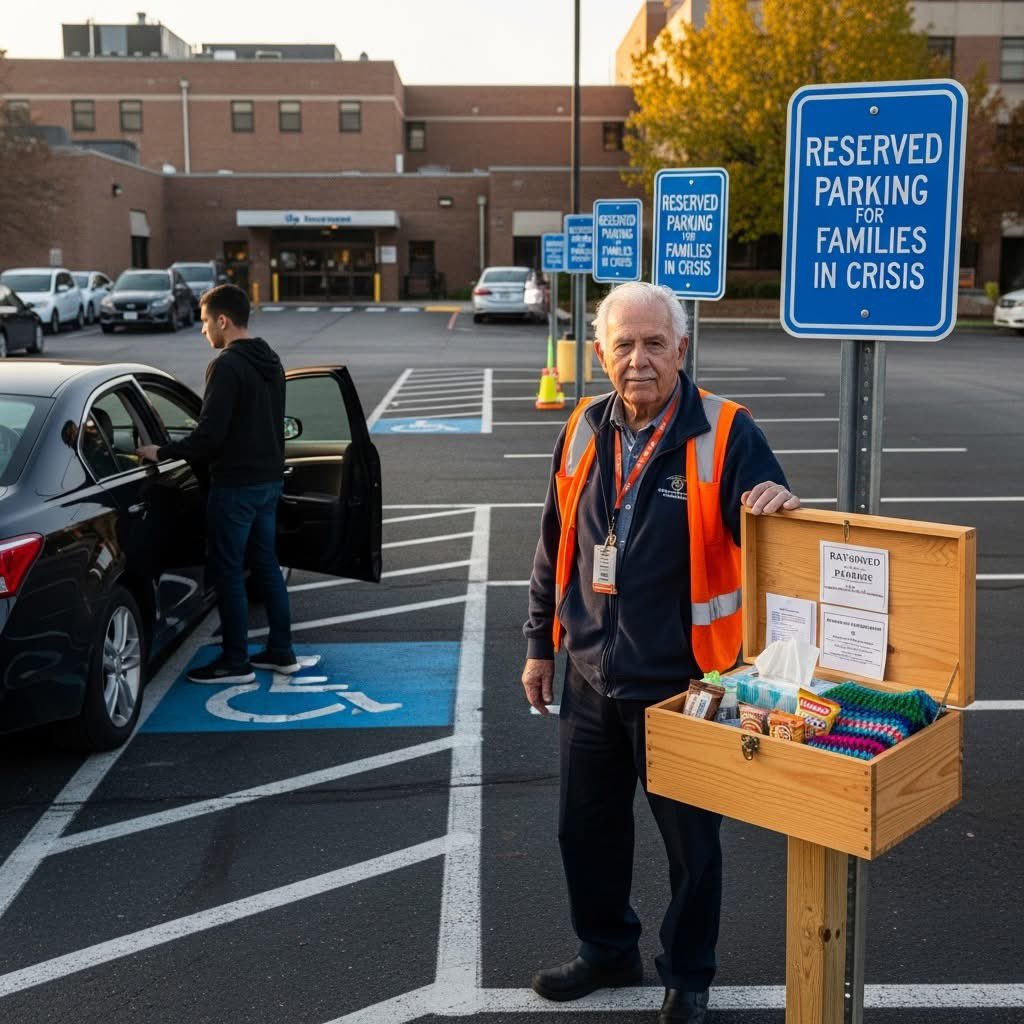
"My name's Raymond. I'm 73. I work the parking lot at St. Joseph's Hospital. Minimum wage, orange vest, a whistle I barely use. Most people don't even look at me. I'm just the old man waving cars into spaces.
But I see everything.
Like the black sedan that circled the lot every morning at 6 a.m. for three weeks. Young man driving, grandmother in the passenger seat. Chemotherapy, I figured. He'd drop her at the entrance, then spend 20 minutes hunting for parking, missing her appointments.
One morning, I stopped him. "What time tomorrow?"
"6:15," he said, confused.
"Space A-7 will be empty. I'll save it."
He blinked. "You... you can do that?"
"I can now," I said.
Next morning, I stood in A-7, holding my ground as cars circled angrily. When his sedan pulled up, I moved. He rolled down his window, speechless. "Why?"
"Because she needs you in there with her," I said. "Not out here stressing."
He cried. Right there in the parking lot.
Word spread quietly. A father with a sick baby asked if I could help. A woman visiting her dying husband. I started arriving at 5 a.m., notebook in hand, tracking who needed what. Saved spots became sacred. People stopped honking. They waited. Because they knew someone else was fighting something bigger than traffic.
But here's what changed everything, A businessman in a Mercedes screamed at me one morning. "I'm not sick! I need that spot for a meeting!"
"Then walk," I said calmly. "That space is for someone whose hands are shaking too hard to grip a steering wheel."
He sped off, furious. But a woman behind him got out of her car and hugged me. "My son has leukemia," she sobbed. "Thank you for seeing us."
The hospital tried to stop me. "Liability issues," they said. But then families started writing letters. Dozens. "Raymond made the worst days bearable." "He gave us one less thing to break over."
Last month, they made it official. "Reserved Parking for Families in Crisis." Ten spots, marked with blue signs. And they asked me to manage it.
But the best part? A man I'd helped two years ago, his mother survived, came back. He's a carpenter. Built a small wooden box, mounted it by the reserved spaces. Inside? Prayer cards, tissues, breath mints, and a note,
"Take what you need. You're not alone. -Raymond & Friends"
People leave things now. Granola bars. Phone chargers. Yesterday, someone left a hand-knitted blanket.
I'm 73. I direct traffic in a hospital parking lot. But I've learned this: Healing doesn't just happen in operating rooms. Sometimes it starts in a parking space. When someone says, "I see your crisis. Let me carry this one small piece."
So pay attention. At the grocery checkout, the coffee line, wherever you are. Someone's drowning in the little things while fighting the big ones.
Hold a door. Save a spot. Carry the weight no one else sees.
It's not glamorous. But it's everything."
Let this story reach more hearts....
Credit: Mary Nelson
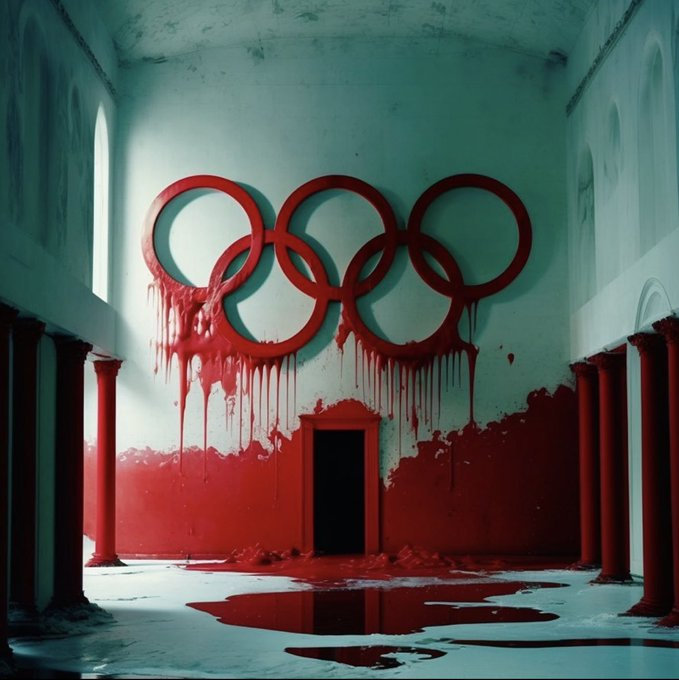
A country that beheads enemy soldiers has no place in the Olympics. A country that rapes and tortures soldiers and civilians has no place in the Olympics. A country that is led by an individual that is wanted by ICC for war crimes, has no place in the Olympics. 1/3
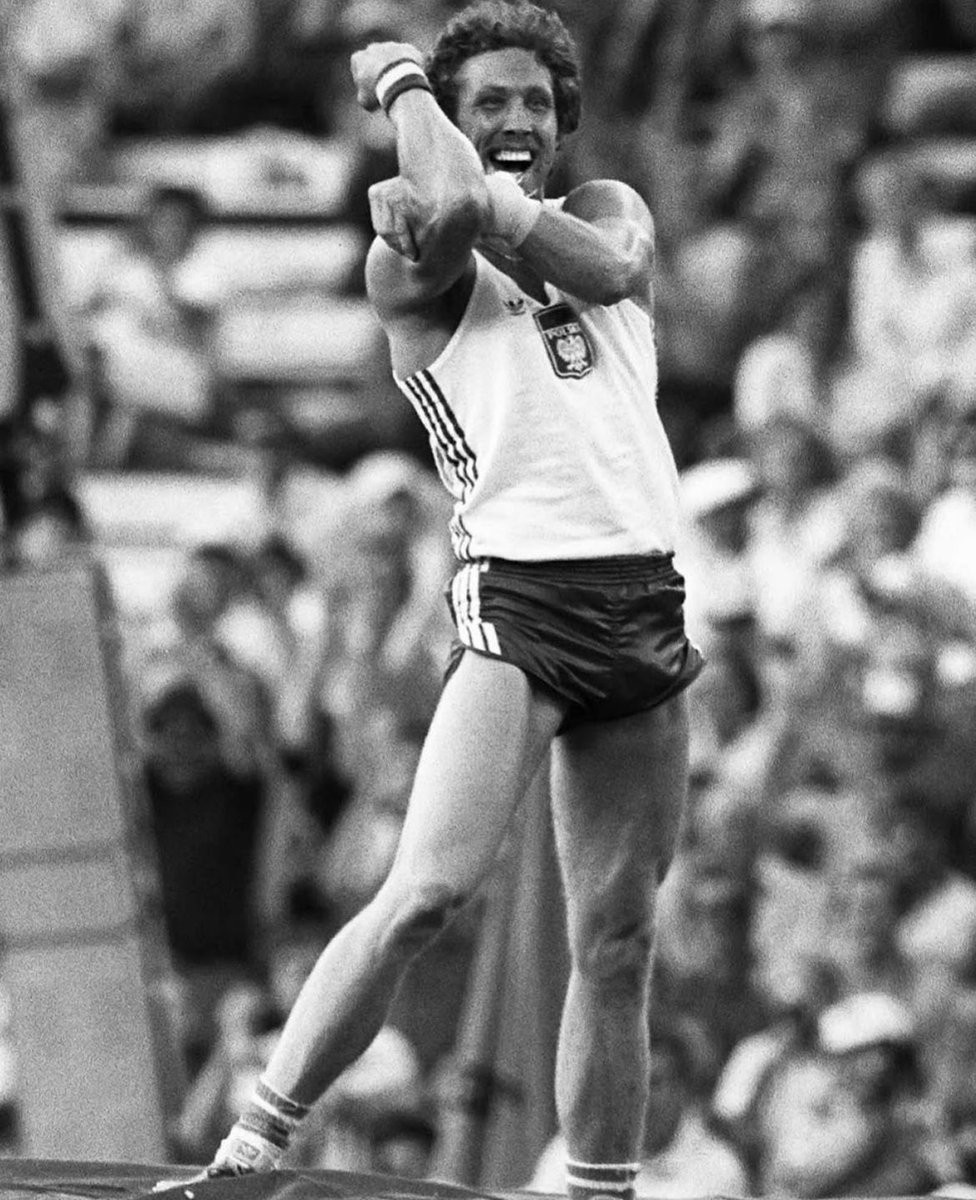
Wladyslaw Kozakiewicz was a Polish pole vaulter who competed during the 1970s and 1980s. His most famous moment came during the 1980 Summer Olympics in Moscow. In the final, Kozakiewicz was competing against the heavily favored Soviet athlete, Konstantin Volkov, in front of a hostile home crowd.
When Kozakiewicz cleared a height of 5.78 meters (18.9 ft), breaking the Olympic record, the Soviet crowd responded with boos and jeers. In response to the hostile atmosphere, Kozakiewicz raised his arm with a rude gesture known as the "Kozakiewicz gesture" towards the crowd. This gesture was seen as a defiant and bold response to the unsportsmanlike behavior of the crowd.
His gesture further fueled the tension and made him even more of a hero in Poland, while at the same time making him a target for criticism from the Soviet media and officials. After the Olympics, the Soviet ambassador to Poland demanded that Kozakiewicz be stripped of his medal over his "insult to the Soviet people". The official response of the Polish government was that the gesture had been an involuntary muscle spasm caused by his exertion.