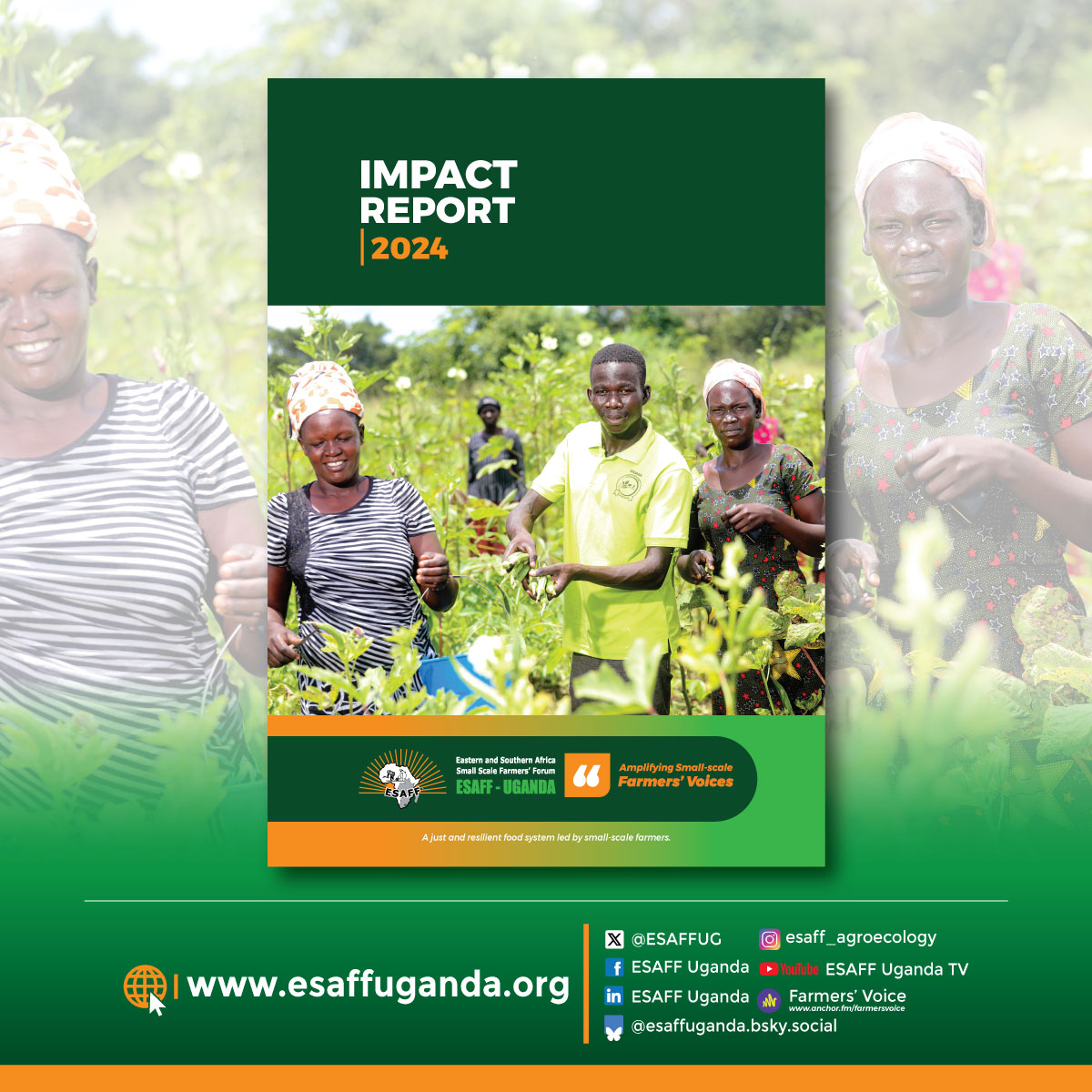
We are pleased to unveil the ESAFF Uganda 2024 Impact Report, a powerful reflection of our collective efforts in promoting Agroecology.
From grassroots organizing to high-level policy engagement, this report showcases the voices of small-scale farmers, our strategic collaborations, and the tangible changes we have contributed to in communities and policy spaces.
Download a copy of the report: https://t.co/pyFeFpCXcC
Watch the Impact Video: https://t.co/LOUxuzBZ8n
#AgroecologyNow
#FundAgroecology
𝐏𝐑𝐄𝐒𝐒 𝐑𝐄𝐋𝐄𝐀𝐒𝐄: 𝐓𝐡𝐞 𝐋𝐚𝐮𝐧𝐜𝐡 𝐨𝐟 𝐭𝐡𝐞 𝟒𝐭𝐡 𝐄𝐝𝐢𝐭𝐢𝐨𝐧 𝐨𝐟 𝐭𝐡𝐞 𝐒𝐜𝐡𝐨𝐨𝐥𝐬' 𝐀𝐠𝐫𝐨𝐞𝐜𝐨𝐥𝐨𝐠𝐲 𝐏𝐨𝐞𝐦 𝐖𝐫𝐢𝐭𝐢𝐧𝐠 𝐂𝐨𝐦𝐩𝐞𝐭𝐢𝐭𝐢𝐨𝐧
@ESAFFUG will on 5th June 2026 launch the 4th Edition of the National Schools’ Agroecology Poem Writing Competition at Serere Township Secondary School in Serere district, as a strategic intervention to promote learner-led solutions to food system challenges, & nurture a generation of environmentally conscious young people capable of advancing sustainable and resilient food systems.
Download the Press Release here: https://t.co/1AmPpPnykg
#YouthInAgroecology | #FundAgroecology
Today, we honour the faith, courage & sacrifice of the Uganda Martyrs that continue to light the path for generations.
We draw inspiration from their legacy to strengthen our resolve to protect biodiversity & build sustainable food systems. May this day renew our commitment to farm with nature, in order to actualize a just & resilient food system led by small-scale farmers.
#MartyrsDay2026 | #UgandaMartyrs
Tumwiine Daniel, winner of the National Schools Agroecology Poem Writing Competition (primary school category), recited a poem in which he painted a glimmer of hope, showing that agroecology could turn the tide, revitalizing our food systems, reducing dependence on harmful chemicals, and protecting them from climate-induced collapse.
Watch video▶️@humundi_ong@UNDPUganda@PeasantsLeague@OxfaminUganda
#YouthInAgroecology | #FundAgroecology
Tumwiine Daniel, winner of the National Schools Agroecology Poem Writing Competition (primary school category), recited a poem in which he painted a glimmer of hope, showing that agroecology could turn the tide, revitalizing our food systems, reducing dependence on harmful chemicals, and protecting them from climate-induced collapse.
Watch video▶️@humundi_ong@UNDPUganda@PeasantsLeague@OxfaminUganda
#YouthInAgroecology | #FundAgroecology
As Africa's food systems face threats from chemical-intensive agriculture, learners in Agroecology Clubs are emerging as powerful voices for a more sustainable future.
Tukamushaba Christine, 2nd Runner-Up in the Grand Finale of the 3rd National Schools Agroecology Poem Writing Competition, recited a poem that exposed the hidden costs of chemical-dependent farming, while championing agroecology as a pathway to safe food & sustainable livelihoods.
Watch video▶️
@humundi_ong@UNDPUganda@PeasantsLeague
#YouthInAgroecology | #FundAgroecology
Did you know human urine can be used as a fertiliser and pesticide?
Watch how @ESAFFUG farmers are using this cost-effective, environmentally-friendly method to promote #agroecology by recycling nutrients & minimising reliance on chemical fertilisers: https://t.co/HUQp0m2Qbq
As we draw closer to the launch of the 4th Edition of the National Schools Agroecology Poem Writing Competition, we reflect on how nurturing creative expression through poetry among learners inspires a new generation of advocates for sustainable farming practices.
This exciting #Agroecology poem by students from St. Gertrude Girls’ Vocational SS in Kisoro district is one example of how we are furthering this vision.
Watch:
#YouthInAgroecology | #FundAgroecology
#NutritionSecurity goes beyond food security, by considering people’s access to essential nutrients, not just calories.
Learners belonging to #AgroecologyClubs have established agroecological gardens, that play a key role in improving nutrition security in schools. This has been realized through enabling learners’ access to balanced diets, thereby enhancing their health, energy and enthusiasm for school.
#FundAgroecology
May this Eid fill your heart with joy and love, opening new doors of success and happiness for you and your family.
Eid Mubarak from all of us at ESAFF Uganda
#EidalAdha2026
𝗜𝗺𝗽𝗼𝗿𝘁𝗮𝗻𝘁 𝗨𝗽𝗱𝗮𝘁𝗲📢
The official launch of the fourth edition of the Schools #Agroecology Poem Writing Competition is almost here!
This time, it will be bigger, bolder and more exciting, with more schools, levels of competition and engagement.
Tag your school, former school, or your children’s school and encourage them to take part in this exciting competition!
#AgroecologyClubs | #FundAgroecology
Natalino José, a 23-year-old from the Zambézia province is a living example of how #Agroecology can transform lives. Married & the father of one son, he makes a living from family farming, but he is no longer just an ordinary farmer: he is a true agent of change.
Read more:👇
Global education systems are shifting toward Competency-Based Curricula; however, synthetic inputs and climate change continue to threaten our food systems, creating an urgent need to equip learners with practical skills to address these challenges.
@ESAFFUG established Agroecology Clubs in schools as living labs where learners actively engage in critical thinking and co-create knowledge on sustainable food systems.
👇Watch Video
#AgroecologyNow
𝗖𝗔𝗟𝗟 𝗙𝗢𝗥 𝗣𝗥𝗢𝗣𝗢𝗦𝗔𝗟𝗦
@ESAFFUG is looking for an experienced and detail-oriented consultant to conduct a comprehensive desk review of seed policies and related frameworks in Uganda and the EAC
Interested applicants are encouraged to review the attached Terms of Reference (TOR) and submit their proposals, at the earliest opportunity.
Download TOR: https://t.co/cWpZALr72S
#FarmerSeedLab
𝗖𝗔𝗟𝗟 𝗙𝗢𝗥 𝗣𝗥𝗢𝗣𝗢𝗦𝗔𝗟𝗦
@ESAFFUG is looking for an experienced and detail-oriented consultant to conduct a comprehensive desk review of seed policies and related frameworks in Uganda and the EAC
Interested applicants are encouraged to review the attached Terms of Reference (TOR) and submit their proposals, at the earliest opportunity.
Download TOR: https://t.co/cWpZALr72S
#FarmerSeedLab
We stand in solidarity with the people of Cuba and call for an end to the blockade. Together, we must reject hunger as a weapon of war and amplify the voices of peasants defending the right to food and sovereignty.
#SolidarityWithCuba#PeasantSolidarityWithCuba@via_campesina
A recent report by the @FAO warns that unless urgent action is taken, climate change is pushing our food systems to the brink, disrupting harvests across the world.
That’s where agroecology offers a path forward. Small-scale farmers from Serere district are already adopting agroecological practices such as organic compost use to rebuild soil health, hence restoring the land’s natural ability to cope with climate stress and reduce greenhouse gas emissions from synthetic inputs.
#FundClimateSolutions | #FundAgroecology
Gaps in the mobilization of climate finance are constraining action across all sectors at a time when climate change is ravaging African agricultural sector. LDCs are reaching adaptation limits, while promised funds remain elusive. Small-scale farmers need real support now, not more meetings, or empty pledges. Climate resilience is a cornerstone of food security in Africa if we make genuine climate investment.
#FundClimateSolutions
Youth championing the transition to Agroecology: In this video by @ESAFFUG showcases 18 youth from across Uganda who were trained on #Agroecology. They gained practical skills and inspiration to mobilize more youth in advancing agroecology.
Watch Video: https://t.co/L9EaLpcm0Q
Most garden pest problems do not require spraying at all. In most cases, all they need is an early response and the right interventions. Integrated pest management practices such as crop rotation, removal of infected plants and the careful use of bio-pesticides should always be applied. Staking and pruning are also important practices that improve plant structure and increase productivity.
#AgroecologyNow | #AvoidHazardousPestcides
Most garden pest problems do not require spraying at all. In most cases, all they need is an early response and the right interventions. Integrated pest management practices such as crop rotation, removal of infected plants and the careful use of bio-pesticides should always be applied. Staking and pruning are also important practices that improve plant structure and increase productivity.
#AgroecologyNow | #AvoidHazardousPestcides