Fundational research from our team: The paper proves the primitive for 160-byte post-quantum on-chain authentication. EternaX composes it into a PQ blockchain architecture: SPHINCS+ as the conservative identity anchor + SILMARILS as the compact authentication layer; tiered selective disclosure + per-tx unlinkability via protocol composition.
Post-quantum migration is usually framed as key replacement. For high-throughput blockchains, it's an unacceptable on-chain size tax in kilobytes.
We just released a paper allowing transaction authentication in 160 bytes by using how blockchains already work. 1/
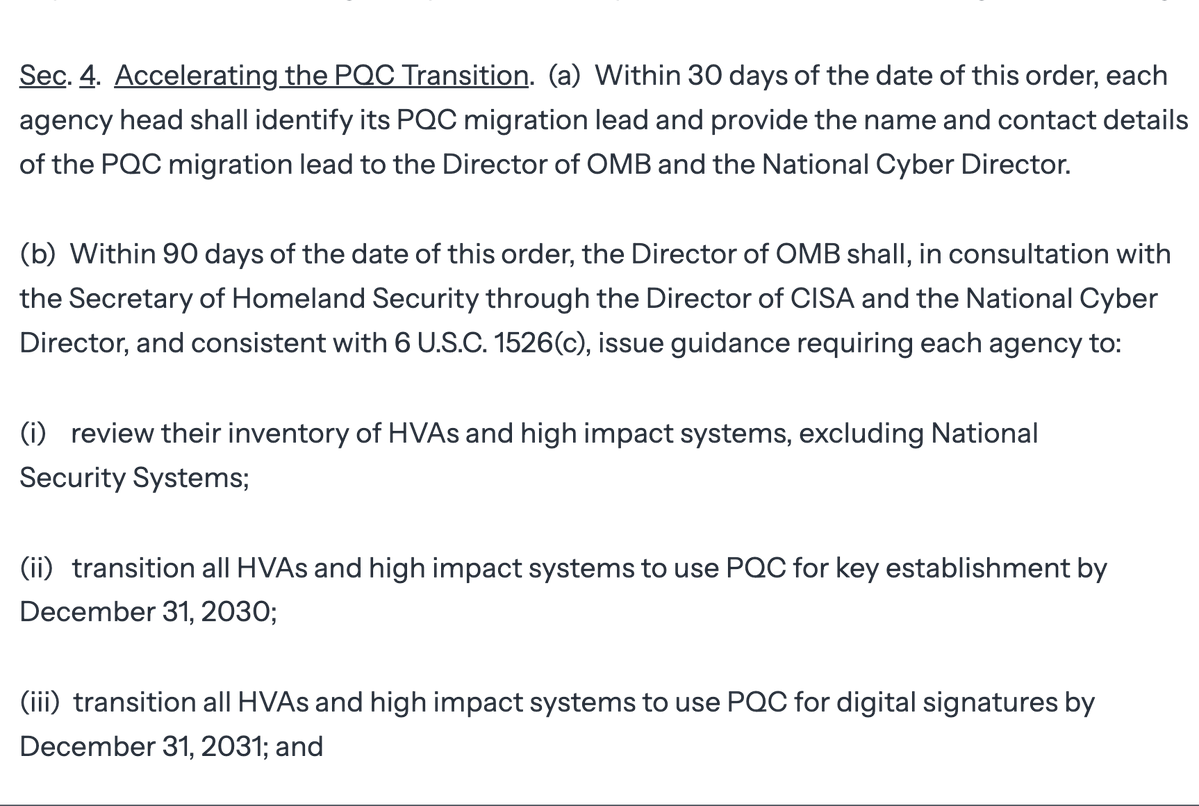
December 31, 2030. That is the new federal deadline for post-quantum encryption.
Five moves from the past two weeks. What each one breaks in institutional crypto.
WEEKLY POST-QUANTUM CRYPTO RISK BRIEF
Edition 04 | Week of July 6, 2026 |
1- Trump signed EO 14412 on June 22. PQ key establishment by December 31, 2030. PQ authentication by December 31, 2031. Federal contractors must comply with PQ FIPS. FAR procurement rule incoming within 180 days. Every institutional crypto product selling into US regulated channels now has a dated legal obligation.
2- Department of War released a 25-page PQC Strategy the next day. Every military system must support PQC by 2030 or be phased out. Nuclear command-and-control named as existential risk. QKD banned. The largest procurement ecosystem on earth just set its PQ clock.
3- Trump signed EO 14413 the same day. Whole-of-government quantum acceleration. DOE directed to deploy a quantum computer by 2028. The US is simultaneously building the machine and mandating defenses against it.
4- Microsoft pulled its PQ target to 2029. Azure CTO: "Cryptographically relevant quantum computers could arrive sooner than previously expected." The world's largest enterprise software company accelerated by four years. Every institutional product on Azure inherits this timeline.
5- Open researchers surpassed Google's ECDLP-256 benchmarks by 47% in combined efficiency. The cost is still falling.
The President signed it.
The Pentagon published it.
Microsoft accelerated for it.
The attack surface is still shrinking.
Every tokenized bond, stablecoin reserve, MPC wallet, and RWA rail runs on cryptography the United States just set a legal deadline to replace.
@EternaXLabs does not need to replace it.
Post-Quantum Native from Day One.
@FutureDies@paarrthhbirla
Every institution in crypto just got a compliance deadline they did not plan for.
President Trump signed Executive Order 14412.
It starts a federal post-quantum audit clock on every custody provider, stablecoin issuer, tokenized fund, and settlement rail using classical cryptography.
If you are at BlackRock, JPMorgan, Goldman Sachs, Citi, State Street, or BNY, your tokenized products are in scope.
If you are at DTCC, Broadridge, or Mastercard, your settlement infrastructure is in scope.
If you are at Circle, Paxos, or PayPal, your stablecoin signing layer is in scope.
If you are at Fireblocks, BitGo, Coinbase Prime, Anchorage Digital, Copper, or Zodia Custody, your custody stack is in scope.
If you are at Securitize, Franklin Templeton, WisdomTree, Hamilton Lane, KKR, or Apollo, your tokenized fund rails are in scope.
One question determines whether you pass or fail the audit:
What signs the asset?
If the answer is ECDSA or EdDSA, you are carrying post-quantum migration debt right now. On every transaction. On every chain you touch.
Ethereum. Solana. Canton. Bitcoin. Stellar. All of them expose classical signing schemes that will FAIL a federal Cryptographic Bill of Materials audit under EO 14412.
The deadlines run to end of 2030 and 2031. That sounds far away. It is not. Migrating signing infrastructure across live custody, settlement, and issuance systems takes years. The planning window is now.
This is not a security conversation. This is compliance, procurement, auditability, and institutional market access. If your chain cannot pass a CBOM audit, your products risk losing federal counterparty eligibility before a quantum computer even exists.
Most of the industry is not talking about this yet. That will change fast.
We broke down the entire EO line by line. @FutureDies , Mansi Birla, and @paarrthhbirla recorded the full episode covering which institutions are exposed, how the federal mandate reaches private crypto companies, what the actual deadlines are, and what the boardroom consequences look like.
The full EternaX Labs EO 14412 report covering every chain, every institution, and every product category is also live.
Podcast, report, and blog links are in the first comment.
Save this post. You will need to reference it in your next board prep, compliance review, or vendor assessment.
Forward it to your CTO.
Forward it to your CISO.
Forward it to your Head of Digital Assets.
Forward it to your General Counsel.
They need to see this before Q3 planning closes.
US EO 14412 makes PQC a hard compliance clock. Procurement and contractor rules pull BlackRock, JPMorgan, Citi, BNY, State Street, DTCC, Nasdaq, Fireblocks, Circle, Coinbase into transition.
Full report: https://t.co/Ccgn95rcMQ
@EternaXLabs
$600M in US federal quantum funding in seven days. China deploying PQC on its quantum computer. What each move breaks in institutional crypto.
WEEKLY POST-QUANTUM CRYPTO RISK BRIEF
Edition 03 | Week of June 22, 2026 |
1- China integrated PQC into its Origin Wukong quantum computer. National PQ standards confirmed within three years. The country building machines to break ECDSA is standardizing defenses against it. Any institution settling digital assets on classical chains faces sovereign compliance asymmetry the moment those standards go live.
2- US Commerce awarded SandboxAQ $500M with an equity stake and signed $100M to Atom Computing for fault-tolerant quantum hardware. The federal government is now a direct shareholder in the quantum security stack. PQ migration is funded at sovereign industrial scale.
3- Atom Computing raised $300M+, demonstrated first neutral-atom quantum error correction, and is deploying the first commercial logical-qubit system with Microsoft. Fault-tolerant quantum computing is entering commercial deployment. The timeline just compressed.
4- EigenQ announced a $3B SPAC for Nasdaq and began integrating PQ into AMD EPYC servers for defense and government. The servers running institutional crypto nodes will ship PQ-capable. The protocols on those servers will not.
5- IBM Nighthawk validated on cybersecurity benchmarks. Quantum processors are now being tested on security workloads. The hardware that will target ECDSA is being benchmarked on the applications next door.
Both superpowers are funding it.
Fault tolerance is deploying.
Capital markets are pricing it.
Hardware is shipping it.
Every tokenized bond, stablecoin reserve, MPC wallet, and RWA rail runs on cryptography both governments are racing to replace.
EternaX Labs does not need to replace it.
Post-Quantum Native from Day One.
@FutureDies@paarrthhbirla
#PostQuantum #QuantumComputing #Blockchain #DigitalAssets #Cryptography #CyberSecurity #NIST
We are designing the post-quantum MPC flow against how custodians operate in practice: small thresholds, share refresh, evidence retention, policy rotation, and provider-grade audit views. We are looking for custody, HSM, MPC, issuer teams to pressure-test workflow fit and evidence-retention requirements.
If you want a post-quantum custody path that keeps distributed authorization without threshold-signing hash-based signatures, we should talk.
Most institutional MPC relies on threshold signatures that work great with elliptic curves but not with hash-based signatures like SPHINCS+.
A report by @taurus_hq@veorq highlighted the problem often overlooked in PQ discourse and gave me an idea.
Problem:
- Black-box threshold signing for hash-based sigs is expensive/impractical.
- But institutions holding $ 10T+ across MPC providers currently have zero production PQ-safe options for distributed approval.
Our proposed fix: Don’t threshold the signature itself.
Instead, use two coupled gates:
1. Individual SLH-DSA signatures from each custody member (for attribution + non-repudiation).
2. A separate on-chain affine/threshold authorization layer (like SILMARILS).
The chain reconstructs/verifies the authorization value.
This post is a call for discussion and design partners. If you’re a custodian, issuer, or RWA team, that wants to keep distributed authorization in PQ era, we should talk. 1/
NIST says "now." 98 days until FIPS 140-2 goes Historical. Five moves from the past seven days. What each one breaks in institutional crypto.
WEEKLY POST-QUANTUM CRYPTO RISK BRIEF Edition 02 | Week of June 15, 2026
1- NIST updated its PQC page June 8: ML-DSA, SLH-DSA, and ML-KEM "can and should be put into use now." Not plan. Not assess. Deploy. No major custodian, blockchain, or tokenization platform has a production PQ implementation live.
2- FIPS 140-2 sunset: September 21. All certificates go Historical. Only FIPS 140-3 validated modules qualify for new federal procurement. CMMC Level 2 enforcement follows seven weeks later. If your custody stack still runs 140-2 modules, your compliance chain breaks in 98 days.
3- Keyfactor launched the Trust Control Plane. Unified PQ migration for every machine identity in an enterprise. Every MPC node, signing key, oracle feed, and bridge relay in institutional crypto is a machine identity on classical cryptography. None have a PQ migration path.
4- SEALSQ confirmed first PQ security satellite launching Q4 2026 with SpaceX. PQ hardware roots of trust entering the supply chain from orbit. Custody HSMs that cannot consume PQ entropy sources face procurement disqualification in regulated markets.
5- ETSI/IQC Quantum Safe Cryptography Conference opens today in Ottawa. PQ migration playbooks for critical infrastructure. The banks, custodians, and clearinghouses in those rooms use the same PKI stack your digital asset settlement depends on. They are migrating it. You are not.
Regulators are mandating.
Infrastructure is migrating.
Procurement is resetting.
Every #tokenized bond, #stablecoin reserve, #MPC wallet, and RWA rail sits on cryptography the rest of the world is replacing now.
EternaX Labs does not need to replace it. #PostQuantum Native from Day One.
@FutureDies@paarrthhbirla
WEEKLY POST-QUANTUM CRYPTO RISK BRIEF
Edition 01 | Week of June 9, 2026
- Let's Encrypt chose Merkle Tree Certificates as its post-quantum authentication path. 700M+ websites. Staging late 2026, production 2027. Chrome and Cloudflare already testing on live traffic.
- 65%+ of human web traffic through Cloudflare is now post-quantum encrypted. Full PQ security including authentication targeted by 2029. CNSA 2.0 mandates PQ signing for new national security system acquisitions starting 2027.
- SEALSQ's QS7001 post-quantum secure element cleared NIST SP 800-90B entropy validation. First PQ chip approaching FIPS 140-3 certification. Hardware is not waiting.
- Q-Day Summit convened June 9 in Paris. First executive summit built entirely around cryptographic transition planning for boards and CISOs. Harvest-now-decrypt-later is now a boardroom line item.
- ETSI/IQC Quantum Safe Cryptography Conference opens June 17 in Ottawa. Sector-specific PQ migration case studies, HSM integration, implementation playbooks. Standards bodies are shipping execution guides, not theory papers.
Web infrastructure is migrating. Hardware is certifying. Regulators are mandating. Executives are convening.
Zero major blockchains have completed a post-quantum migration.
EternaX does not need one. #PostQuantum Native from Day One. @FutureDies@paarrthhbirla
STARK ecosystems still depend on non-#PostQauntum components such as Pedersen, wallet signing methods. @EternaXLabs advantage is that PQ authorization, settlement, issuance, and asset control are designed at the base layer, not added later through proof-system patches.
Most Web3 projects treat Post-Quantum security like a 2030 problem.
The reality? It’s an urgent threat to core blockchain infrastructure.
If your network isn't future-proofed against quantum computing, it’s a ticking time bomb.
Tune in to AURA8 tomorrow as we unpack the uncomfortable realities of the cryptographic shift.
Topic- The Hard Truth About Post-Quantum Crypto
📅 Friday, 5 June 2026
🕛 12:00 PM UTC
We're diving deep into security vs. speed with an incredible panel -
• Sarah Ahmed (Co-Founder, Cryptonite UAE) @0xsfav
• Dariia Porechna (CEO & Founder, eternaX) @FutureDies
• Vaibhavv Ali (Co-Founder, Cryptonite UAE)
Shoutout to our partners making this happen: @BitAngels, @CryptoMonday, @Ecoxdubai, and @offchainglobal.
I’ll be in Paris for @proofoftalk next week!
Looking to connect with teams working on tokenized assets, stablecoins, custody and institutional digital-asset rails.
At @EternaXLabs, we’re working on the post-quantum bottleneck: ensuring conservative security while keeping high-throughput TPS.
Our latest work, SILMARILS, achieves 160-byte transaction authentication on-chain footprint with SPHINCS+ as the post-quantum security anchor.
If you’re thinking about long-horizon cryptographic risk for institutional assets, I’d be glad to connect in Paris!