Competition giveaway!
We’re giving away:
1x home
1x away
1x third
Winners chosen size and choice of PL or Europa patches on the sleeve. Unfortunately not offering a name and number on the back.
To enter, repost this post and make sure you’re following us!
Good luck!! #NFFC
As a GP, I am not allowed to receive a pen or post-it note pad from a pharmaceutical company rep
Govt banned them in case I was influenced to prescribe medications
This should also be banned
Influence being bought in Govt
Patients should influence not the healthy & wealthy
We should talk about the the inevitable q of how this mess happened.
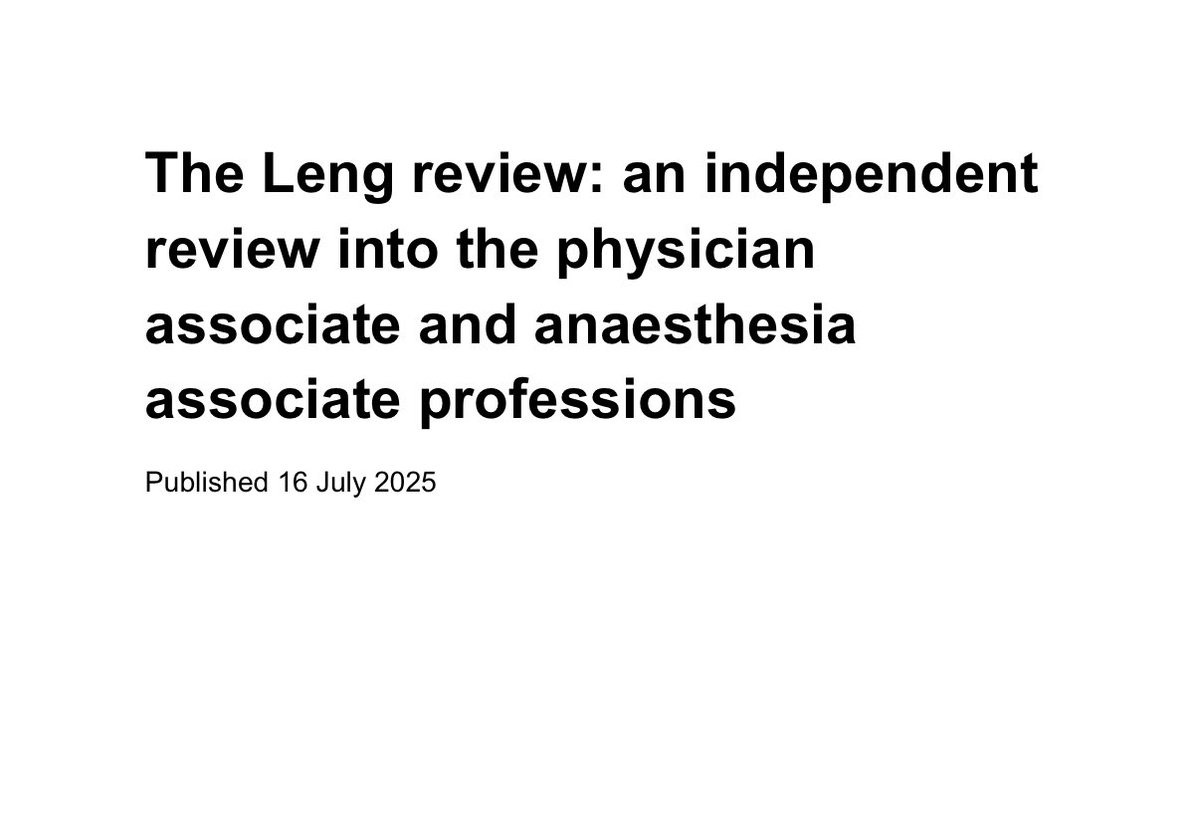
Prof Leng stated her review wouldn’t dwell on it. This is within her gift - the review is hard enough to land despite sticking to its precise question.
But the question of how this happened cannot be ignored
1/
@MartinSLewis As a student my landlord put all energy debts (prior to our tenancy) for the house in my name and only found out when debt collectors turned up at my parents house! Over 1.5k of debt! Provided evidence of paid bills during tenancy and finally left alone.
Steve, this epitomises the problem with your and @NHSEngland and @NavinaEvans single minded commitment to employ PAs despite the legitimate patient safety concerns of thousands of doctors
Basic fact checking shows
1. The false claims including those in the first paragraph were baseless and withdrawn
2. The PA in the photo claims to be a paediatric surgeon. As you know pretending to be a doctor is a criminal offence under the 1983 Medical Act.
Statements of fact like this must not be silenced by accusations of bullying or toxicity or misuse of #bekind
Please correct your post and indicate how you plan to deal with this misconduct
Coordinated promotion of this article is as evident as the lack of action on patient safety concerns around PAs and the false narrative that this is toxic debate rather than legitimate patient safety concerns
Nothing to see here, just the Head of Workforce for @NHSEngland using an inaccurate, one-sided & context-free Times piece to double down on the insinuation that the only issue with PAs in the NHS is ‘online toxicity’ from a small number of rogue doctors.
You must know, Navina, how disingenuous & inflammatory the framing in your tweet is. Of course bullying in all its forms is wrong. But thousands of doctors, myself included, have politely & professionally expressed grave concerns about the way PAs are deployed. Multiple large scale surveys of doctors back us up. We spoken out without bullying, toxicity or inappropriateness. We are ignored by you & by @gmcuk over & over again.
You may believe you can smear, belittle & silence every one of us by these carefully coordinated NHS establishment/media attacks on doctors, but all you are doing is exposing more explicitly your agenda.
Our motivation is patient safety. You cannot safely substitute doctors with non-doctors lacking a national scope of practice in on-call doctors rotas, as GPs, in operating theatres, anywhere. You cannot permit patients to be misled into thinking they’ve seen a doctor when they haven’t. You cannot & will not gaslight our profession by dressing up a wilful refusal to listen to our concerns as a form of “kindness”.
And if the Leng Report is a whitewash? We will persist and persist and persist.
I’m astonished you choose not listen, even now, to doctors speaking out in their thousands on this issue.
IMO I think the publication of this article suggests that the associate project is on the path to failure in the UK.
There are people who are emotionally intelligent enough to understand why doctors are particularly upset, and they moderate their communications accordingly.
And another one… this is beginning to look awfully coordinated…
Nothing to see here, just the National Medical Director of @NHSEngland using an inaccurate, one-sided & context-free Times piece to double down on the insinuation that the only issue with PAs in the NHS is ‘online toxicity’ from a small number of rogue doctors.
You must know, Prof Powis, how disingenuous & inflammatory the framing in your tweet is. Of course bullying in all its forms is wrong. But thousands of doctors, myself included, have politely & professionally expressed grave concerns about the way PAs are being deployed. Multiple large scale surveys of doctors back us up. We have spoken out without bullying, toxicity or inappropriateness. We have been ignored by @NHSEngland & @gmcuk over & over again.
You may believe you can smear, belittle & silence every one of us by these carefully coordinated NHS establishment/media attacks on doctors, but what you are doing is more fully exposing a clear agenda.
To repeat (again), our motivation is patient safety. You cannot safely substitute doctors with non-doctors lacking a national scope of practice in on-call doctors rotas, as GPs, in operating theatres, anywhere. You cannot permit patients to be misled into thinking they’ve seen a doctor when they haven’t. You cannot & will not gaslight our profession by dressing up a wilful refusal to listen to our concerns as a form of “kindness”.
And if the Leng Report is a whitewash? We will persist and persist and persist.
I’m astounded you choose, even now, not to listen to doctors speaking out in their thousands on this issue. It’s arrogant & disrespectful - the NHS at its myopic worst.
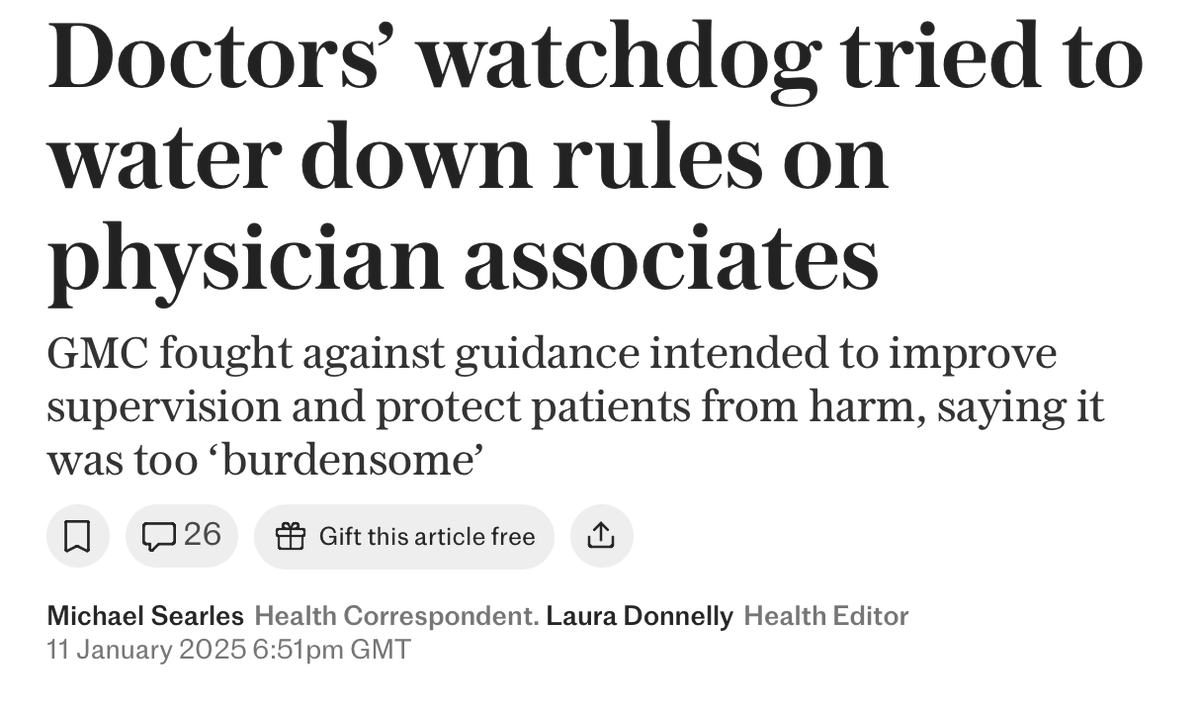
Crikey, @gmcuk - is there really nothing you won't do to make sure physician associates can work as doctors, despite having no medical degree?
This extraordinary piece reveals how the GMC tried to dilute new royal college rules preventing PAs seeing patients solo. 🧵
On clinic this week, seeing someone just shy of their 16th birthday, I was not allowed to perform skin prick testing for allergies, a minor diagnostic test I perform on a near daily basis, as doing so in a child was outside of my defined scope of practice.
And then we see this?
Thank you @gmcuk for the update. May I ask about a process issue as you do not wish to set national scope of practice for PAs/AAs. Let's say a procedure in Trust A results in patient harm and you decide to investigate a PA, the supervising consultant and resident doctors who happened to be present nearby.
So you look at the local scope for that procedure in Trust A, how do you judge whether it is safe & appropriate? And by what/whose standards? Also, it might very well be different in neighbouring trusts.
If you conclude (after applying whatever standard (?) rather than just accepting a supervisor's word for it) that the local scope is inappropriate in Trust A, then will your take both the supervisor and the poor PA to the MPTS?
And will you then advise all other trusts to amend their local scopes for that procedure and in effect, setting up a de facto national scope for that procedure?
And what happens if other trusts don't follow suit, will the you then enact enforceable national scope for that procedure? And have to rinse and repeat for every other procedure as further patient harm incidents occurs as a result of a supervisor's/PA's actions/omissions?
And if you conclude that the local scope for that procedure in Trust A is actually safe & appropriate, will you be in effect setting a precedent so that if things go wrong in Trust B because a PA there doing the same procedure was less experienced/trained/less supervised than the original PA in Trust A, that would be okay with you, even though objectively it might not be?
A nightmare no? Why don't you adopt national scope guidance from Royal Colleges? It would save time, money, it would make your investigations far more efficient and it would better protect patients, doctors and of course PAs themselves! You did say back in June 24 that you support the Colleges' work on scope?
Finally, are you using doctors' annual fees to fight them in the Judicial Review actions by BMA and Anaesthetists United?
We have two limited edition pre-match shirts to give away to two followers.
To enter the competition, you just need to retweet this tweet and make sure you’re following us.
Winners will be contacted Friday via DM. Good luck! #NFFC 🌳❤️
🧵/
This is, I believe, unprecedented in the history of UK medicine.
28 eminent UK doctors have written publicly to @LaylaMoran, the new chair of @CommonsHealth, to report something nothing less than scandalous.
Read their letter here (1/n) 👇
https://t.co/qh5iZj7Xnj
@BDChadwick@Burnt2020@UKGastroDr @TomStocks1982 @ExplosiveEnema2@RCPhysicians@BritSocGastro Either all of that stuff is necessary for what an FY1 is doing (even with all the relative supervision and oversight they correctly get) or it's not, and this scope document is a good chance to set everything in stone with regards that.
Because people were surprised when I said this yesterday here it is again:
It takes 2 years of unaccredited training (not medical training) to become a PA, science background not essential.
It takes at least 12 years of medical and specialist training to become a surgeon.
This offer is not FPR, but it’s also not instead of it.
The question it poses is one of strategy on how best to secure FPR:
Accept, bank these initial gains, use the next 9 months to reorganise and win back doctors lost to strike fatigue.
OR
Reject, and carry on as we are.
"If others won't lead, we will."
Today @DrPhilBanfield announced we are launching legal action against the GMC, over MAPs and the use of the term ‘medical professionals’.
Here's why ⬇️📣 #ARM2024
Thank you for asking me this question
I generally refrain from comparing medical scandals because they are all tragedies in their own way.
The Bristol heart scandal arose because the unit had demonstrably worse results for paediatric cardiac surgery than other units, but was telling parents the UK average mortality rates rather than the unit’s actual rates. To compound matters, the problems in Bristol were widely known amongst the profession, the Royal College of Surgeons, the Society of Cardio Thoracic surgeons, the Department of Health specialist commissioning group etc. Everyone knew apart from the parents, until a very brave whistleblower called Steve Bolsin spoke up. The public inquiry, which finished nine years after I broke the story in Private Eye, concluded that around three dozen babies might have survived if they’ve been operated on elsewhere over a set period. Over a longer period, Professor Bolsin puts the number at around 170. The real tragedy of Bristol is that it made 198 recommendations, many of which have been subsequently repeated in all the other health scandal since, most notably the Mid Staffs inquiry and more recently the infected blood inquiry. The UK is a world leader in public inquiries, and then we ignore the findings so we can have another public inquiry.
The physician associate scandal may not progress to a public inquiry because so many people have raised concerns early, both here and elsewhere. Various Royal Colleges and the GMC have egg on their face and are reversing, or may shortly be reversing, their positions. Far more NHS staff are speaking up for patient safety and, with a new government in charge, constructive changes are more likely to happen and people will continue to speak up if they don’t.
There have been some well publicised disasters where PAs have either voluntarily or forcibly been put in positions that were beyond their competence, and serious harm and death has resulted. However, this clearly doesn’t just apply to PAs. In the Bristol Inquiry report, it was estimated that around 25,000 people die every year in the NHS from either substandard care, or failure to access care. More recently we seem to have settled on a number of 11,000 avoidable deaths a year. Only a tiny fraction of these will have anything to do with PAs.
I guess what I’m saying is that we need to look at patient safety in the round, and speak up forcibly about every aspect of it. My big lesson from Bristol was that how you raise concerns matters as much as the concerns you raise. I did it in a very aggressive way, that made people pull up the drawbridge and probably delayed constructive change and adversely affected the mental health of surgeons trying to do the hardest operations on some of the sickest children. There are plenty of competent PAs out there doing their best in very difficult circumstances, and suicide rates are high enough amongst NHS workers without making things worse.
If we see everything through the prism of patient safety, safe staffing and skill mix levels, it gives us something to unite around as healthcare workers. As Steve Bolsin famously said about the Bristol case, “if you want to prevent future scandals, never lose sight of the patient.” And the lesson from Bristol for PAs out there is that you have to be very explicit and honest with patients about who you are and what your levels of expertise are. If you give misinformed consent, there is no defence. And hospitals and professional bodies that misrepresent the expertise of PAs are equally culpable.
Does that answer your question?