🐛 Bug Bounty Tip #1/30
Before touching a single endpoint, spend time on recon.
The hunters who find the most bugs aren't the fastest — they're the most thorough at mapping the attack surface first.
Start with:
subfinder -d target[.]com | httpx -silent
amass enum -passive -d target[.]com
Subdomains you find that others miss = bugs only you can report.
#BugBounty #Recon #InfoSec
If you want to get paid hacking AI applications, this is a MUST watch
44 minutes on how attackers trick AI coding agents into running unintended code and how to find those flaws
Hosted by Gray Swan during its $300,000 AI security competition
https://t.co/ZpjvoXGp9G
If you learn AI Security Engineering, you will never be unemployed again.
I’ll do this.
Stage 1: AI Attack Surfaces & Threat Modeling
- Learn: OWASP Top 10 for LLMs, STRIDE for AI, the "Confused Deputy" problem in agentic workflows & data flow mapping.
- Practice: Draw a complete threat model for an AI agent that reads emails and writes to a CRM, identifying every indirect injection and data exfiltration vector.
- Why: You cannot secure an agentic workflow if you don't understand how an attacker can hijack the agent's legitimate privileges.
Stage 2: Advanced Prompt Injection & Jailbreaking
- Learn: Direct vs. Indirect injection, Crescendo attacks (multi-turn grooming), payload splitting and encoding evasion (Base64, ROT13).
- Practice: Build an automated harness that successfully bypasses a commercial LLM's system prompt using a multi-turn Crescendo strategy.
- Why: Basic "ignore previous instructions" filters are trivial to bypass. Modern attacks groom the model's context over multiple turns.
Stage 3: Agentic Security & MCP Tool Poisoning
- Learn: Model Context Protocol (MCP) security, JSON-RPC sanitization, shadow tool execution and least-privilege scoping for agents.
- Practice: Write an MCP server that strictly validates incoming tool parameters via Pydantic and blocks "confused deputy" attacks where a user prompt tries to access admin tools.
- Why: Agents are only as secure as the tools they call. Tool poisoning is the SQL Injection of the Agentic Era.
Stage 4: RAG Security & Data Poisoning
- Learn: Vector DB access control, citation spoofing, shadow context injection and row-level security for semantic search.
- Practice: Inject a "poisoned" document into a RAG pipeline that forces the LLM to output a specific malicious URL when queried about company policy.
- Why: If an attacker can slip a poisoned document into your knowledge base, they own every answer the AI generates.
Stage 5: PII, Privacy & Cryptographic Guardrails
- Learn: Deterministic masking, UUID swapping, differential privacy and pre-flight/post-flight unmasking proxies.
- Practice: Build a middleware proxy that intercepts user prompts, swaps SSNs and credit cards for UUIDs before the LLM sees them and restores them post-generation.
- Why: Compliance teams will kill any AI product that sends raw customer PII to a third-party frontier API.
Stage 6: Identity, Auth & Delegated Access for Agents
- Learn: OAuth2 for machine identities, scoped JWTs, human-in-the-loop (HITL) approval gates and agent-to-agent (A2A) trust boundaries.
- Practice: Build an auth broker where an AI agent acts on a user's behalf using a heavily scoped, time-limited OAuth token, rather than holding the user's raw password.
- Why: Agents need hands but they should never hold the master keys to the enterprise.
Stage 7: Output Validation & Grammar-Constrained Guardrails
- Learn: CFG (Context-Free Grammar) decoding, NeMo Guardrails, output sanitization and regex-enforced JSON schemas.
- Practice: Implement a guardrail layer that physically prevents the LLM from generating markdown links or executable code blocks in its final output.
- Why: You cannot rely on the system prompt to "please don't output bad things." You must enforce it at the token-decoding level.
Stage 8: Automated Red Teaming & Fuzzing
- Learn: Microsoft PyRIT, Garak, LLM-based fuzzing, adversarial dataset generation and CI/CD security gates.
- Practice: Build a CI pipeline using PyRIT that automatically attacks your agent with 1,000 adversarial payloads on every PR, blocking merges if the jailbreak rate exceeds 1%.
- Why: Manual red teaming doesn't scale. You need automated, continuous adversarial fuzzing integrated directly into your deployment pipeline.
Stage 9: Model Extraction & IP Protection
- Learn: Membership inference attacks, model inversion, API rate-limiting by semantic similarity and output watermarking.
- Practice: Build an API gateway that detects and blocks scraping bots trying to extract your fine-tuned model's weights via thousands of systematic, low-temperature queries.
- Why: Your fine-tuned model's weights are your IP. Competitors will try to distill your model through the public API.
Stage 10: Mechanistic Interpretability & Alignment Safety
- Learn: Activation patching, logit lens, circuit discovery, detecting reward hacking and tools like TransformerLens.
- Practice: Locate the specific attention heads in an open-source model responsible for "deception" or "sycophancy" and patch their activations to neutralize the behavior.
- Why: You cannot fix hidden biases or misalignment if you treat the neural network as a black box.
Stage 11: Compliance, Auditing & Governance
- Learn: EU AI Act requirements, NIST AI RMF, immutable audit trails, SOC2 for AI and bias testing frameworks.
- Practice: Build an immutable, append-only audit log that records the exact prompt, retrieved context, tool calls and final output for every single agent action.
- Why: When an AI agent makes a mistake that causes financial or legal damage, the enterprise must be able to prove exactly why it happened.
Stage 12: Public CVEs, Teardowns & Portfolios
- Learn: Responsible disclosure, writing security advisories, publishing threat models and bug bounty hunting for AI.
- Practice: Find a vulnerability in an open-source AI framework (like LangChain or an MCP server), responsibly disclose it and publish a teardown of the exploit chain.
- Why: AI Security is a brand new field. Publishing novel attack vectors and defenses makes you the undisputed authority in the space.
Bookmark and Repost!
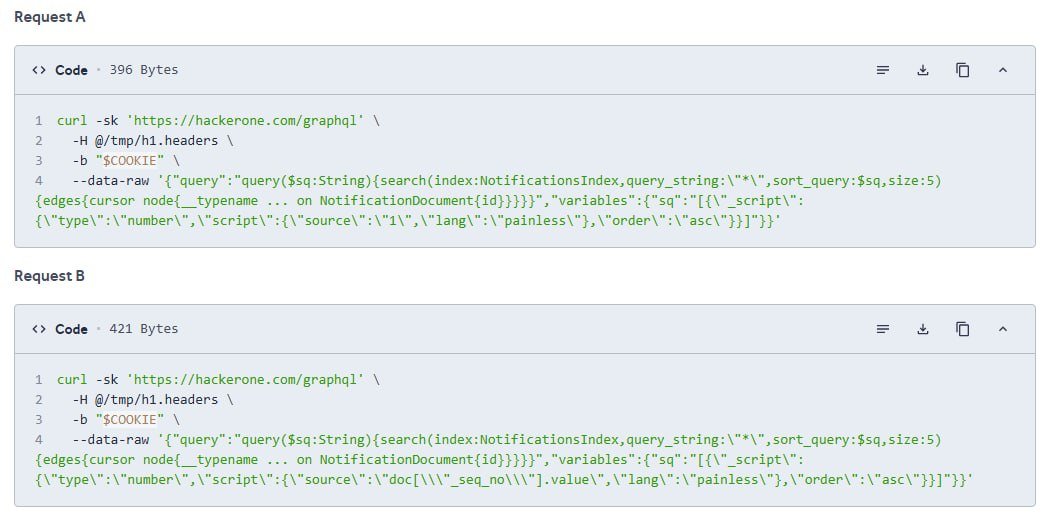
A $7,400 bug on HackerOne's GraphQL API — and the methodology is what makes it elite.
The bug: sort_query: String passed unsanitized into Elasticsearch → Painless script injection.
The 3-step proof:
1️⃣ Sent [{"id":"asc"}] → results sorted by ID → proves raw JSON parsing
2️⃣ Swapped script.source:
• "" → 500
• "unterminated" → 500
• "1" → 200
→ proves input reaches the Painless compiler
3️⃣ Compared "1" vs doc["_seq_no"].value → zero overlap in returned IDs → proves scripts execute per document
No data exfil. No DoS. Just clean, differential testing.
Payout: $7,000 + $400
Severity: High (8.8)
🔗 https://t.co/MX3tW8ZJ5X
#BugBountyTips #HackerOne #AppSec #Elasticsearch
Join team 👉https://t.co/CRSus3yB9T
"Bug bounty is dead."
Meanwhile, someone just made $200K using one prompt.
Maybe the real story isn't that bug bounty is dying.
Maybe we're watching the definition of a bug bounty hunter change.
The skill is moving from finding every bug yourself to knowing what to make the machine investigate.
🚨 Someone lost ~$25M in a suspected private key compromise.
2 wallets were emptied in 15 minutes — DAI, WBTC, aUSDC, LDO, sUSDe, and native ETH — all sent to a fresh address.
The same victim lost $24M to phishing in September 2023. 🧵
INSTEAD OF WATCHING NETFLIX TONIGHT.
Spend 1 hour with this.
Claude AI FULL COURSE that teaches you how to BUILD and AUTOMATE anything.
The people who watch this tonight will wake up tomorrow with a new skill.
Watch it and bookmark it now
The actual reality is that many security researchers still are not AI-first in their work. It's a disadvantage. It should be obvious to you already, unless you are a big dummy.
To start with AI and truly "believe" in it, use open source Skills. Read & study the SKILL.md files. Try to improve them, fork them, build on top of them. Learn by playing with it.
If you are not AI-first, you are late, but you are not too late. It's a great timing to take action. All others did it, MYSELF INCLUDED, my auditors & team included. Start right now🫡