EVAfocus:Focus on Electric Vehicle Advance
Join Our EV Community
Welcome to the EVAfocus Global EV Community -- the network connecting EV owners, enthusiasts, and professionals worldwide.
Here's what you get:
✓ Breaking EV news & insider views
✓ Live chats with global EV lovers
✓ Direct links to industry leaders
Scan the QR code to join now
XPeng has completed the first customer delivery of the P7+ in Paris, France.
The P7+ sold in the European market is produced at Magna Steyr’s factory in Graz, Austria. Its starting price is €45,990, about RMB 380,000.
Congratulations to this P7+ owner.
#EVExports #AutoInfluencer #XPengP7Plus
England’s new EV driveway rules are now in force: easier home charger installation, less planning red tape, and grants up to £500 for households without driveways.
#EVCharging#ElectricVehicles#UKTransport
The CEO of Magtalent, a Spanish professional headhunting firm, posted that he is particularly interested in XPeng and has already applied for a test drive.
Indonesia’s Q1 2026 new vehicle market wraps up at 175,111 units, down 10.6% YoY 📉, with dramatic shifts reshaping its long-standing competitive landscape.
🇯🇵 Japanese brands still occupy 76.6% market share (134,219 units), but the segment fell 18.9% yearly. Toyota slumped 41.5%, Honda & Mitsubishi also posted losses; only Daihatsu and Suzuki managed positive growth amid the downturn.
🇨🇳 China-origin automakers stand out as the biggest market bright spot ✨, surging 68.2% YoY to take 19.9% share (34,834 units). BYD (+111.2%), Geely (+1125.2%) and Aion (+78.9%) fuel the sharp expansion, while Wuling and Chery record yearly declines within the Chinese lineup.
🇰🇷 Korean brands shrink 47.9% overall at merely 2.1% share: Hyundai tumbled heavily, countered by Kia’s steep growth from low volume base.
🇩🇪 German premium players make up just 0.4% market share, with the group’s total sales dropping 23.6% YoY.
Overall, Indonesia’s Japan-dominated auto market is facing tangible disruption as Chinese vehicle brands accelerate local penetration.
#EVAFocus #IndonesiaAutoMarket #ASEANAutomotive #ChineseEVGlobal #Q12026AutoAnalysis
Mexico’s automotive market kicks off Q1 2026 on a positive note:
Total new car sales reached 381,653 units, up 3.7% YoY, with major shifts reshaping the country’s long-standing competitive landscape.
🇯🇵 Japanese Brands | 40.1% share (+0.8% YoY)
Still the undisputed market leader. Nissan tops all single brands at 17.6% market share, followed by Toyota at 7.8%. Performances diverge across the lineup: Mitsubishi jumps 22.4%, while Suzuki drops 11.9%, showing fragmented growth among Japanese OEMs.
🇺🇸 US Brands | 21.5% share (+6.7% YoY)
GM dominates American players at 13.2% share with mild 1.9% growth. Chrysler stands out with a strong 26.9% surge, counterbalancing Lincoln’s 8.9% decline and lifting the overall US segment’s yearly gain.
🇨🇳 Chinese Brands | 11.4% share (+47.2% YoY)
The biggest highlight of Mexico’s Q1 2026 market. MG (+30.5%) and Geely (+272.2%) lead China’s rapid expansion, while Changan, JAC and GWM also record strong double-digit growth. Chinese automakers are quickly gaining market share from legacy Western and Japanese players.
🇩🇪 German Brands | 11.2% share (-4.4% YoY)
VW remains the core brand at 8.8% share with a slight annual dip. Premium brands BMW and Audi show mixed results, dragging down Germany’s overall yearly performance.
🇰🇷 Korean Brands | 10.4% share (+2.6% YoY)
Stable overall growth: Kia climbs 4.3%, offsetting Hyundai’s minor pullback and securing steady market footing in Mexico.
🇫🇷🇪🇸🇮🇹 Other Regions
French, Spanish and Italian brands hold small niche shares with mixed performance.
Key Takeaway
Japan and the US still control over 60% of Mexico’s auto market, but Chinese vehicle manufacturers are emerging as the game-changer, with rapid growth accelerating their penetration in Latin America’s core automotive hub.
#EVAFocus #MexicoAutomotive #Q12026AutoData #ChineseEVBrands #LatinAmerica
BEV penetration figures across European countries for April are out, revealing a widening divide between regional markets.
Norway is nearing full electrification with BEVs accounting for an impressive 98.6% of new registrations, while Denmark follows closely at 81.9%.
By contrast, multiple Eastern and Southern European nations remain stuck in single-digit territory, including Poland at 5.1%, Spain at 9.1% and Greece at just 4.9%.
Established automotive powerhouses such as Germany, France and the UK sit in the middle ground; their EV uptake is respectable yet far from a complete industry shift to electrification.
#EVAFocus #EuropeanEVMarket #BEVData #AutoElectrification #ACEA #NewCarRegistration
A major fire recently broke out at a Hyundai Mobis factory in India.
Since the factory supplies several key components, Hyundai Motor has acknowledged that short-term production disruptions may occur.
So far, no casualties have been reported, and Hyundai also stated that its current inventory is still sufficient to meet market demand.
#EVExports #AutoIndustry #HyundaiIndia
Currently, 2,910 electric vehicles have entered Canada, accounting for nearly 12% of the first-round total quota.
The vast majority of them are Tesla Model 3 vehicles produced at the Shanghai Gigafactory. #Tesla#ElectricVehicles#TeslaModel3#ChinaEV#CanadaEV
South Africa Automotive Market Q1 2026: A Dramatic Power Shift
South Africa’s auto market grew 12.3% YoY in Q1 2026, but the story lies in the reshuffling of market power.
Japanese brands still lead with a 42.7% share, driven by Toyota’s dominant 23.1% share. However, their growth (+2.7%) pales in comparison to the explosive rise of Chinese automakers.
Chinese brands have surged to 18.8% market share, growing 30.3% YoY. GWM (+42.9%), Chery (+21.3%), and Jetour (+249.0%) are the key drivers, rapidly capturing market share from legacy players.
German brands (13.7% share) saw a slight decline (-1.7%), while South Korean (9.1%) and American (5.7%) brands posted modest growth. India’s Mahindra and Tata also show promise, with combined sales up 19.1%.
This isn’t just growth—it’s a structural shift. The era of Japanese dominance is being challenged by Chinese brands bringing affordable, tech-packed vehicles to a price-sensitive market.
#EVAFocus #SouthAfricaAuto #AutomotiveIndustry #Q12026Data #ChineseBrands #MarketShareShift #EmergingMarkets
In 2025, China’s new energy vehicle sales reached 16.49 million units, already exceeding the total annual car sales in the United States, which stood at 16.38 million units.
The U.S. auto market has long entered a mature replacement stage. It is very common for people to drive one car for more than ten years, so new demand is limited.
China is different. New energy vehicles are rapidly replacing fuel-powered cars. At the same time, more people are buying cars not only because they need “a car to drive,” but because they want to upgrade to a better and smarter vehicle.
#ElectricVehicle #EV #NewEnergyVehicle #ChineseEV #ChinaEV #NEV #EVMarket #EVSales
A Korean importer brought the Chery QQ Ice Cream into South Korea and renamed it Masada QQ. They directly removed the rear seats and sold it under South Korea’s ultra-compact electric vehicle category.
This car is equipped with a 13.9 kWh battery, has a maximum speed of 80 km/h, and cannot be driven on highways.
Dealers have now started clearing inventory, reducing the price to around 8 million Korean won, which is approximately $6000.
#KoreaEV #MasadaQQ #Chery
I saw data from a car export platform, and I didn’t expect that in the non-official trade export market, Xiaomi Auto has become so popular.
In 12 major EU markets, including Germany, the Netherlands, Spain, and Italy, Xiaomi Auto is the best-selling brand on this platform.
There is another interesting figure: 10% of Xiaomi’s export sales are the high-performance Ultra version. In China, this version accounts for only 2.5% of sales. It seems that foreign buyers choose the best version when they buy.
Another interesting brand is Huawei-backed Zunjie/Maextro. In Middle Eastern countries such as Saudi Arabia and Oman, it is the best-selling brand on this platform.
Although the platform’s sample size is only 11,000 vehicles, it still shows the overseas popularity potential of some models that have not officially entered international markets yet.
If Huawei-backed cars and Xiaomi Auto officially go global, it is hard to imagine what the market will look like.
#XiaomiAuto #EVExport #ChineseEV
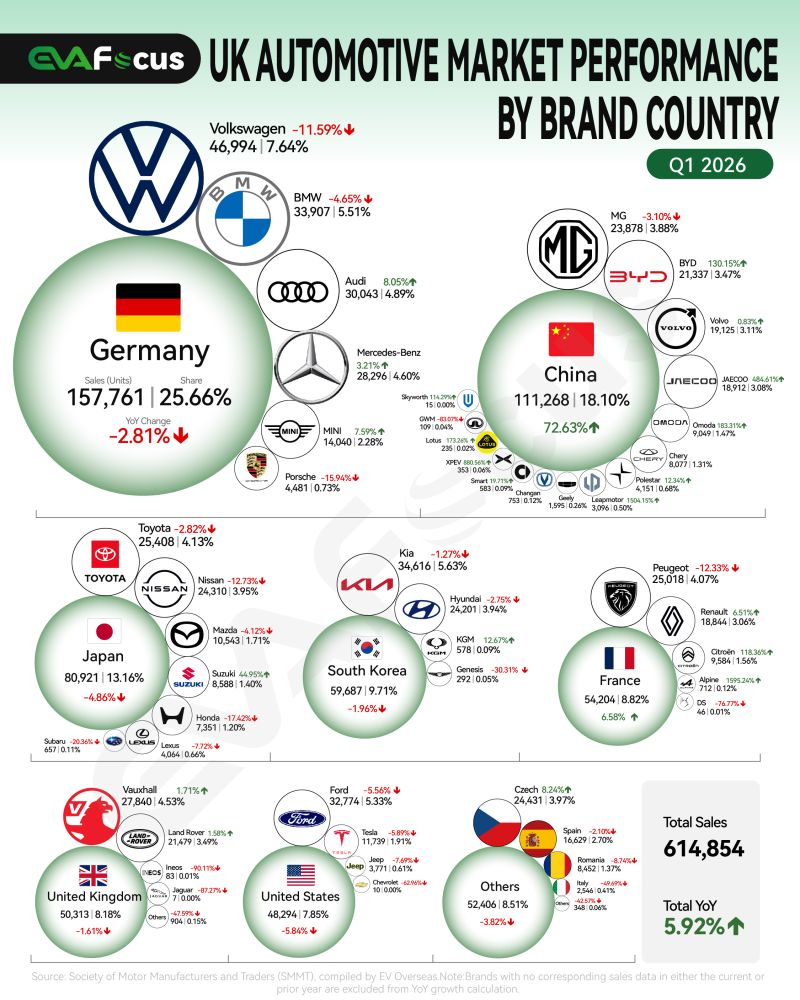
The UK automotive market grew 5.92% YoY in Q1 2026 to 614,854 units—but the real story is the seismic shift in competitive dynamics.
German brands still lead with 25.66% share, but contracted 2.81% YoY. The divergence is clear: premium badges like Audi and Mercedes held steady, while mass-market stalwarts like Volkswagen faced steep declines, underscoring pressure on legacy ICE models.
Chinese brands are the defining growth story, surging 72.63% YoY to 18.10% share. BYD’s triple-digit expansion and Jaecoo’s explosive growth signal they’re no longer niche players, but mainstream competitors reshaping the market with aggressive EV strategies.
Japanese, South Korean, and US brands all faced headwinds, with flat or declining sales. Even Tesla saw a drop, highlighting how its once-unchallenged EV dominance is now under threat.
The takeaway? The UK market is no longer just “growing”—it’s being redefined. The gap between EV-first disruptors and legacy brands will only widen from here.
#EVAFocus #UKAutomotive #Q12026 #AutoIndustryTrends #ChineseEVs #MarketDisruption
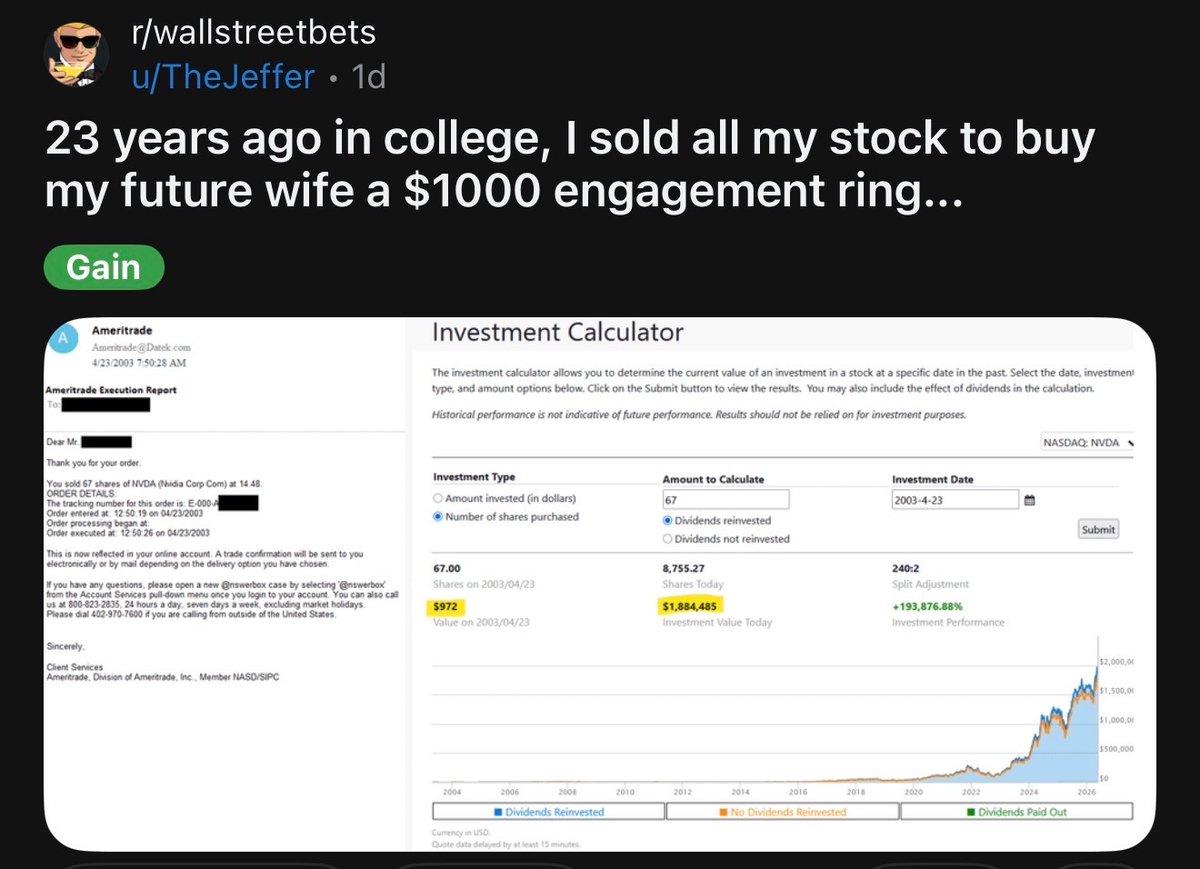
Someone on Reddit said he sold his Nvidia shares 23 years ago to buy a $1,000 engagement ring. Today, those shares would be worth $1.88 million.
Then I saw someone in the comments say: “Between 23 years of a happy marriage and $1.8 million, I’d choose the marriage.”
#EVAfocus #Nvidia
NIO has just launched the ES9 — a massive executive electric SUV aimed straight at the luxury market.
This is being called China’s largest battery-electric SUV, with three rows, 697 horsepower, and up to 620 kilometers of range.
But the biggest surprise is the price.
The ES9 starts at 498,000 yuan, which is around 73,400 US dollars. And with NIO’s battery rental plan, the entry price drops to 390,000 yuan — around 57,500 US dollars.
That puts it directly against luxury rivals, but with NIO’s battery-swapping ecosystem and a huge focus on rear-seat comfort.
To make the message even bigger, NIO brought in NBA Hall of Famer Yao Ming as Chief Experience Officer — a perfect move to highlight just how spacious this SUV really is.
Deliveries begin from May 28 for selected versions, and the launch has already given NIO shares a strong boost.
So the question is: can the ES9 help NIO win back momentum in China’s premium EV market? #NIO #ElectricVehicles #AutomotiveIndustry
Former Ferrari chairman Luca di Montezemolo didn’t hold back on the new electric Ferrari “Luce”:
“If I said what I really think, I’d harm Ferrari. We’re risking the destruction of a myth. I’m very sorry about that. I hope they at least remove the Prancing Horse from that car.”
Ferrari’s EV era is already controversial.
#Ferrari #ElectricVehicles #AutomotiveIndustry
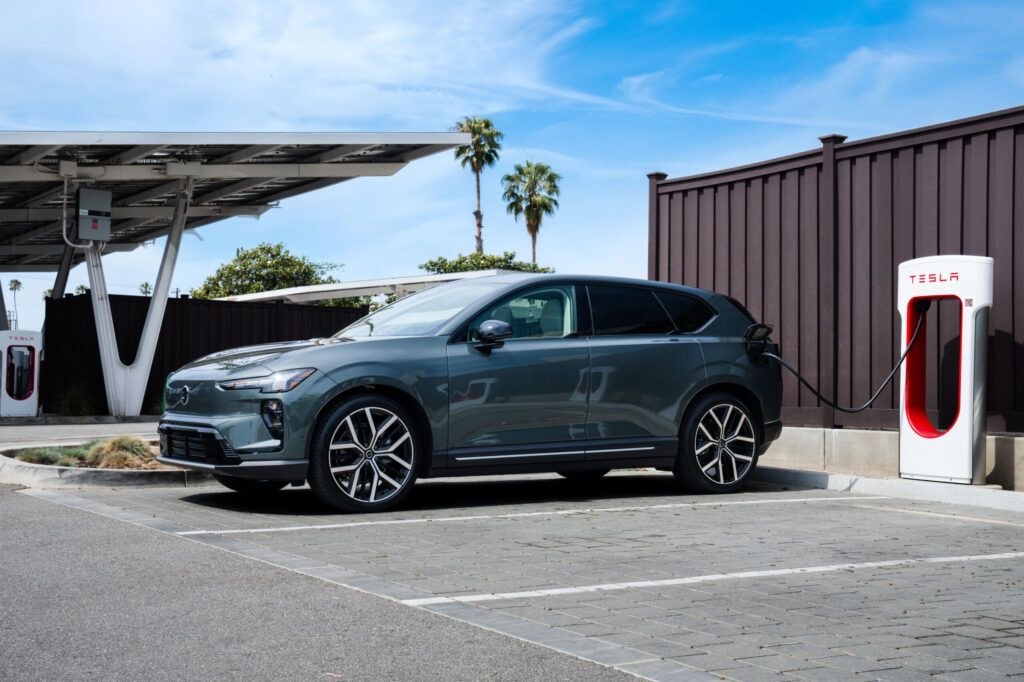
Starting from Q4 2026, Volvo fully electric vehicle users in 29 European countries will be able to use the Volvo App directly to charge at Tesla Supercharger stations, with access to more than 20,000 chargers.
Previously, brands such as Polestar, Ford, and General Motors had also either already connected to Tesla’s Supercharger network or were preparing to do so. #VolvoEV #TeslaSupercharger #ElectricVehicles