How do donors see the future of #EvaluationCapacityDevelopment in a context of tight funding & declining trust in institutions?
Join GEI's #Glocal2026 session & hear directly from funding organizations.
🗓️ June 2, 12 PM (CET)
👉 Sign up here: https://t.co/LEZXyj7CB6
It's Day 2⃣ of #Glocal Evaluation Week 2026!✨
The #glocal2026 dialogue on evaluation, evidence & trust in the age of #AI continues, with knowledge-sharing sessions taking place worldwide until June 5.
✅Here's a shortlist of sessions happening today: https://t.co/OB2O55OJUV
@EvalforEarth will convene six sessions during #gLOCAL2026: 3 in English, 2 in French, and 1 in Spanish.
Join discussions on #Evaluation, #AI, sustainability, resilience, food systems, ethics, and evidence use.
📅 English Sessions
🔹 3 June: Doing More with Less while Not Losing Trust: How Should Evaluation Standards Evolve in an AI-Augmented World?
⏰ 15:00–16:30 Rome time
🔗https://t.co/shRNUkic2q
🔹 4 June: Grounding AI in Evaluation Practice: Lessons from Nepal and Georgia
⏰ 14:00–15:00 Rome time
🔗 https://t.co/R3GxZ5usYa
🔹 5 June: Evidence We Can Trust: AI, Ethics, and the Future of Evaluation Practice
⏰ 11:00–12:00 Rome time
🔗 https://t.co/mkLNIBMMSU
#AIforEvaluation #Evidence #Sustainability #gLOCALevaluationWeek
📢@EvalforEarth participará en #gLOCAL2026 con 6 sesiones: 3 en inglés, 2 en francés y 1 en español.
📅 Sesión en español: " Evaluación en la era de la inteligencia artificial: evidencias, capacidades y gobernanza"
🗓️ 1 de junio de 2026
⏰ 15:00–16:00 (hora de Roma / GMT+2)
La sesión reunirá a evaluadores, profesionales, investigadores y socios para el desarrollo para debatir sobre #Evaluación, #IA, sostenibilidad, resiliencia, sistemas alimentarios y uso de la evidencia.
Plazas limitadas. Regístrese hoy para asegurar su participación⤵️
https://t.co/AB4dzLnoGF
#InteligenciaArtificial #Evidencia #Sostenibilidad #gLOCALevaluationWeek
@GEI_GlobalEval@Clear_Lac@GEF_IEO@IFADeval@WFP_Evaluation
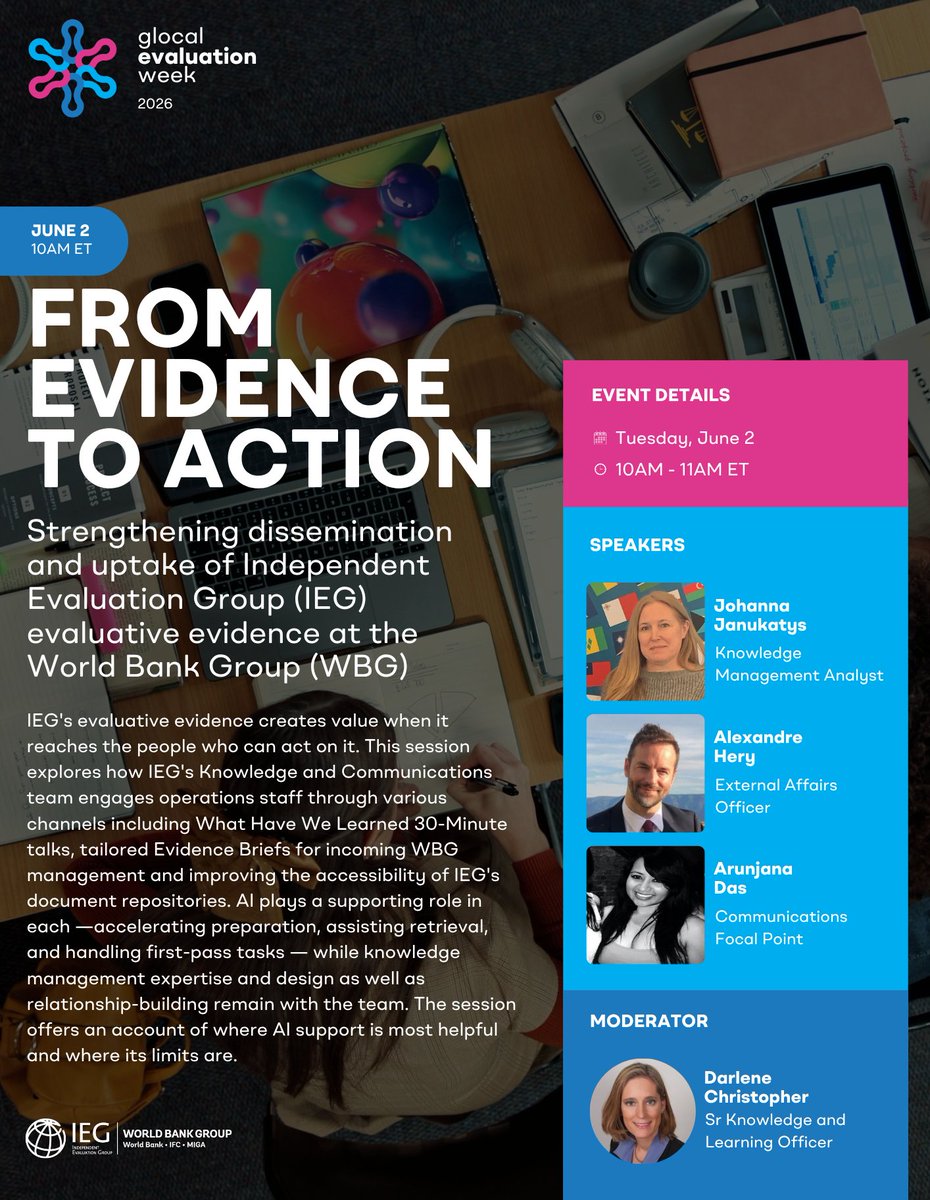
Our evaluative evidence creates real value when it reaches those who can act on it.
📅 Join us June 2 at 10 AM ET to explore how our Knowledge & Communications team uses #AI-supported channels to engage operations staff.
🔗 Register: https://t.co/RjoNgdT74V
Mapping smarter decisions: How geospatial data is transforming evidence-informed governance in South Africa 🌍
The Geospatial Information Management Strategy (GIMS), developed by @DpmeOfficial, highlights the growing role of geospatial technologies, spatial data, and analytics in strengthening government planning, monitoring, and evaluation: https://t.co/0ipjObdMff.
Designed to improve evidence-based planning and decision-making, GIMS also aims to strengthen spatial governance, enhance data integration, and support more coordinated and responsive public service delivery.
For the evidence-informed decision-making (EIDM) community, particularly #AENmembers, the strategy demonstrates how innovative data systems can improve policy responsiveness, accountability, and developmental impact.
The initiative is especially relevant for professionals working in monitoring and evaluation, governance, health systems, climate adaptation, urban planning, and public policy, as it reinforces the importance of integrating diverse forms of evidence into decision-making processes across Africa.
#Accountability #AfricaLovesEvidence #AfricanEIDM #DataForDevelopment #DigitalGovernance #EvidenceUse #GeospatialData #InnovationInPolicy #PublicSectorInnovation #SpatialAnalytics
Have you heard? The agenda for #Glocal Evaluation Week 2026 is OUT!
💡Choose from 300+ free knowledge-sharing events, including sessions on this year's theme: Evaluation, Evidence & Trust in the Age of #AI.🤖
🔎 Explore the #Glocal2026 agenda & register: https://t.co/1OkRzRDI1r
One week to go⏩Youth in Evaluation Forum'26
🌳19 May—Inauguration
↳ Youth in Evaluation champions awards
🌐20-21 May—34 events in 9 regions
↳ Amplifying regional & local voices on advancing meaningful youth engagement in evaluation
https://t.co/QPwjwwnyr3
#Eval4Action
Good news! The agenda for Glocal Evaluation Week 2026 is now LIVE!🎉
From June 1-5, #Glocal2026 will bring you 300+ free events exploring key topics in monitoring & evaluation. You can join as many as you want!
👀Explore the agenda & sign up for events: https://t.co/1OkRzREfQZ
How can young people actively influence the future of evaluation?
From 19-21 May, Youth in Evaluation Forum 2026 will amplify young voices in shaping how evaluation responds to evolving global challenges
Register for the global inauguration: https://t.co/QPwjwwnyr3
#Eval4Action
"The most useful shift..was not a specific platform or technique. It was a mindset. To use #AI critically, deliberately & with a clear understanding of its limitations. Because in #evaluation, credibility is everything & that still sits with the evaluator" https://t.co/CwwU6Iplfe
🌍 AI in evaluation: Opportunity or oversimplification for evidence use?
A recent reflection by @TwendeMnE challenges the evidence-informed decision-making (EIDM) community to think beyond the hype of AI and focus on what truly matters for evaluation and evidence use.
As AI tools become more integrated into our workflows, they are undeniably improving speed and efficiency, supporting everything from data synthesis to report drafting. But as highlighted by the author, faster does not automatically mean better.
⚖️ For #AENmembers and the wider #EIDMcommunity, a few critical insights stand out:
🔹 What’s changing:
AI is reshaping how quickly evaluation tasks can be completed.
🔹 What isn’t:
The fundamentals—rigor, critical thinking, and contextual understanding—remain non-negotiable.
🔹 What matters most:
• Credibility must not be sacrificed for convenience
• Context cannot be automated; local knowledge remains essential.
• Evidence must be translated into usable, decision-friendly formats.
• AI should strengthen, not replace human expertise.
🚀 The real question for our community is not whether to use AI, but how to ensure it strengthens evidence uptake and real-world impact.
�� A reflection for our #AENmembers:
How can we intentionally use AI to make evidence more accessible, relevant, and actionable across African contexts, while maintaining the integrity that underpins #EIDM?
🔗 Read the full reflection: https://t.co/OAZKZkACtt.
#AI #Evaluation #EvidenceUse #EvidenceToAction #ResearchImpact #AfricaEvaluation #KnowledgeTranslation
[Webinar] On 6 May:
If Communication Doesn’t Lead to Use, What Are We Missing? Rethinking how we communicate #evaluation
https://t.co/25DA8PCHRe
"learning exchange to reflect on this gap & explore how communication can move beyond dissemination to become a driver of learning"
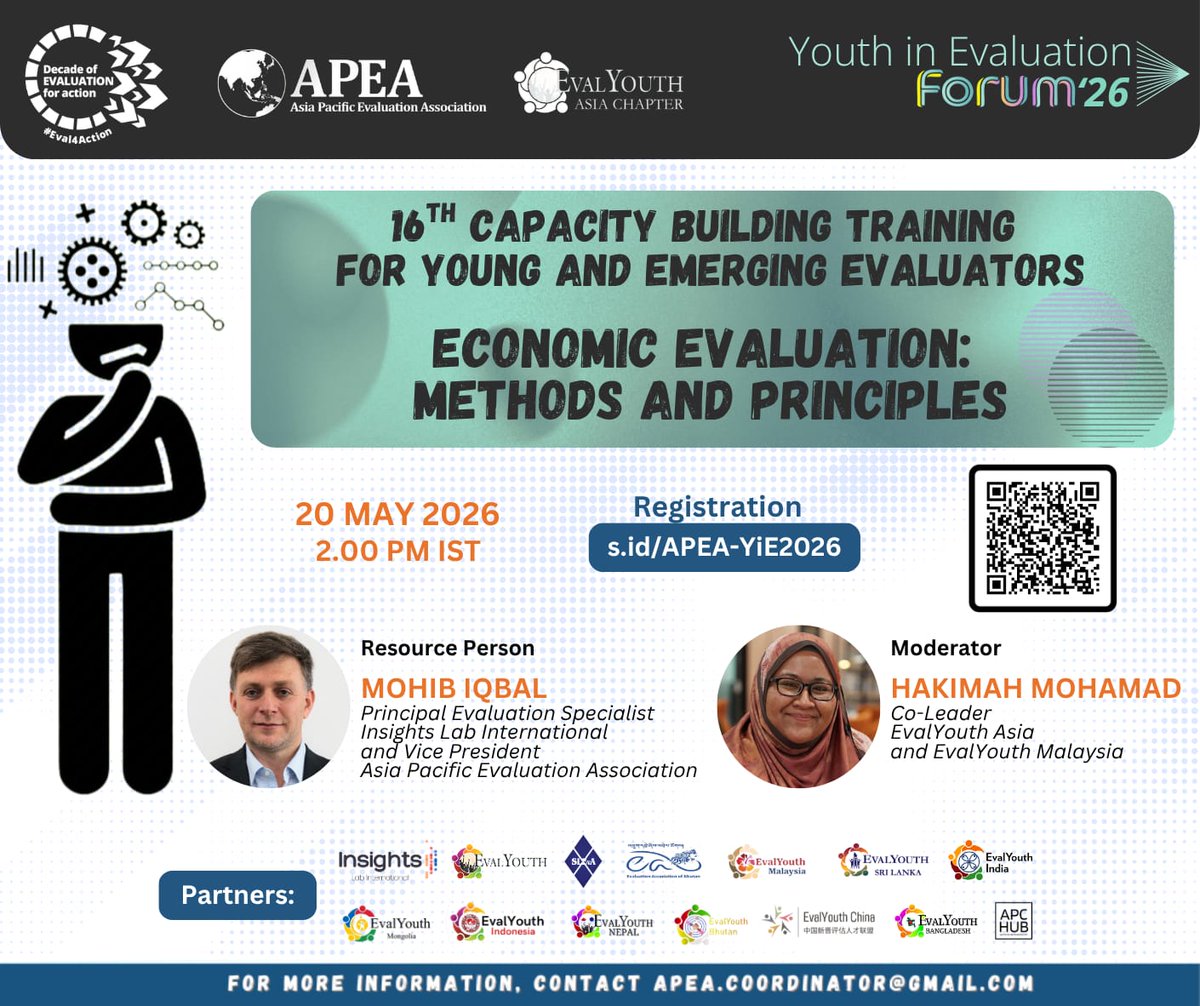
🎓 Capacity Building on Economic Evaluation: Methods and Principles
💡 This session is part of the Youth in Evaluation Forum 2026, designed to empower young and emerging evaluators with practical skills and global insights.
👉 Register now: https://t.co/TYcT7EHx1y
#Eval4Action
"What matters is not how innovative the methods are, but how well they fit the questions. ... #Evaluation practitioners today face situations that did not exist ten years ago ... The first act of creativity is to choose the method that fits the question ..." #Eval#MandE#Methods
🎬 Season 1 of the Future of Evaluation dialogues has come to a close!
On 21 April 2026, #Eval4Action hosted the season finale to explore how innovative approaches are reshaping evaluation.
7 takeaways from the dialogue: https://t.co/ih9PCjyLrW
Season 2 will launch this July!
📣Your input is needed!
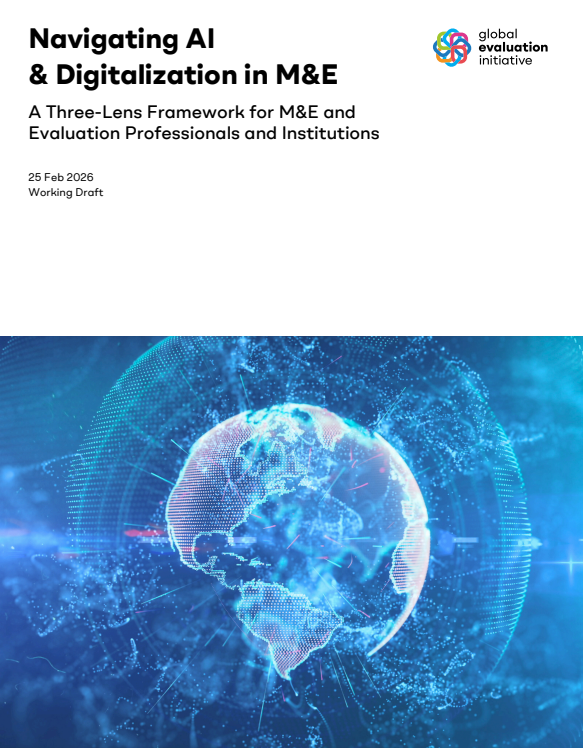
GEI recently published a working paper proposing a 3-lens framework for assessing the use of #AI in monitoring & evaluation (M&E).
🗨️ We'd love to hear back from the M&E community. Please read the paper & share your thoughts: https://t.co/MHWti05Xvg
AEA and The MERL Tech Initiative are excited to present the 2026 Hackathon—Virtual Edition! Happening the weeks of April 12 and 19, the hackathon challenges participants to create ethical AI-powered solutions for real-world evaluation problems. Start now: https://t.co/Y2LhoNRYOw
▶️Recording available
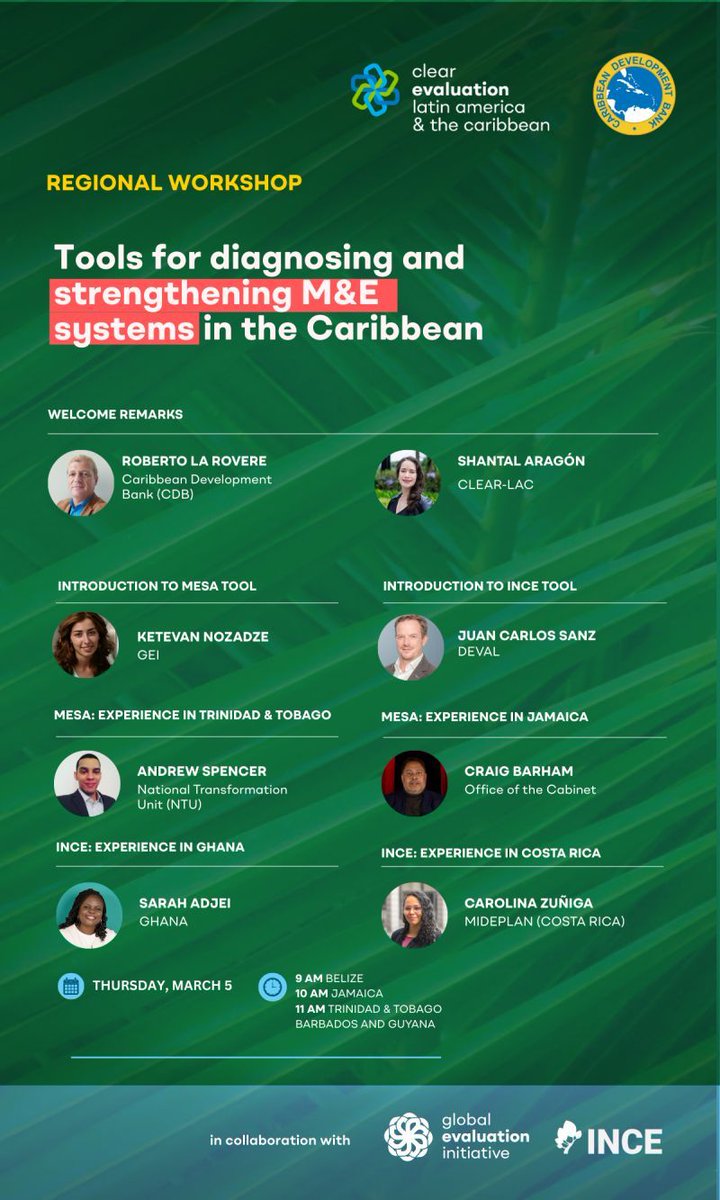
This workshop led by @Clear_Lac & @Caribank presents 2 essential tools for diagnosing & strengthening M&E systems:
🔎Monitoring & Evaluation Systems Analysis (MESA)
🔎National Evaluation Capacities Index (INCE)
Watch the recording: https://t.co/yE5EdxGAfj
The use of geospatial AI unlocks new insights and shapes evaluation findings. But with greater capabilities come inherent risks, ones that demand a dedicated approach to ethics and transparency.
Explore the promise and pitfalls of #GeoAI in our new blog: https://t.co/7sjDDv0RLR
"This resource is intended for researchers who are interested in collecting cost data & conducting comparative cost-effectiveness analysis (CEA) for their #evaluation. It provides an overview of CEA, outlines the basic calculations & key assumptions, & provides two ... examples"
Examining program cost-effectiveness can help illustrate which programs are likely to offer the greatest value for 💲 in a particular situation. Explore cost-effectiveness analysis in these #ResearchResources. https://t.co/1MxprgXJue
"Null results - when a study does not find significant impacts on chosen outcomes - can provide valuable insights for research & policies ... In #JPAL's null results blog series, we highlight randomized #evaluations that yielded null results in order to ...inform future research"
Results from well-designed #RCTs are important for informing policy making, regardless of the result. But null results can be difficult to act on. Learn more about how to think about designing & learning from studies with null results in this blog post: https://t.co/EVu60yvUEW