LinkedIn is suppressing AI content, and I think what it's actually suppressing is content without thinking.
So instead of generic AI posts & comments, what gets through is well-thought ideas, unique POV, proprietary data, and experience.
But it goes beyond that.
Because the same dynamic plays out in every GTM system right now.
AI-generated outreach sequences, messaging, content workflows and design that are all the same when you run the same stack.
And the only variable left is the thinking that came before you touched any of it.
I mean the kind of thinking that can't be automated:
accurate ICP, positioning and messaging built from actual buyer understanding, brand that is human and has something different to say, and more.
Everything else is execution. And execution without that foundation just gets you to the wrong place faster.
You get it. LinkedIn's algorithm didn't create a new standard, but surfaced the one that was always there.
AI can't hide a weak GTM system, and the real question is: what role are you actually giving it?
Google I/O for me is more than a product announcement, it's actually saying that the ten blue links are gone.
Not slowly fading, but structurally replaced.
Conversational answers, information agents, and generative UI - the entire experience is moving inside Google's AI layer.
And this didn't start at I/O.
70% of B2B tech queries already trigger AI Overviews, most without a single click out. With what Google is planning, the educational & consideration stages of the buyer journey are now being absorbed into an AI layer they never leave (zero click content).
So most companies will respond by optimizing for AIO (like schema markup, citation-friendly content & structured data), but that's the wrong game.
Because you can't earn a presence inside a journey that already happened without you.
The GTM question isn’t how we get into AIO.
It’s how we build enough familiarity and authority before the search starts, so Google isn’t the first place buyers learn who matters.
I've sat through enough GTM audits this year to know what's coming when a CMO says "we're doing AI."
They (we...) are under pressure to "do something with AI," so they bolt copilots and workflows onto a Marketo or HubSpot stack that was never built for any of it.
And 6 months later, the dashboard looks busier and the pipeline looks the same...
The reason is structural. AI sitting next to the MAP isn't the same as AI built into it.
I've been using @conversionai on with one of my clients for a few weeks now. Here's one thing we did:
We pointed an agent at their weekly pipeline digest, the one that used to eat half a Monday for their MOps lead. It now lands in the leadership Slack channel before the team even logs on.
That's a small example, but it changes what the MOps function is actually for. And that's how you benefit from "AI for marketing", instead of just adding a feature to a legacy product.
So if you're a CMO planning your 2026 AI investment, this is the layer to start with before you add more tools on top of the one you already have.
P.S. If you want to see how it works, check it our here: https://t.co/8ekoZSALCH
You can free up budget without creating value, and many AI business cases are built on that confusion.
Gartner’s data shows this across 350 large enterprises. 80% cut jobs, some by as much as 20%. The companies that cut the most saw nearly identical financial returns to the ones that cut the least.
That's not a workforce story, but a strategy mistake.
Most of these companies made a downstream move and called it a strategy. Because cutting headcount frees budget, but it doesn't redesign how value gets created.
And AI just amplifies it. So if your operating model is broken, AI just helps you scale the broken parts faster.
Remember Klarna?
They cut 700 CS roles, quality declined, and rehiring started��
You get it. The companies seeing real returns aren’t cutting deeper. They’re redesigning how work gets done:
→ What humans own
→ What AI handles
→ Where the two connect
That’s what your GTM system should define before AI gets layered in.
And yes, that upstream work tends to get skipped because it’s harder than putting a headcount number on a slide.
Which is why Gartner predicts half the companies that attributed cuts to AI will rehire under new titles by 2027.
If your AI business case is built around headcount reduction, you’re solving for cost, not returns.
Check out the full article here: https://t.co/FjjuKNYbCu
My client was happy with the opportunities coming from their branded search. So was I… but their buyers told a completely different story.
When we dug into self-reported attribution and listened to what buyers said on sales calls, most of them described the same journey:
They found the company on ChatGPT first, then Googled the brand to check if it was legit, and then hit the website and converted.
So, what's my point?
The campaign didn't drive discovery, AI did. And Google was just the verification step.
You see, in many cases, buyers aren't coming to your website to research anymore. That part of the journey already happened somewhere else like AI conversations, peer recommendations, dark social, and more.
By the time someone Googles your brand, they're not researching but verifying.
And by the time they hit your site, they're not curious but close.
Simply put, there are 3 layers to the buying journey you should take into account:
1- Discovery → AI search, dark social, communities, peer conversations
2- Verification → Google, brand search, review sites
3- Conversion → your website
So if you're still building your GTM around driving traffic to your site just for awareness & education, you're optimizing for a buyer who is changing as we speak.
You should build your GTM system based on how your buyers are actually buying today, not yesterday, and it's evolving faster than you think.
85% of CMOs say AI adoption is their num 1 GTM priority for 2026, but 53% of GTM leaders say it's had little to no impact on their results.
(Exit Five, 2026 & 2025 State of B2B GTM Report)
The gap between those two numbers is the GTM architecture they skipped. And that's not a tooling problem, but a sequencing problem.
Many teams invested in the execution layer: signal-based outbound, AI-powered sequences, and automated workflows.
And still generate almost no pipeline...
Because GTM Engineering is an amplifier.
It takes whatever foundation you have and scales it, so if your ICP is fuzzy, your messaging doesn’t land, or your motion is wrong, AI won’t fix it but will amplify the problem.
The teams seeing results from AI all ran the same sequence:
architecture → data → signals → execution. And on top of it all, a feedback loop that continuously refines the architecture.
Before you add more tooling, audit what you're amplifying.
GTM Architecture > GTM Engineering
Right now, this is the only GTM advantage that's actually hard to copy.
AI here, AI there… yes, we all get it.
Content creation? Outbound sequences? Easy… Building an app? Claude Code does it in an afternoon. The list goes on.
When the cost of doing anything dropped to near zero, easy became table stakes. The only thing that didn't get easier is having something worth saying.
Last week I was in a GTM audit with a ~$15M ARR SaaS team. Win rates fine, pipeline thin. And you can guess their first instinct… we need more output (=more sequences, content, ads & budget).
But output is exactly what AI does better than any team, and supply exploded while attention didn't.
When we dug into how their best customers actually found them, the shortlist was already set before any sales conversation.
What builds that list isn't volume, but recognition.
Which means a real perspective, showing up consistently, wherever your buyers actually are. And your buyers remember who said something worth remembering long before the search starts.
And here's the thing:
The measurement trap kills it every time. Since there's no direct attribution and no pipeline credit, they default to cutting it. Teams double down on output and wonder why nothing changes.
AI can execute faster, but it can't have a real POV.
That's the only GTM advantage right now that's actually hard to copy.
In some markets, your biggest competitor isn't another company. It’s "this is fine."
Working with a B2B Saas/AI healthtech company right now, and the GTM situation is one I find interesting.
There are real players in the space, but that's not the problem.
The problem is that many of their buyers have lived with the inefficiency long enough that they've normalized it - workarounds, friction and all.
So the real competitor isn't another vendor. It's "this is fine."
And that changes how you should design your GTM.
Because most playbooks assume demand already exists and buyers are actively looking. So they're built around capture: outbound, campaigns, and conversion optimization.
But that's the wrong starting point here.
When buyers aren't aware of the problem or not prioritizing solving it, you can't capture your way to pipeline.
So first, you have to change their perception:
→ Understand their JTBD deeply
→ Make the pain visible
→ Reframe the status quo as costly
→ Show what the old way vs. the new way actually looks like
And that's why your GTM has to be built around buyer reality, not a recycled playbook.
Sometimes the job is capture, sometimes it's education, and sometimes it's both.
In the end, your job is to figure that out first, and then build your GTM system around it.
I've never had a CEO come to me and say "we have a retention problem." It's always "pipeline isn't converting" or "growth is slowing."
Retention is usually buried underneath. And that's exactly the point.
Because retention & expansion usually didn't break post-sale. They were never built into the GTM system in the first place.
The whole system was designed around one thing: acquiring new customers.
So when growth slows, the reaction is predictable: more pipeline, more SDRs, more spend, and more activity.
Because that's the only lever that got built. And then 6 months later, it's the same problem, just more expensive.
Instead, here's how your GTM system should actually work:
Pipeline creates revenue.
Retention protects it.
And expansion compounds it.
Where each lever does something the others can't. And growth compounds only when all three are working together.
In fact, the market data makes it harder to ignore. Median NRR has dropped to 101%. New CAC rose 14% in 2024, and companies are now spending a median of $2 to acquire every $1 of new customer ARR (Benchmarkit, 2025 + SaaS Capital, 2025).
So no, this isn't a channel gap or a pipeline problem.
When retention and expansion aren't designed from the start - in ICP, onboarding, customer handoff, and how post-sale is resourced - you can't optimize your way out of it later.
And if pipeline is the only lever you built, you didn't build a GTM system. You built a treadmill.
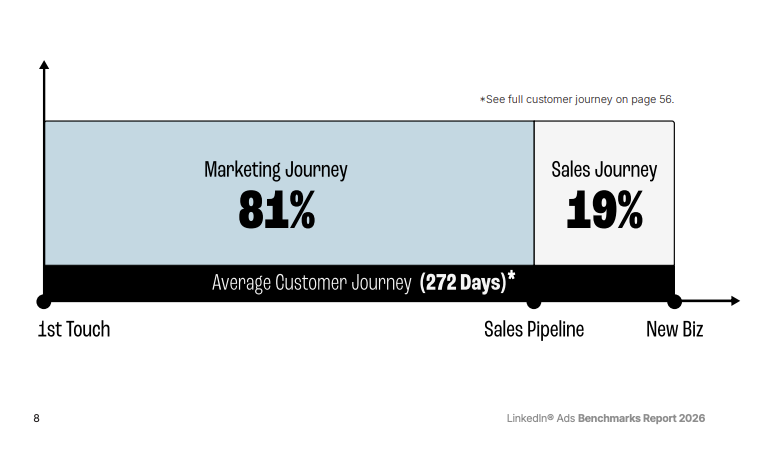
81% of the B2B buyer journey now happens before sales gets involved, up from 70% last year. If that's not telling you something, you have a problem...
In reality, your buyers are doing more before they ever talk to sales: more research, more peer validation, more content consumption, and more quiet shortlist-building.
So by the time they enter your pipeline, the real work is often already done.
That’s why pipeline problems are rarely just pipeline problems. When teams respond with better sequences, more SDR activity, or tighter qualification, they’re usually trying to fix too late in the system.
Because the issue often started earlier: weak market presence, unclear positioning, and not enough trust built before intent appears.
And that’s not a pipeline problem. It’s a GTM architecture problem.
The 81% isn’t just a marketing stat. It’s the phase where future pipeline is being built, without you in the room.
The teams that get this don’t just invest in brand. They build GTM in the right sequence: presence before intent, memory before outreach, and trust before conversion.
Because when buyers finally surface, your goal isn’t to introduce yourself, but to already be on their shortlist.
Some of the smartest GTM workflows I'm seeing right now are solving the wrong problem.
AI sequences, enrichment stacks, signal-based outbound, and automations stitched across 10 tools. And yes, all impressive to build and impressive to share.
But to be honest, many of them don't provide proof they actually moved the needle.
Win rates up? Sales cycle shorter? Pipeline more predictable? You know the answer…
Not to mention AI makes mistakes. It hallucinates context, misreads signals, sends the wrong message to the wrong person. Just imagine what it does at scale.
But the deeper problem isn't the tools. It's that all this complexity is being stacked onto GTM systems that still can't answer the basics:
Who do we actually win with? Why & how do they buy? Does the message land? Does the motion fit the ACV?
When you don't nail these, no workflow in the world will save you.
What works is a simpler sequence: GTM Foundations → Simple execution → Amplification
And when you know what’s working and what's not, AI and workflows can help scale it. With you in the loop, of course.
Predictable pipeline isn't a workflow problem. It never was.
A company I advise asked me this week whether to rebuild their site on an AI builder like Lovable, Base44, that kind of thing.
Yes, AI makes building cheaper, but it doesn’t make ownership easier.
And that’s basically the SaaS story right now.
The market isn’t holding a funeral. It’s repricing defensibility. When building gets cheap, “hard to copy” stops being a moat.
So what survives?
Companies with at least one of these moats:
→ Workflow depth
Leaving is an organizational project, not a software decision. Switching touches integrations, compliance, governance, and the way work actually gets done.
→ Compounding operational logic
The longer you use it, the harder it is to replace, not because of “data,” but because the system absorbs decisions, edge cases, and process memory until it becomes part of how the business runs.
→ Distribution advantage
Sometimes the moat isn’t the product. It’s the installed base and ecosystem that make “being considered” easier than “being better.”
And here’s the part many takes miss: AI doesn’t just disrupt products, but also disrupts pricing units.
Seats matter less when agents do more of the work. And companies still priced for human users, in a world where agents are becoming the user, will feel that mismatch even if the product is good.
In the end, repriced is very different from disrupted.
The companies that come out stronger know exactly what makes them hard to replace, and they make that story show up in their positioning, pricing, and how they sell.
Full piece in my latest (free) newsletter: https://t.co/A3Ne5lairZ
Run demand gen, fix positioning, ship product marketing, build brand, clean the data, support sales, report results... oh, of course, and move fast.
That's the CMO job = Do magic
No wonder exhaustion is the num 1 feeling marketers are expressing right now, and no wonder tenure averages under 2 years.
And then you add this on top.
Marketing is the only function where everyone in the building thinks they have a valid opinion on how to run it. Because they've all been on the receiving end of it (think ads, emails, LinkedIn posts, etc.), so suddenly they get it.
Your CFO doesn't get notes on the cap table, right? But the homepage/narrative/channel mix? You know the answer...
So, you own the outcomes, but everyone else owns the inputs. And most of those inputs are noise.
That's why it's the first thing I fix in any fractional engagement: fewer priorities, clear ownership of GTM calls, and a return to foundations before anything new gets added.
More activity is never the answer. Going back to who you're selling to and what actually moves them, that's where it starts.