after reading a book about neuroplasticity I realized that learning hard things is the equivalent of an intelligence buff
that year I purposefully introspected within myself what I found difficult to do then I did just that
by year end I was doing bio research in a lab
This person just gave you the neuroplasticity recovery protocol most people pay therapists $200/hour to discover.
The core mechanism here is dopamine baseline depletion. When you scroll, each interesting post spikes dopamine 100-200% above baseline. The problem is what happens next. Your dopamine drops 40-60% BELOW baseline for 2-4 hours. This means the homework, the book, the focused thinking you try to do afterward feels neurologically impossible. You’re not lazy. Your prefrontal cortex is literally running on empty.
Here’s the thing about that “I used to be sharp” feeling. Working memory capacity correlates directly with dopamine available in the prefrontal cortex. Lower dopamine, shorter working memory span. D’Esposito and colleagues at Berkeley showed this with neuroimaging. The people who can hold longer strings of information have more dopamine available for release. So when you’ve been chronically depleting your dopamine reservoir through high-stimulation activities, your working memory atrophies. You feel dumber because, neurochemically, your prefrontal cortex is operating at reduced capacity.
The “three days” recommendation in this article maps onto clinical literature. Anna Lembke’s research at Stanford’s Addiction Medicine clinic shows dopamine system resets require approximately 30 days for severe cases, but meaningful restoration begins within 72 hours of removing the stimulus. That’s why day three of any detox feels qualitatively different. Your neurons are beginning to upregulate dopamine receptors.
The boredom piece is where most people fail. Your brain interprets boredom as a signal to seek stimulation. That discomfort you feel when you’re unstimulated? That’s withdrawal. The reaching for your phone is your brain trying to bring dopamine back above baseline. Sitting with it trains the system to tolerate lower stimulation and still function. This is called raising your distress tolerance threshold.
What the article calls “rehabilitate,” the neuroscience literature calls neuroplasticity. Your brain is continuously rewiring based on what you repeatedly do. Chronic scrolling strengthens attentional circuits optimized for novelty-seeking and rapid task-switching. Sustained reading strengthens circuits for linear focus and deep processing. You’re not permanently damaged. You’ve just trained your brain for the wrong environment.
Two protocols actually accelerate the restoration. First: non-sleep deep rest. NSDR scripts (free online, 10-20 minutes) increase dopamine in the basal ganglia by up to 60%. Second: brief cold exposure. One to three minutes in cold water spikes dopamine 250% above baseline and sustains it for 2-4 hours afterward. Both of these replenish the reservoir without creating the crash cycle.
The real work is what she described: tolerating the discomfort of being understimulated long enough for your system to recalibrate to normal dopamine dynamics. The girl who used to read voraciously is still in there. The neural circuits are dormant, not dead. Plasticity works in both directions. Start with 10 minutes of focused reading a day. Your prefrontal cortex will adapt. Give it six weeks and measure the difference.
Ever wondered where words come from? 🗺�� built this app on @GoogleAIStudio called 'Wanderword' to map the evolution of language through time and space.
It uses Gemini to trace linguistic roots and D3.js to animate the geographic migration of words through history.
https://t.co/WrEXUVYSa2
some of my fav tech channels im subscribed to and why (random order):
Hussein Nasser (backend topics nicely explained)
PewDiePie(goat)
Sriniously (backend and go)
Computerphile (literally everything about programming)
LaurieWired (fun tech documentary style vids)
The Primeagen (yk him)
Neetcode (dsa)
Joma Tech (funny skits and shit)
ForrestKnight (general software engineering)
AnthonyGG (fav go dev)
The Cherno (2nd fav cpp dev)
Reducible (nice random algorithm explanations)
Nic Barker (nice vids on some data structures and some random explanations)
Akhil Sharma (cool backend projects)
Kay Lack (very random, loved the vid about language and parsing)
Phoebe Yu (why certain tech works so well kinda videos)
My top cortisol lowering tips if stuck in stressful environment:
-Purse your lips tight & slow your exhalations
-Warm milk, glycine & sugar
-Breath holds (15-20 seconds) or box breathing or other
-Hum for a few minutes every hour or when you feel a need
- Massage ears, head, neck, & shoulders (while humming)
- Clench & release fists & feet
- Reframe sensations (Feeling Overrides Nutrition style) “this is just adrenaline”
- Warm shower & splash your face with cold water
- Carb, protein & salt snack
- I love Coke, but not for everyone
- Self hug or lymph massage (pro tip- add humming)
*What’s your favorite thing to do?*
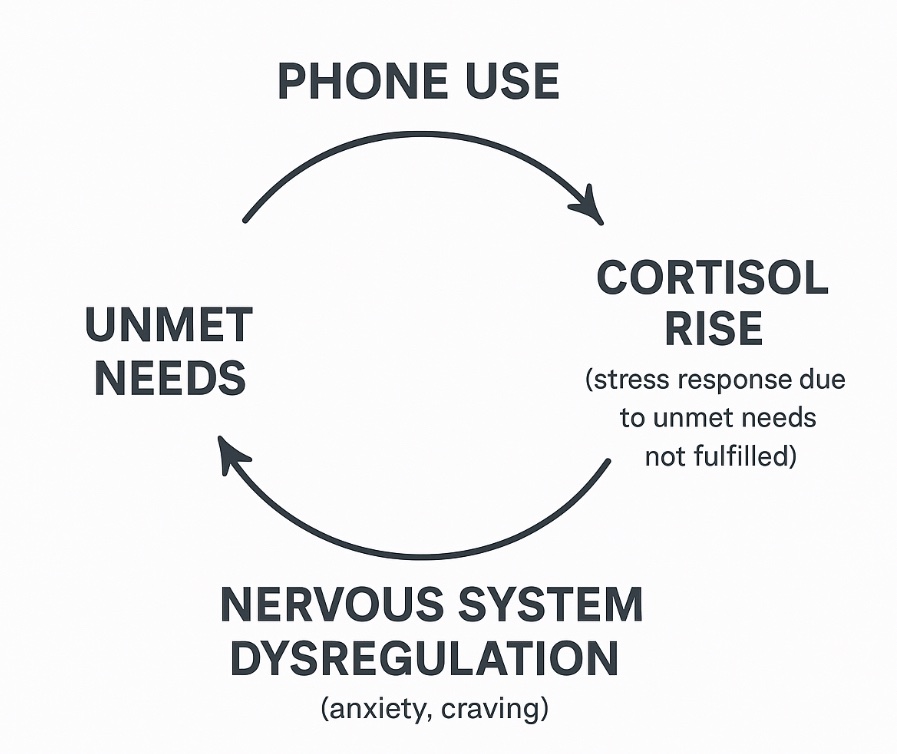
Phone addiction is cortisol, not a dopamine problem.
doomscrolling meets your unmet needs of novelty, connection, and excitement—temporarily calming your nervous system.
but because your phone doesn’t nourish you long term, cortisol increases. your bodies survival feels threatened because it believes it lost something.
the moment you lower overall cortisol, is the moment your phone addiction dies.
some practical ways to lower cortisol:
> dancing
> buteyko breathing
> daily breathwork
> eat enough carbs & sodium
> supp magnesium glycinate
> EMDR/bioenergetic exercise
> physiological sigh’s
> healthy social connection
> sprinting 1-2x weekly
save this for later + send to a friend who’s addicted to their phone lol.
Our brains are fried.
You try to read a book...can’t focus.
Sit with loved ones...your mind drifts to work or phone.
Feel a buzz in your pocket....but there’s no notification.
We’re not just distracted. We’re digitally disoriented.
Here’s what’s going on and how to push back:
My computer science college professors used to look down on programming -- it's too volatile to deserve formal education (new paradigms and languages come out all the time).
Instead, we did all kinds of theory: types, probability, queuing. Back then, it felt anachronistic and smug. Today, it feels like solid ground in a swampy AI world. The professors were right, and probably didn't even know how right they would be.
Universities are not meant to optimize for a fancy X bio today, but for a lifelong career.
Also, I can't wait for the credential arms race to be over. Universities should attract the intellectually curious, not the success-motivated. Newton didn't discover gravity under that tree in front of Kings College in Cambridge to get a job at OpenAI.