$META is considering raising tens of billions of dollars through a stock offering to fund AI infrastructure, per FT.
The discussions intensified after Alphabet’s $85B equity raise saw strong investor demand. Meta is preparing to raise AI-related CapEx to as much as $145B this year and even higher in 2027.
No banks have been hired yet, and Meta may still choose another financing route.
@valiovalentino That's interesting. Is there any data what % of society (or younger people) follow sports etc. Given that people don't socialize and many have TikTok attention span (seconds) that's probably much lower than before?
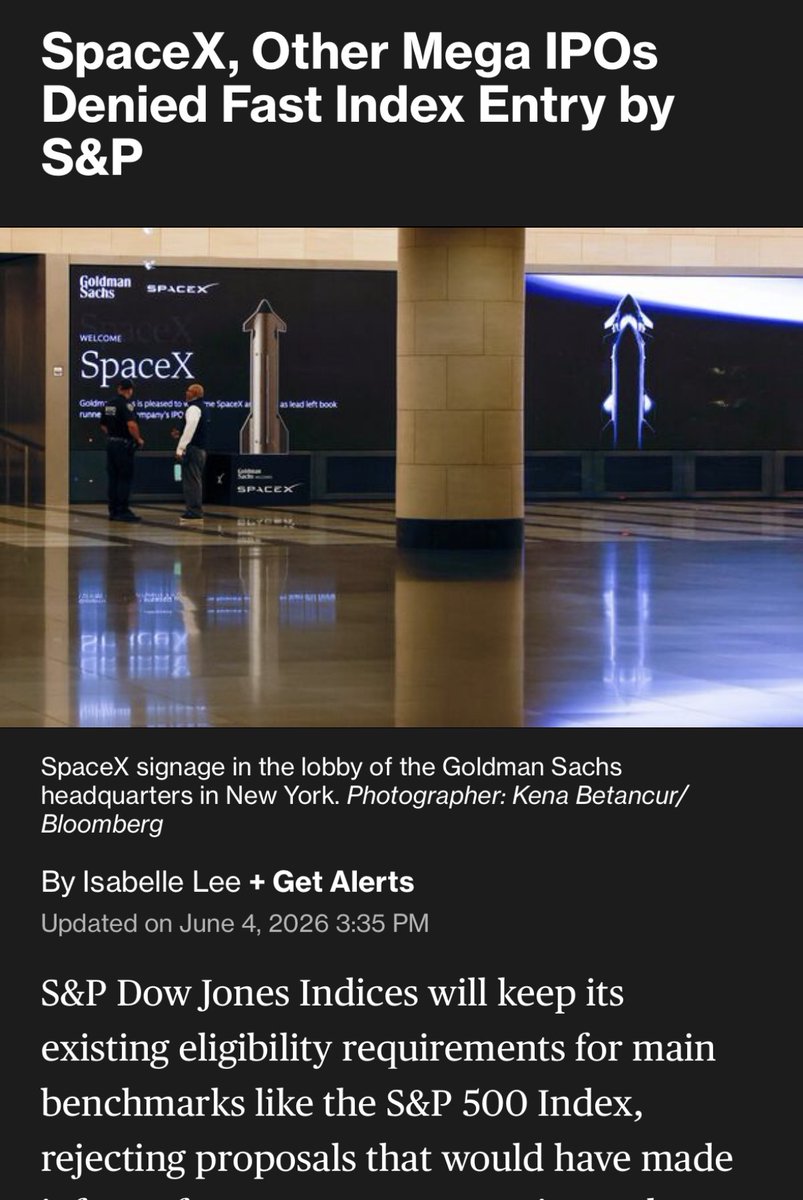
@PronkDaniel You have lots of followers Daniel. Would you make a poll with the question "The market cap of SpaceX in 12 months from IPO will be" 1/higher 2/lower 🙂
Bill Ackman just exposed a silent killer of value creation in public markets:
“The problem of being a public company today is the very short-term nature of markets, analysts, etc. A good business is a forever thing. You want to make decisions in the context of decades — and how can you do that when someone's asking about the tax rate in the second quarter?”
___
This is one of the most important things any investor or operator can internalize — because the disease he’s describing has infected nearly everyone.
We live in an era where everyone—corporate managers and individual investors—has been trained to chase the next quarterly dopamine hit.
Markets reward the immediate and punish the patient. Analysts grill executives on next quarter’s tax rate while the company is trying to reinvent its entire industry over the next decade. Boards panic at any sign of short-term pain.
And for some individual investors? Even worse.
You see the exact same mindset on X, Reddit, and every investing forum:
“So-and-so stock hasn’t done anything for 2 years! Why would I own it?”
That sentence is the sound of someone voluntarily building their investing foundation on sand.
Because here’s the brutal truth Ackman is pointing at:
Real, durable wealth is created by thinking and acting in decades, not days.
It requires deliberately suppressing the most primal human impulses—fear of missing out (FOMO), impatience, the desperate need for immediate validation. Most people simply refuse to do it. They’d rather feel smart for two straight years of “I told you so” than actually compound capital over ten.
Stock price in the short run reflects sentiment, positioning, and the mood of the marginal trader, none of which tell you anything about what the business is actually worth.
The fundamentals ARE the foundation.
The price eventually follows the fundamentals, but it can lag by years — and the investors who get shaken out during that lag are the ones who hand their returns to the patient.
@BillAckman point isn’t just about having a big shareholder on the board (though that can help enormously). It’s a deeper lesson for all of us:
Managers: Stop managing to the short-term consensus estimate. Manage to the 5 and 10-year outcome. Use your big owners as a sounding board.
Investors: Stop using the short-term stock price action as your primary research tool. If the business is getting stronger and the price isn’t reflecting it yet, that’s not a problem—that’s an opportunity.
Everyone: Train yourself to feel discomfort when you catch yourself thinking in quarters instead of decades. That discomfort is your edge.
The market will always try to drag you back into short-term noise. Be disciplined.
I love this clip because Bill Ackman didn’t just describe a governance hack. He diagnosed a cultural disease (STT or “short-term-thinking”) that is quietly destroying trillions in potential value—both inside companies and inside portfolios.
The cure is simple, but almost no one has the stomach for it:
Think long-term. Act long-term. Ignore the noise.
As Benjamin Graham said: “In the short run, the market is a voting machine, but in the long run, it is a weighing machine.”
___
🎙️ All-In Podcast | Bill Ackman (06/03/26)
"We have a vaccine that prevents shingles, a vaccine that markedly lowers the risk of dementia, and a vaccine that might even slow aging itself. Conveniently, these three vaccines are actually just one: the shingles vaccine. But fewer than half of eligible Americans have received the vaccine." https://t.co/VKyZMDHJdj
After a secular bear market, which lasted from 2000 until 2012 — twelve years of dead money — most individual investors threw in the towel and "gave up".
At that point, institutions owned more equities than individuals. However, over the last 17 years, US equities have been in a secular bull market, consistently making new highs.
In the last few years, a new generation of retail (individual investors) has become attracted to stocks. They haven't learned the risk and valuation lessons of the last secular bear market.
And to no one's surprise, today, individuals once again own more equities than institutions.
FOMO and extrapolation (recency bias) are building massive momentum in US equities — which now trade at record-high valuations — and individual investors cannot get enough of it!
Are we about to re-learn the lessons that have been quickly and easily forgotten?
Additional notes for those that haven't done a lot of historical analysis... 👇🏽
Periods when individuals owned more public equities than institutions:
• late 90s into 2001 (dot com peak)
• 2006 and 2007 (just before the GFC)
• since 2021 (just before the spike in rates)
Periods when institutions owned more public equities than individuals:
• 2003 and 2004 (bottom of the tech crash)
• 2008 to 2012 (bottom of GFC & EU crisis)
Make no mistake: retail is dumb money. They are the "Johnny-come-lately" investor type.
Once they arrive, and arrive in droves, we are probably near the end of major trends. Ironically, it coincides with insiders and smart money doing massive IPOs which the retail investors absorb at premium valuations. This best describes the market conditions in 2026.
As always, Buffett said it best:
"What the wise do in the beginning, fools do in the end."