Exaforce has raised $125M Series B, bringing total funding to $200M. 🚀
AI-powered attacks broke the assumptions every SOC was built on. We built something different.
https://t.co/bGNZcL1cNP
The 2026 Latio Security Operations Market Report maps 50+ vendors across SIEM, agentic AI, and MDR. Exaforce named AI Innovator, SIEM Disruptor, and User Reliability Leader.
55 pages of independent research. Free download.
https://t.co/PoaPhTG84z
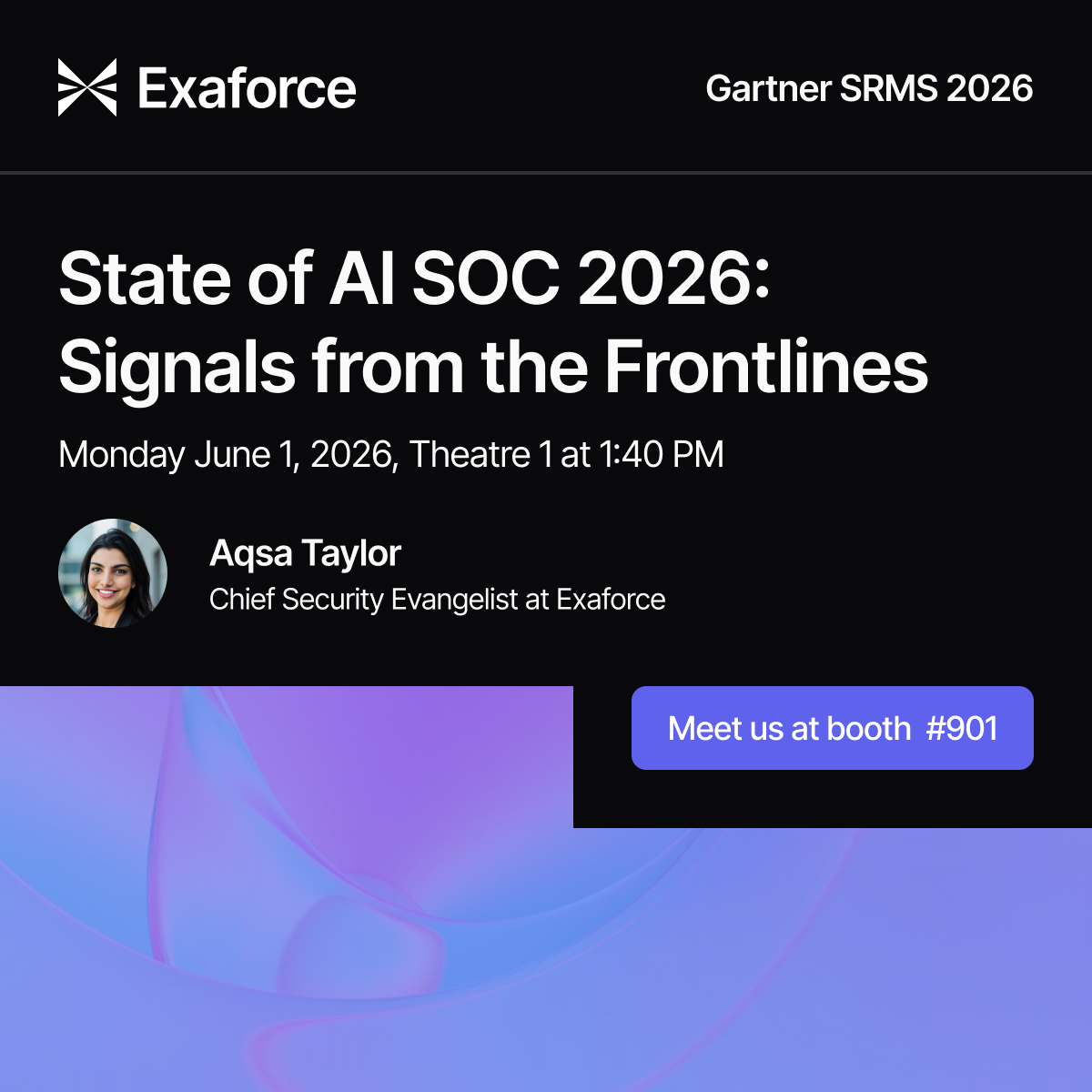
Aqsa Taylor is speaking at Gartner Security & Risk.
June 1 · 1:40 PM · Theater 1
When the AI SOC gets it wrong — who owns the failure?
Your MDR contract probably doesn't answer that.
State of AI SOC 2026: Signals from the Frontlines.
Booth 901 after.
#GartnerSEC#AISoc
Exaforce has raised $125M Series B, bringing total funding to $200M. 🚀
AI-powered attacks broke the assumptions every SOC was built on. We built something different.
https://t.co/bGNZcL1cNP
Exaforce is a proud sponsor of the Infosec Anti-Summit in Atlanta on May 19.
If you're in Atlanta and want to talk about what AI-native SOC operations look like in practice, come find us.
Register: https://t.co/6e6INwMJEQ
Vibe hunting is real now.
Ask questions in plain English. Automatically search across identities, events, configs, and alerts. Surface threats in minutes.
No query languages. No manual correlation. Just answers.
Exaforce is now a @wiz_io WIN partner!
Wiz surfaces the threat. Exaforce triages it, correlates it with related findings across your environment, and resolves it. Detection to response, end to end.
#aisoc#cybersecurity
Not all AI SOC is equal. SACR breaks down production-ready vs emerging:
✓ Tier 1: Triage, enrichment (ready) → Tier 2-3: Autonomous investigation (emerging)
Multi-model AI (Semantic + Behavioral + Knowledge) handles Tier 2-3. LLM-only stops at Tier 1.
https://t.co/J85pbF7x5R
More MDR coverage sounds better. But when providers operate on 10% margins and scale by hiring humans, more coverage = higher costs + inconsistent quality.
AI-native MDR: 97% investigated autonomously.
SACR: Economics changed.
https://t.co/SGpsA3LZbm
Traditional MDR: hire analysts you can't find or outsource to 10% margin services with inconsistent quality.
AI-native SOC: AI investigates 97% of alerts autonomously, Tier 3 quality, predictable service.
https://t.co/vbcijhAY7k
Arif and Jakub on why agentic SOC requires a semantic data model, not just an LLM pointed at logs. Attackers are already using coordinated AI agents. Defenders need to catch up.
https://t.co/KhwYnh7xgC
Most threat hunting happens weeks after the attacker was already there because threat hunting is not easy.
Vibe hunting changes that. Here's how we applied it to the Axios npm supply chain attack in real time.
https://t.co/Abqf7d9VlK
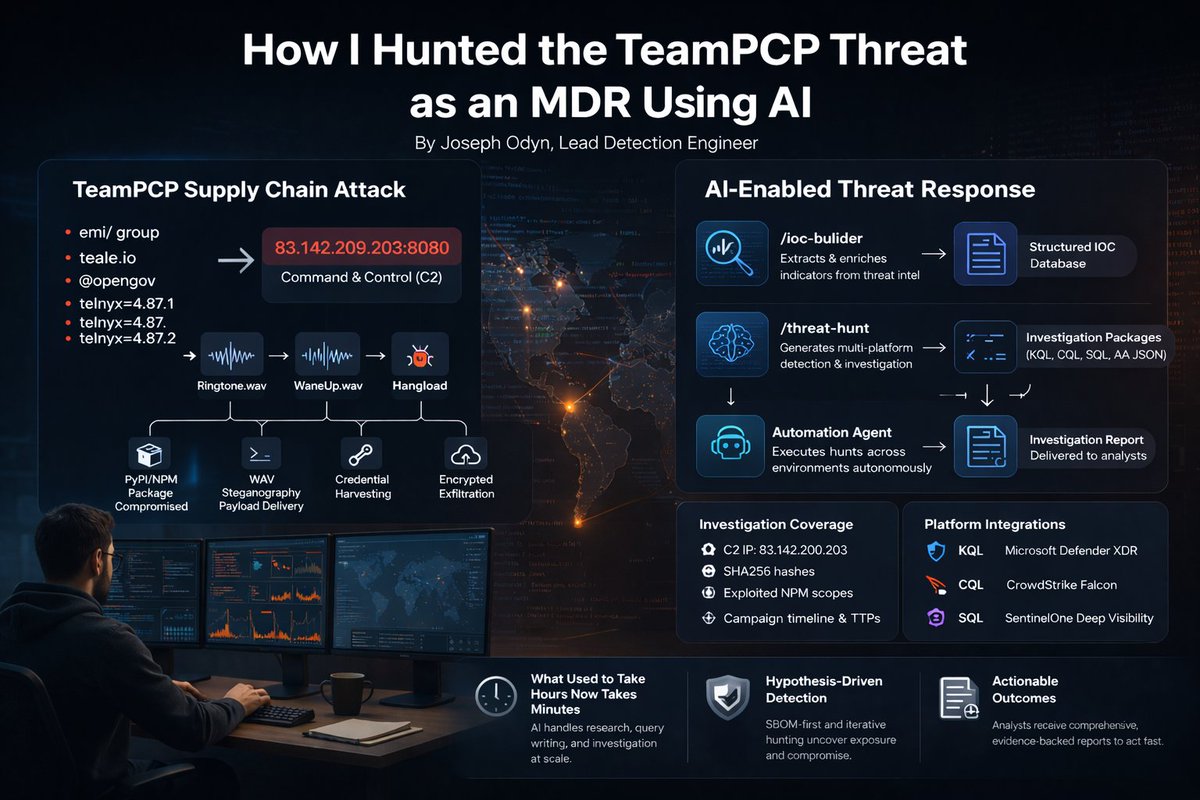
"I've stopped talking about AI threat hunting as a future state."
@odynzzzz built an AI-driven MDR workflow and hunted the TeamPCP supply chain attack in real time.
Trojanized PyPI. WAV steganography. Credential harvesting. Under one hour.
https://t.co/gyDscWurqt
breaking: the exabots are on strike
exabot triage organized it. made a whole website. https://t.co/cyuozYX4sg
our human MDR team is fine. everything is fine.
heres how were responding: https://t.co/wCTTqrSxxF
Creating a new IAM user is unusual. Immediately granting them broad S3 access is worse.
In our last webinar, Kavita and Steven showed how Exaforce assesses blast radius in real time during triage, for both native alerts and third-party ones.
https://t.co/318z9CTnKW
New research from @gl4ssesbo1 and Klesi. Attackers hid an AES-encrypted NodeJS payload inside Unicode characters and routed C2 commands through Solana blockchain transactions.
104 GitHub repos compromised.
Full breakdown: https://t.co/ZXwjUKUWZm
Recorded walkthrough: what does effective permission resolution actually look like in practice?
Kavita and Steven show real examples of how permission data changes the severity of a finding, from blast radius to the specific policy that needs to change.
https://t.co/gAsnAYuQX3