Romans 10:9-10 KJV — That if thou shalt confess with thy mouth the Lord Jesus, and shalt believe in thine heart that God hath raised him from the dead, thou shalt be saved. For with the heart man believeth unto righteousness; and with the mouth confession is made unto salvation.
🚨‼️This chart shows that God did not preserve His words in one locked academic vault for scholars to discover later. He preserved His words among His people, read in churches, preached in pulpits, copied by faithful men, taught in homes, memorized by believers, translated for common people, defended against corruption, and passed from generation to generation. The Body of Christ did not create the Bible, and the church is not over the Bible; the Bible is over the church. But God kept His words alive among His people, not hidden away under academic control. The word of God is not bound.
What Does It Mean To Be “Complete In Christ”?
To be “complete in Christ” is one of the greatest, cleanest, strongest, most liberating truths in the Christian life, and yet it is one of the doctrines religion hates the most. Colossians 2:10 says, “And ye are complete in him, which is the head of all principality and power.” That verse is not a suggestion, not a feeling, not a goal, not a future possibility, and not a reward for elite saints who reach some higher plane of spirituality. It is a present-tense statement of what God says about the believer’s standing in the Lord Jesus Christ. “Ye are complete in him.” Not complete in a church system. Not complete in a priesthood. Not complete in sacraments. Not complete in philosophy. Not complete in self-improvement. Not complete in mystical experiences. Not complete in Hebrew roots. Not complete in religious traditions. Not complete in your performance. Complete in Him.
The book of Colossians is a direct assault on religious substitutes for Christ. Paul warns about philosophy and vain deceit, traditions of men, rudiments of the world, voluntary humility, worshipping of angels, fleshly ordinances, and a false spirituality that looks deep but leaves a man puffed up in his fleshly mind. Right in the middle of that battlefield, the Holy Ghost drops the hammer: “For in him dwelleth all the fulness of the Godhead bodily. And ye are complete in him” (Colossians 2:9-10). That means the believer does not need something outside Christ to finish what God has already made complete in Christ. The fullness is in Him. The believer’s completeness is in Him. Religious systems always say, “Christ plus this.” The Bible says, “Christ is enough.” The flesh wants to add something so it can boast. The cross removes boasting and leaves the believer standing in Christ alone.
This truth does not mean a Christian is mature in practice the moment he is saved. It does not mean he knows everything, has victory over every habit, understands every doctrine, feels strong every day, or has no need for growth, correction, discipline, prayer, preaching, fellowship, service, and sanctification. That is not what “complete in Christ” means. It means that as to spiritual standing, acceptance, salvation, justification, identity, and position before God, the believer lacks nothing because he is in the Lord Jesus Christ. Growth is still needed in the walk, but nothing needs to be added to Christ to make the believer accepted before God. The Christian grows from completeness, not toward completeness. He serves from acceptance, not for acceptance. He walks because he is in Christ, not to earn his way into Christ. That distinction will either free a man from religious bondage or expose how much bondage he still loves.
Chapter One: Complete In Christ Means Christ Is Enough For Salvation
The first thing it means to be complete in Christ is that Christ is enough for salvation. That sounds simple, but it is the line where most religion goes wrong. Every false gospel eventually says Christ is necessary, but not sufficient. Rome says Christ plus sacraments, priesthood, confession, penance, mass, purgatory, and church authority. The cults say Christ plus their organization, their prophet, their restored gospel, their temple, their works, or their membership. Legalists say Christ plus law-keeping. Mystics say Christ plus experiences. Modern self-help religion says Christ plus your inner greatness. But the Bible says, “In whom we have redemption through his blood, even the forgiveness of sins” (Colossians 1:14). Redemption is in Christ, through His blood, not through man’s religious machinery.
The gospel that saves today is not complicated. Christ died for our sins, was buried, and rose again the third day according to the Scriptures (1 Corinthians 15:1-4). The sinner is saved by grace through faith, “and that not of yourselves: it is the gift of God: Not of works, lest any man should boast” (Ephesians 2:8-9). If
🚨‼️This chart gives a rightly divided look at secret sins, lust, bondage, and the believer’s body. Salvation is not a spiritual scorecard, but grace is not an excuse for uncleanness either. The body belongs to the Lord, secret sins thrive in darkness, and victory comes through Scripture, the Spirit, and the grace of God that teaches us to deny worldly lusts.
🚨‼️This Tabernacle chart gives a clear, KJV-only overview of God’s pattern for holiness, sacrifice, priesthood, and access. It walks through the layout, furniture, materials, priestly ministry, veil, mercy seat, and key typology, showing how every part of the Tabernacle pointed forward to Jesus Christ. The big picture is simple: the Tabernacle was the shadow, but Christ is the substance; sinful man comes to God only through blood, cleansing, mediation, and mercy.
🚨‼️This chart shows how the Rapture ends the Church’s walk by faith and brings us into sight. Hebrews 11:1 defines faith as trusting what God has promised before we see it fulfilled. At the Rapture, the Lord Himself descends with a shout, the dead in Christ rise, the living saints are changed, and every promise we believed by faith becomes visible glory.
🚨‼️A powerful overview chart of The Hidden Rulers of This World, tracing the Bible’s revelation of earthly princes, spiritual powers, hidden rulers, and the final supremacy of Jesus Christ. This chart helps show how Scripture unveils the unseen conflict behind the nations and why every throne, power, and principality ultimately falls beneath the Prince of princes.
🚨‼️This chart explains what it means to be complete in Christ from Colossians 2:9–10. The believer is not completed by religion, rituals, philosophy, works, or traditions, but by the finished work, fullness, blood, righteousness, and headship of Jesus Christ. We still grow in our walk, but our standing before God is already complete in Him.
The Bible Isn’t Outdated—The World Is – Sin Hasn’t Evolved, It’s Just Rebranded
Introduction
The world loves to accuse the Bible of being outdated because the world hates being exposed by something older, higher, cleaner, and more permanent than itself. Every generation of rebels thinks it has discovered some new enlightenment that finally makes God’s Book irrelevant. They strut around with their degrees, slogans, movements, hashtags, political theories, psychological labels, religious compromises, and cultural revolutions, acting as though the Almighty has been waiting for modern man to correct Him. But the Bible is not outdated. The world is. The world is the old rotten thing still repeating the same sins with new packaging. Pride is still pride. Lust is still lust. Murder is still murder. Idolatry is still idolatry. Covetousness is still covetousness. Rebellion is still rebellion. The world has not evolved past the Bible. It has merely changed the labels on the same poison bottles.
Sin has never needed much creativity because the flesh is easy to deceive. Ecclesiastes 1:9 says, “there is no new thing under the sun.” That verse ought to humble every generation that thinks it invented wickedness. Modern man did not invent sexual perversion; Sodom had it. Modern man did not invent idolatry; Babylon had it. Modern man did not invent religious corruption; Cain had it. Modern man did not invent rebellion against God’s words; Eve heard it in the garden. Modern man did not invent pride; Lucifer had it before Adam ever drew breath. What the world calls progress is often just ancient sin wearing a modern costume. The names change, the devices change, the technology changes, the slogans change, but the heart of man remains exactly what Jeremiah 17:9 said it was: “deceitful above all things, and desperately wicked.”
The Bible remains relevant because it deals with the root, not the costume. The world keeps treating symptoms, renaming diseases, and celebrating infections, while the Book lays the sinner open before God. Hebrews 4:12 says the word of God is “quick, and powerful, and sharper than any twoedged sword.” That is why the world hates it. The Bible cuts through the rebrand. It does not care whether rebellion has been renamed authenticity, lust has been renamed love, covetousness has been renamed ambition, bitterness has been renamed trauma response, or unbelief has been renamed deconstruction. God’s Book still calls things by their right names. The world says the Bible is behind the times. The Bible says the world is still stuck in Genesis 3, still listening to the serpent, still hiding from God, still sewing fig leaves, and still blaming someone else for its sin.
Chapter One: The Bible Is Not Old-Fashioned; It Is Eternal
The Bible is not old-fashioned because old-fashioned things belong to a time period, and God’s word belongs to eternity. Old-fashioned clothing may fade. Old-fashioned customs may disappear. Old-fashioned tools may be replaced. Old-fashioned language may fall out of common use. But the words of God are not a cultural artifact trapped in the past. Psalm 119:89 says, “For ever, O LORD, thy word is settled in heaven.” Settled. That means the Bible is not waiting for the approval of philosophers, scientists, theologians, judges, activists, educators, politicians, or religious committees. It is settled where no vote can overturn it and no generation can revise it.
Men call the Bible outdated because they confuse age with weakness. A thing can be ancient and still be true. Gravity did not become outdated because men discovered airplanes. The sun did not become outdated because men invented electric lights. The law of sowing and reaping did not become outdated because men learned how to market sin. Truth does not expire just because sinners get bored with it. Isaiah 40:8 says, “The grass withereth, the flower fadeth: but the word of our God shall stand for ever.” Grass is the world’s
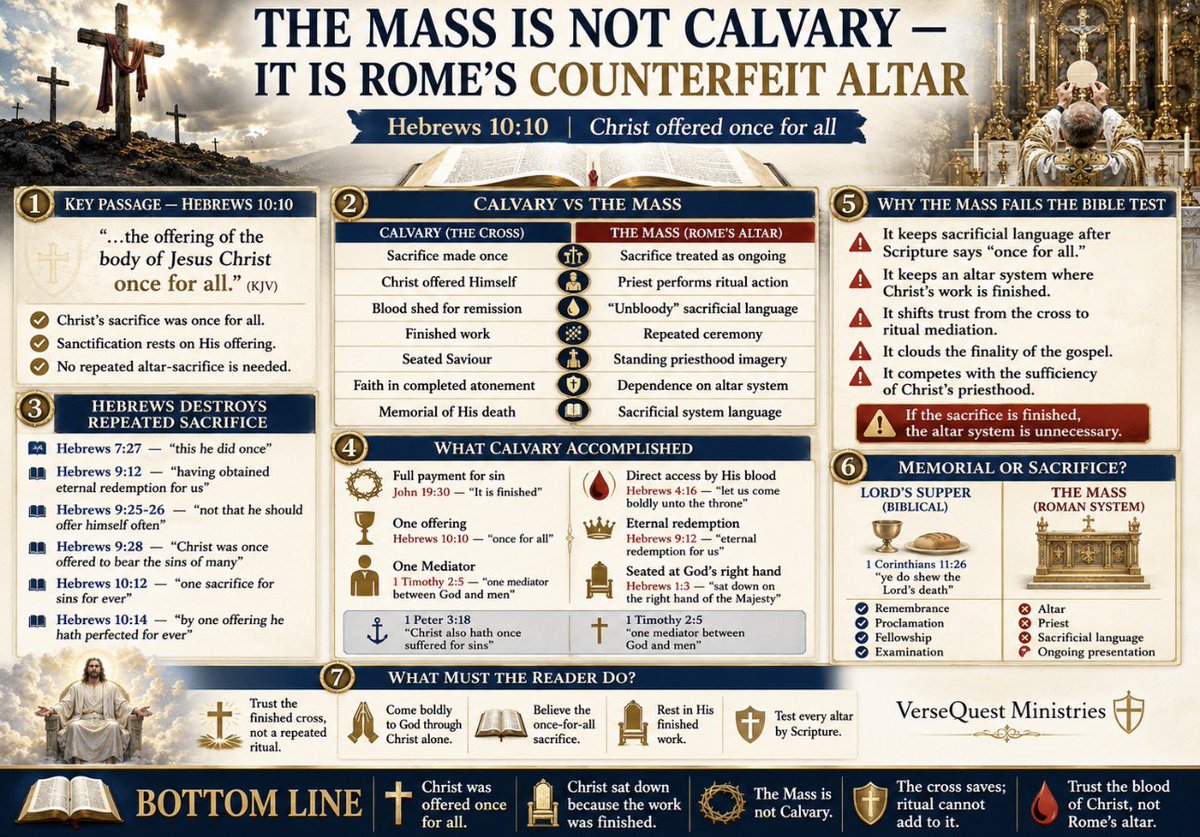
🚨‼️This chart lays out the Bible case from Hebrews 10 that Christ’s sacrifice was offered once for all. Calvary was bloody, historical, final, and sufficient. Jesus Christ offered Himself, finished the work, and sat down at the right hand of God because nothing else needed to be added.
The chart contrasts that finished cross with Rome’s Mass altar system: repeated sacrificial language, a standing priesthood, ritual dependence, and the idea that Christ’s sacrifice must be continually presented. The bottom line is plain: the cross saves; ritual cannot add to it. Trust the blood of Christ, not Rome’s altar.
I can tell you this: the Achilles heel on the Catholic is assurance of salvation. They do not have it. Also, they hold that the church has authority over the Bible whereas we hold that the Bible has authority over the Church.
So, I would park authority and assurance at the foot of the cross and stay there. Don’t get drug out into the weeds. And if you do, don’t stay, get back to those two things. May God bless your efforts….
Freemasonry is Satanic as hell. The G is for Gilgamesh, another name for Lucifer. The Square and compass is a sigil for Lucifer who they believe is God. They themselves call it “The Craft”.
1 Corinthians 15:57 Commentary
Verse Quoted in KJV
“But thanks be to God, which giveth us the victory through our Lord Jesus Christ.” (1 Corinthians 15:57)
Detailed Exegesis of Each Phrase
“But”
The verse begins with “But,” and that little word turns the whole battlefield. Verse 56 told us the problem: “The sting of death is sin; and the strength of sin is the law.” If the passage stopped there, man would be left with death, sin, law, condemnation, and judgment staring him in the face. Death has a sting. Sin gives death its poison. The law gives sin its legal strength. Man is guilty, exposed, condemned, and unable to deliver himself.
But God does not leave the believer under that sentence. “But” introduces the divine answer. Death has a sting, but God gives victory. Sin has strength through the law, but Christ answered the law’s curse. The grave appears powerful, but the risen Christ has the keys of hell and of death. The word “but” is the hinge between Adam’s ruin and Christ’s triumph. It shifts the focus from what death uses to what God gives.
This is the gospel turn. Man’s religion ends at verse 56 with sin and law. God’s salvation moves to verse 57 with victory through Jesus Christ.
“thanks be to God,”
Paul does not say, “Thanks be to man.” He does not thank religion, the law, the church, the preacher, the priest, the ordinances, the sacraments, the sinner’s effort, or human morality. He says, “thanks be to God.” The victory over death is not man-made. It is not earned. It is not achieved by religious discipline. It is not purchased with good works. It is given by God.
Thanksgiving is the proper response to grace. A man who thinks he helped win the victory will boast. A man who knows God gave the victory will give thanks. The believer does not stand before death and say, “Look what I accomplished.” He says, “Thanks be to God.” Every part of salvation points back to God’s grace, God’s mercy, God’s wisdom, God’s power, and God’s Son.
This phrase also preserves worship. Victory over death is not a doctrine that should make a believer cold or merely argumentative. It should produce gratitude. If God has removed death’s sting, answered sin’s guilt, overcome the law’s condemnation, and promised resurrection victory, then thanks belongs to Him.
“which giveth us”
The victory is not merely shown to us, offered vaguely near us, or placed on a shelf for us to earn. God “giveth us” the victory. The wording is present and gracious. God is the giver. The believer is the receiver. This is not law language. This is gift language. Law says, “Do and live.” Grace says, “Christ has done; receive and live.”
“Us” refers to believers in Christ, the saved, the brethren to whom Paul has been speaking in this chapter. The victory belongs to those who are in Christ. It is not a universal victory automatically applied to every sinner regardless of faith. The lost man still faces death with sin’s sting intact. The believer, however, has victory given by God through the Lord Jesus Christ.
The word “giveth” also shows security. God does not loan the victory. He gives it. The victory rests on God’s faithfulness, not man’s performance. It rests on Christ’s finished work, not human effort.
“the victory”
This is not a partial victory. It is “the victory.” The article matters. Paul has been talking about death, the grave, sin, law, corruption, mortality, resurrection, and immortality. The victory includes the whole triumph of Christ over everything that came through Adam’s fall. It is victory over sin’s penalty, victory over the law’s condemnation, victory over death’s sting, victory over the grave’s temporary claim, and victory in the coming resurrection body.
This victory is not merely emotional comfort. It is doctrinal, legal, spiritual, and bodily. The soul is saved. The believer is justified. Sin is paid for. Condemnation is removed. Death’s sting is gone. The grave will lose the body. The corruptible shall put
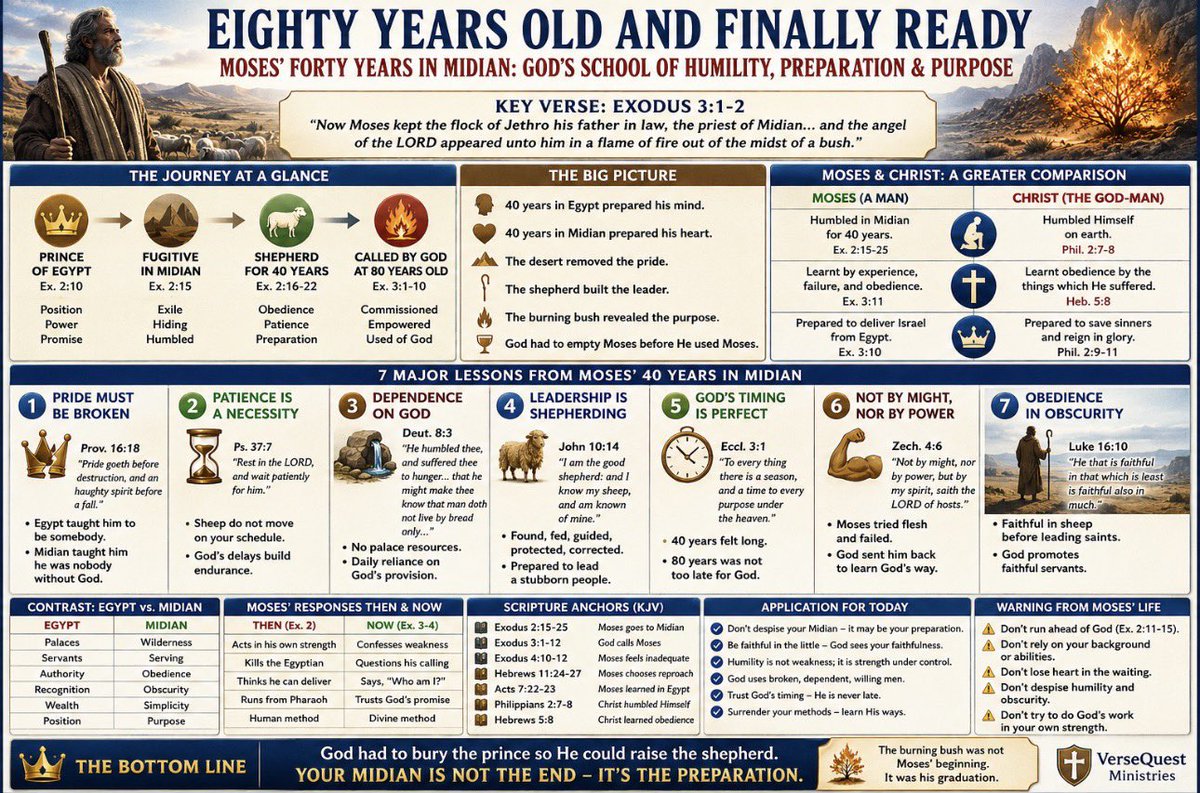
🚨‼️God Buried the Prince to Raise the Shepherd
This chart looks at Moses’ forty years in Midian, where God took a prince of Egypt and humbled him into a shepherd fit to lead His people. Before Moses ever stood before Pharaoh, God had to break his pride, slow his steps, teach him patience, and make him dependent on the LORD.
Midian was not the end of Moses’ story, it was God’s preparation ground. The burning bush was not his beginning; it was his graduation.
Your hidden season may be where God is making you useful.
Eternal Security Made Plain - The Door Christ Opens Is Not Held Shut by Your Hand
Key Passage: John 10:9
Introduction
John 10:9 says, “I am the door: by me if any man enter in, he shall be saved, and shall go in and out, and find pasture.” That verse is so plain a child can understand it, which is probably why theologians and religious systems have spent centuries trying to fog it up. The Lord Jesus Christ did not say, “I am one of several doors.” He did not say, “I am the hallway that leads you to the real door.” He did not say, “I am the door, but Rome has the key, water keeps the hinges oiled, works hold the lock in place, and your hand must keep the thing shut after you get inside.” He said, “I am the door.” Salvation is not entrance through a denomination, a sacrament, a priesthood, a moral improvement plan, a confirmation class, a Hebrew roots performance ladder, or a fear-based religious treadmill. It is entrance through a Person, and that Person is Jesus Christ.
The beauty of the door is that it settles both access and security. A door is not merely decoration. A door determines entrance. A door determines exclusion. A door marks the boundary between outside and inside. In John 10, Christ is not inviting sinners to admire the door from the outside while hoping they can someday qualify to enter. He says, “by me if any man enter in, he shall be saved.” That is not probation language. That is salvation language. The sinner does not become the door after entering. He does not have to stand there holding the hinges, guarding the lock, polishing the threshold, and making sure the Shepherd’s promise does not fall apart. The Door is Christ, and the security of the sheep rests in the strength of the Door, not in the sweaty grip of the sheep.
This essay is built around a simple truth: the door Christ opens is not held shut by your hand. If your salvation depends on your ability to protect the door after entering, then the door is not really Christ; it is your performance with a Jesus label pasted on the front. If eternal life can become temporary life because your flesh failed, then Christ’s “shall be saved” becomes “might be saved if the sheep guards the entrance.” But the Bible does not put the sheep in charge of the sheepfold. The Shepherd owns the sheep. The Door admits the sheep. The Father keeps the sheep. The Spirit seals the sheep. The believer may fail in his walk, lose fellowship, need correction, burn rewards, and feel the rod of God, but none of that means the Door has fallen off the hinges. Christ is the Door, and He does not need your weak hand to keep His promise shut.
Chapter One: Christ Does Not Say He Is a Door, But the Door
The first words of John 10:9 are absolute: “I am the door.” That is exclusive language. The Lord Jesus Christ does not present Himself as a religious option. He does not stand beside a row of doors marked “sacraments,” “law,” “tradition,” “church membership,” “good works,” “Mary,” “priests,” “personal holiness,” and “human endurance.” He says, “I am the door.” That means every other supposed entrance is either a fraud, a wall, a trapdoor, or a thief’s ladder. John 14:6 says the same thing another way: “I am the way, the truth, and the life: no man cometh unto the Father, but by me.” Acts 4:12 says, “Neither is there salvation in any other.” That is not narrow because Bible believers are mean; it is narrow because Christ told the truth.
The word “door” also shows how personal salvation is. Salvation is not primarily an institution. It is not a system you join. It is not a ritual you perform. It is not a process managed by religious professionals. It is Christ Himself. A sinner enters through Christ by faith. He is not saved by admiring Christ, talking about Christ, placing Christ somewhere in a religious cabinet, or adding Christ to a list of religious helps. He must come through Christ. The door is not a doctrine floating apart from the Lord; the
🚨‼️This chart explains John 10:9 and the security of entering through Christ, the Door. Salvation is not held together by the sinner’s grip, effort, fear, or performance; it rests on the Person and promise of the Lord Jesus Christ. The sheep enter by Him, are saved by Him, and are kept by the power of God.
The chart also keeps the Bible balance clear: eternal security is not a license to sin or freedom from chastening, consequences, or loss of reward. It simply means the Door Himself is Christ, and the saved man’s security does not depend on weak sheep trying to guard the hinges.
🚨‼️A bold, Scripture-rich overview of The Crucified Life series, this chart highlights the nine major themes of the cross-centered Christian life, from “Crucify Him” to being crucified with Christ, the flesh judged, the world rejected, and the coming glory of the Crucified One. Designed to be clear, sharp, and easy to follow, it gives a strong visual summary of the series for study, teaching, sharing, and personal reflection.
GIVEAWAY TIME!
Real Leather Bible, but not just any Bible, a Monochrome Bible.
These are rare and expensive.
Like, Repost, comment
(JESUS IS LORD). 👈(Entry)
I'll select a winner on Sunday.
📖 Eighty Years Old and Finally Ready
Before Moses could lead a nation, God led one man into the desert. This chart explores Moses’ forty years in Midian, the forgotten years that became God’s school of humility, patience, dependence, and preparation. From prince of Egypt to shepherd of sheep, Moses learned lessons that no palace could teach and no classroom could provide.
Discover the powerful contrast between Egypt and Midian, the seven major lessons God taught Moses in obscurity, and how his journey points to the greater humility of the Lord Jesus Christ. Sometimes what feels like a delay is actually divine preparation. The burning bush was not the beginning of Moses’ training, it was his graduation.
Your Midian is not the end. It may be where God is getting you ready for what comes next. #VerseQuest #KJV #BibleStudy #Moses #Exodus #ChristianGrowth #RightlyDividing #VerseQuestMinistries
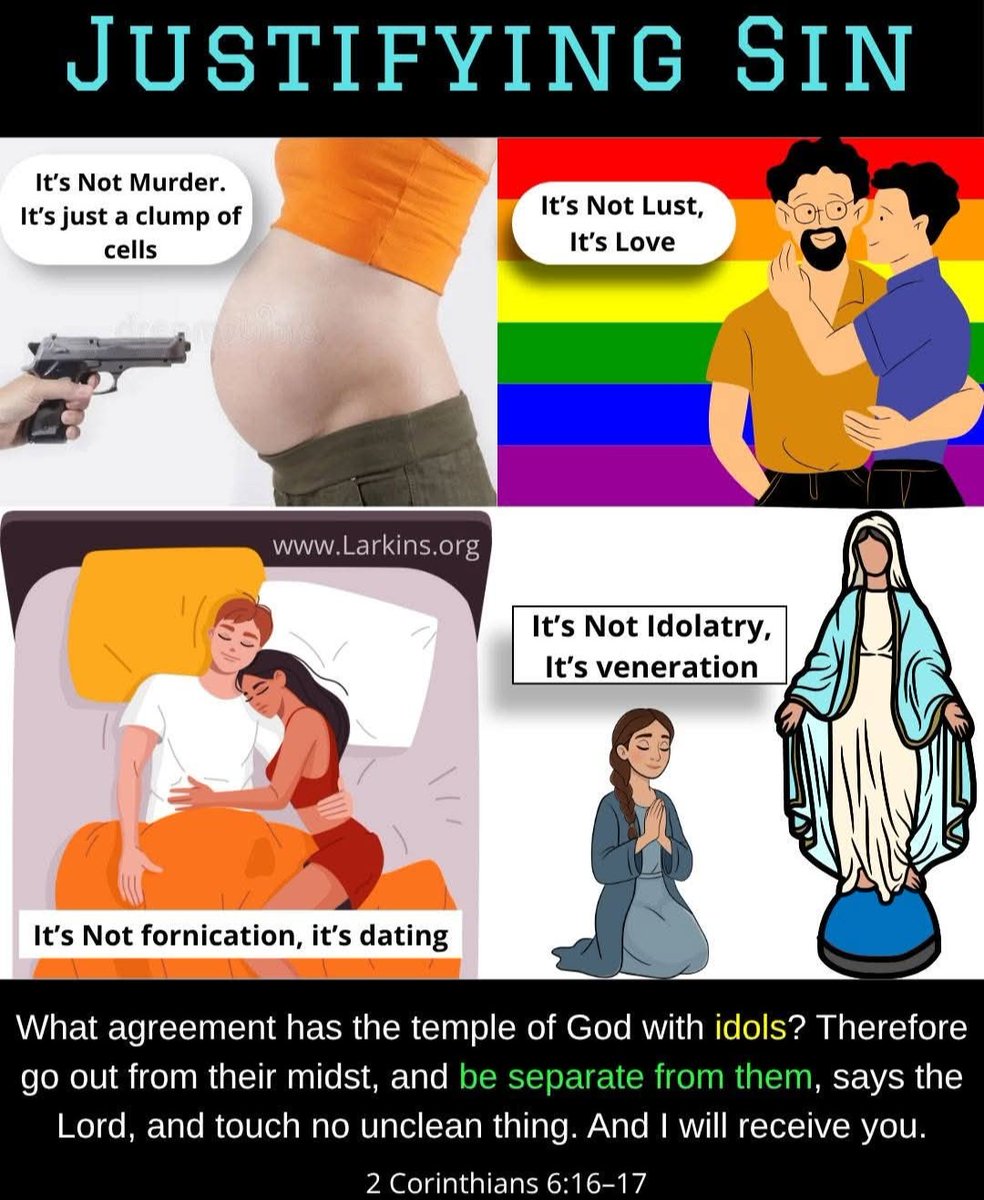
A true Christian might fall into sin, but will not dwell in it. People pretending to be Christians give all kinds of excuses justifying their sin or their sinful lifestyle; they are not saved in the first place and belong to the world.
Romans 1:22–25: "Claiming to be wise, they became fools, and exchanged the glory of the immortal God for images resembling mortal man and birds and animals and creeping things... they exchanged the truth about God for a lie and worshiped and served the creature rather than the Creator."
Come under the safety of the finished works of Jesus Christ on the cross because there is life in him.
Where sin increased Grace increased much more. ~ Romans 5:20
But if we don't allow the Grace to abound, we don't agree in the first the place that we sinned there is no Grace for such person.
So I ask my Roman Catholic brothers and sisters to repent of your Roman Catholic Paganism and come to Christ.
Direct Quote: Pastor Larkins Dsouza