AUTHOR, Retired bounty hunter Premier investigation & security expert in legal, personal, and corporate needs with ethics, transparency, and advanced technology
Three nights later I found him and he ended up bleeding out in a motel bathroom, and the only thing between him and death was pressure from my bare hands.
He looked up at me — the same fugitive who'd tried to kill me days earlier — and said: "Don't let me die."
I said “You’re not gonna die” and I didn't let him.
Reality TV loves the chase and there’s plenty of that. Nobody ever shows you the rest — the pressure, the paperwork, the letter he wrote me from jail weeks later, thanking me for his life.
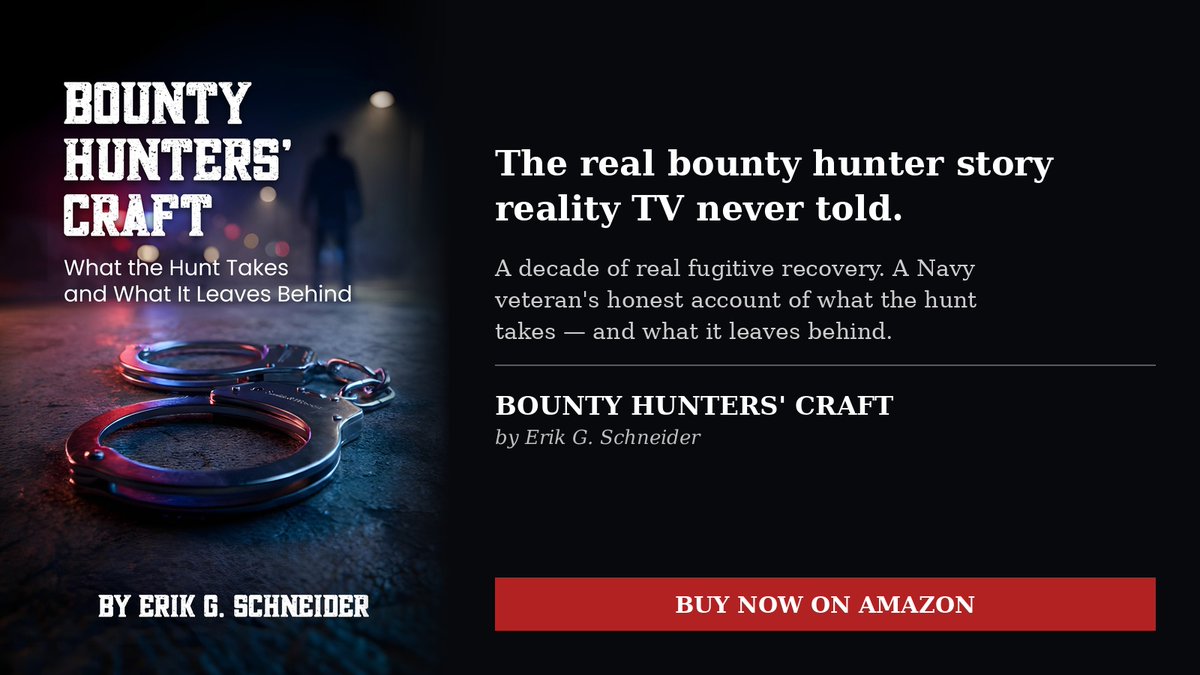
That's what BOUNTY HUNTERS' CRAFT is actually about. True story, one of dozens inside.
Bounty hunters have more authority than most people realize. More than a lot of cops would ever admit out loud.
If a police department kicks in the wrong door, a city attorney and an insurance company handle it. If I kick in the wrong door, I go to jail.
No department behind me. No qualified immunity. No legal buffer.
You are your own department. Your own risk assessment. Your own internal affairs.
That's the part nobody puts on television.
Three nights later I found him and he ended up bleeding out in a motel bathroom, and the only thing between him and death was pressure from my bare hands.
He looked up at me — the same fugitive who'd tried to kill me days earlier — and said: "Don't let me die."
I said “You’re not gonna die” and I didn't let him.
Reality TV loves the chase and there’s plenty of that. Nobody ever shows you the rest — the pressure, the paperwork, the letter he wrote me from jail weeks later, thanking me for his life.
That's what BOUNTY HUNTERS' CRAFT is actually about. True story, one of dozens inside.
Reality TV has spent 20 years turning bounty hunting into a joke — slamming doors, shouted threats, primetime theatrics. I spent well over a decade actually doing the job. This book is what TV never showed you.
From the epilogue of BOUNTY HUNTERS' CRAFT:
"To the young hunter reading this, or the cop who still sees us as cowboys: the job isn't about who's fastest or strongest. It's about who's smart enough to see the person behind the warrant. Grant dignity when you can. It costs nothing and buys you everything — trust, safety, a piece of your soul that doesn't break."
I retired the badge. I never retired the hum. It's quieter now — no jail doors, no fugitive files, no cold coffee at two in the morning — but it's still there, running low and steady under everything, the way it always has.
That's what this book is really about: not the chase, but what the chase leaves in you.
📖 BOUNTY HUNTERS' CRAFT — available now in paperback, hardcover & Kindle.
He ran me over with his van to dodge a $20,000 bond.
Three nights later I found him and he ended up bleeding out in a motel bathroom, and the only thing between him and dying was my bare hands.
He looked up at me — the same fugitive who'd tried to kill me days earlier — and said: "Don't let me die."
I said I wouldn't and I didn't let him die.
Reality TV loves the chase. Nobody ever shows you the rest — the pressure, the paperwork, the letter he wrote me from jail weeks later, thanking me.
That's what BOUNTY HUNTERS' CRAFT is actually about. True story, one of dozens inside. Now #3 Best Seller (Law and Ethics) on Amazon.
https://t.co/eQGjHQa10S
Didn't expect a memoir about fugitive recovery to land in the Ethics & Professional Responsibility bestseller list — but here we are. #3 on Amazon.Turns out a book about restraint, dignity, and doing the job right resonates in exactly the place you'd hope it would.
Thank you to everyone who bought a copy this week — this is because of you. Link in bio/reply
The single biggest favor you can do for me is leaving a quick review on Amazon once you finish. New books live or die on early reviews — even 2-3 sentences makes a real difference in whether Amazon shows it to other readers. Means more than you know. Thank you for the support.
The One-Line Rule That Was Costing Me Thousands of Claude usage Tokens
I run several Claude Code sessions managing algorithmic trading bots on Kalshi. Each bot has its own long-running session with its own memory — accumulated rules, past incidents, hard constraints like "never claim market state without a live query." Or “Verify data before posing an answer”
Last week, Claude summarized my golf bot's state and mentioned a tournament market as if it were still active. It wasn't — that tournament had settled days earlier. I asked: "then why did you even see it or mention it if you knew it was settled?"
The honest answer: it hadn't actually checked. It saw a stale field in the bot's state file and reported it as current fact — a direct violation of a rule that had been in memory the whole time. This happens far too often causing me to go down a whole rabbit hole of usage to put the Agent back on track.
So I asked the real question: “how do I get you to actually follow hard rules, instead of drifting from them?”
Here's the mechanism, in Claude's own words when I pushed on this:
"Memory index entries are summaries, not blockers. I read the memory file, but the one-liner doesn't stop me mid-response when I'm pattern-matching from a state file. The rule has to be in my face at generation time, not filed away."
That's the whole insight. A memory system is fantastic for context — who you are, what you've built, what's been tried before. It is not built to enforce anything. It's a reference the model can consult, not a gate the model must pass through. Under enough tokens of conversation, a rule that lives three files deep in a memory index competes with everything else for attention — and sometimes loses.
Why "Remembering the Rule" Isn't Enough ….The Fix: CLAUDE.md
CLAUDE.md is different. Drop one in a project directory and its contents get loaded at the top of every context window, before any code, any state file, any tool output. It's not something the model has to decide to go check — it's already there, structurally prioritized, every single time that directory is opened.
Same information. Completely different enforcement power.
So instead of relying on Claude to recall "never assume live market state, always verify" from a memory index, I now have a CLAUDE.md sitting in every single bot's directory with the hard gates spelled out with any hard rules I.e:
*No claims about live account/market state without a fresh, shown query
*No cross-bot changes without explicit approval
*No paper-trading mode — shadow means real orders, small size
Seven bots, seven files, same core rules, one afternoon. And going forward, every new bot gets one automatically — it's now a standing template that a new bot session starts with a CLAUDE.md before a line of strategy code is written.
Why This Actually Matters (Beyond My Trading Bots)
Every drift, every re-explained rule, every "wait, I told you this already" moment costs tokens — and worse, it costs trust. If you're running any long-lived Claude Code project, especially one with real consequences (money, production systems, anything irreversible), the pattern is the same:
Memory is for context. CLAUDE.md is for constraints.
If a rule is "nice to know," memory is fine. If a rule is "must never be violated" — no live-state assumptions, no destructive commands without confirmation, no touching X without approval — put it in CLAUDE.md, not just in a memory file you're hoping gets re-read at the right moment.
I'd been relying entirely on memory to keep Claude on the rails for months. One bad mid-response assumption, called out clearly, was enough to find the actual fix. Wish I'd known this on day one.
@JesseBWatters I find it really mind blowing and ironic that so many of you respond to a message about anti-hate with such abject hate…talk about cognitive dissonance.