$SRXH just dropped fresh 424B3s registering shares for the Keystone ELOC + legacy holders. Translation: Company stacking the war chest for growth while the real fireworks (EMJ merger, AI/crypto IP, Astro dividends) are still loading.
They’re not diluting — they’re arming up for the moonshot.
Lone green candle season incoming 🔥 $SRXH #SRxHealth @EMJXai@EMJCapital
$SRXH ➡️ $EMJX
REVERSE MERGER
Instead of rehashing the same tired argument about whether the merger is okay, whether a reverse split happens, or whether the share structure is ugly, I think it’s worth talking about why this setup is not only plausible, but possibly a sleeping giant the market is currently overlooking.
If the whole debate is still “dilution bad” versus “merger good,” then everyone is arguing semantics while the real question is whether this is just another ugly microcap cleanup or the start of an infrastructure story the market hasn’t priced yet.
The market keeps trying to shove EMJX into the basic digital asset treasury bucket. Company buys crypto, puts it on the balance sheet, hopes the market gives it a premium, rinse and repeat. That model already exists. Buy coins, issue a press release, pray the cycle doesn’t kick you in the teeth. Groundbreaking stuff... back in 2020. Fast forward to present day and I see a much bigger angle.
The real question should be whether EMJX is trying to build an Ai-driven treasury operating system around regime detection, risk controls, capital allocation rules, probability analysis, and market intelligence. If that’s the direction, then this isn’t just a holdings story. It becomes a financial infrastructure story.
That is where EHIQ could become a much bigger deal than people are giving it credit for. And before someone drops a lazy one-liner, I’m not saying EHIQ has been clearly confirmed as transferring into EMJX at close or that it automatically becomes the main monetized product on day one. This is a what-if thesis based on the public direction, the language being used, and how EHIQ could fit into the larger EMJX structure if it ends up being part of the machine.
The part people may be brushing past is @ericjackson calling EHIQ “upstream” of Kalshi and Polymarket. I don’t read that as a random flex. I read it as the entire point: EHIQ may be trying to identify the evidence before the odds adjust.
Kalshi and Polymarket are useful because they show where belief is being priced right now. They are markets for probability. They reflect what participants currently recognize, process, and are willing to bet around. That has value, but it also creates a weakness.
A market can only price what the crowd has absorbed.
If evidence is forming before consensus catches up, the price of belief can lag reality. EHIQ’s potential edge is not being another place to watch probabilities move after everyone already figured it out. The better angle is identifying the evidence underneath those probabilities before the market fully reprices.
Kalshi and Polymarket show where the crowd is currently standing. EHIQ may be trying to figure out where the crowd is about to be forced to move.
That’s where the value is. Anybody can look at a prediction market after the odds move and pretend they saw it coming. Congrats, captain hindsight. The money is in seeing where the odds are wrong before the crowd realizes they’re wrong.
And this is why I don’t think the use case has to stop at financial markets or crypto. If the core idea is finding stale consensus before the market adjusts, then the same logic can apply anywhere probability turns into money.
Sports betting is an obvious one. Lines move based on public money, sharp money, injuries, weather, travel, rest, matchup data, coaching tendencies, and market positioning. A system that can detect when the underlying probability has shifted before the line fully adjusts could be extremely valuable. Not because it magically “knows who wins,” but because it may identify when the current price is wrong. That is the entire game.
Weather is another interesting angle. Not in the basic “will it rain tomorrow?” app sense. I’m talking about insurance, commodities, energy demand, crop risk, logistics, shipping, disaster modeling, and event planning. Weather impacts natural gas, electricity demand, agricultural prices, travel disruption, supply chains, and insurance exposure. If an intelligence layer can detect when risk probabilities are shifting before businesses or markets fully adjust, that has real-world value.
Same logic can stretch into elections, court cases, earnings, regulatory decisions, supply-chain shocks, credit stress, and commodities. Anywhere there is a priced expectation, there can be a stale expectation. Anywhere there is stale expectation, there is potential edge.
That is where a Monte Carlo comparison starts to form. Monte Carlo can run thousands or millions of possible future paths based on assumptions. Scenarios, stress ranges, volatility, correlations, distributions, all of it. Useful tool, no argument.
But Monte Carlo has the same weakness every model has: bad assumptions make bad outputs, even when the dashboard looks expensive. If the environment changes and the model keeps using stale inputs, it’s not forecasting reality anymore. It’s just doing math cosplay.
EHIQ seems closer to asking the question that should come before the model. Are the assumptions already changing? Has the market noticed? Is the crowd still pricing yesterday’s reality while the evidence underneath the event has already shifted?
That could make EHIQ more powerful than a simple probability model. Not because it replaces Monte Carlo, but because it may sit before it. Monte Carlo models outcomes from known assumptions. EHIQ may be trying to identify when those assumptions are already breaking.
The Aladdin comparison is worth bringing up too, but it needs to be framed correctly. Aladdin is the giant institutional risk machine. It helps big money manage portfolios, exposure, operations, accounting, reporting, and risk across massive books of assets. Nobody serious is pretending that isn’t a monster.
But Aladdin is largely built around managing the portfolio and understanding risk inside the book. What do we own? Where is our exposure? How does our book react under stress? How do we manage the machine at scale?
EHIQ’s potential lane is different. It looks more like market-state intelligence. What regime are we in? Is belief stale? Is stress building? Is the market pricing the wrong probability? Are decision-makers telegraphing a shift before the crowd catches it? Is the environment changing before the old models adjust?
That could make EHIQ less of a traditional portfolio management tool and more of an upstream intelligence layer. Not the accounting room. Not the back-office risk report. The part that tries to catch the shift before it shows up neatly in everyone else’s dashboard.
If it works, even partially, that is not small.
EHIQ could become data. It could become institutional access. It could become API feeds. It could become treasury risk infrastructure. It could become something funds, companies, digital asset treasuries, sportsbook operators, insurers, commodity desks, and decision-makers pay for because they don’t want to be the last ones figuring out the market already changed.
The actual angle is whether EMJX is building a system that can identify market shifts before consensus adjusts, then use that intelligence to govern capital allocation and risk.
The revenue math does not need fantasy numbers to matter either. If EHIQ had 2,500 users paying $49/month, that’s roughly $1.47M/year. At 5,000 users, it’s about $2.94M/year. At 10,000 users, about $5.88M/year. Decent validation, but retail subscriptions are not the real prize.
The real money would be institutional access, data licensing, API feeds, custom sensors, treasury overlays, risk dashboards, and decision-support tools. If they landed 10 institutional clients at $100K/year, that’s $1M ARR. 25 clients is $2.5M ARR. 50 clients is $5M ARR. If higher-touch packages run $150K to $250K per year, 50 clients becomes $7.5M to $12.5M annually before licensing deals.
Five data licensing deals at $500K/year is $2.5M/year. Ten deals at $1M/year is $10M/year.
Then add the treasury operating system angle. If EMJX eventually helps companies or funds govern digital asset exposure, the model could include software fees, implementation fees, data access, risk overlays, or basis-point economics on assets governed. $500M in governed assets at 0.25% is $1.25M/year. $1B is $2.5M/year. $5B is $12.5M/year. $10B is $25M/year.
Layer subscriptions, institutional access, data licensing, and treasury governance together, and this stops looking like some random Ai dashboard slapped onto a merger story. It starts looking like financial intelligence infrastructure.
I’m not plugging in some dumb $20B valuation just because prediction markets are getting insane numbers. That’s lazy carnival math. But if EHIQ/EMJX turns into an upstream intelligence layer that institutions actually pay for, then $500M to $1B in 5 years is not some fantasy number. At $25M to $70M in recurring revenue, the math can get there fast. If it scales into treasury risk, prediction-market edge, sports lines, weather risk, commodities, insurance, and macro decision support, then $2B to $5B over 10 years is a real bull-case lane. Not guaranteed, but that is a completely different conversation than “does this ugly microcap shell have dilution?”
Kalshi and Polymarket price current belief. Monte Carlo models possible futures from known assumptions. Aladdin manages institutional risk across massive portfolios. Sportsbooks price game outcomes. Weather models feed risk decisions across energy, insurance, agriculture, logistics, and commodities. EHIQ may be trying to identify when the assumptions behind those priced beliefs are already changing before the market catches up.
That’s the thesis. Not another Ai tool. Not another crypto treasury. Not another website with probabilities.
The thesis is that EHIQ could become an upstream intelligence layer that helps expose stale market belief before it gets repriced. If that plugs into EMJX’s broader treasury operating system, then this becomes a much bigger category than people are assigning to it.
Invest accordingly. NFA.
$SRXH / $EMJX Let’s have a real conversation.
YES… people are frustrated with the merger timeline.
YES… the silence at times has been painful.
YES… the volatility has shaken weak hands.
But let’s also talk about FACTS.
SRXH already filed the S-4 with the SEC for the EMJX merger.
EMJX’s Gen2 treasury platform reportedly outperformed the S&P by over 10% during March 2026, according to shareholder communications.
SRXH/EMJX deployed millions into its BTC/ETH treasury strategies.
The company announced that over 10% of its investable capital was allocated to Astro Investment XVII, with exposure to SpaceX, AI, and space-related companies.
The board even approved returning 75% of the profits from that Astro investment to shareholders through dividends, if profitable.
This is NOT the same company it was 6 months ago.
People keep valuing $SRXH as if it’s still an old legacy healthcare/pet company, even though the entire thesis now revolves around the Gen2 digital treasury platform, AI-driven hedging strategies, crypto treasury management, and alternative investments.
The market hates uncertainty.
That’s exactly why patience gets rewarded.
Most people want life-changing returns with zero pain, zero waiting, and zero doubt. That’s not how public markets work. The stock market is a transfer of wealth from the impatient to the patient.
Could there still be bumps ahead? Absolutely.
Could dilution, volatility, or delays still happen? Of course.
But when the merger closes and EMJX fully takes over operations, the way many of us believe it will… the entire narrative around this company changes overnight.
I didn’t come here for 10%.
I came here because I believe Gen2 has the potential to become something MUCH bigger than most people currently understand.
The frustration today will become the reward tomorrow.
Long $SRXH
Long future $EMJX
Still holding. Still believing.
JMO. Do your own DD.
One of $Upo biggest services are Launching Tomorrow
The #Launchpad ICO service!
-includes #investor tracking & #CMC listing
-presale buyers get guaranteed allocation
$gala $axs $naka $myria $uos
The golden thing about #UPO is 2 million Mcap and 50 million coin supply!
3cents rn : ATh was $1.38
Do you understand now? @UpOnlyOfficial
One of $Upo biggest services are Launching Tomorrow
The #Launchpad ICO service!
-includes #investor tracking & #CMC listing
-presale buyers get guaranteed allocation
$gala $axs $naka $myria $uos
The golden thing about #UPO is 2 million Mcap and 50 million coin supply!
3cents rn : ATh was $1.38
Do you understand now? @UpOnlyOfficial
NOTHING TO SEE HERE...
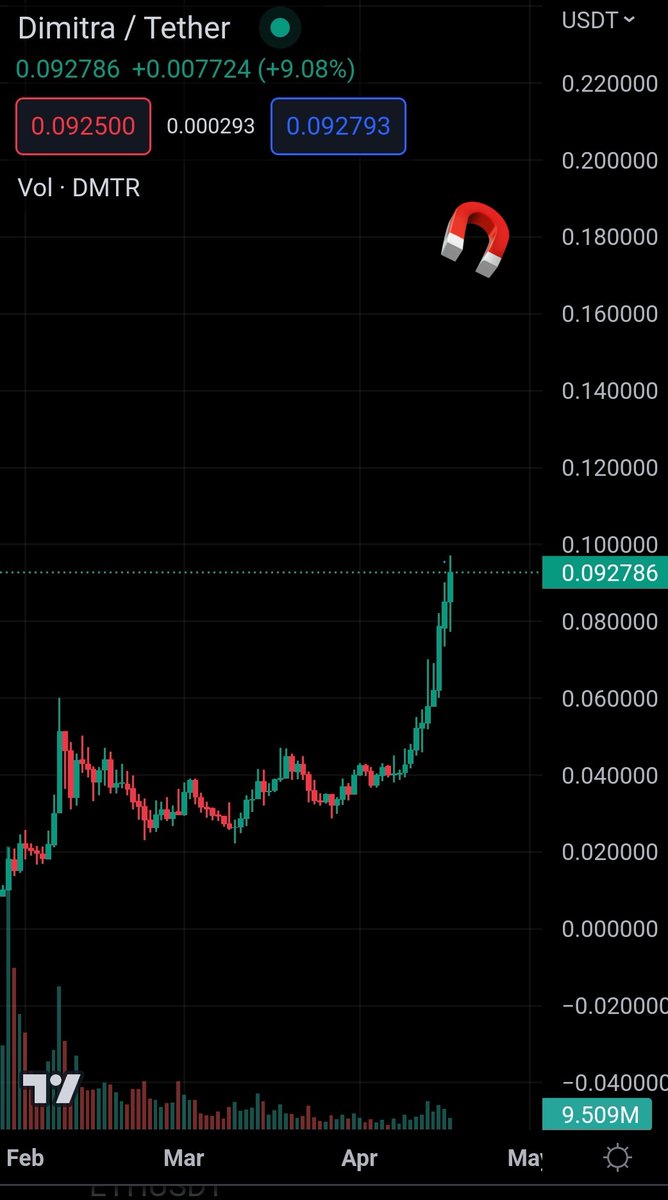
JUST $DMTR A SOLUTION SENDING. THIS IS JUST THE BEGINNING....
THE BEARS ARE REKT. THERE DONE. NO WHERE TO BE SEEN.
PREPARE FOR THE MOON LANDING.
$1 IS A MAGNET. I DONT MAKE THE RULES. I'M FROM THE FUTURE SO WHAT DO I KNOW.
@dimitratech#DMTR
$DMTR IS GOING TO BE ONE OF THE BEST PERFORMING ALTS THIS MARKET. I DONT MAKE THE RULES. IT'S JUST FACT.
$1 IS LITERALLY A MAGNET HERE. NOTHING BUT CLEAR SKIES AHEAD.
WHEN $DMTR HITS $1 I WILL GIVE ONE LUCKY FOLLOWER $10,000. IT'S THAT SIMPLE.
@dimitratech
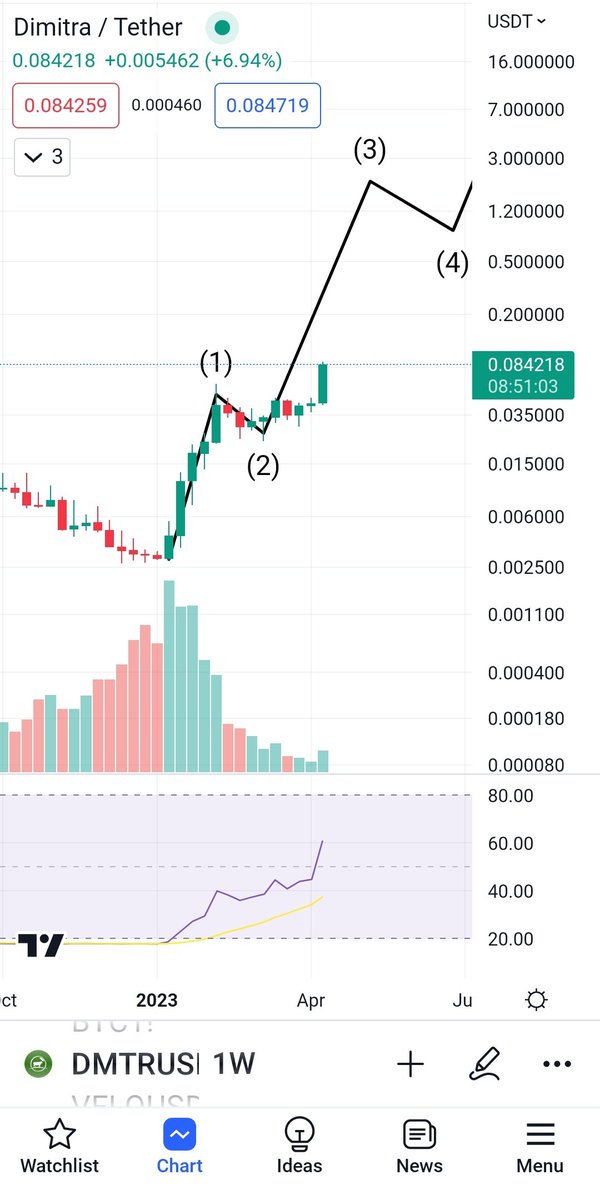
$dmtr #dmtr Isn't project having its dream run? What fascinates me is that even now W RSI is just 60 giving it lot of room to grow
Note: Not buying reco coz I don't buy FOMO candles, when I bought it earlier I infrmd you. Also daily RSI is 86 so in short term anything can happen
My fellow 💎 hunters...
$UPO did great the last three weeks.
@UpOnlyOfficial with a market cap of around $2.5M after this crazy pump is still ridiculous low and undervalued.
@NakamotoGames is sitting on $22M Mcap which is also drastically undervalued
$NAKA #gaming#Metaverse
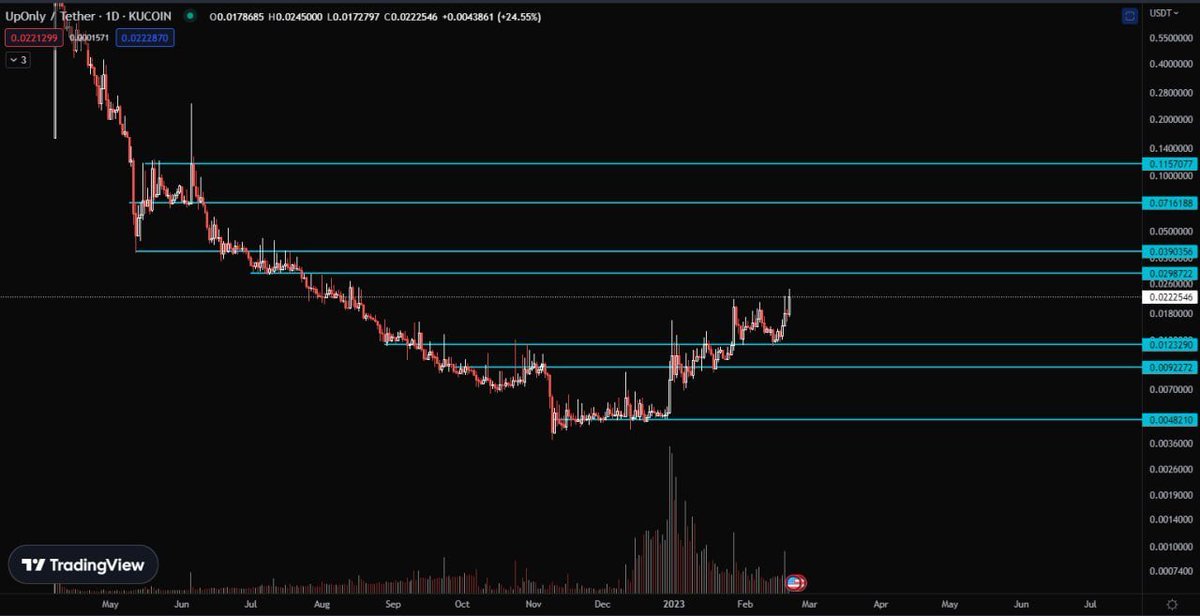
$UPO Targets in the chart below. IMO getting under $0.03 cents is a gift.
$NAKA MC: 20 million vs $UPO MC: 1.4 million (Same management)
#ICO platform going live this week. Partnership with #CoinMarketCap#Binance
Chart by @PayneResidence.
Trade here: https://t.co/rRmsXHdBfq