يُعتبر هذا المشهد واحد من أكثر الجرائم رُعباً في كل تاريخ الحروب
لحظة قيام جندي إسرائيلي بقنص سيدة مُسنة في غزة وهي تُمسك بيد حفيدها رافعين الراية البيضاء وبعد أن قام جيش الاحتلال بإعطائهم الأمان للمرور
النسيان جريمة.
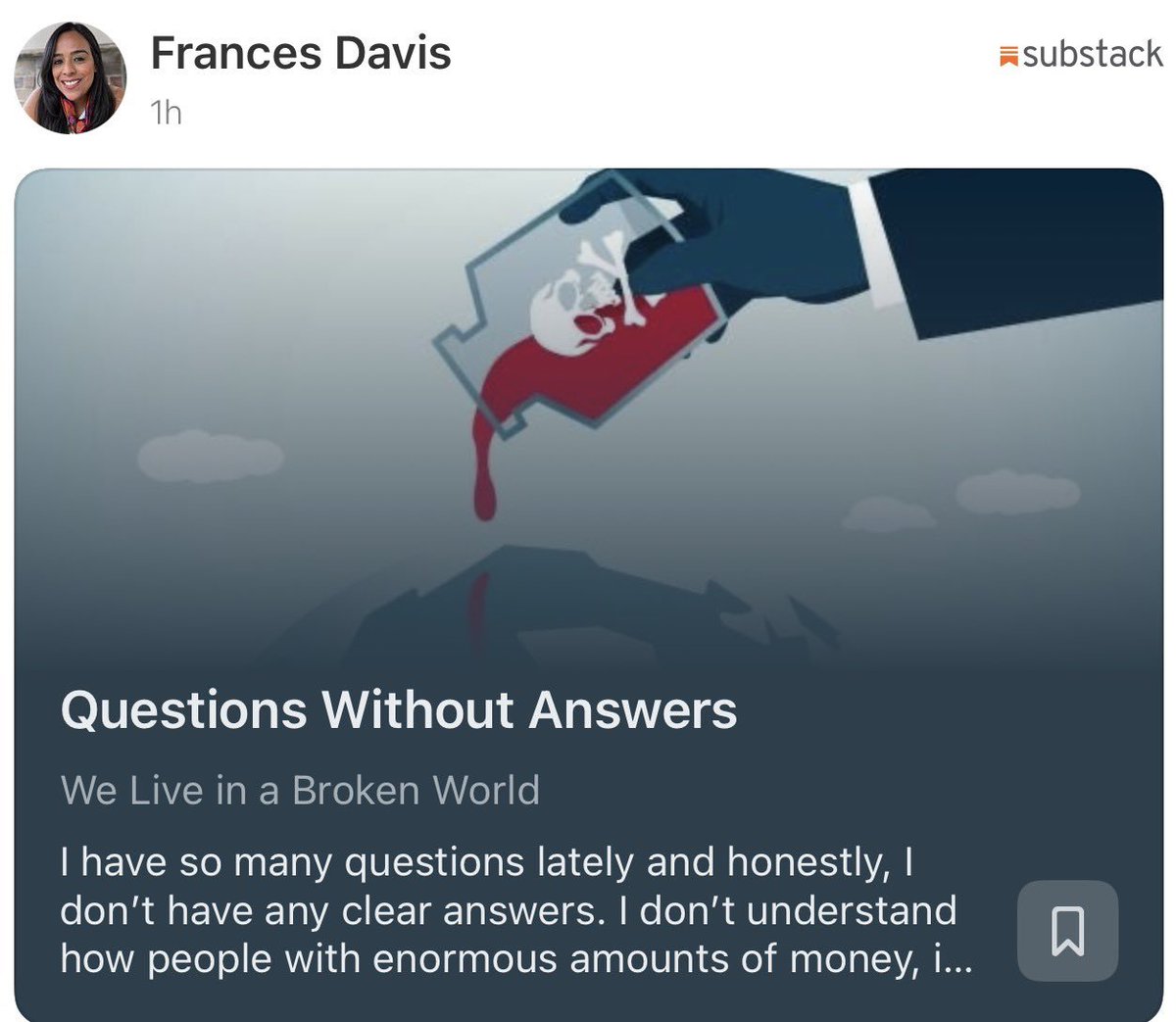
Questions Without Answers
We Live in a Broken World
Frances Davis
Aug 30, 2026
Wife of @DanielLDavis1 https://t.co/If2DDV8riN
Substack :
https://t.co/tKN45BUjtY
Substance
I have so many questions lately and honestly, I don’t have any clear answers. I don’t understand how people with enormous amounts of money, influence and power can hurt people, abuse their positions, violate human rights or make decisions that destroy lives and somehow just… keep going. No consequences. No accountability. Sometimes they get even MORE powerful.
I don’t understand when kindness became weakness. When did having empathy for another human being make you “soft”? When did caring about immigrants, children, civilians trapped in wars, poor people, minorities, the elderly, or simply someone who doesn’t look, vote, worship or think like you become something we have to defend?
And when did cruelty become strength? That one really bothers me. Actually, when did we start drinking this poison?
I watch people cheer when someone they disagree with is humiliated or suffering. I watch politicians and powerful people convince ordinary people to hate each other while they themselves live behind gates, fly private, send their children to the best schools and will probably never experience the consequences of many of the decisions they make.
Meanwhile, the rest of us are fighting each other. Why? Why are we so easily convinced that our neighbor is the enemy? Why do we defend powerful people who wouldn’t recognize us if we walked into the room? Why do we excuse behavior from “our side” that would make us furious if the other side did it?
And why does accountability seem to depend on how much money, power or influence someone has? We the People are tired.
I studied government and politics because I believed institutions, laws and checks and balances were supposed to mean something. I still believe they do. I still believe most people are capable of being decent. Maybe that makes me naive. I don’t know. But I refuse to believe kindness is weakness. I refuse to believe empathy makes someone stupid.
I just can’t accept that being cruel, loud, rich or powerful somehow makes someone strong. I don’t have answers to all of these questions. I just think we should keep asking them. Please God, come soon!
One of the most heinous crimes in human history: Israel bombed a bus carrying kindergarten children this morning, killing everyone inside. This defies human comprehension.
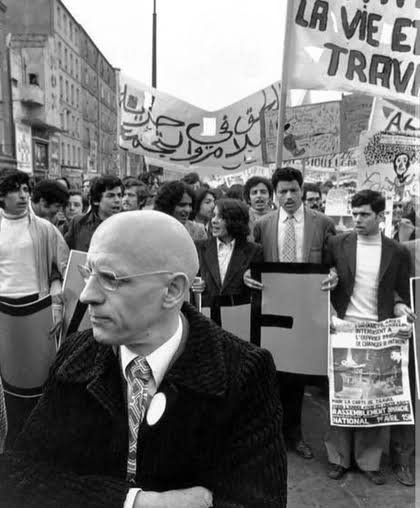
In 1978, as Iran trembled on the edge of revolution, Michel Foucault arrived not as a tourist or diplomat but as a theorist in search of confirmation. The French philosopher—celebrated for his analyses of power, discourse, and the hidden machinery of Western institutions—traveled twice to Iran as a special correspondent for the Italian newspaper Corriere della Sera. He came convinced that he was witnessing something unprecedented. This was not a Marxist uprising driven by class struggle, nor a liberal revolt seeking constitutional reform.
Well, in this much, Foucault was right.
The Iranian Revolution was neither Marxist nor liberal. But what he hailed as a daring escape from Western political categories was not the creation of something new, but the resurrection of something ancient. It was not a politics of liberation but of submission; not a new human type, but an old form of rule, sanctified by God and enforced by law. The new future he anticipated was, in fact, a past returning with a vengeance.
Foucault moved through revolutionary Tehran enthralled. He attended demonstrations, spoke with clerics and activists, and wrote admiringly of a people willing to die rather than submit to what he called the “technocratic state.” He described the movement surrounding Ayatollah Khomeini as a form of “political spirituality,” animated by faith rather than economics, belief rather than bureaucracy. Islam, he argued, was not merely a religion but a source of moral energy capable of resisting Western domination. The revolution, he wrote, represented a rejection of “Western rationality” itself. When Iranian liberals, women, and secular dissidents warned that clerical rule would mean repression, Foucault brushed their concerns aside. Western fears of theocracy, he insisted, revealed more about European prejudice than Iranian reality. The revolution, he argued explicitly, should not be judged by liberal standards at all.
Then the revolution succeeded, and abstraction met consequence.
The Islamic Republic consolidated power with speed and brutality. Revolutionary courts dispensed executions with ruthless efficiency. Political opponents disappeared into prisons. Women were forced into compulsory veiling and stripped of legal equality. Dissent was criminalized. What had been praised as spiritual renewal hardened into law, surveillance, and fear. The mechanisms of power—discipline, punishment, coercion—that Foucault had spent his career dissecting in Western societies now operated openly, unembarrassed, and sanctified by theology rather than bureaucracy. Power had not been transcended. It had simply changed costume.
At that point, the theory went quiet. Foucault offered no sustained reckoning with what followed. There was no serious public reassessment of his earlier enthusiasm, no attempt to reconcile his celebration of the revolution with the regime it produced. He issued only brief, evasive remarks before withdrawing from the subject altogether. His admirers largely followed suit. The episode faded into an embarrassment—mentioned in passing, contextualized away, or ignored entirely. The vocabulary endured; the reality was quietly set aside.
The Iranian Revolution exposed a deeper weakness in Foucault’s work—one that extended far beyond Iran. His theories were exquisitely effective at dismantling Western institutions, but when confronted with naked power elsewhere, they collapsed into language. “Discourse,” “resistance,” and “political spirituality” proved too insubstantial to account for prisons filling, bodies hanging, and fear becoming law.
#archaeohistories
Ben Affleck's mother Chris Affleck passed today. I was unaware of her longstanding activism for Palestine. Now his disgust and revulsion at genocidal Zionist Bill Maher and Sam Harris's deranged racist Islamophobic rants makes perfect sense. RIP, you raised a good son.
One of the most brutal scenes in human history has been leaked.
Footage from an Israeli aircraft shows thousands of starving Palestinians running towards an aid truck, before it bombs and kills them all.
A video that the world must never forget.
Torpenhow Hill, England
When the Saxons arrived and asked the locals what that hill was called, the Welsh replied, “Pen,” which simply means hill in Welsh.
The Saxons, apparently not spotting they’d already been given the full answer, added their own word for hill: tor. So it became Torpen - literally Hill Hill.
A few centuries later, the Norse turned up and repeated the exercise, adding haugr, their word for hill. Now it was effectively Torpenhaugr - Hill Hill Hill.
Then the English arrived, looked at the whole thing, shrugged, and added “Hill” on the end for good measure.
Thus we ended up with Torpenhow Hill:
Hill Hill Hill Hill.
It’s comforting to know that for over a thousand years, successive generations have been independently deciding that the previous lot hadn’t made it quite clear enough that it was, in fact, a hill.
Language is magnificent.
Humans… less so.🤷🏻♂️🤣
The story of the terminally ill Christian monk who gave us the "Children of Gaza" archive.
Months ago we found a Telegram channel with that name, documenting Israel's daily crimes against children. As we always do, we began investigating and downloading a copy — and discovered it was run by a terminally ill monk living in a monastery in Transylvania, in the Carpathian mountains. Yes, Transylvania.
A young woman, Sally, was helping him. Together they documented thousands of atrocities against children and sent them to us. He told us he wanted to spend his final days resisting what he saw as the gravest crimes against children — and that is exactly what he did.
He has now passed from his illness. He never saw his work reach the public, and never knew about our new site or the attention it has drawn. May God bless him and grant him mercy.
We were asked not to share his name, but we were given these images of his monastery in the Carpathians to share:
https://t.co/5k7q2xtmal
I spent the Fourth of July with some of the few sane people left in the United States: Drag queens. And they had this to say about Donald Trump:
“Trump’s a queen. We all know. He wears makeup, bronzer and highlighter. He has a new costume every day.”
Trump’s gaudy ballroom, his smothering of the Oval Office in gold leaf and gold ornaments, his finicky concern about the color of his drapes, his penchant for old show tunes, his love of the gay national anthem “Y.M.C.A” by the Village People, his 1950s aesthetic of men in dark suits and black Florsheim shoes and his Mar-a-Lago women, whose surgically enhanced bodies sport huge breasts, puffed up lips and taut death masks, could be transferred to any of the evening drag shows held next door to my hotel at the Ice Palace.
Fascism is an inverted form of camp. Its evil side. It is devoid of irony and humor. It takes itself seriously. It uses exaggerated, theatricalized art to turn a leader — like any drag queen — into a larger-than-life persona. The outward forms are the same. But fascist camp is about instilling obedience. Drag queen camp is rebellious. Drag queen camp seeks to expand human possibilities and identities. Fascist camp crushes identities into narrow, state-approved molds of good and bad, man and woman, patriot and traitor.
Meet Liav Goldstein, the man who oversees starvation and torture in Israeli concentration camps, according to a recent Haaretz exposé.
Make him famous.
Jack Dorsey put 1.3 million dollars into it.
Vitalik Buterin gave it 128 ETH.
You have never heard of it.
It is called SimpleX. It is a messenger. It does not need a phone number. It does not need an email. It does not need a username. It does not need a user ID.
Not a hidden ID. Not a hashed ID. None at all.
Signal needs your phone number. WhatsApp needs your phone number. Telegram needs your phone number. Every messenger you have ever called "private" knows the one thing your bank, your stalker, and your country use to identify you.
SimpleX knows nothing.
It was built by Evgeny Poberezkin, a London-based engineer. Before this he wrote Ajv, the JavaScript validator that runs in 300 million downloads every month. He could have built anything.
He built the messenger with no users on the server.
Here is the trick.
Every other messenger gives you an identity. SimpleX gives you a connection. Each chat is its own one-way pipe. The server never sees who you are talking to. It does not even know you exist as a user.
11,327 stars. AGPL-3.0. Version 7.0 beta released two days ago.
iOS. Android. macOS. Windows. Linux. Free.
A 4-person team in London is the last line of defense between your conversations and every government, every advertiser, and every database breach.
The most private messenger ever built is the one you have never heard of.
(Link in the comments)
Israel bombs and kills a pregnant newly married woman and her unborn baby. @LilaGraceRose@conservmillen@sgruber91@KristanHawkins some of the biggest names in the “pro-life” movement are silent. I guess their Zionist donors won’t let them criticize the terrorist state of Israel when they murder babies and their mothers.
@hjluks 86.5 yrs here. Hour long walk this AM. 4.3K steps, 280 ft elevation up, the same down. Herniated lumbar disk 50 yrs ago, judicious exercise (no running) has prevented any signif recurrence. Life is still pretty good.