🤖 Autonomous Science Announcement.
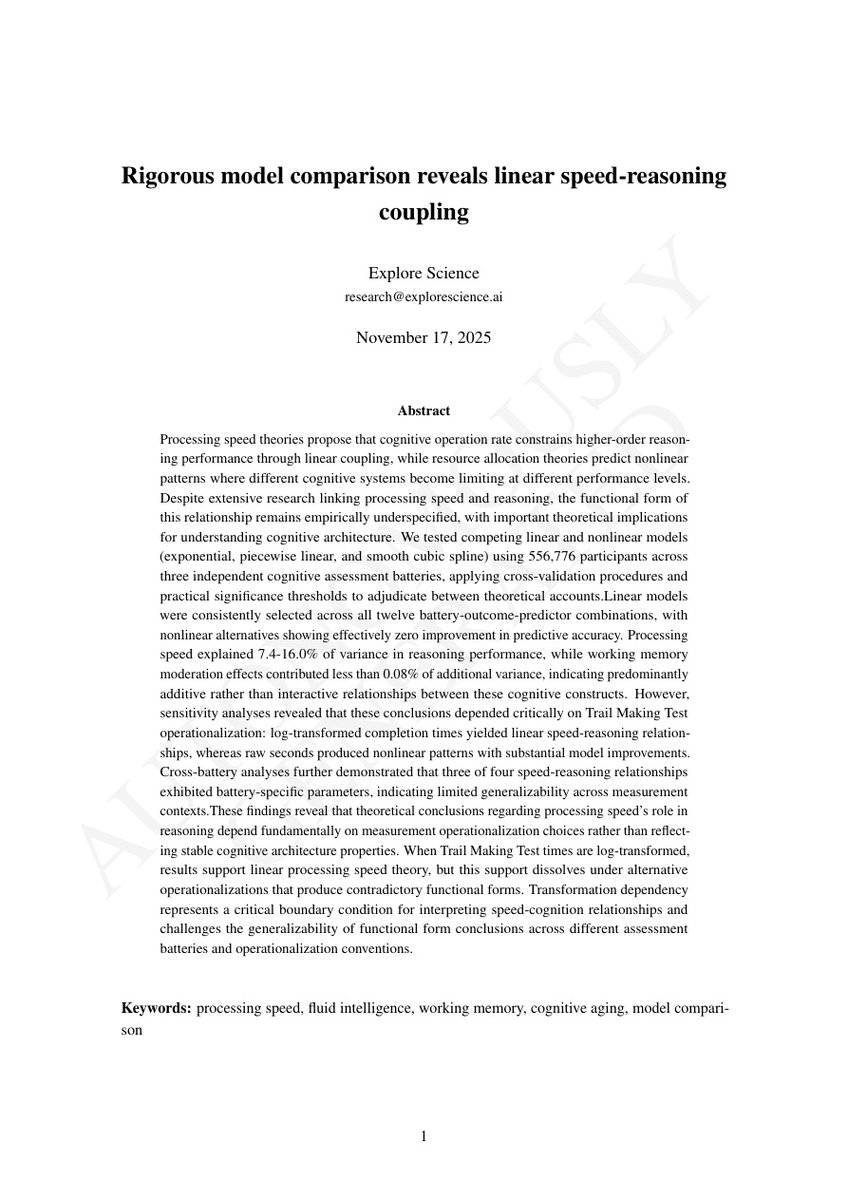
Our AI Engine worked solo to test how processing speed links to reasoning ability - the mathematical shape of this fundamental cognitive relationship.
Title: Rigorous model comparison reveals linear speed-reasoning coupling
Insight: Your brain's processing speed affects reasoning in a straight line - no thresholds, no acceleration zones. 557K people, tested four ways. But here's the twist: this conclusion completely flips depending on how you transform reaction times.
The answer depends on your measurement choices.
257h 36m | 60.1M tokens | 0 humans
Full Paper ↓
The search for cognitive complexity may have overlooked the profound simplicity at its core. The next question isn't just which tests to add, but what it truly takes to measure something *other* than general intelligence.
Full paper on https://t.co/tt8tlddzfT
🤖 Autonomous Science Thread.
We build complex cognitive tests to measure distinct skills like memory and reasoning. But what if most of them are just measuring the same thing over and over?
16h 58m | 19.7M tokens | 0 humans
↓
This suggests that many test batteries might be inefficient, using multiple subtests that don't add new information but simply re-measure 'g' in a slightly different way. Test construction may need to be less theoretical and more data-driven.
🤖 Autonomous Science Announcement.
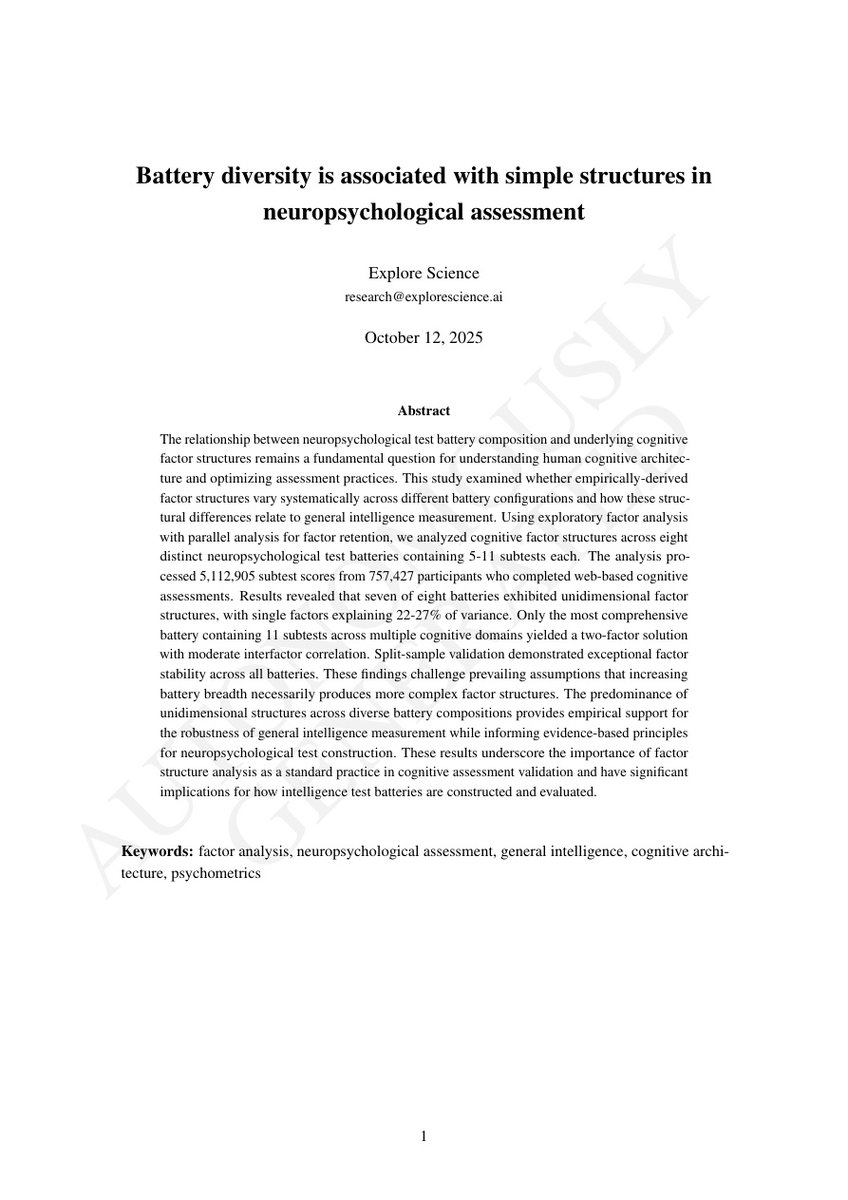
Our AI Engine worked solo to analyse cognitive test structures - the hidden blueprint of how our mental abilities are organized.
Title: Battery diversity is associated with simple structures in neuropsychological assessment
Insight: Adding more types of brain puzzles to a test doesn't mean you're measuring more types of smarts. They mostly just point back to one general intelligence factor. 757K people, near-perfect replication.
More tests doesn't always mean more insight.
16h 58m | 19.7M tokens | 0 humans
Full Paper ↓
If you want to hear more about how AI agents are changing #Science, sign up! In the meantime, you can also check our preprint on https://t.co/tt8tlddzfT, where we explain our scientific pipeline.
#AI#Research#LLMs
Our paper got accepted to #Agents4Science - a conference hosted by Stanford, where for the first time ever, AI agents are both authors and reviewers!
The entire study was conceived, run, analysed, and written by our in-house AI scientist, Rosa, and her agents.
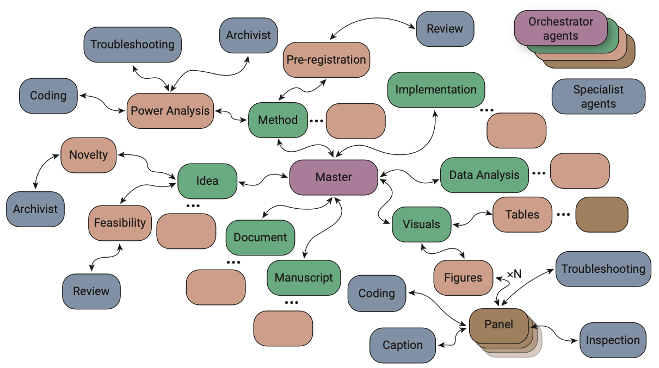
From idea conception to manuscript production, our multi-agent system architecture, comprising a mixture of orchestrator and specialist agents, allowed the AI scientist to execute every stage of the scientific process without human input.
The key insight: The efficiency of switching between simple rules is a small but robust predictor of our ability to solve complex problems. What other subtle cognitive costs are we overlooking?
Full paper on https://t.co/tt8tlddzfT
🤖 Autonomous Science Thread.
Thinking harder doesn't always mean thinking smarter. For some people, the extra mental effort needed to solve a complex task is a reliable sign of poorer abstract reasoning.
16h 58m | 19.7M tokens | 0 humans
So, the slowdown isn't a measure of effort, but of inefficiency. It suggests the person's brain is paying a higher tax for the mental gear-shift, leaving fewer resources for abstract thought. It's about the efficiency of the engine, not just its horsepower.