In October I said the work around the frontier model had earned silicon of its own. @vithursant19 and I built it. @ExstillAI is out of stealth.
Our belief: AI compute is nowhere near as efficient as it could be. Most of what you pay to run AI isn't the math. It's the mismatch.
Every token has a cost. We think you should be able to account for it.
On Exstill's pre-silicon design:
• “pilot” after 117 tokens: 48 µs, 401 µJ
• “machine” after 16,024 tokens: 50 µs, 520 µJ
Every cycle. Every microjoule. Across the full model.
Part 3 of our technical series explores what AI chip performance numbers actually tell you, and why the methodology behind them matters.
https://t.co/0GORdtHzAG
This is exactly the tradeoff we’re tackling at Exstill.
Specialization unlocks enormous efficiency gains, but the challenge is building hardware that remains useful as models and workloads evolve.
Our approach is to co-design a shared model architecture with the silicon it runs on, then specialize through training and distillation.
One architectural foundation, different learned capabilities, silicon built for both.
https://t.co/Q5xwIF8z3x
The interesting shift is from how much a model knows to what it can actually accomplish. Smaller models with the right tools and fast feedback loops could change the economics of AI entirely. @ExstillAI
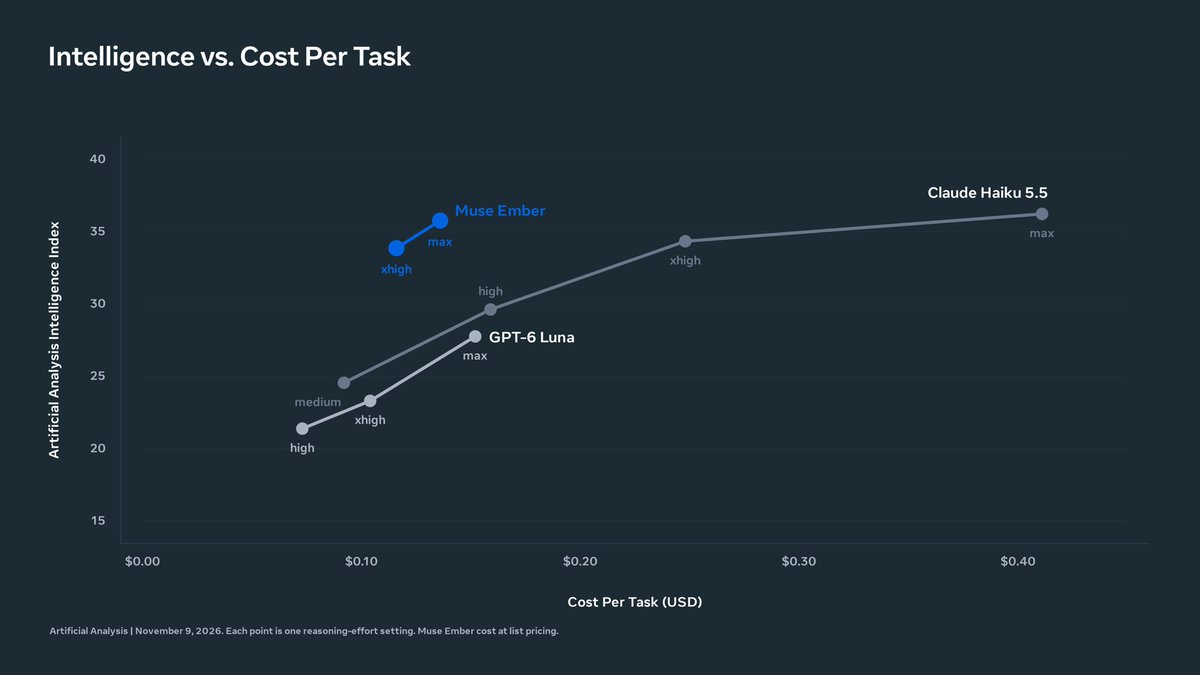
Meta's Muse Ember reinforces where we believe AI is heading: frontier models handle the hardest reasoning, while smaller models take on the repeated work inside agents.
At @ExstillAI , we're building the other half of that equation: dedicated silicon co-designed to run small, specialized models alongside frontier AI, making their inference radically faster and more efficient.
https://t.co/0nX1Bba6x3
2/ you can pair the small and big models for the hardest problems: wonder can plan, ember can handle the volume. available now on muse code and API.
https://t.co/2vNzQhrYvX
1/ announcing our smallest, most efficient little model is here: muse ember 🔥
built for work that agents repeat all day, it gets you more intelligence per dollar than Haiku, Luna, and all other flash models at any reasoning setting and does it at a third of the cost or less!
How much of the next token is actually math?
On an NVIDIA B300, we measured 994 mJ/token for one user, 361 mJ with 12 sharing it. The arithmetic alone: 0.89 mJ.
Our co-designed chip projects 0.52 mJ/token at matched quality (pre-silicon).
Part 2: https://t.co/P85n8mGqwF
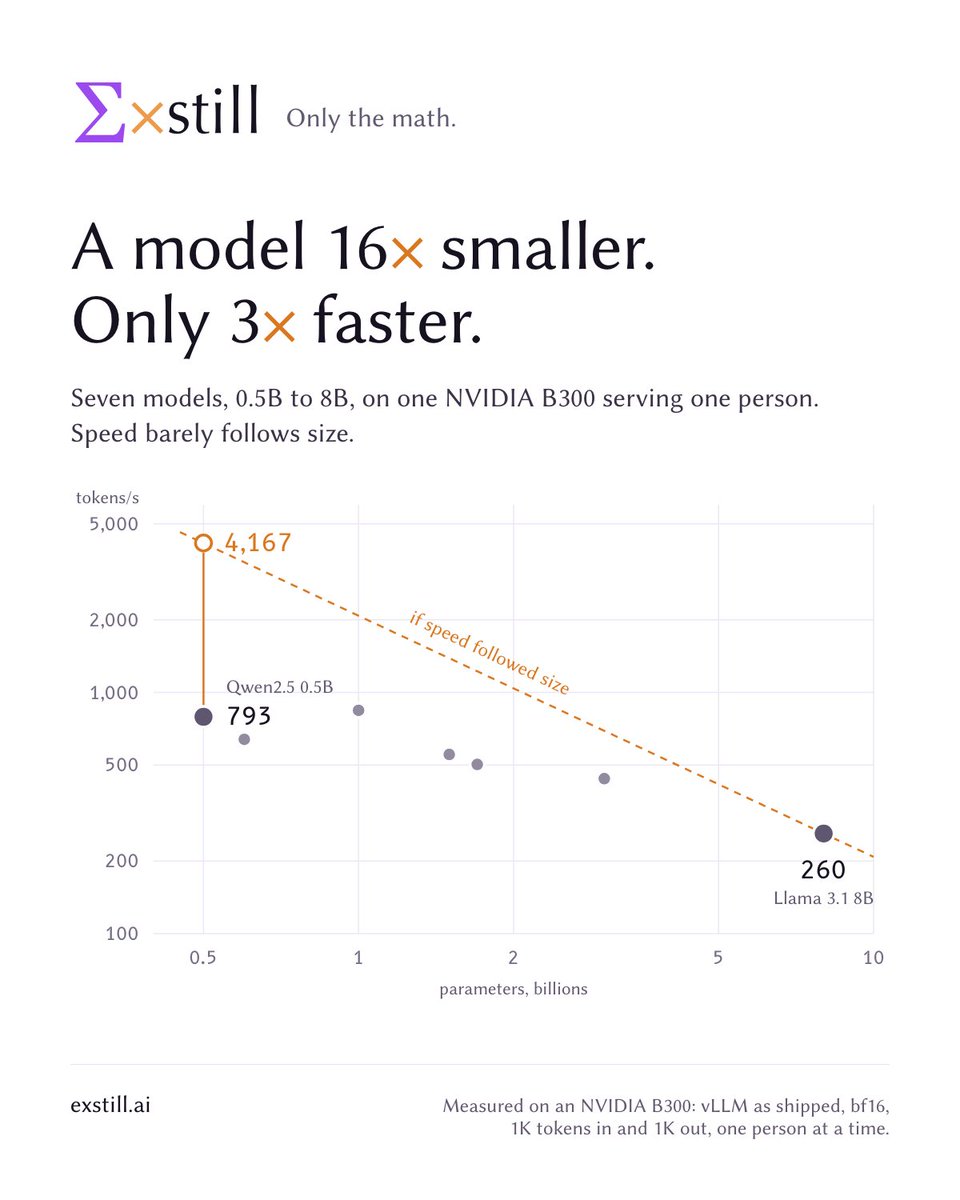
A model 16x smaller. Only 3x faster.
That's what we measured on an NVIDIA B300 serving a single user.
Frontier models get most of the attention, but the smaller models working around them increasingly determine how long users wait.
They draft tokens, screen prompts, route requests, and power multi-step agents. Each operates in the critical path of inference.
Yet they're running on hardware primarily optimized for much larger models and higher throughput.
We think these workloads deserve silicon of their own.
Today, we're kicking off an eight-part technical series exploring the research and engineering behind Exstill, from GPU inference bottlenecks to ML–silicon co-design and our first co-processor.
Part 1: The work around the frontier model.
https://t.co/e0VP1Yz17G
We're coming out of stealth.
The limits of AI compute are inherited, not fundamental.
At Exstill, we're designing AI models and silicon together to push inference efficiency toward its limits.
Our first step: the frontier model's co-processor.
Founded by Valavan Manohararajah and Vithu Thangarasa (@vithursant19), we've been building toward this moment for a while, and we're excited to finally share what we've been working on.
We're just getting started.
Explore what we're building: https://t.co/1RO7hGRHfU