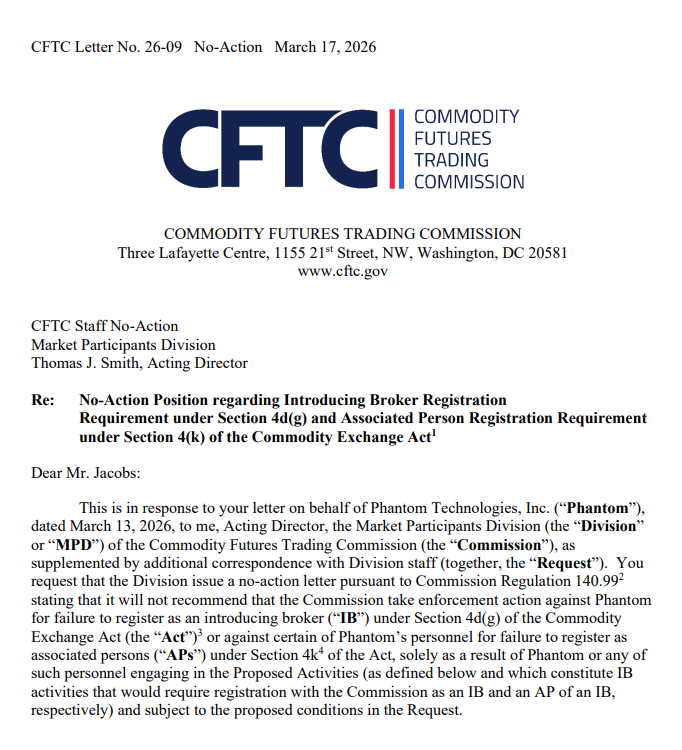
The CFTC just told self-custodial wallet developers they don't need to register as brokers.
Phantom Wallet received a no-action letter stating the CFTC will not pursue enforcement against self-custodial wallet developers who connect users to regulated trading venues, as long as they don't custody user funds. First time the agency has formally drawn that line.
Here's why this is massive:
Under existing U.S. law, any entity that solicits or facilitates derivatives trading typically must register as an introducing broker with the CFTC. That rule was written for traditional finance intermediaries. But as self-custodial wallets started integrating access to derivatives markets, developers faced a legal gray area that could have classified them as unregistered brokers simply for writing software.
The CFTC's position was, if your wallet software connects users to properly registered futures commission merchants, introducing brokers, or designated contract markets, and you don't custody user funds, you are not a broker. You're a software provider.
The timing is not coincidental. One week ago, CFTC Chairman Mike Selig said at FIA's Boca Raton conference, "For too long, there has been an open question as to whether software providers trigger the CFTC's registration requirements. We intend to address this question head-on."
Seven days later, they did.
This matters far beyond Phantom. Every self-custodial wallet developer and every open-source protocol interface that connects users to regulated markets now has a reference point. Write software, don't custody funds, route through registered intermediaries, and the CFTC will not come after you.
For context, the previous administration used ambiguous intermediary rules as a weapon against developers. Tornado Cash developers were prosecuted. Frontends shut down preemptively. The chilling effect pushed builders offshore.
This no-action letter, combined with Selig ending "the days of CFTC-SEC infighting" through Project Crypto, signals a complete reversal. The U.S. is actively trying to bring developers back.
Since the market crash on October 11 — for reasons everyone in the industry understands — we’ve seen some institutions take hits, some people exit the space, and some competitors quietly stop promoting their “XX Life Meme” tokens.
Many friends have asked me whether this means a bear market is coming.
I don’t have that answer — but there’s a more important question you should be asking yourself:
Do you still believe in the future of Bitcoin and the crypto industry?
If your answer is no, then perhaps this is the right moment to step away.
But if your answer is yes, then even if a bear market is approaching, this is actually the best time to build — to create real value for users and position yourself for the next wave of growth.
Bear markets test conviction.
Builders use them to prepare for the next bull run.
Fifteen years ago, Satoshi Nakamoto introduced the world to a peer-to-peer electronic cash system. Today, billions benefit from the crypto industry, driven by Bitcoin’s core values of fairness and transparency.
It is deeply disappointing to witness unjustified discrimination against an EU member state that has been early in regulating crypto, upholds some of the highest standards for crypto regulation—simply because it is proactive and agile.
At OKX, we established our Malta entity in 2018, inspired by the visionary “Blockchain Island” strategy. Over the past seven years, we have built one of the most robust compliance frameworks in the industry, including:
1. Comprehensive KYC: Every OKX user globally must complete full identity verification, including residential ID, liveness-verified selfie, and—in the EEA—proof of address, in line with local regulations. Unlike many other platforms, OKX does not permit simplified due diligence for “small transactions.”
2. 100% Transaction Monitoring: All global transactions are monitored using a hybrid system that combines third-party vendors and in-house behavioral analytics. We are one of the largest users of Chainalysis tools.
3. Strict Sanctions Compliance: We enforce both name-based and transactional sanctions screening to ensure that no sanctioned individual can access our services.
4. Proactive Web3 Risk Controls: Beyond our obligations, we have built real-time on-chain monitoring to protect users of the OKX Web3 Service—even though it is a self-custody solution and not legally subject to most global compliance regimes.
5. Global Law Enforcement Cooperation: We actively collaborate with partners like Tether and law enforcement agencies. Most recently, we contributed to the largest-ever seizure of scam-related crypto funds, as announced by the U.S. Department of Justice.
OKX has resolved historical issues with the U.S. DOJ and other regulators. We remain fully committed to strengthening our compliance effectiveness, earning the trust of both global users and regulators.
Stay compliant. Stay innovative. Stay responsible.
Load up on the most epic panel of industry leaders & vision casters at #Token2049 with:
🎙️ @Star_okx (our founder & CEO), @Jerallaire (co-founder @Circle) & @VitalikButerin
🗣️ Moderated by @Haider (our CMO)
Get your insights on what’s next for crypto. Catch us irl 👀
Here’s a controversial take on the future of ZK. Ready?
In short, for any given project, ZKVMs will fade, and custom ZK will take over.
Here's why: ZKVMs have been crucial for widespread adoption by significantly reducing time to market. However, this comes at the cost of high resource demand for proof generation. While this cost is decreasing, custom ZK is likely to be more performant.
Consider an application's evolution. It starts with ZKVM, finds PMF, achieves success, and then aims to improve its performance. Transitioning from ZKVM to custom ZK becomes an obvious choice, as time-to-market is no longer an issue.
Now, to be clear, this doesn't diminish the value addition of ZKVMs at all. I think they will forever be essential, but as a bootstrap mechanism for any new project.
Feel free to challenge it!
Proud of our team for this achievement for Malta as OKX MiCA hub in EU. Following the launch in Netherlands and Türkiye, it improve our service capability in EU. Also highlights OKX's commitment to offer top-tier,secure products and build a trusted, transparent and safe gateway to crypto and blockchain world. We look forward to OKX's journey to contribute to blockchain ecosystem in EU.
OKX @okxweb3 make it easy for everyone to participate in #Web3 world with unified, chain-agnostic and fee-free trading across top inscription standards. Look forward to feedback on new integrations 🙏
https://t.co/mudY40taKo
I just had a speech on 2024 OKX team’s Annual Gala. 2024 is the 12th year of okx company. We are not a young startup, but all of our team members are full of energy to continue building in this magic crypto industry.