Ranked: AI Competitiveness by Country
1. 🇺🇸 United States
2. 🇨🇳 China
3. 🇮🇳 India
4. 🇰🇷 South Korea
5. 🇬🇧 United Kingdom
6. 🇸🇬 Singapore
7. 🇪🇸 Spain
8. 🇦🇪 UAE
9. 🇯🇵 Japan
10. 🇨🇦 Canada
11. 🇨🇭 Switzerland
12. 🇱🇺 Luxembourg
13. 🇫🇷 France
14. 🇮🇱 Israel
15. 🇩🇪 Germany
16. 🇧🇷 Brazil
17. 🇮🇪 Ireland
18. 🇫🇮 Finland
19. 🇸🇦 Saudi Arabia
20. 🇵🇹 Portugal
21. 🇩🇰 Denmark
22. 🇳🇱 Netherlands
23. 🇧🇪 Belgium
24. 🇦🇺 Australia
25. 🇸🇪 Sweden
26. 🇲🇾 Malaysia
27. 🇮🇹 Italy
28. 🇷🇺 Russia
29. 🇦🇹 Austria
30. 🇳🇴 Norway
Source: Stanford University’s Global AI Vibrancy Tool
GERD generates the equivalent of 4 large nuclear units
Come close and look with me. This is a live frame from GERD’s control room.
Total power reads 4,822.85 MW. Reactive power 93.09 MVAr. Flow tag 3,048.64 m³/s. Numbers, yes. But also a heartbeat.
What does that mean in plain words?
GERD’s roof is 5,150 MW. Right now we are just 327.15 MW under it - about 93.6% loaded. That is the plant running strong and steady, voltage tight, almost unity power factor. If you split the moment across all 13 Francis units, you get roughly 371 MW per unit. Some breathe a little lighter, some a little heavier - that is normal with head, efficiency, and grid limits.
About the flow tag on the screen.
If it were the total discharge, the implied head would be around 179 m, which is higher than GERD’s usual band. More likely it is the readout from one powerhouse or it excludes some units. Double it to about 6,100 m³/s and the implied head lands near 90-100 m, right where big Francis machines like to work. Either way, the power number is the truth. We are sitting near the ceiling.
Now, let’s make the size of 4,822.85 MW feel real.
• Picture Addis Ababa lit many times over. Addis peaks around 0.6-0.8 GW. This single reading is like powering 6-8 Addis Ababas at once.
• Think of Nairobi and its neighbors around 2 GW. GERD at this moment is more than double that.
• Think of London at 6-7 GW. We are at about two thirds of London’s peak.
• Think of New York City around 12-13 GW. We are at about one third of NYC’s glow.
• Or count homes. At roughly 1.3 kW per home, this instant lights about 3.7 million homes. At 1.0 kW, it is about 4.8 million homes. Hold this for 24 hours and you deliver around 116 GWh - enough for 3.9 million homes at 30 kWh/day, or 11.6 million at 10 kWh/day.
• Plant for plant, think 4 large nuclear units together, or about 10 big gas turbines.
Now, a question I know I will get: why not 5,150 MW every minute?
Because real operators keep headroom. A few percent of space for frequency control, temperature, vibration, line limits, and safe ramping. That is good practice, not weakness.
Let’s ask a second question: where does this power come from in the rhythm of the year?
From storage. From the Abay’s pulse. Long run, the river brings about 50 bcm each year. GERD’s normal lake band is ~625-640 m. We store during flood months and release steadily later. That is the job. That is why you cannot take one high minute and multiply by 8,760 hours to make an annual number.
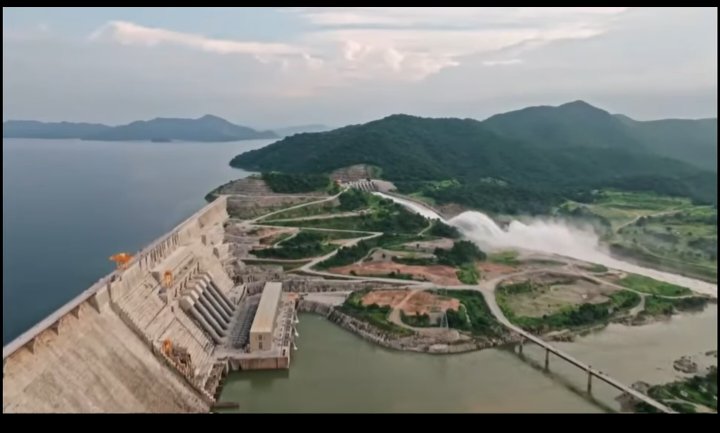
Another scene people ask about is the crest spill.
At FSL 640 m the lake is full - roughly 74 bcm. When inflow nudges the top of the band, the ungated crest behaves like any weir and passes the extra gently into a lined, stepped chute and a stilling basin. That is the spillway doing what it was built to do. It is not uncontrolled overtopping. It is control.
Seatbelts are on too.
There is a continuity release so the river does not go dry. There is day-to-day ramp discipline to protect Roseires and the banks. There is monitoring and emergency coordination because this is a flagship plant, not a guessing game.
Let’s look at the national picture for a moment.
Before GERD, Ethiopia’s installed fleet was ~4.7-5.2 GW. Today’s single snapshot at ~4.82 GW is essentially the old entire system, concentrated in one station. If you want to see exactly how much the rest of the country is making right now, open Merkava and subtract 4,822.85 MW from the total. That number is the non-GERD share in that minute.
Machine sense-check for the engineers reading this:
At net head ~100 m and efficiency ~90%, one 400 MW unit needs about 453 m³/s, one 375 MW needs about 425 m³/s, and all 13 at nameplate would want around 5,833 m³/s. That is why we push harder in the wet months and ease in the dry months. That is the music of a storage plant.
Why 13 units?
Because a hub plant must cover peaks, keep n-1 reserve, rotate maintenance, capture seasonal surges, and support exports. A few units alone cannot do all that with resilience.
So what does this image really tell us?
It says the turbines are humming near full song. It says voltage is crisp. It says the lake is being managed inside its band and the spillway is ready to pass what it must. It says a single project now stands shoulder to shoulder with the grid we used to have as a country. For me, as an Ethiopian, that is pride. For readers who love numbers, that is 4,822.85 MW and a story of water turned into light.
#GERD #GrandEthiopianRenaissanceDam #Abay #BlueNile #NileBasin #Hydropower #CleanEnergy #PowerAfrica #Energy #Electricity #Infrastructure #Ethiopia #Egypt #Sudan #SouthSudan #Uganda #Kenya #Tanzania #Rwanda #Burundi #DRC #CongoDRC #Eritrea
Money doesn't come from Hard work.
Money doesn't come from patience.
Money comes from solving big problems for people who can pay for it.
The game is the game.
100 days of ccna course
🌟 Day 1 of #100DaysOfCCNA! 🚀 Today, I���m diving into the fundamentals of networking. Starting with the OSI model and understanding how data travels across networks. Excited to build a strong foundation for my CCNA journey! 💻🔗 #CCNA #Networking #learning
Future CSS Tip! 🔮
You can create this scrolling image pop-out effect with CSS scroll-driven animations and zero JS! 🔥
.pop {
view-timeline-name: --pop;
}
img {
animation: slide both;
animation-timeline: --pop;
animation-range: entry 100% cover 50%;
}
.skateboarder {
--x: 0;
--y: -45%;
}
@ keyframes slide {
to { translate: var(--x) var(--y); }
}
The "trick" is to layer up two image elements and keep one clipped by the container 🤙
Slide them both together and it will look like one pops out of the container 🎈 You can leverage scoped custom properties to translate by different distances too! 😎
You can use macOS's built-in image background removal tool to get the pop-out image ✨ And for added effect, you can animate the brightness on that to make it stand out ⭐️
@CodePen link below! 👇