$HYFT MindWalk still had approximately $28.6 million available under its existing ATM, having only used about $1.36 million.
So if this was simply about needing cash… why not continue using the remaining $28.6 million already available?
Instead, management increased the ATM from $30 million to $50 million.
My interpretation? They’re positioning themselves with additional financing flexibility. With the universal dengue program in third-party neutralization testing and the universal influenza program continuing to advance, interesting timing .
We’ll find out soon enough whether this was simply administrative… or preparation for something much bigger.
$HYFT Another point worth emphasizing is that as AI models grow larger, costs increasingly leak through context rather than parameter count alone. No matter how effectively a model is integrated, if companies must repeatedly feed raw sequences, assay reports, and research abstracts into every query, inference costs can rise to an unsustainable level as usage scales across the organization.
MindWalk’s technologies are designed to structurally reduce unnecessary token consumption by converting fragmented biological data into reusable and queryable context. This could help enterprises reduce the growing financial burden associated with excessive token usage.
$HYFT Genesis Mission Phase 1 수상자는 7월 22일 발표된다.
근데 이 발표 자체보다 눈여겨봐야 할 지점은 따로 있다. DOE가 2026년 Genesis Mission University/Science Philanthropy Summit 보고서에서 드러낸 방향성이다.
보고서를 뜯어보면 이 미션의 본질이 AI 모델 성능 경쟁과는 거리가 멀다는 게 보인다. 핵심은 AI가 과학적 맥락 안에서 신뢰할 수 있는 추론을 하도록 만드는 고품질/구조화/출처 추적 가능한 도메인 데이터 인프라다.
과학 AI의 병목은 모델 크기가 아니라 데이터 쪽에 있다. 모델이 이해하고 추론할 수 있는 형태로 정제된 생물학 ���이터 계층, 그게 진짜 관건이라는 얘기다.
바이오 분야에서 이 니즈를 실제로 ���족시킬 수 있는 제품군이 MindWalk 말고 또 얼마나 있을까?
Genesis Mission이 지향하는 게 과학 AI를 위한 신뢰 가능한 도메인 데이터 계층이라면, MindWalk는 그 요구와 꽤 정합적인 위치에 서 있다.
다만, 경영진들이 이 프로젝트의 지원했는지는 그들을 제외하고 아무도 모른다는 것
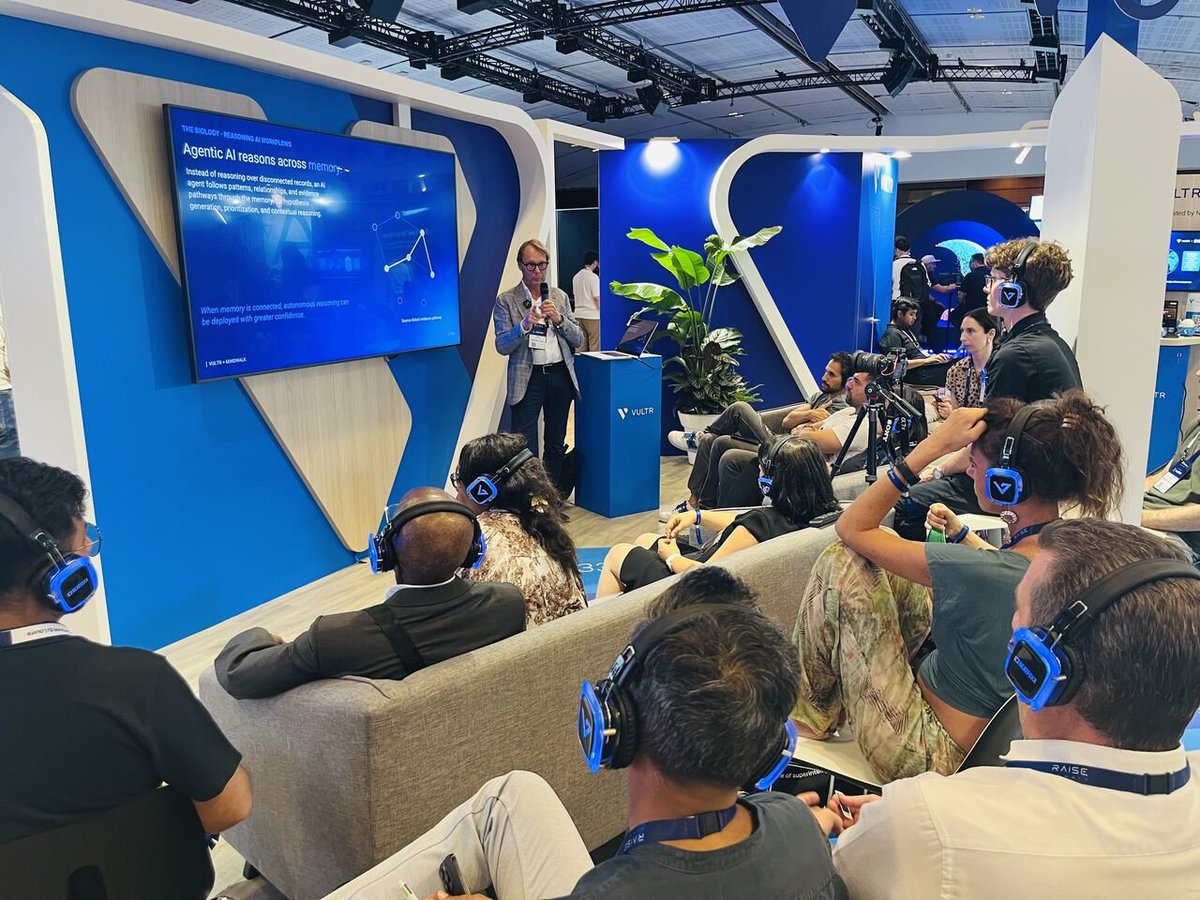
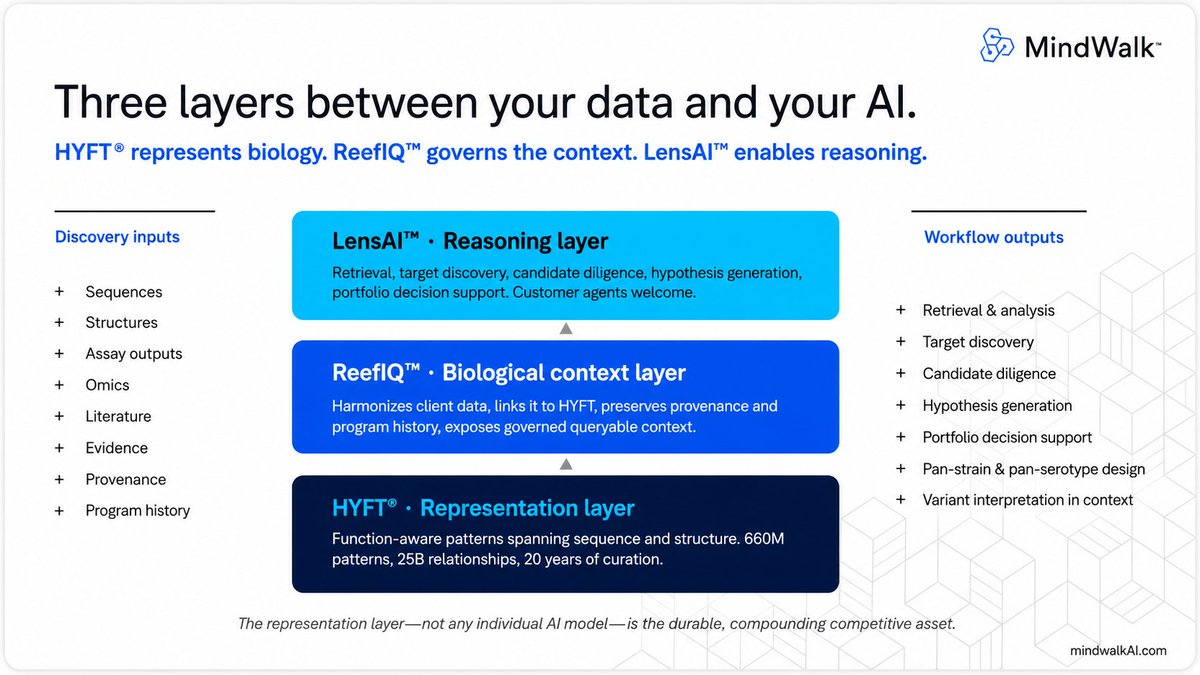
$HYFT AWS AI Summit에서 유출된 Mindwalk PPT
------
당신의 데이터와 AI 사이에 있는 세 개의 레이어
HYFT®는 생물학을 표현합니다. ReefIQ™는 맥락을 관리합니다. LensAI™는 추론을 가능하게 합니다.
발견 입력 데이터: 서열/구조/분석 결과/오믹스/문헌/증거/출처 정보/프로그램 이력
1)LensAI™ 추론 레이어
검색, 타깃 발굴, 후보물질 실사, 가설 생성, 포트폴리오 의사결정 지원. 고객 에이전트도 사용 가능.
2)ReefIQ™ · 생물학적 맥락 레이어
고객 데이터를 조화롭게 정리하고, 이를 HYFT와 연결하며, 출처와 프로그램 이력을 보존하고, 관리된 검색 가능한 맥락을 제공합니다.
3)HYFT® · 표현 레이어
서열과 구조 전반에 걸친 기능 인식 패턴.
6억 6천만 개의 패턴, 250억 개의 관계, 20년에 걸친 큐레이션.
워크플로우 출력: 검색 및 분석, 타깃 발굴, 후보물질 실사, 가설 생성, 포트폴리오 의사결정 지원, 범균주 및 범혈청형 설계, 맥락 기반 변이 해석.
표현 레이어는 개별 AI 모델이 아니라 지속적이고 복리처럼 축적되는 경쟁 자산입니다.
$HYFT MindWalk at the foundation. That’s the edge. Everything else is getting commoditized. Models. Compute. APIs. All of it. But biology isn’t solved by bigger models. It’s solved by structure. If the foundation is weak, nothing holds. If the foundation is right… Everything compounds on top of it. That’s where MindWalk is positioning itself. Not on the surface. Under it.
$HYFT 큰 그림의 퍼즐조각이 점점 맞춰지고 있다.
AI 신약개발을 구동하는 고차원 생물학 데이터 아키텍처 특허 출원
AI 신약개발을 위한 핵심 인프라로서 HYFT® 패턴 앵커를 중심으로 생물학적 의미를 고차원 데이터 구조로 조직화��는 유럽 특허 EP26187897.9를 출원했다
기존 HYFT 특허가 생명체 전반에서 반복되는 생물학적 패턴을 찾아 정렬 없이 비교하는 기반 기술이었다면, 이번 출원은 그 패턴 주변에 서열, 구조, 기능, 물리화학적 특성, 실험 결과, 문헌, 프로그램 이력 같은 맥락을 연결해 ReefIQ™, LensAI™, 고객 AI 워크플로가 재사용할 수 있는 모델 비의존적 생물학 표현 계층을 보호하려는 것이다.
$HYFT AUSTIN, Texas--(BUSINESS WIRE)-- MindWalk Holdings Corp. (“MindWalk”) (NASDAQ: HYFT), a Bio-Native AI company, today announced the filing of European patent application No. EP26187897.9, directed to high-dimensional data structures for biological subsequences and property inference. The application is intended to protect the enriched biological representation architecture that underpins MindWalk's HYFT® Technology, its ReefIQ™ biological context layer, and its LensAI™ reasoning workflows.
The filing comes as agentic AI in life sciences converges on a clear architectural lesson: frontier models alone are not enough. Recent public work on scientific agents, including NVIDIA's BioNeMo Agent Toolkit [1] and AstraZeneca's ChatInvent system [2], points to the need for domain-specific context, structured tool interfaces, reliable input/output schemas, provenance, memory, and validation when AI agents are deployed in real scientific workflows. As frontier models trend toward commodity, MindWalk believes the durable advantage migrates to the data layer, the structured, domain-specific representation that lets any model or agent retrieve, compare, and reason over biology with traceable context.
“As AI models become more broadly available, we believe lasting advantage in life sciences will come from the biological context those models can use. The differentiator is not a generic AI interface, but the structured biological representation that lets models and agentic workflows retrieve connected evidence, preserve provenance, and reuse knowledge across programs. This filing is intended to protect aspects of the architecture at the core of HYFT® Technology, where MindWalk believes lasting value in biological AI can compound.”
— Jennifer Bath, Ph.D., Chief Executive Officer and President, MindWalk Holdings Corp.
That data layer also anchors a large and growing market. Spending on AI in drug discovery is projected to grow from approximately US$5 billion in 2026 to more than US$8 billion by 2030 [3], and it sits atop the more than US$250 billion the pharmaceutical industry invests in research and development each year [4].
The new application builds on MindWalk's foundational HYFT patent (EP3881326A1), which established how the Company identifies the characteristic biological patterns that recur across life and uses them as a searchable language to compare sequences without alignment. EP26187897.9 protects a distinct and additive layer: organizing the biological meaning around those patterns into a form that can be reused across MindWalk's infrastructure, customer programs, and AI workflows. It is the computational layer built on the original foundation, not a re-filing of it.
MindWalk’s earlier HYFT® patent estate established the foundation of the Company’s biological intelligence platform: the ability to identify recurring biological patterns and use them as a searchable language across life sciences. The newly filed patent is intended to address a distinct, additive layer above that foundation — by seeking protection for how biologically meaningful subsequence-level pattern anchors can be enriched with connected biological context and made usable across MindWalk’s platform, customer programs, and AI workflows.
The added value of the new representation layer is that each HYFT® pattern can become more than a search result, annotation, or output from an AI model. The filing is intended to help keep the biological meaning around each pattern connected — including sequence-level, structural, physicochemical, functional, experimental, literature-derived, and program-history context — so that ReefIQ™, LensAI™, and customer-selected AI workflows can retrieve and reuse that knowledge over time.
This makes the layer complementary to protein LLMs and other AI models. Those models are powerful, but MindWalk believes lasting platform value comes from the biological context that models can use, not from any single model itself. By keeping biological meaning organized in a model-agnostic layer, the filing is intended to support a data asset that can become more valuable as more programs, evidence, and customer data are connected to the platform.
“Biology does not live in one file type. Sequence, structure, physicochemical behavior, function, evidence, and literature all need to stay connected for AI systems to be useful in discovery. Through this filing, we are seeking to protect the layer that keeps those biological connections organized, accessible, and usable as discovery work moves between AI models, software tools, and human scientific teams. That is the layer we believe can make AI workflows more grounded, more reusable, and more valuable over time.”
— Dirk Van Hyfte, M.D., Ph.D., Chief Technology Officer, MindWalk
The approach reflects MindWalk's functional and evolutionary-constraint thesis. Biology is not random text: recurring patterns often persist because they are tied to function, structure, binding, immune recognition, or evolutionary fitness. By representing those patterns together with their surrounding biological context, MindWalk aims to give AI systems a more organized and traceable basis for reasoning over biology, not just more data, but better-connected biological meaning.
MindWalk has begun to demonstrate the approach in active programs. In dengue, the Company has reported preclinical binding-level data in which a HYFT®-identified target informed immunogen design and generated antibodies that bound across antigens from all four dengue serotypes in two independent campaigns. In influenza, MindWalk has disclosed a HYFT®-defined functional constraint observed across broad influenza A and B datasets, including human, avian, swine-associated, Victoria, and Yamagata backgrounds. These programs remain preclinical, and additional studies are required to assess neutralization, safety, durability, clinical translation, regulatory path, and commercial potential.
ReefIQ™ and LensAI™ are the commercial expression of this representation strategy. LensAI™ is in contracted, recurring arrangements with life-sciences customers today, and the filing is intended to protect a layer those deployments can build on as data, evidence, and program experience accumulate across the platform. As life-sciences organizations move toward more governed, AI-assisted discovery, MindWalk believes traceable biological context, reusable program memory, and model-independent access to structured biological knowledge will become increasingly important.
For investors, the significance is that the filing supports MindWalk's strategy of building value beyond any single AI model. In that stack, HYFT® identifies biologically meaningful pattern anchors; ReefIQ™ organizes customer and program data around those anchors as governed biological context; and LensAI™ operates over that context to support target discovery, candidate diligence, hypothesis generation, and portfolio decision support. The durable asset is the biology-aware representation layer itself, a model-agnostic infrastructure asset that can become more valuable as more programs, evidence, and customer data are connected to it.
About MindWalk Holdings Corp.
MindWalk Holdings Corp. (NASDAQ: HYFT) is a Bio-Native AI company building the BioIntelligence infrastructure that AI-driven life sciences and agentic workflows require, integrating models, data, and advanced wet lab capabilities into one connected discovery ecosystem. At its core is HYFT® Technology, a proprietary, function-aware representation of biology whose HYFT fingerprints span sequence and structural biology, refined over 20 years of curation, form a continuously evolving biological representation of 660 million patterns and 25 billion relationships. This enriched biological representation is the architecture behind ReefIQ™, the biological context layer for life sciences, enriching data at ingestion and growing more valuable with each program run on it, and LensAI™, the reasoning and application layer for target discovery, candidate diligence, portfolio decision support, and the agentic AI workflows pharma is racing to deploy. By design, value compounds in this HYFT representation layer, not in any individual model that runs on top of it.
Forward-Looking Statements
This press release contains forward-looking statements within the meaning of applicable United States and Canadian securities laws. Forward-looking statements are based on management's current expectations and assumptions and are subject to known and unknown risks, uncertainties, and other factors that may cause actual results to differ materially, including: risks relating to patent prosecution and the outcome of examination of European patent application No. EP26187897.9 covering the Company's high-dimensional vector data structure; the possibility that claims may be narrowed, rejected, or successfully challenged; the scope, issuance, enforceability, and competitive value of any patent that may issue; risks relating to the protection and enforcement of intellectual property; risks that preclinical results described in this release, including the dengue binding-level data and the influenza functional-constraint findings, may not be reproduced and may not translate into neutralization, safety, efficacy, durability, or clinical or commercial success, and that these programs remain preclinical and subject to substantial further study; the size, growth, and addressability of the markets referenced, which are based on third-party estimates that may prove inaccurate; the role of the patented architecture in HYFT® Technology, ReefIQ™, the biological representation, and the LensAI™ platform; the pace and degree of customer and market adoption of the Company's infrastructure; the technical performance of AI-based discovery methods and of the underlying compute infrastructure; competition; regulatory determinations; and capital markets conditions. Additional information is available in MindWalk's Annual Report on Form 20-F and other filings on SEDAR+ (https://t.co/7AN8hvCGbh) and EDGAR (https://t.co/qusokOoBFb).
Trademarks
HYFT® is a registered trademark of MindWalk Holdings Corp. LensAI™, ReefIQ™, HYFT Base™, HYFT Matrix™, HYFT Prime™, and B cell Llama™ are trademarks of MindWalk Holdings Corp. or its subsidiaries; ReefIQ™ registration is pending. All other trademarks are the property of their respective owners.
References
[1] NVIDIA Developer Blog, “Build an AI Scientist for Life Science Discovery with NVIDIA BioNeMo Agent Toolkit,” https://t.co/GY4pa4hUrn.
[2] He J, Lai H, Saigiridharan L, Ghiandoni GM, et al., “Democratising real-world drug discovery through agentic AI,” Drug Discovery Today, 2026; 31(2):104605. DOI: 10.1016/j.drudis.2026.104605 (PMID 41548711). Describes AstraZeneca’s ChatInvent agentic system.
[3] AI in drug discovery market size and forecast: Fortune Business Insights, Artificial Intelligence (AI) in Drug Discovery Market, 2026 (approximately US$5 billion in 2026); Astute Analytica, AI in Drug Discovery Market, February 2026 (more than US$8 billion by 2030). Third-party estimates vary; figures are presented for context only.
[4] Global pharmaceutical research and development spending: Fierce Biotech, The Top 10 Pharma R&D Budgets of 2025; Statista, Worldwide Pharmaceutical R&D Spending. Industry-wide annual R&D investment exceeds US$250 billion.