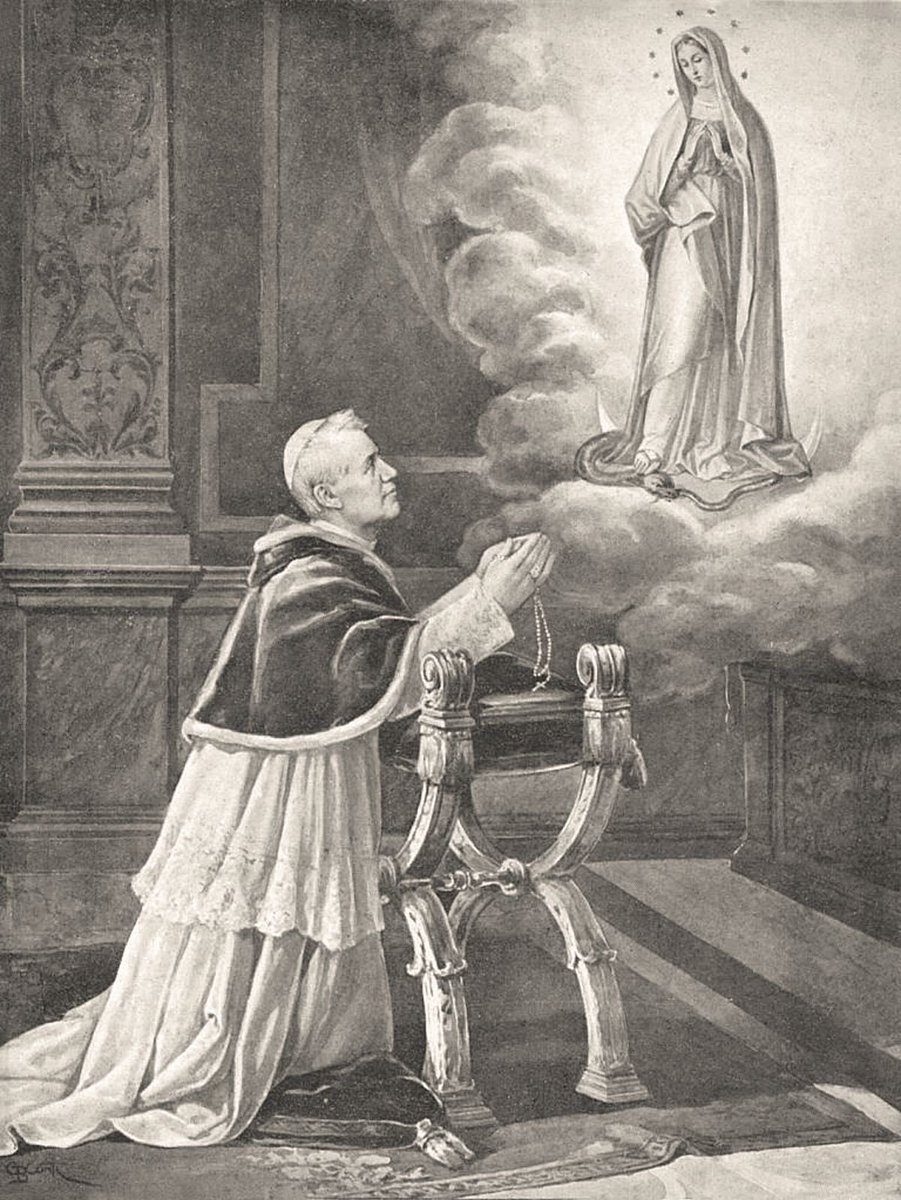
🌹St. Ephrem, Ora pro nobis🌹
Feast Day - June 9th
"I was born in the way of truth: though my childhood was unaware of the greatness of the benefit, I knew it when trial came."
Ephrem (or Eprhaim) the Syrian left us hundreds of hymns and poems on the faith that inflamed and inspired the whole Church, but few facts about his own inspiring life.
Most historians infer from the lines quoted above that Ephrem was born into a Christian family -- although not baptized until an adult (the trial or furnace), which was common at the time. Other than that little is known about his birth and youth although many guess he was born in the early fourth century in Mesopotamia, possibly in Nisibis where he spent most of his adult life.
"He Who created two great lights, chose for Himself these three Lights, and set them in the three dark seasons of siege that have been."
Ephrem served as teacher, and possibly deacon, under four bishops of Nisibis, Jacob, Babu, Vologeses, and Abraham. The first three he describes in the hymn quoted above written while Vologeses was still alive. As the verse states, Ephrem did not live in easy times in Nisibis.
"I have chanced upon weeds, my brothers, That wear the color of wheat, To choke the good seed."
According to tradition, Ephrem began to write hymns in order to counteract the heresies that were rampant at that time. For those who think of hymns simply as the song at the end of Mass that keeps us from leaving the church early, it may come as a surprise that Ephrem and others recognized and developed the power of music to get their points across. Tradition tells us that Ephrem heard the heretical ideas put into song first and in order to counteract them made up his own hymns. In the one below, his target is a Syrian heretic Bardesan who denied the truth of the Resurrection:
"How he blasphemes justice, And grace her fellow-worker. For if the body was not raised, This is a great insult against grace, To say grace created the body for decay; And this is slander against justice, to say justice sends the body to destruction."
The originality, imagery, and skill of his hymns captured the hearts of the Christians so well, that Ephrem is given credit for awakening the Church to the important of music and poetry in spreading and fortifying the faith.
Ephrem's home was in physical as well as spiritual danger. Nisibis, a target of Shapur II, the King of Persia, was besieged by him three times. During the third siege in in 350, Shapur's engineers turned the river out of its course in order to flood the city as Ephrem describes (speaking as Nisibis):
"All kinds of storms trouble me -- and you have been kinder to the Ark: only waves surrounded it, but ramps and weapons and waves surround me... O Helmsman of the Ark, be my pilot on dry land! You gave the Ark rest on the haven of a mountain, give me rest in the haven of my walls."
The flood, however, turned the tide against Shapur. When he tried to invade he found his army obstructed by the very waters and ruin he had caused. The defenders of the city, including Ephrem, took advantage of the chaos to ambush the invaders and drive them out.
"He has saved us without wall, and taught us that He is our wall: He has saved us without king and made us know that is our king: He has saved us, in each and all, and showed us that He is All."
In the end, however, Nisibis lost. When Shapur defeated the Roman emperor Jovian, he demanded the city as part of the treaty. Jovian not only gave him the city but agreed to force the Christians to leave Nisibis. Probably in his fifties or sixties at that time, Ephrem was one of the refugees who fled the city in 363.
Sometime in 364 he settled as a solitary ascetic on Mount Edessa, at Edessa (what is now Urfa) 100 miles east of his home.
"The soul is your bride, the body is your bridal chamber..."
In the time before monks and monasteries, many devout Christians drawn to a religious life dedicated themselves as ihidaya (single and single-minded followers of Christ). As one of these Eprhem lived an ascetic, celibate life for his last years.
Heresy and danger followed him to Edessa. The Arian Emperor Valens camped outside of Edessa threatening to kill all the Christian inhabitants if they did not submit. But Valens was the one forced to give up in the face of the courage and steadfastness of the Edessans (fortified by Ephrem's hymns):
"The doors of her homes Edessa Left open when she went forth With the pastor to the grave, to die, And not depart from her faith. Let the city and fort and building And houses be yielded to the king; Our goods and our gold let us leave; So we part not from our faith!"
Tradition tells us that during the famine that hit Edessa in 372, Ephrem was horrified to learn that some citizens were hoarding food. When he confronted them, he received the age-old excuse that they couldn't find a fair way or honest person to distribute the food. Ephrem immediately volunteered himself and it is a sign of how respected he was that no one was able to argue with this choice. He and his helpers worked diligently to get food to the needy in the city and the surrounding area.
The famine ended in a year of abundant harvest the following year and Ephrem died shortly thereafter, as we are told, at an advanced age. We do not know the exact date or year of his death but June 9, 373 is accepted by many. Ephrem relates in his dying testament a childhood vision of his life that he gloriousl fulfilled:
"There grew a vine-shoot on my tongue: and increased and reached unto heaven, And it yielded fruit without measure: leaves likewise without number. It spread, it stretched wide, it bore fruit: all creation drew near, And the more they were that gathered: the more its clusters abounded. These clusters were the Homilies; and these leaves the Hymns. God was the giver of them: glory to Him for His grace! For He gave to me of His good pleasure: from the storehouse of His treasures."
📷
You don't have to pray alone | Light Your Free Prayer Candle
In His Footsteps:
Has a song ever moved you so much that it changed or challenged your faith or lifestyle -- for good or bad? How do you feel about the music you sing during liturgy? Put your whole heart and soul into the hymns you sing next. Listen to the words and let them speak to you.
Prayer:
Saint Ephrem, sometimes we treat the power of song lightly. Help us to open our hearts and souls to the inspiration of the Holy Spirit given us through music. Amen .
https://t.co/UrbipPgKWl
Always bring the essentials when I travel.
I pray this prayer and sprinkle Holy Water.
Almighty God, I ask you to send your angels to be with me in this place, and protect me from all assaults of the Evil One. Please forgive any wrong that has been perpetuated in this room, and grant those who offend you the grace of conversion. Dispel the powers of darkness which may be in this room and protect me this night, and those who will sleep here in the forthcoming nights. Jesus I trust in You!.
Lord, we [or I] beg you to visit this house [room] and banish from it all the deadly power of the enemy. May your holy angels dwell here to keep us in peace, and may your blessings be upon us always. We ask this through Christ our Lord. Amen.
“Stay quiet with God. Do not spend your time in useless chatter…Do not give yourself to others so completely that you have nothing left for yourself.”
~ St. Charles Borromeo
“The two most important moments of our lives are now, and the hour of our death.”
~ St. Catherine of Siena
Holy Mary, Mother of God, pray for us sinners, now and at the hour of our death. Amen🙏🏻
Saint Rita, pray for us. 🌹🙏
Patroness of impossible causes, Saint Rita is a gentle reminder that no wound is too deep, no burden too heavy, and no situation beyond God’s reach.
For the hearts carrying pain, for families in struggle, for prayers that seem unanswered, and for the impossible situations we place before Heaven — may Saint Rita intercede for us and lead us to patience, peace, and trust in God’s timing.
St. Rita, pray for us in impossible situations, wounded hearts, and burdens too heavy to carry alone. Lead us to patience, peace, and trust in God’s timing. Amen.
If you are praying for an impossible situation, comment:
Saint Rita, pray for me.
"So long as she is in your mind, you are safe from deception."
— St. Bernard of Clairvaux
The closer we stay to the Mother whom God chose for His Son, the less likely we are to be led astray by pride, confusion, or the spirit of the world.
Mary's whole life was a perfect "yes" to God.
She points away from herself and toward Jesus. That is why so many saints had a deep devotion to her. They knew that following her example of humility, purity, faith, and obedience helped them follow Christ more faithfully.
When life feels confusing, when temptations come, or when you don't know what to do, think of Mary. Ask for her prayers. Let her lead you closer to her Son.
💬 Have you ever experienced a moment when devotion to Mary brought you closer to Jesus?
Gayle Benson, a Catholic and owner of the New Orleans Saints NFL team, donated $3.5 million through her charitable foundation to Archbishop Chapelle High School, an all-girls Catholic school in Louisiana with over 600 students, to support the construction of a chapel for Mass and theology classrooms dedicated to Catholic formation.
Info: Archbishop Chapelle School
Liberal Catholics are wolves in sheep’s clothing. You will be called clerical, intolerant, retrograde, but pay no heed to the derision and mockery of the wicked. Have courage; you must never yield, nor is there any need to yield…
St. Pope Pius X
Sister Maria Faustina Kowalska, the Apostle of Divine Mercy, was given a profound and sobering vision of hell during her eight-day retreat in October 1936. Obedient to God’s command, she recorded it in her Diary (no. 741) so that souls might believe in its existence and turn to His mercy🇻🇦❤️🔥
Led by an angel, she described hell as a place of great torture; vast, dark, and filled with unimaginable suffering. Among the torments she witnessed:
- The loss of God; the greatest agony of all.
- Perpetual remorse of conscience.
- The knowledge that one’s condition will never change.
- A spiritual fire that burns the soul without destroying it, lit by God’s anger.
- Continual darkness, suffocating stench, and the constant company of Satan and other damned souls.
- Horrible despair, hatred of God, curses, and blasphemies.
She noted special torments for particular sins, and most shockingly: “Most of the souls there are those who disbelieved that there is a hell.”
Faustina wrote: “What I have written is but a pale shadow of the things I saw… Consequently, I pray even more fervently for the conversion of sinners. I incessantly plead God’s mercy upon them.”
This vision does not contradict Divine Mercy l, it magnifies it! Jesus desires that no soul be lost, but calls us to repentance, trust in His mercy, and fervent prayer for others. As long as we live, His mercy is available.
Short Prayer for Sinners (inspired by St. Faustina):
O Jesus, I plead for Your mercy upon the whole world, especially for sinners who do not trust in Your mercy. Have mercy on them and envelop them in Your compassionate Heart. Jesus, I trust in You!
St. Faustina, Pray for us.
Divine Mercy, we trust in You.
The Worship of the Sacred Heart in Relation to the Love of God and of Our Neighbour
1. There is nothing sentimental about having devotion to the Sacred Heart of Jesus. Neither does this devotion consist only in prayers and pious practices. It is much deeper than this. It should flood our whole being, enkindle the fire of divine love in our hearts, and transform our lives in accordance with the commands of Jesus. A love which is not active cannot be genuine; it is only a passing emotion.
Our love for the Sacred Heart of Jesus should be real and effective. As far as possible it should change us into living replicas of Jesus Christ.
“You are my friends,” He said, “if you do the things I command you.” (John 15, 14) Which commands does He mean? All of them, of course. “Learn from me, for I am meek and humble of heart. (Mt. 11, 29) If anyone wishes to come after me, let him deny himself, and take up his cross, and follow me. (Mt. 16, 24) Thou shalt love the Lord thy God with thy whole heart and with thy whole soul.” (Mt. 22, 37)
Anyone who practises these precepts and all others which are contained in the Gospel is sincerely devoted to the Sacred Heart. If anyone neglects to put them into practice, but is satisfied with prayers, ejaculations and the performance of spiritual exercises, his devotion is empty and has no foundation.
These prayers, ejaculations and pious practices have their value in so far as they can attract God’s grace. But we must co-operate with God’s grace by our good actions. Then our devotion to the Sacred Heart of Jesus will be sincere and effective.
2. The cult of the Sacred Heart demands especially the practice of the two great fundamental precepts of Christianity, namely, that we should love God above all things and our neighbour as ourselves. The implementation of this teaching can transform our lives.
Do we love God above all things and more than we love ourselves? What is the predominant concept in our minds? Is it the concept of God? What is the first love in our hearts? Is it the love of God? What is our main desire in life? Is it the glory of God? Or is it our own glory or our own pleasure?
We have still a long way to go in the way of the love of God, which is the way of perfection. We can only really be said to be ourselves, moreover, when we love God above all things and more than ourselves. If a man does not love God above all things, neither does he love himself in the way in which he ought to love himself, because God is our only true happiness.
Do we love our neighbour as ourselves? How much moral and physical wretchedness do we see around us? But do we try and remedy it by every means in our power, no matter what the sacrifice? Or are we cold and disinterested? Let us remember the words of St. John, the apostle of charity. “In this we have come to know his love, that he laid down his life for us; and we likewise ought to lay down our life for the brethren.” (I John 3, 16) Are we prepared to do this? Are we at least prepared to give away whatever we do not need ourselves in order to relieve poverty and want?
3. Anyone who is lacking in an effective love for God and for his neighbour has no real devotion to the Sacred Heart of Jesus.
"My Jesus, mercy!" (Antonio Cardinal Bacci)
“The Rosary is a long chain that links heaven and earth. One end of it is in our hands and the other end is in the hands of the Holy Virgin.”
- St. Thérèse of Lisieux
St. Thérèse reminds us that the Rosary is much more than repeating prayers. It is a real connection between Heaven and earth.
When you hold a Rosary, you are not praying alone. You are turning your heart toward God while asking the Blessed Virgin Mary to pray with you and for you.
Think about that for a moment.
One end is in your hands. The other is in Mary's. Every Hail Mary becomes an act of trust. Every mystery invites you to look at the life of Jesus through the eyes of the woman who knew Him best.
Many people think they need perfect words or strong emotions to pray. The Rosary teaches the opposite. You can come distracted, tired, anxious, or overwhelmed. Just keep praying. Like a child holding a mother's hand, you stay connected even when the road feels dark.
The Rosary has carried countless saints through suffering, temptation, fear, and uncertainty. It still does today.
💬 Do you believe the Rosary has the power to change a person's life, or do you think most people underestimate what it really is?
Someone you know may need this reminder more than you realize. ❤️🔥
Heart of Jesus, burning with love for us, set our hearts on fire with love of Thee...
Eucharistic Heart of Jesus, increase in us our Faith, Hope and Charity....


![CatholicDeacon's tweet photo. Always bring the essentials when I travel.
I pray this prayer and sprinkle Holy Water.
Almighty God, I ask you to send your angels to be with me in this place, and protect me from all assaults of the Evil One. Please forgive any wrong that has been perpetuated in this room, and grant those who offend you the grace of conversion. Dispel the powers of darkness which may be in this room and protect me this night, and those who will sleep here in the forthcoming nights. Jesus I trust in You!.
Lord, we [or I] beg you to visit this house [room] and banish from it all the deadly power of the enemy. May your holy angels dwell here to keep us in peace, and may your blessings be upon us always. We ask this through Christ our Lord. Amen.](https://pbs.twimg.com/media/HKUul-UWoAAiugA.jpg)