NEW: Despite mounting pressure at home, Putin believes he can seize the whole of the Donbas by the end of the year. Moscow also no longer believes Trump can force Kyiv into territorial concessions. Our long read on the mood in Russia. With @shaunwalker7
https://t.co/UvphFncs1o
The key question people have to address is what is the mechanism of change inside Russia. People / oligarchs / one tower of the Kremlin being frustrated with a man they usually don't even dare name isn't enough. The repressive dial has a long way to go.
@MarkGaleotti@ABarbashin@RiddleRussia The silence following his reported release from the psychiatric ward on March 27 makes everything even stranger. A fairly similar post from early March by Dmitrii Olshanskii suggests that a certain mood is circulating that extends far beyond Remeslo.
@MarkGaleotti@ABarbashin@RiddleRussia One thing I couldn't explain was why he jumped right at Putin. This seems to set him apart from the discourse in the Z environment more broadly. What's the point, besides getting interviews with Khodorkovsky's Youtube & The Breakfast Show? Would be curious to hear your thoughts.
@MarkGaleotti@ABarbashin@RiddleRussia Thanks, Mark! "One of the most popular" is not my wording, but I see your point. The coverage is a bit disproportionate to his following. I decided to use his case as an exercise to analyze Z narratives over a longer period of time & to learn more about how this ecosystem works.
Ausführlicher @dekoder_org-Artikel über Nepotismus in Russland, der auch unsere Studie über d. russische Nomenklatura zitiert. Diese zweite Riege ist wichtig für staatliche Herrschaft, funktioniert aber nach anderen Rekrutierungslogiken als die Top-Elite.
https://t.co/Lhmp4P9aP8
For more on why you should treat regime functionalism more often as a research question, rather than a generic assumption, see our book:
https://t.co/UFJ3l01qA0
Great new report out with granular data on nationalization processes in wartime Russia. They very appropriately do not assume regime functionalism (i.e., 'this is all about Putin staying in power') but actually test it along with other possible explanations for the pattern.
A new Cedar analysis maps wave of wartime nationalisation in RU. Its findings reinforce point I’ve argued for some time: this process reflects the heterogeneity of Russian elites, and as a result its limited controllability, including from the Kremlin.
1/
https://t.co/O0aEaMzbbb
@Ni_Zakharov I don't believe in the diversionary war theory, but the rallies are certainly a welcome bonus. It will also be interesting to see if the war with Iran and the resulting oil windfall yield some relief in terms of trust ratings.
State-controlled pollster VTsIOM has just published Putin's lowest trust rating (open question!) since the full-scale invasion. This is not terrible for Putin so far, but it is getting closer to the all-time low 2021-08. No connection to the incidental video of Putin coughing.
main trends from 2016 to 2026. The direct question obviously yields a very different result: 77.5% of respondents say that they trust Putin (all caveats regarding state-controlled VTsIOM and surveys in authoritarian Russia with war censorship and repression apply).
No conspiracy needed to explain why VTsIOM published the data now. In 2019, they changed from publishing weekly data to monthly data, but it will be crucial to watch if they stop publishing it altogether when things turn really bad. It is still useful to take a closer look at the
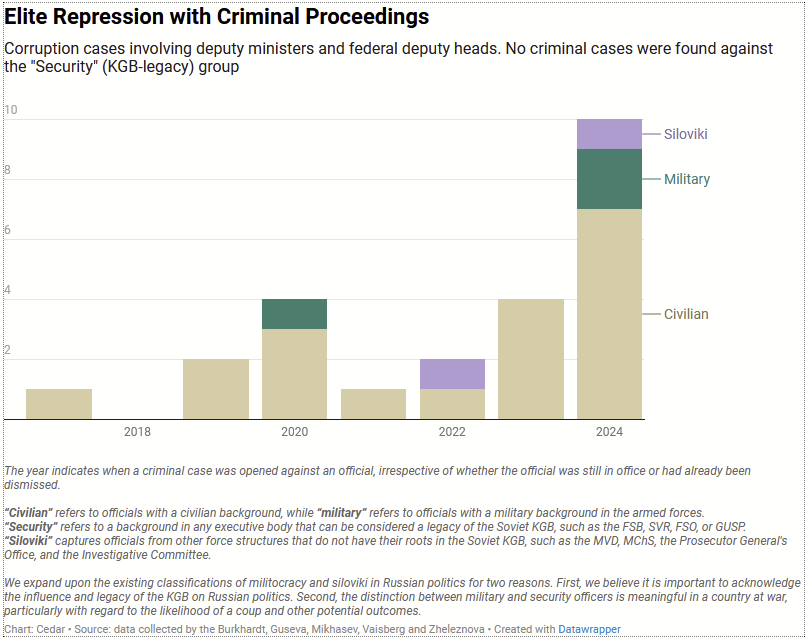
Here is a link to the full report of our Russian Elites Lab, in which we tracked criminal cases against deputy ministers. Another report exclusively focused on criminal charges against Russian officials will follow soon. https://t.co/VobwRKLv78
The arrest of former Russian Deputy Minister of Defence Ruslan Tsalikov is significant because of his close ties to Shoigu. This is already the fourth former deputy of Shoigu to be arrested. However, it also sheds light on the broader increase in elite repression since 2024.
Business weekly Vedomosti leads on a different story: the arrest of Ruslan Tsalikov, a former first deputy defence minister, whom the paper describes as “one of the closest comrades of [former defence minister] Sergei Shoigu…”
“It’s the first time a former military official of this rank has been accused of creating an organised criminal group,” it reports. The 69-year-old stands accused of embezzling public funds, money laundering and large-scale bribe-taking.
Tsalikov is not, however, the first ally of Sergei Shoigu – sacked by Vladimir Putin as defence minister in 2024 in favour of Andrei Belousov and moved to the Security Council – to be accused of corruption. It appears he could be the latest “victim” in the ongoing purge of Shoigu associates from Russia’s security ranks.
“Of all of the military head’s [Shoigu’s] deputies, Tsalikov was the closest,” the paper quotes a former colleague as saying, noting Tsalikov gave evidence against another deputy defence minister who also came under fire for corruption: Timur Ivanov was later convicted and sent to prison for 13 years.
“When Russia says they’re ‘deporting’ someone, they’re not deporting them back to Ukraine.”
My story on how Putin’s latest attempt to force Russian passports on Ukrainians paves the way for more war crimes in the occupied territories. https://t.co/A8rf83hM4j @meduza_en
since Putin's 2000 presidential campaign).
Reporting on these yet to be confirmed developments in the redistribution of responsibilities from Kozak to Kirienko: https://t.co/DDXWW0wE8A
Kirienko's empire in the presidential administration to grow: As usual, formal structural changes will follow earlier informal power shifts. Kirienko has already dealt with post-Soviet space (especially the occupied territories) and foreign policy, including hybrid interference.
he formally retained his position in the presidential administration. But as a decades-long Putin confidant, Kozak's fate will send an important signal to the elite about how Putin deals with (former) close associates (Kozak has been a key team member






![BBCBenTavener's tweet photo. Business weekly Vedomosti leads on a different story: the arrest of Ruslan Tsalikov, a former first deputy defence minister, whom the paper describes as “one of the closest comrades of [former defence minister] Sergei Shoigu…”
“It’s the first time a former military official of this rank has been accused of creating an organised criminal group,” it reports. The 69-year-old stands accused of embezzling public funds, money laundering and large-scale bribe-taking.
Tsalikov is not, however, the first ally of Sergei Shoigu – sacked by Vladimir Putin as defence minister in 2024 in favour of Andrei Belousov and moved to the Security Council – to be accused of corruption. It appears he could be the latest “victim” in the ongoing purge of Shoigu associates from Russia’s security ranks.
“Of all of the military head’s [Shoigu’s] deputies, Tsalikov was the closest,” the paper quotes a former colleague as saying, noting Tsalikov gave evidence against another deputy defence minister who also came under fire for corruption: Timur Ivanov was later convicted and sent to prison for 13 years.](https://pbs.twimg.com/media/HCuIqZHbAAAbKKX.jpg)


