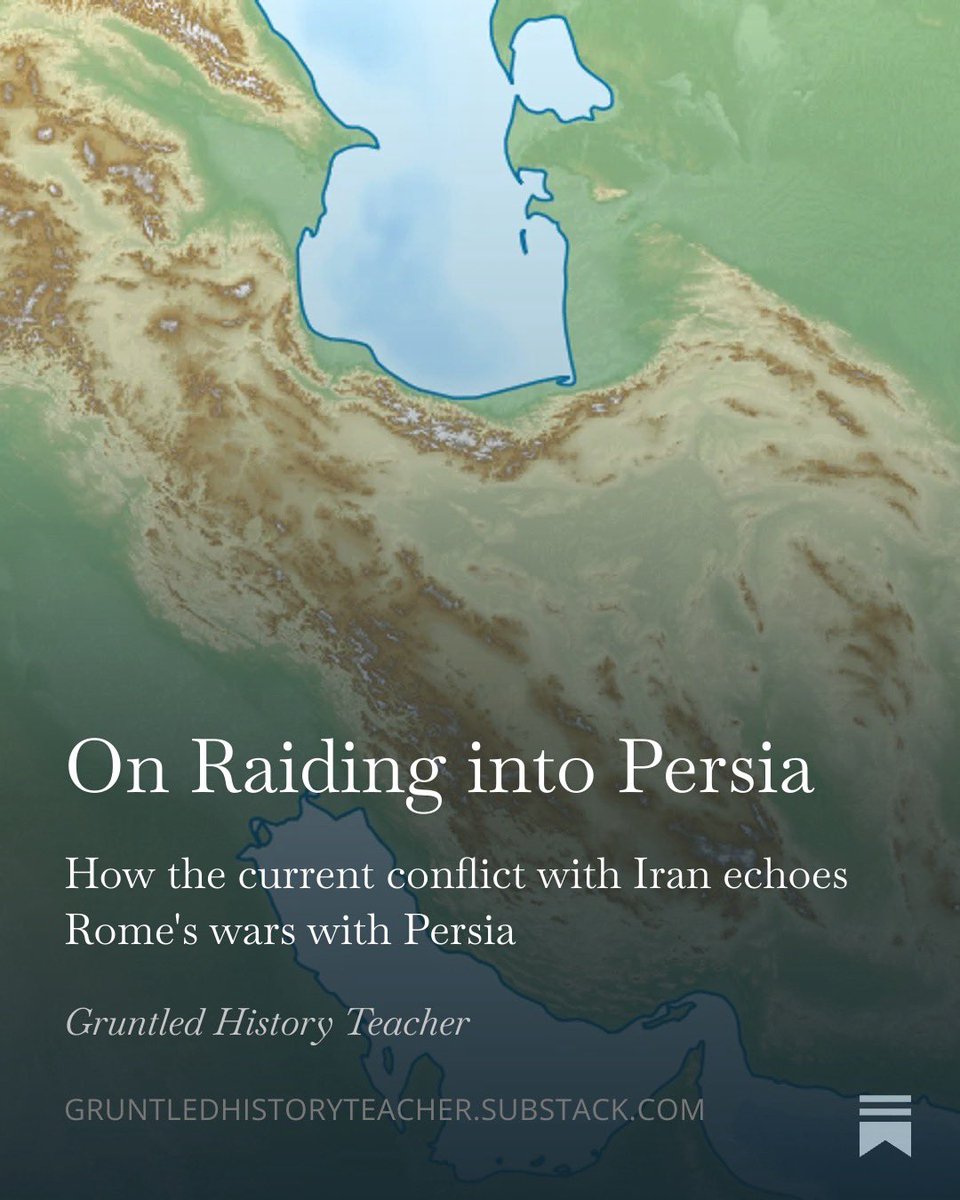
If you step back from the daily churn over the ceasefire and Hormuz, it should become apparent that, over the last three years, Iran has suffered a decisive reversal in its imperial fortunes in the Middl East.
And if you pull back even further, it turns out that Rome’s wars with Persia have more than a little in common with the current conflict, and were often fought across some of the exact geography as Iran used to build its “ring of fire” in the Middle East today.
It’s even possible that the extended fallout from the current conflict may strongly echo the wars of Alexander, Septimius Severus, and Heraclius.
This isn’t really that different from ancient labor, especially on the high end.
Ancient agrarian laborers might’ve had more daily flexibility with some tasks, but they were also far less free structurally.
Starbucks worker’s time really is his own off the clock.
an underdiscussed aspect of modern capitalism is that most low-wage jobs tightly regulate what you're doing at all times while you're on the clock and most high-wage jobs consist of hours of unstructured time in front of the computer during which you can do whatever
Why did Carthage lose the First Punic War?
There are many misunderstandings of how that war went and why Rome won. Let's debunk some myths and look at the likely reasons they lost. As always with Carthage, there is some guesswork to do for lack of Punic sources. 🧵
A huge national fair for America 250 would’ve been cool, but the Europeans are showing us that there are wonders all around us.
Kinda fits that the real celebration of America would be just normal American life.
I’ve been enjoying all the “just discovering American stadiums” posts recently
What everyone’s really noticing is the “luxury turn” in US stadium design. Everything has gotten much more premium and upscale
The old theory was to put as many seats as possible in a stadium, and make revenue with scale. The new strategy has been to actually reduce the number of available seats (college stadiums work a bit differently, I’m talking about the pro level here) but substantially increase the spend per seat. Much more space is dedicated to high end experiences and amenities, and everything is much more stratified. The top end especially has rocketed away in terms of both pricing and services on offer. The old “box seat” tier now seems practically primeval; some stadiums now offer hot tubs, pools, you name it
In terms of food and drink, the millennial food revolution has not missed US stadiums either. The old “hot dog and Cracker Jack” staples are long past. Now you’ve got dozens of craft beers on tap, artisanal food, third wave coffee, Michelin starred chefs. Just a totally different universe of possibilities
As for the architecture, that too has been entirely transformed. There’s much more emphasis on scale and spectacle. The audio systems are much more elaborate and cinematic. The screens are IMAX quality and size - or beyond. The acoustics are an entire science in and of themselves: how sound will be channeled from the field and up is modeled by software above any design is approved (the Intuit Dome is an excellent recent example of this).
If you haven’t paid attention to how all this has changed over the last few decades, it will really impress you. The experiential impact of it - to say nothing of the pricing - is considerable
Instead, in German cultural memory, the 17th century is as dark as the 20th, and modern Germany was built on Prussia, Napoleon, and Destruction.
The more you stare at the Thirty Years War, the more human it seems in its ability to reflect back human frailty and myopia, and inhuman in the horrors and misery it produced.
Apparently, the extremely negative impression of the Crusades among Muslims only really dates back to the 19th century; until then, Orthodox Christians held more historical fury at the Crusaders.
From Jonathan Riley-Smith’s “The Crusades, Christianity, and Islam” (2008)
After over a decade teaching it, I think I’m finally beginning to understand the 30 Years War.
There are a host of “simple enough to teach, but still not truly accurate” narratives about the war, and the more you stare at them, the less clear they become.
Like a fire, the Thirty Years War consumed everything it touched, and like a fire, it is easy to lose yourself in contemplation as you stare at it. Narratives and interpretations flicker in the light, constantly changing and going up in smoke. It is the end of the Middle Ages, even after the Middle Ages were supposedly over, and the beginning of the Modern world, before the Modern world supposedly came into being.
Actually, I’m still not sure I understand the 30 Years War.