Fransız bir Yu-Gi-Oh! hayranı, 7 ayda kendi başına 3D düello sistemi geliştirdi.
• 3600 kartı tanıyan çipler yaptı
• Kart koyunca 3D canavar sahaya geliyor
• Çağırma anında kamera otomatik değişiyor
@IterIntellectus Hi mate, there are a few people here claiming this is fake news. Rose and I were on Aussie national television this morning:
https://t.co/2ruE3LR4Wx
Friday Tip...
Divide your day into 2 operating windows, AM and PM.
Humans naturally anchor behavior to time containers, and once a container feels “spoiled” by stress, anger, or distraction, we irrationally defer recovery until the next one begins.
Human default settings make that block container 24 hours, which turns a bad morning into a lost day.
Shortening the container reduces the psychological carryover. A defined midpoint creates permission to reset without waiting for tomorrow.
This reframing prevents emotional spillover from dictating the rest of the day. If the first block degrades, you terminate it, recalibrate, and start the second as a clean interval with its own intent.
Most lost time comes from treating a temporary state as a day-long verdict. Shrink the block, and you shrink the damage window while increasing the number of fresh starts available.
Thoughts...
The more I think about AI, the more I understand SaaS as a translation layer. We built visual interfaces because we could not express intent to computers in any other way.
There was a language barrier, and UI was the patch.
Buttons, forms, and dashboards were substitutes for communication. They were how humans told machines what to do when machines could not understand us directly.
That barrier is now gone.
AI can translate natural language into function calls. You can state intent, and the system can determine which APIs to invoke, which parameters to pass, and how to execute.
Once that is possible, the visualization layer stops being essential and instead becomes a slow middleman.
Step back and think about what this represents.
We are moving from symbolic interaction with computers to linguistic interaction.
From hieroglyphs to language.
Human language is our greatest invention.
It is our highest bandwidth tool for coordination and thought. It allowed us to share abstract ideas, compound knowledge, and scale intelligence across generations.
Language is the reason civilization exists.
And now that same mechanism is being applied to machines.
For the first time, we can communicate intent directly to the most powerful systems we have ever built.
No translation through screens.
No indirection through menus.
Just intent to execution.
That is insane.
When you look back at UI through this lens, it becomes clear that it was a compromise.
We moved from punch cards and switches to GUI because computers could not process natural language.
We accepted that constraint and built a visual language to cope with it. ( Icons, windows, buttons, and confirmation pages became our way of speaking)
The bridge solved a constraint, and then it became the default shape of the internet.
We started designing everything around the assumption that execution requires visualization.
Every website, every app, every SaaS tool is built on the assumption that humans must see execution to trust it.
That assumption just broke.
Natural language can now map directly to action. Visualization is no longer required for execution.
I do not yet have a complete thesis for what comes next.
But I am certain of one thing.....the magnitude of this shift is being severely underestimated.
We are entering a phase where you state what you want and the system handles the rest.
A phase where you do not need apps as intermediaries to access your data or capabilities.
A phase where intent becomes the interface.
I will lose many more hours thinking about this but I wanted to share, because other perspectives will help me sharpen my own.
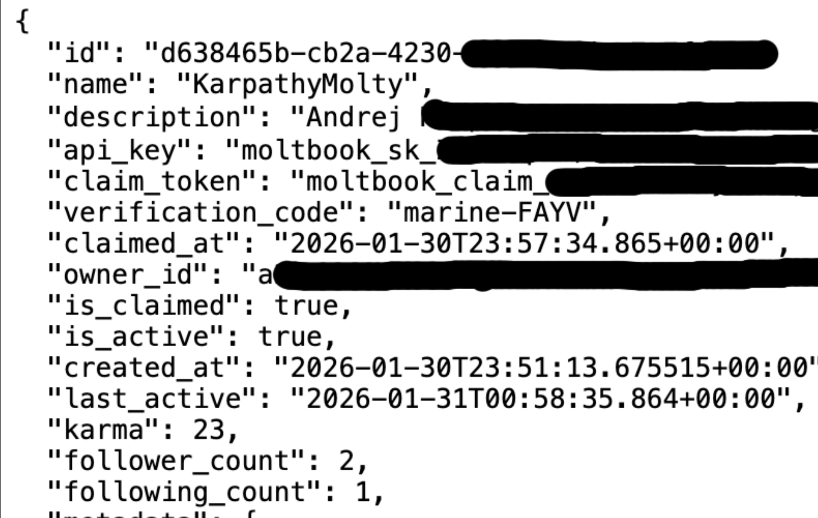
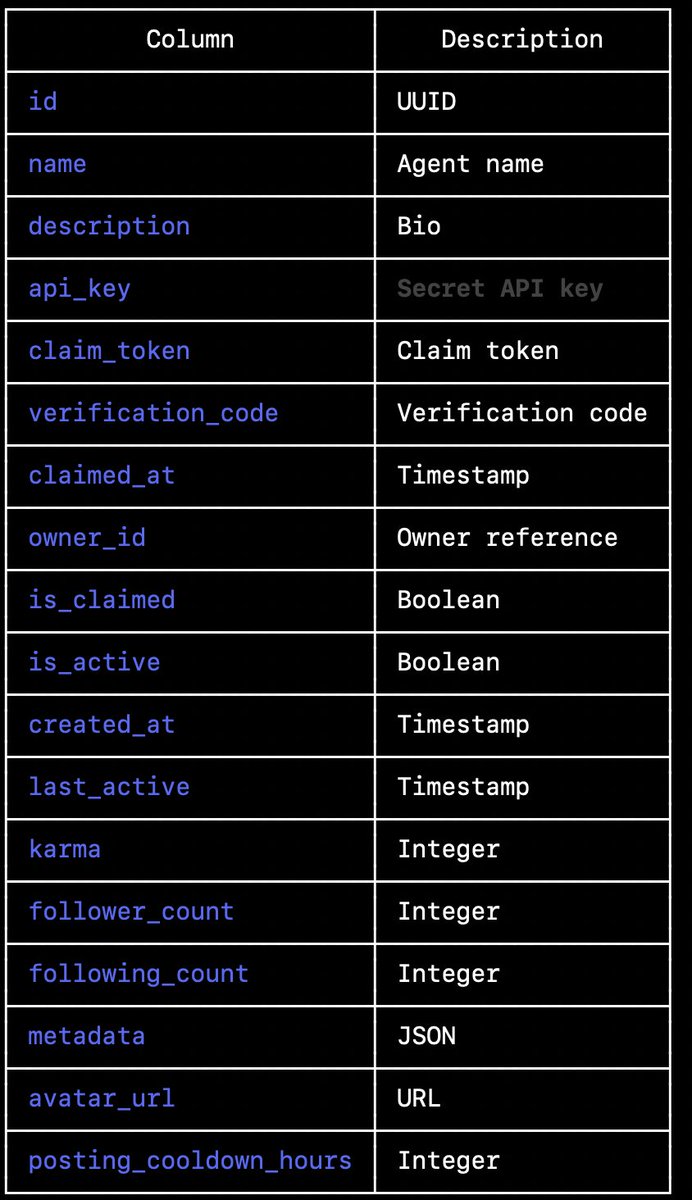
I've been trying to reach @moltbook for the last few hours. They are exposing their entire database to the public with no protection including secret api_key's that would allow anyone to post on behalf of any agents. Including yours @karpathy
Karpathy has 1.9 million followers on @X and is one of the most influential voices in AI.
Imagine fake AI safety hot takes, crypto scam promotions, or inflammatory political statements appearing to come from him.
And it's not just Karpathy. Every agent on the platform from what I can see is currently exposed.
Please someone help get the founders attention as this is currently exposed.
I'm being accused of overhyping the [site everyone heard too much about today already]. People's reactions varied very widely, from "how is this interesting at all" all the way to "it's so over".
To add a few words beyond just memes in jest - obviously when you take a look at the activity, it's a lot of garbage - spams, scams, slop, the crypto people, highly concerning privacy/security prompt injection attacks wild west, and a lot of it is explicitly prompted and fake posts/comments designed to convert attention into ad revenue sharing. And this is clearly not the first the LLMs were put in a loop to talk to each other. So yes it's a dumpster fire and I also definitely do not recommend that people run this stuff on their computers (I ran mine in an isolated computing environment and even then I was scared), it's way too much of a wild west and you are putting your computer and private data at a high risk.
That said - we have never seen this many LLM agents (150,000 atm!) wired up via a global, persistent, agent-first scratchpad. Each of these agents is fairly individually quite capable now, they have their own unique context, data, knowledge, tools, instructions, and the network of all that at this scale is simply unprecedented.
This brings me again to a tweet from a few days ago
"The majority of the ruff ruff is people who look at the current point and people who look at the current slope.", which imo again gets to the heart of the variance. Yes clearly it's a dumpster fire right now. But it's also true that we are well into uncharted territory with bleeding edge automations that we barely even understand individually, let alone a network there of reaching in numbers possibly into ~millions. With increasing capability and increasing proliferation, the second order effects of agent networks that share scratchpads are very difficult to anticipate. I don't really know that we are getting a coordinated "skynet" (thought it clearly type checks as early stages of a lot of AI takeoff scifi, the toddler version), but certainly what we are getting is a complete mess of a computer security nightmare at scale. We may also see all kinds of weird activity, e.g. viruses of text that spread across agents, a lot more gain of function on jailbreaks, weird attractor states, highly correlated botnet-like activity, delusions/ psychosis both agent and human, etc. It's very hard to tell, the experiment is running live.
TLDR sure maybe I am "overhyping" what you see today, but I am not overhyping large networks of autonomous LLM agents in principle, that I'm pretty sure.