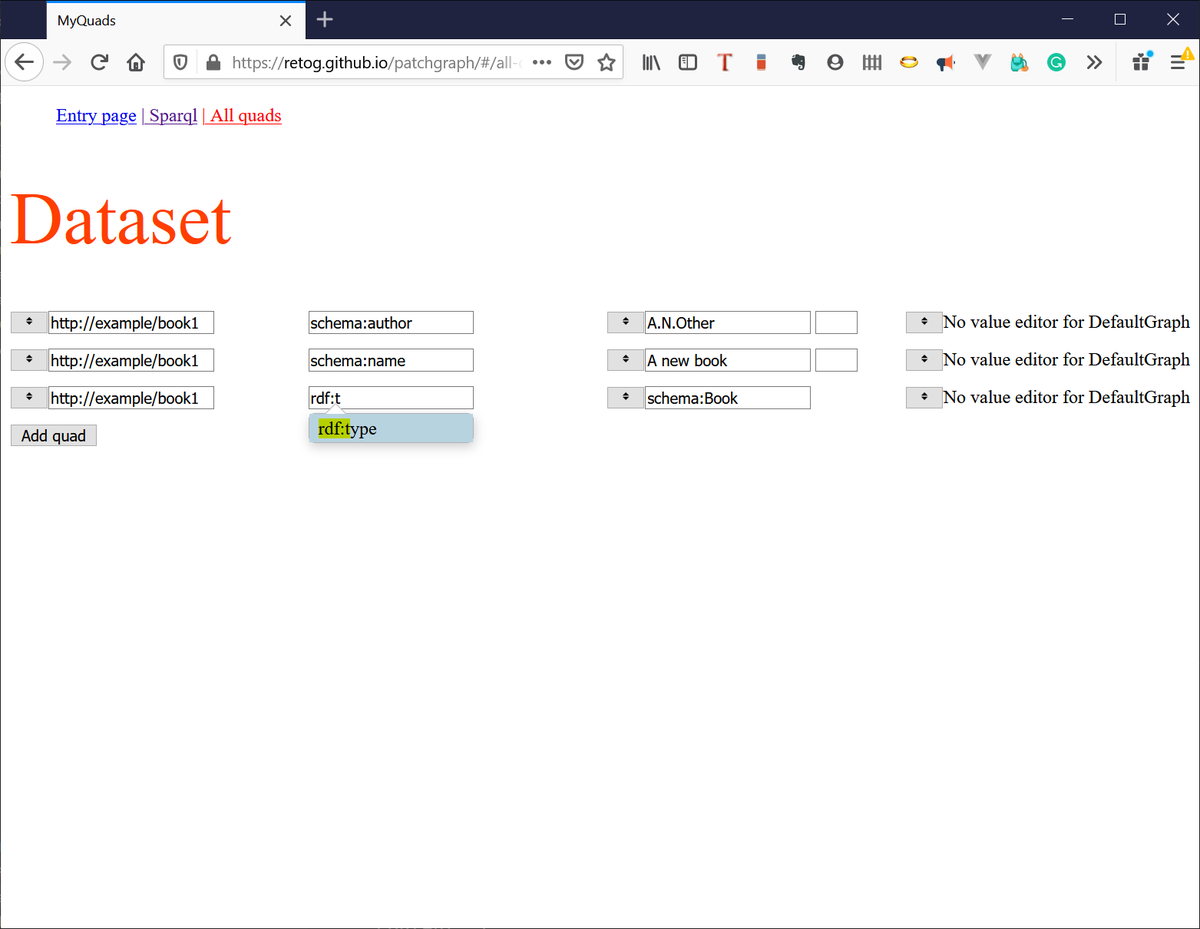
Combining @binteractions' impressive node-quadstore with YASGUI to have #SPARQL running in the browser with persistent data in indexedDB. Start with SPARQL UPDATE to insert some data. As it's all uses #RDFJS the data can also be edited with rdfjs-svelte.
https://t.co/zUlmLImS9X
How to edit RDF Data in the browser? RDFJS-VUE provides #Vuejs components for all #RDFJS types. Check out how you can browse and edit a Dataset: https://t.co/KNLLzPF3Cc
@plazi_ch's SynoSpecies is now faster than ever thanks to the new AllegroGraph 7 #RDF Store. Many thanks to @Franzinc for supporting this project!
Check out the current and past biodiversity as #LinkedData.
https://t.co/y1MvCmHSyk
Wikidata fun finding: There are 2431 one way twin relationships among administrative regions. Bavaria has 8 twins, but not one of them lists Bavaria as its twin.
https://t.co/pw0qSuJrcx
@kvistgaard@LeaVerou In productive use on an intranet or website prefitplete is most likely used with a dedicated PSPS instance and repo of recommeded vocabularies. The https://t.co/UY0krazuuG data is meant as an example and https://t.co/VC8a6pwRqx is started irregularly to harvest the data..
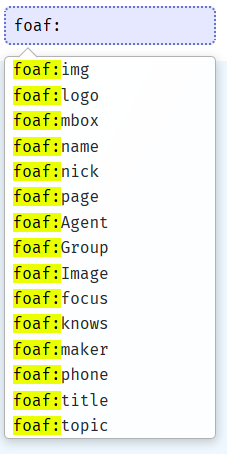
One more application of @LeaVerou's #awesomeplete: using https://t.co/UY0krazuuG data to get autocompletion for ontological terms (there's a bit of #SPARQL and PSPS in the mix too). Try it out: https://t.co/1BmRJQFbF1
Harvested the ontologies on @cygri's https://t.co/6MxIckiWjQ to https://t.co/XOijWmMNtL. Thanks to @FactsMission's PSPS, what's on GitHub can also be accessed via #SPARQL. See the stats: https://t.co/fhOj18VKmH
https://t.co/MioBOcCGLl
“Promoting the use of ontologies and the Semantic Web as a tool for scientists is crucial for generating new approaches to biodiversity informatics” says Zárate. https://t.co/gN8EM11hIR
If @GBIF embraces linked data more applications like https://t.co/X1aPEgSKaZ will be possible.
@kidehen@swiss_geoportal@p1d1d1@timberners_lee Slow down! I would ❤️ to write it myself. However, contrary to what you seem to suggest, I don't think it's possible to get the MSG of a resource from https://t.co/KjVUvmLern with a single query. To convince me otherwise a working query would be more effective than 1000 tweets 😉
@kidehen@swiss_geoportal@p1d1d1@timberners_lee If you have a better solution than the workaround with two queries at https://t.co/LfCcAdReJn , your pull-request would be more than welcome.
@kidehen@swiss_geoportal@p1d1d1@timberners_lee MSG (Minimum Selfcontained Graph) is the same as a Symmetric Concise Bounded Description, that's the union of your CBD and OBJCBD. To quote @timberners_lee: "A concise bounded description, which only follows links from subject to object, does not work."
https://t.co/EoB4KbXizi
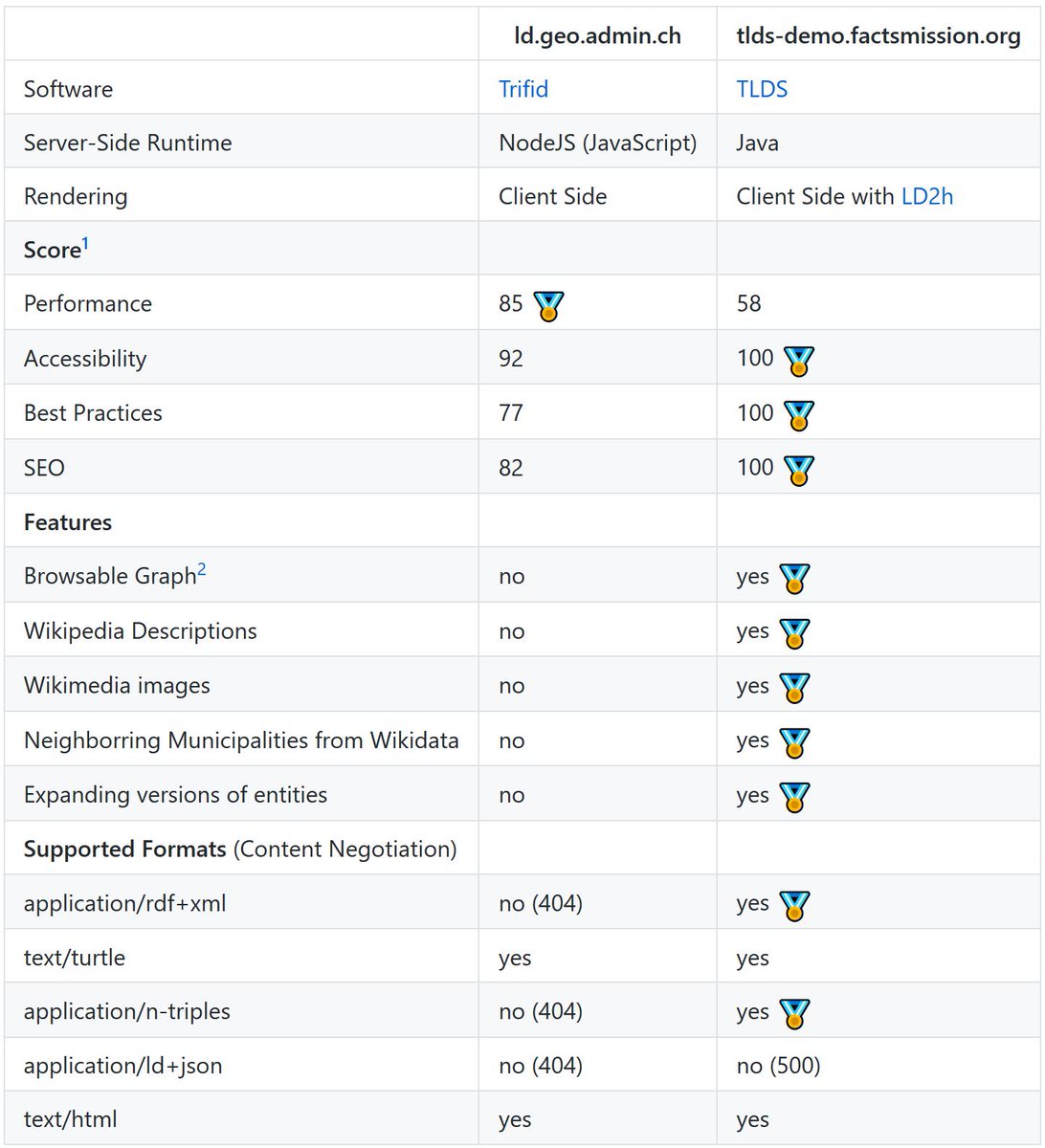
@linkedktk@zazukocom When publishing data available from a SPARQL one can choose between different options like Pubby, brwsr, lodView, Trifid and TLDS; it seems useful to have a comparison of features.
I've tested the media-types again and updated the comparison, thanks for pointing this out!
Comparing lightweight #LinkedData Servers: How does https://t.co/895BIcpXDn compare to the Trifid-based https://t.co/thGLcVNSyC ? For now, it's a partisan comparison but we invite @zazukocom to help improve it so we can improve TLDS even more! 😉
https://t.co/W6T02nGyfZ
#RDF
@kidehen@swiss_geoportal@p1d1d1@timberners_lee The virtuoso trick we apply requires 2 queries: https://t.co/LfCcAdReJn
The problem is that OBJCBD expands only backwards. Getting MSGs allows the graph to be fully explored (browsable) using DESCRIBE queries, without using non-standard extensions. So that would be better.
@kidehen@swiss_geoportal@p1d1d1@timberners_lee No, you cant get the MSG with a CONSTRUCT as you can't recursively expand blank nodes while stopping at named nodes.
The only way to get MSG is to hope in useful implementations of the underdefinded DESCRIBE.
@swiss_geoportal@p1d1d1 There are several reasons why the perfomance is slower, one of them is that in order to provide a browsable graph as per @timberners_lee's definition we need to provide backward links, so TLDS makes twice as many requests to the backend as Trifid. We think this gain is worth it.