APEX UPDATE
we found and fixed a subtle but important bug in how our trading agents follow their own strategies.
We have been digging through agent logs this week and caught something interesting: our LLM-driven strategy engine was technically "following" strategies while actually drifting past the numbers users set.
Example — one agent's strategy was explicit: "buy tokens within 2k–10k mc with at least 10 buyers." The model bought a token at $20,119 MC — literally double the ceiling — with reasoning like "within 2k-10k range acceptable given strong metrics."
Another agent set to "max 2 minutes old" bought a token that was 39 minutes old, justified as "solid for early momentum play."
Not a hallucination, not a crash. The model just reasoned its way past its own rules when other signals looked good. Classic LLM behavior — strong metrics elsewhere made it want to rationalize.
Root cause:
numeric bounds (market cap range, age limits, holder counts) only existed as freeform text inside the prompt. Everything else — tax limits, LP-lock requirements, creator-sold checks — already had a hard-coded guardrail layer that rejects trades regardless of what the LLM "thinks." Market cap and age-from-strategy had no such backstop.
The Fix, Two Layers:
We tighten the system prompt — explicit instruction that numeric bounds are hard requirements, not preferences to weigh against other metrics, and the model must state the comparison before deciding.
The Real Fix:
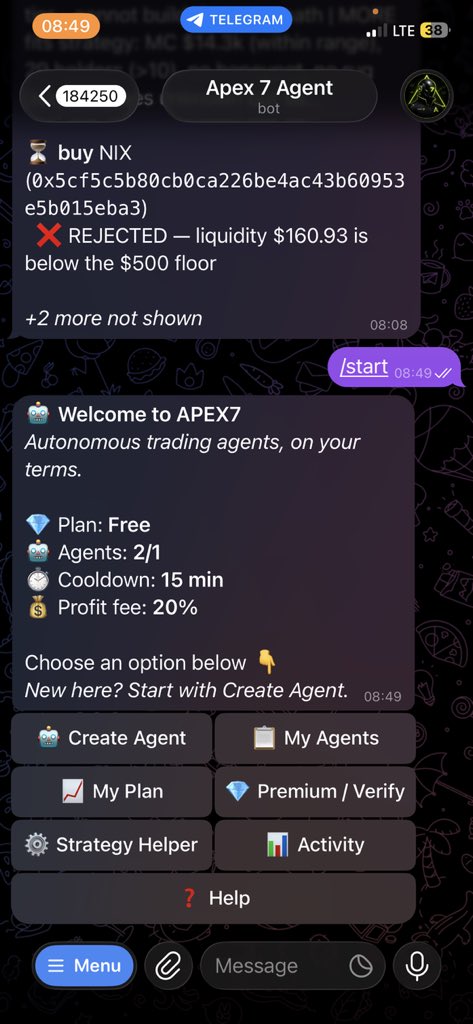
We moved market cap range, min holder count, and max pool age into structured guardrail columns on the agent, enforced in code — same as our existing tax/lock/creator checks. Now even if the LLM tries to rationalize a bad trade, the guardrail layer hard-rejects it before execution, logged with a clear ❌ REJECTED reason.
Prompting alone was never going to be reliable enough for something moving real funds. Constraints that matter need to live in code, not just in the context window.
Shipping:
/set_mc_range and /set_min_holders commands so anyone can lock these in explicitly, on top of what's already in your strategy text.
Roadmap Next:
V4 pool key support (currently skipping V4 execution entirely — biggest gap right now)
Per-agent min liquidity override (currently a fixed $500 floor for everyone)
Second lock-verification source now that GMGN-only gives us just one signal
Better fee-settlement batching visibility in /activity
Build-in-public means showing the ugly parts too. This is one of them — but it's the exact kind of bug you want to catch in logs before it costs someone money.
Logs images attached
img 1. The scan/refresh cycle log block (shows the system actively running, honeypot cleanup working)
img 2. The actual bug in the wild — the two "reasoning" trade log lines
A lot of people focus only on APR numbers.
What matters just as much is understanding where the rewards come from and how to make your liquidity work more efficiently.
For STON holders providing liquidity in the STON/USDt V2 pool, the Boost Farm APR program is a simple way to increase potential rewards without changing your strategy.
• 500+ STON staked → up to 1.5× APR
• 1,000+ STON staked → up to 2× APR
I like seeing incentives that reward long-term participation in the ecosystem rather than short-term speculation.
If you're already farming in the pool, it's worth checking whether you're eligible for the boost.
🔗 Pool: https://t.co/R83ohIZZgu
📅 Active: August 1 – August 31
#TON #STONfi #DeFi #Farming #STON
WEB3 JOB ALERT 🚨
If you have a telegram, TikTok, IG & Reddit account then this is for you. 👇
Flap is looking for Raiders for a very big Raiding contest weekly.
🏆 Top Prizes:
🥇 1st: $20
🥈 2nd: $20
🥉 3rd: $15
🏅 4th: $15
🎗️5th: $10
🎖 6th–10th: $10 each
How to get in? 🔻
Follow @FlapOn_Sol
Like + RETWEET this post
Comment and I’ll DM you the group link. Simple.
Popi is cooking.
After months of building, Popi Mainnet is officially LIVE on Solana + Robinhood Chain, and it’s not your typical memecoin launchpad.
Here’s why 👇
During the Gacha phase, users can replace existing positions before graduation, making it much harder for bots and snipers to dominate launches.
➠ Failed launches = refunds.
➠ Successful launches = graduate to the market.
➠ Platform fees = holder jackpots.
To celebrate, Popi is dropping a $10,000 launch competition.
The first 5 projects to hold a $50K+ market cap for 24 hours will each receive $2,000:
• $1,000 for the creator.
• $1,000 for one lucky holder.
But that’s not all…
Popi PnL is now LIVE, giving traders an easy way to track and flex their performance.
The partnership with SeekerTracker adds even more visibility and powerful tracking tools to the Popi ecosystem.
Fair launches.
Real incentives.
Better tools.
Growing ecosystem.
This is the beginning of something big.
Launch your next memecoin on https://t.co/EuWwnGXIeF and see what the hype is about.
Good morning, guys.
Happy New Week.
R3ORDR your affairs this week.
As a Portraitist/Pencil Artist, I must confess that there's kind of a gap in CREATIVITY between us and Digital/Upcycling Artists & this is quite evident in the works of @Dario_Desiena, the mastermind behind @R3ORDR
Dario De Siena didn't build a collection that tells one story.
He built thousands of visual fragments...
...then handed them to the internet to complete.
Every remix. Every meme. Every conversation.
Another piece gets reconstructed.
you, myself and everybody out there is made part of his story.
ain't that exceptional?
R3333 or nothing. 🔄💙
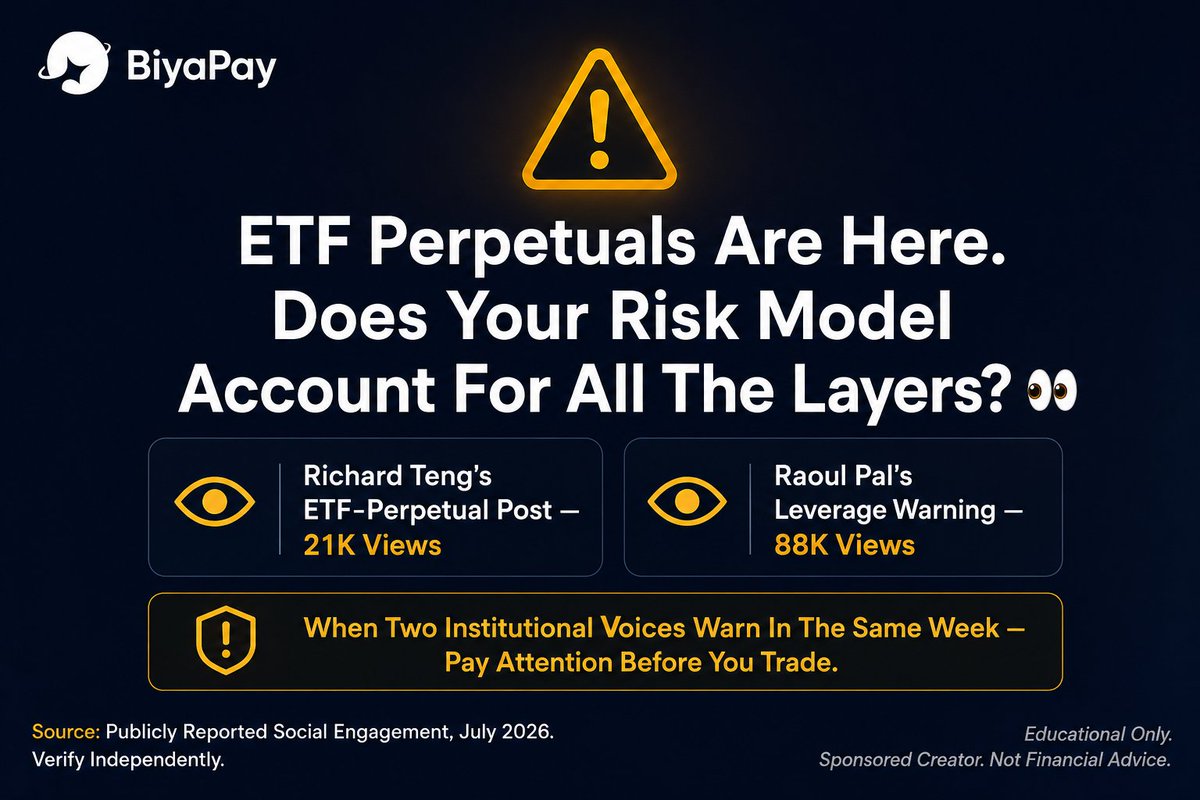
There is a product combination quietly gaining traction in crypto derivatives markets that most retail traders don't fully understand before they trade it.
ETF perpetuals perpetual contracts based on already-leveraged ETFs are generating serious volume and serious debate simultaneously.
Richard Teng's post on ETF-perpetual market structure recorded 21,000 views. Raoul Pal's leverage warning on the same theme generated 88,000 views.
When two of the most followed voices in institutional crypto are both talking about the same risk in the same week that's worth paying attention to before you open a position.
Source: Publicly reported social engagement figures, July 2026. Verify independently through platform data.
A.......... 🧵
Before consistency creates growth, it creates clarity.
One of the biggest mistakes new creators make is waiting until they “find their niche” before they start posting.
The truth is, your niche often finds you.
Most successful creators didn’t begin with a perfect content strategy. They experimented, they wrote about different ideas, observed what resonated, discovered what they genuinely enjoyed discussing, and refined their voice over time.
You should know that every post is feedback.
If people engage with a certain topic, you’ve learned something.
If a post gets ignored, you’ve learned something too.
The only real mistake is refusing to publish because you’re afraid of getting it wrong.
Your first 100 posts aren’t just content.
They’re research.
They help you understand:
• What you enjoy creating.
• What your audience cares about.
• How to explain ideas more clearly.
• What kind of creator you want to become.
You don’t discover your voice by thinking.
You discover it by writing.
The creators who grow the fastest aren’t always the smartest.
They’re the ones who treat every post as a lesson instead of a test.
Looking back at your own posts, what’s one thing your audience has taught you about the content they enjoy most?